

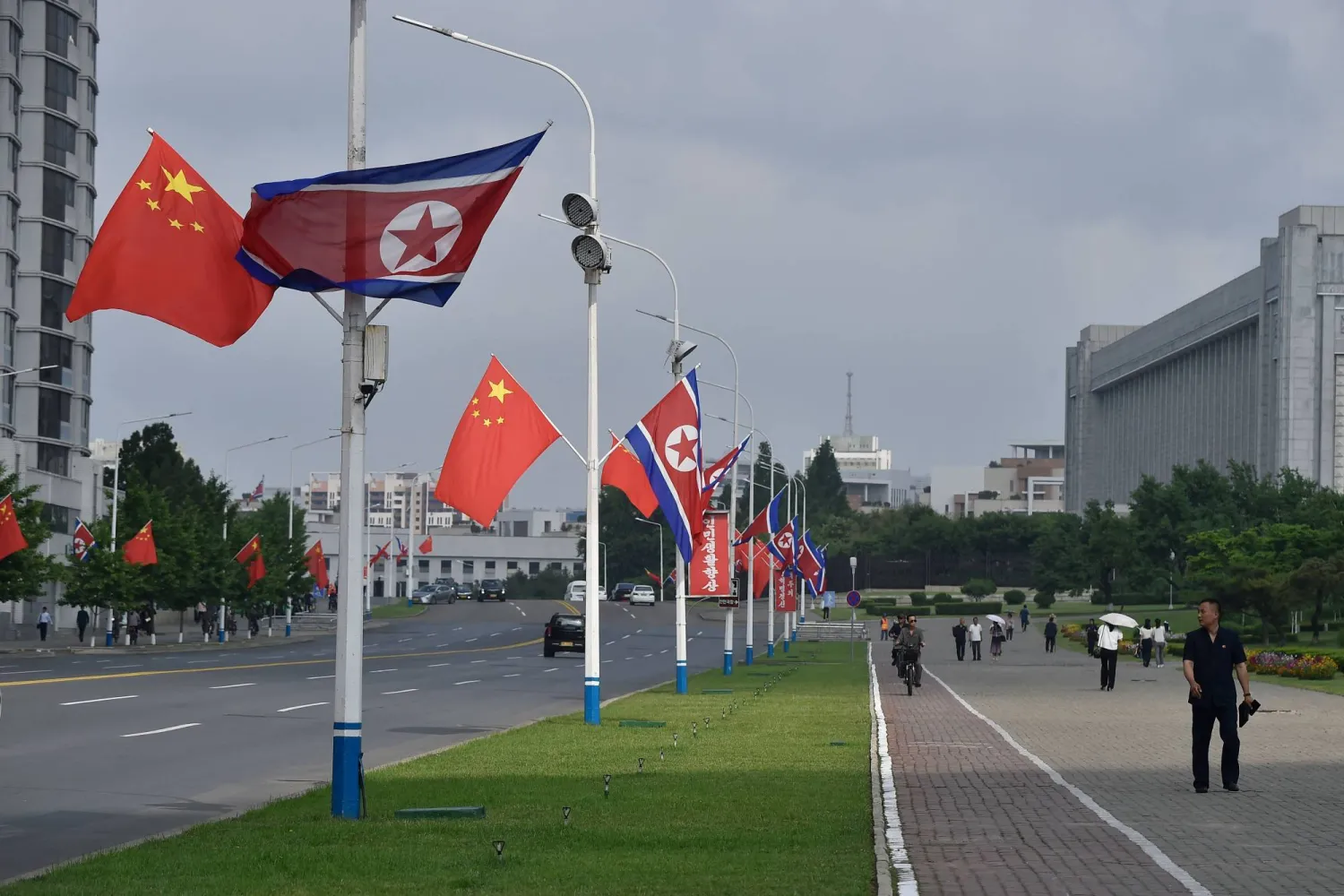

China’s Xi Lands in North Korea for Rare Visit

The national flags of North Korea and China are displayed on a street in Pyongyang on June 8, 2026. (AFP)
TT

China’s Xi Lands in North Korea for Rare Visit

The national flags of North Korea and China are displayed on a street in Pyongyang on June 8, 2026. (AFP)

China's President Xi Jinping hailed an "invincible friendship" with Pyongyang as he arrived in North Korea Monday, his first trip abroad this year after hosting back-to-back summits in Beijing.

China, Washington's chief geopolitical rival, has been North Korea's main trading partner by far for decades and a key source of diplomatic and economic support for the country hit by multiple international sanctions.

Military officers lined a red carpet as an Air China plane carrying Xi arrived for his first visit since 2019, video from Xinhua showed.

A banner that read "We warmly welcome Comrade Xi Jinping" and hailing the two countries' "unbreakable friendship" hung below Chinese and North Korean flags at the airport.

Xi made the trip after hosting US President Donald Trump and Russia's Vladimir Putin separately in Beijing, and as North Korea's nuclear talks with Washington remain deadlocked.

The White House said last month that Xi and Trump "confirmed their shared goal to denuclearize North Korea" during their summit in Beijing.

However, leader Kim Jong Un's powerful sister said on the eve of Xi's arrival that North Korea's nuclear weapons program was "the line of no retreat".

Minseon Ku, a diplomacy professor at DePaul University, told AFP that "Beijing probably has accepted North Korea as a nuclear state" but Xi "will probably tell Kim that China wants stability more than anything".

China has "always prioritized stability and is currently having to manage its relations and differences with the US", Ku said.

Seong-Hyon Lee, a visiting scholar at the Harvard University Asia Center, also said Beijing is shifting towards "underwriting regime durability" rather than seeking to coerce North Korea into denuclearisation.

"China's broader regional strategy benefits from a stable, heavily armed, and aligned buffer state that absorbs US and allied military bandwidth," he told AFP.

- Elevated status -

North Korea has repeatedly declared itself an "irreversible" nuclear state since Kim and Trump's 2019 summit collapsed over the scope of denuclearisation and sanctions relief.

Kim has also been emboldened by the war in Ukraine, securing critical support from Moscow after sending troops to fight alongside Russian forces.

Some analysts say the summit could be Xi's way of countering Russia's growing influence over North Korea, but DePaul's Ku stressed that "overall, Moscow is not a major power like China".

"Moscow-Pyongyang power relations are more equal than Beijing-Pyongyang; Moscow needs Kim for their war in Ukraine as much as Kim needs technology sharing and food from Russia," she said.

In an article published on the front page of North Korea's Rodong Sinmun, Xi pledged closer cooperation.

"No matter how the times change or how the international situation evolves, the traditional friendship between China and North Korea is always invincible," Xi wrote.

Xi last met Kim in September, when he invited the North Korean leader and Putin to a military parade in Beijing marking the 80th anniversary of the end of World War II.

- Taiwan counterweight -

Trump has made little progress on North Korea, especially on the nuclear front, despite his earlier high-profile summits with Kim.

North Korea is also the only country with an official, binding military alliance with China.

"America is currently engaged in offensive warfare potentially harmful to China's key interests, such as energy supplies," Vladimir Tikhonov, Korean Studies professor at the University of Oslo, told AFP.

"It appears Xi is trying to consolidate the alliance" with North Korea partly for that reason, he said.

Beijing claims self-ruled Taiwan as part of its territory, and North Korea could also serve as a useful counterweight to US partners in the region, including South Korea and Japan, analysts said.

Long-frosty China-Japan ties have deteriorated since Prime Minister Sanae Takaichi, a security hawk, suggested last year that Tokyo might intervene militarily in any Chinese attempt to take Taiwan.

"As China's international standing rises, Beijing is likely seeking to draw Pyongyang more actively into its diplomatic orbit," said Lim Eul-chul, a North Korea expert at Kyungnam University.



South Korea Demands Ukraine Apology Over Denial of Confidential Deal on North's POWs

 South Korean President Lee Jae Myung speaks during a press conference at the presidential Blue House in Seoul, South Korea, Friday, Sept. 18, 2026. (AP Photo/Ahn Young-joon, Pool)
South Korean President Lee Jae Myung speaks during a press conference at the presidential Blue House in Seoul, South Korea, Friday, Sept. 18, 2026. (AP Photo/Ahn Young-joon, Pool)
TT

South Korea Demands Ukraine Apology Over Denial of Confidential Deal on North's POWs

 South Korean President Lee Jae Myung speaks during a press conference at the presidential Blue House in Seoul, South Korea, Friday, Sept. 18, 2026. (AP Photo/Ahn Young-joon, Pool)
South Korean President Lee Jae Myung speaks during a press conference at the presidential Blue House in Seoul, South Korea, Friday, Sept. 18, 2026. (AP Photo/Ahn Young-joon, Pool)

South Korea's presidential office has demanded an apology from Ukraine for denying an agreement to keep the transfer of two North Korean prisoners of war to Seoul confidential.

The incident came after Ukrainian President Volodymyr Zelensky told the United Nations that his country had sent two North Korean soldiers to the South, adding they were "not easy to capture alive".

Hours later, South Korea's President Lee Jae Myung said on X, "I do not know why the Ukrainian side broke the agreement and made the matter public, but it is very disappointing."

As a response to this, Zelensky's aide Dmytro Lytvyn told journalists that Ukraine was "an open country" and that it would have been strange to hand over the soldiers in secret.

"From the entire story -- which is long and detailed -- we reported only the fact itself, that they were sent to the Republic of Korea," he said.

"It is in itself a very serious matter that the Ukrainian side violated the confidentiality agreement between the two countries and made the disclosure unilaterally," Seong Ghi-hong, senior presidential secretary for public relations, said in a statement late Sunday.

"But the Ukrainian presidential press office's false statement that there had been no confidentiality agreement... seriously undermines trust between the two governments and gravely damages friendly relations between the two countries," he said.

The South Korean Presidential office demands "an official explanation and apology," said Seong.

The South Korean presidential office is "considering additional measures that may be necessary regarding this matter," he added, but did not specify what they were.

Early last year, Ukraine captured two North Korean soldiers among Pyongyang's troops fighting for Moscow.

A South Korean lawmaker had previously said the pair wanted to live a "normal life" in the South.

Under South Korea's constitution, all Koreans, including those living in the North, are considered citizens, and officials have said this would apply to any North Korean troops captured in Ukraine.


Trump Expects New Iran Talks Despite Rejecting Deal Offer

Iranian missiles are displayed on a street in Tehran, Iran, September 27, 2026. Majid Asgaripour/WANA (West Asia News Agency) via Reuters
TT

Trump Expects New Iran Talks Despite Rejecting Deal Offer

Iranian missiles are displayed on a street in Tehran, Iran, September 27, 2026. Majid Asgaripour/WANA (West Asia News Agency) via Reuters

US President Donald Trump said Sunday that he expects talks with Iran to resume in the coming week, despite his rejection of a truce proposal put forward by Tehran.

Iranian officials brought with them to the UN General Assembly in New York a plan for a seven-day truce followed by the reopening of the Strait of Hormuz shipping channel.

Trump dismissed the plan and has mused on resuming full-scale air strikes on Iranian targets, but he told the news platform Axios that he expects negotiations to resume.

"They want to make a deal, but it is not the deal that I want to make," Trump told Axios. "It is what we would have maybe agreed to a year ago."

"They overplayed their hand," Trump said, in the interview published Sunday.

Citing sources familiar with the matter, Axios reported that indirect talks between Washington and Tehran could take place as early as Monday.

On Sunday, Iran was still standing by its conditions for reopening the Strait of Hormuz, leaving the Gulf front of the Middle East war locked in a stalemate, while fighting rages in Yemen.

- 'We will not back down' -

Hormuz is a key chokepoint for the world's energy supplies and is now central to the conflict between Washington and Tehran, which was started nearly seven months ago when the US and Israel launched a wave of strikes against Iran.

Iran's plan called for a cessation of all hostilities in the Middle East, including in Lebanon, according to Foreign Minister Abbas Araghchi, and a return to the conditions in an earlier ceasefire deal that fell apart.

That agreement, which collapsed during fighting over Hormuz, called for the release of frozen Iranian assets, the lifting of sanctions on Iranian oil and an end to the US naval blockade.

"Our conditions are clear, and any move toward reopening the Strait of Hormuz is contingent upon these conditions being fulfilled. We will not back down from them," Araghchi said on Sunday, state broadcaster IRIB reported.

"We have never closed the door to diplomacy or negotiations, but at the same time, we have never backed down from our rights."

Washington's ambassador to the UN, Mike Waltz, accused Tehran of demanding too much in exchange for a return to the negotiating table.

"This was, I think, a pretty cynical attempt to put something on the table that they knew was unacceptable. To ask for the release of the blockade, the sanctions, international sanctions and access to billions in assets, just to talk," he told NBC News in an interview broadcast Sunday.

"I think it's kind of common sense that the president doesn't have a lot of confidence this time after we just tried a few months ago."

Iran's Revolutionary Guards meanwhile said that they seized an American submersible drone on Sunday in the Strait of Hormuz.

It said the underwater vehicle was being used "for espionage purposes", adding that it was "now in the hands of the force's specialists for data recovery".

- 'Tool for pressure' -

Washington and Tehran signed a memorandum of understanding in June aimed at ending the war, reopening the strait and launching talks on Iran's nuclear program.

But the deal broke down shortly afterwards when Iran fired on commercial ships in Hormuz that it accused of deviating from its approved route through the waterway.

Iran requires ships to obtain authorization before passage, citing security and sovereignty reasons.

Ships that refuse to comply are regularly targeted, while the United States sporadically bombs Iranian coastal areas in retaliation.

Araghchi said at the UN that Iran has conveyed to the United States, through Qatar, a concrete seven-day plan, adding: "The choice now rests with the United States."

Hossein Mohebi, a spokesman for Iran's Revolutionary Guards, was quoted by Tasnim news agency as saying: "We will not cease punishing the US until Iran's seven conditions are met."

Mohebi had told AFP in an exclusive interview on Tuesday that ending hostilities in Yemen was also among Tehran's demands.


Iran Insists on Diplomatic Solution after Trump Rejects Peace Plan

Iranians walk near an anti-Trump billboard in Tehran, Iran, 19 August 2026. EPA/ABEDIN TAHERKENAREH
TT

Iran Insists on Diplomatic Solution after Trump Rejects Peace Plan

Iranians walk near an anti-Trump billboard in Tehran, Iran, 19 August 2026. EPA/ABEDIN TAHERKENAREH

Iran on Sunday insisted that only diplomacy can solve its conflict with the United States and Israel after US President Donald Trump said he rejected an Iranian proposal to reopen the Strait of Hormuz and end fighting.

"Our conditions are clear, and any move toward reopening the Strait of Hormuz is contingent on these conditions being met," Iranian Foreign Minister Abbas Araghchi posted on social media. "Only a negotiated solution can get them out of this deadlock."

Iran announced a peace proposal last week at the UN General Assembly in New York, saying it had been transmitted to the Americans via Qatari mediators. Trump said on Saturday he rejected the plan and argued that desperation was driving the Iranians’ push for an agreement on the key waterway.

"They want to make a deal to open ‌the Hormuz Strait immediately ‌because they're losing so badly," Trump told reporters at the White House.

Despite Trump's public ‌statements, ⁠mediators facilitating Iran's talks ⁠with the United States have not officially relayed a US rejection of the plan, according to Araghchi.

"We are waiting for the mediators to convey the definitive views to us, and we will make a decision based on them," Araghchi posted.

The US has imposed an economic blockade on Iran to put pressure on Tehran to stop Iranian attacks on vessels in the Strait of Hormuz, which have drastically reduced shipping through the area even as Trump repeatedly asserts that the US controls the waterway.

The Wall Street Journal first reported that Trump had rejected the Iranian proposal, citing unnamed US officials.

It said Trump was privately skeptical that Iran ⁠would meet his demands and had told his staff that he sees a renewed bombing campaign ‌as likely after the November US midterm elections.

A US official had said ‌earlier that discussions with Iran through mediators were "positive and constructive".

CONFLICT HAS DISRUPTED OIL FLOWS, HARMED GLOBAL ECONOMY

Araghchi told reporters at the United Nations on Friday the proposed deal would trigger a seven-day countdown to reopening the strait and a pause in regional fighting.

"If there is seriousness on the US side to come to a deal and reopen the Strait of Hormuz, everything is now prepared," Araghchi said. If the US were to agree, ‌the warring parties could start wider talks "on mutually agreed subjects."

That could potentially include discussions of Iran's nuclear program. Trump has said Tehran must never acquire a nuclear bomb, while ⁠a senior Iranian official ⁠told Reuters that Iran would show no flexibility over its nuclear program even if the US accepted its peace deal.

Iran would grant no concessions over its rights, including enriching uranium or shipping its highly enriched uranium out of the country, the official said.

Iranian President Masoud Pezeshkian, in an interview with the CBS show "Face the Nation", said Tehran was ready for talks on its nuclear program and other issues, but would not accept "bullying or coercion".

"Iran is not seeking war, but will defend itself against pressure, threats and attacks,” Pezeshkian said, adding that it had already agreed that "we're not supposed to develop nuclear weapons".

Previous attempts at diplomacy have failed to end the war, which began on February 28 with US and Israeli attacks.

Since then the war has alternated between pauses and renewed strikes, killing thousands while degrading the conventional forces of Iran and damaging its already ailing economy.