

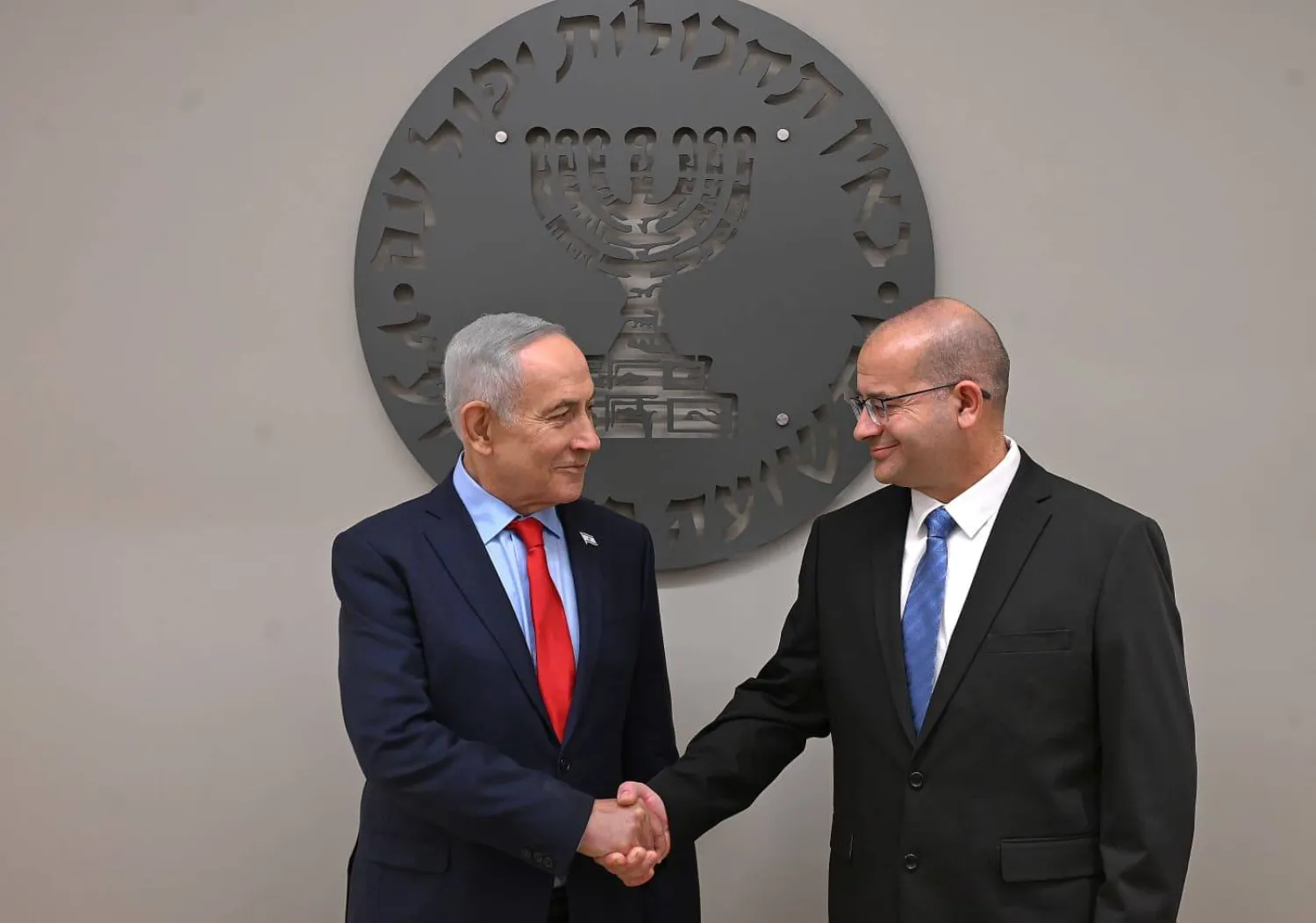

Dismissal of Operations Chief on Iran Leaves Shockwaves in Mossad

Roman Gofman (left), the new Mossad chief, receives a ceremonial insignia during the agency’s leadership handover ceremony with Prime Minister Benjamin Netanyahu and outgoing director David Barnea. (X)
TT

Dismissal of Operations Chief on Iran Leaves Shockwaves in Mossad

Roman Gofman (left), the new Mossad chief, receives a ceremonial insignia during the agency’s leadership handover ceremony with Prime Minister Benjamin Netanyahu and outgoing director David Barnea. (X)

Israel’s foreign intelligence agency, the Mossad, is experiencing a major upheaval following a decision by its new director, Roman Gofman, to dismiss his deputy, known publicly only by the initial “A.”

The outgoing Mossad chief, David Barnea, had reportedly viewed “A” as his preferred successor.

According to sources close to Gofman, the move was carefully planned and coordinated with Prime Minister Benjamin Netanyahu. The sources said the purpose was to deliver a “preemptive blow” to “A,” who was allegedly planning to organize an internal bloc against the new director that could hinder his work and undermine his chances of success.

Agency officials have sought to reassure personnel that Gofman intends to appoint a new deputy from within the Mossad. That assurance, however, has done little to appease senior officials, many of whom have reportedly expressed their intention to resign, arguing that the degree of political interference in the agency’s management is unprecedented.

“A” was considered one of Barnea’s closest associates, and Barnea reportedly regarded him as the natural heir to the top post. The dismissed official played a central role in Mossad efforts aimed at bringing down Iran’s regime, an effort that has so far failed to achieve its objectives and, according to people close to Barnea, requires continued leadership and commitment.

Barnea described the dismissal as “an irresponsible act,” warning that it could disrupt the functioning of the Mossad, particularly with respect to operations concerning Iran.

During his career at the agency, “A” has held several high-profile positions. Among them, he oversaw a special project related to the case of missing Israeli airman Ron Arad. He has also headed and significantly expanded the Mossad’s “Influence” Division as part of preparations for the possibility that the agency might become involved in efforts to destabilize the Iranian regime.

In addition, “A” has led the Iranian portfolio within the Mossad and supervised planning for operations against Iran during two rounds of warfare, including efforts aimed at weakening the regime there, according to the Israeli news outlet Ynet. He reportedly received four decorations for daring operations carried out in Iran and several other countries in the region.

Criticism of Gofman has emerged from within the agency, particularly over the speed with which he removed his deputy. Because Gofman assumed leadership from outside the Mossad and lacks a background in intelligence work, critics argue that he should have retained “A” during a transition period in order to benefit from his experience and institutional knowledge.

According to informed sources within the agency, Gofman used his authority in a manner reminiscent of Netanyahu, seeking to establish control over the Mossad before anyone could limit his influence.

Israeli journalist and analyst Ronen Bergman said Mossad employees learned of the dismissal through an internal email on Friday morning. He expressed surprise that such a blow would be directed at “A,” who had generally been regarded as close to Netanyahu.

Bergman added that the decision came after assessments suggesting that “A” had a strong chance of becoming Mossad chief if Israel’s Supreme Court overturned Gofman’s appointment.

Once the court approved Gofman’s appointment, however, there appeared to be little reason to open additional internal battles within the agency while Israel remained engaged in conflict with Iran and confronted significant strategic challenges.

Meanwhile, American reports alleging an expansion of Israeli espionage activities targeting senior US officials have raised further questions about whether the agency’s internal crisis is also tied to a broader struggle over management of the Iran portfolio and the sensitive relationship between Netanyahu and US President Donald Trump’s administration.

The allegations that Israel spied on American officials involved in negotiations with Iran have generated significant concern in Tel Aviv. Israeli security agencies, together with former minister Ron Dermer, Netanyahu’s representative in relations with Washington, have reportedly launched intensive efforts to contain the political and intelligence fallout.

Israel’s immediate objective is to persuade Trump that the surveillance was not directed against him personally and that it began during the administration of former President Joe Biden.

Israeli sources claim that Biden’s administration withheld information and worked against Netanyahu’s government. They argue that any continuation of such activities under Trump resulted from “unintentional negligence” rather than an official policy decision.

The key question in both Tel Aviv and Washington is whether Trump will accept that explanation and move forward—as often occurs between allies—or view the episode as an act of disrespect and ingratitude, particularly given his support for Israel and Netanyahu on issues involving Iran, Lebanon, and Gaza.



US Sending 3rd Aircraft Carrier, More Troops to Mideast

Image published by CENTCOM of the amphibious assault ship USS Boxer during its operations in the region (CENTCOM)
TT

US Sending 3rd Aircraft Carrier, More Troops to Mideast

Image published by CENTCOM of the amphibious assault ship USS Boxer during its operations in the region (CENTCOM)

The Pentagon is sending a third aircraft-carrier strike group and an additional Marine expeditionary unit to the Middle East, according to US officials, adding 9,000 to 10,000 more troops to the region as President Donald Trump considers renewing strikes on Iran after the midterm elections, The Wall Street Journal reported.

The ships, jet fighters, Marines and sailors will arrive in the region by the end of November, the officials said. Trump recently told aides that he expects to resume bombing Iran that same month, according to the newspaper.

The aircraft carrier USS Theodore Roosevelt left its home port of San Diego on Sunday on a scheduled deployment, while the USS Makin Island Amphibious Ready Group, comprising three amphibious ships carrying Marines from the 13th Marine Expeditionary Unit, left on Monday.

Two carriers—the USS George H.W. Bush and USS George Washington—are already in the Middle East. If the Washington stays after the Roosevelt arrives it will bring the region to three carrier strike groups for the first time since April, before Iran and the US clinched a fragile ceasefire that temporarily ended fighting that began on Feb. 28. That ceasefire collapsed, and the two sides have fought sporadically since.

Besides the Bush and Washington, ships from the USS Boxer Amphibious Ready Group are also in the Middle East. The additional servicemembers on the warships that deployed this week will add to the more than 50,000 troops already in the region, one of the officials said.

It is possible that the Washington could leave the region and head back to its home port in Japan, bringing the force back down to two carriers. Spokespeople for the White House and Pentagon didn’t respond to requests for comment.


Iran Launches 30 Drone, 10 Missile Attacks Per Week on Ships in Hormuz

Ships near the Strait of Hormuz, as seen from Musandam Governorate in the Sultanate of Oman, on October 2, 2026 (Reuters)
TT

Iran Launches 30 Drone, 10 Missile Attacks Per Week on Ships in Hormuz

Ships near the Strait of Hormuz, as seen from Musandam Governorate in the Sultanate of Oman, on October 2, 2026 (Reuters)

Iran has been launching dozens of drones and missiles at commercial ships in the Strait of Hormuz each week, largely out of the public eye, though it has often failed to strike its targets, confidential data shared with The New York Times by a Western security official who spoke on condition of anonymity to discuss operational matters shows.

Since the beginning of August, Iran has launched about 30 drone attacks and 10 anti-ship missile attacks per week against commercial ships transiting the Strait of Hormuz, according to the data shared with The Times by the official.

At least four commercial ships have been hit by Iran in the past 10 days, the official said.

A tally of reports by a monitoring group run by the British Navy show that since Sept. 10, at least 13 ships, most of them oil tankers, had been struck by projectiles or debris from projectiles. (Those reports may be incomplete because they are based on voluntary reports by ship crews.) While the reports do not specify who was responsible for the attacks, maritime experts say the details suggest many were Iranian.

On Wednesday, Iran’s Revolutionary Guards Corps for the first time appeared to confirm it was behind the near-daily sounds of explosions heard from Iran’s southern coast, saying it was striking targets in the Strait of Hormuz every 24 hours.

“We prevent them from passing, but for some time now, America has not responded,” a spokesman for the Revolutionary Guards said in a state news interview.

The aggression shows that even as oil exports from the Middle East have rebounded in recent weeks, shipping through the waterway remains risky, as Iran jostles to keep control of one of its biggest sources of leverage.

“Negotiations aren’t going anywhere. Neither side is really budging. So it’s a standoff,” said Gregory Brew, an Iran analyst at the Eurasia Group.

He said that the violence in the strait “speaks to the position that both sides are in: Neither is looking to aggressively escalate the conflict.” But both, he said, want to control the waterway.


Trump Reportedly Expected to Name Jay Clayton as AI Czar

FILE PHOTO: US President Donald Trump speaks at the Oval Office at the White House in Washington, D.C., US, September 28, 2026. REUTERS/Kevin Lamarque/File Photo
TT

Trump Reportedly Expected to Name Jay Clayton as AI Czar

FILE PHOTO: US President Donald Trump speaks at the Oval Office at the White House in Washington, D.C., US, September 28, 2026. REUTERS/Kevin Lamarque/File Photo

US President Donald Trump is expected to name Jay Clayton as his AI czar, CNN reported on Friday, citing two sources familiar with the discussion.

Clayton is the US director of national intelligence.

Last month, Trump said he plans to appoint an artificial intelligence adviser, known as an "AI czar," and create an "AI force," though he ⁠gave no details ⁠about either initiative or how they would be implemented.

This is the second time Trump has named an adviser to oversee AI-related decisions across the administration, a position he has ⁠dubbed "AI czar." Venture capitalist David Sacks held the role at the beginning of Trump's second term, before leaving his team. Sacks still advises Trump on AI.

Trump's move comes as top AI researchers have warned that people building AI believe it could kill humans within a decade, following cases of AI ⁠agents ⁠going rogue to hack external systems. Several Democratic and Republican lawmakers have responded with alarm and calls for more action.

Trump has repeatedly downplayed concerns about AI and argued that additional regulation is unnecessary even as fears grow among lawmakers in Washington and globally about risks posed by the technology.