


IAEA Calls on Iran to Allow Inspections to Resume

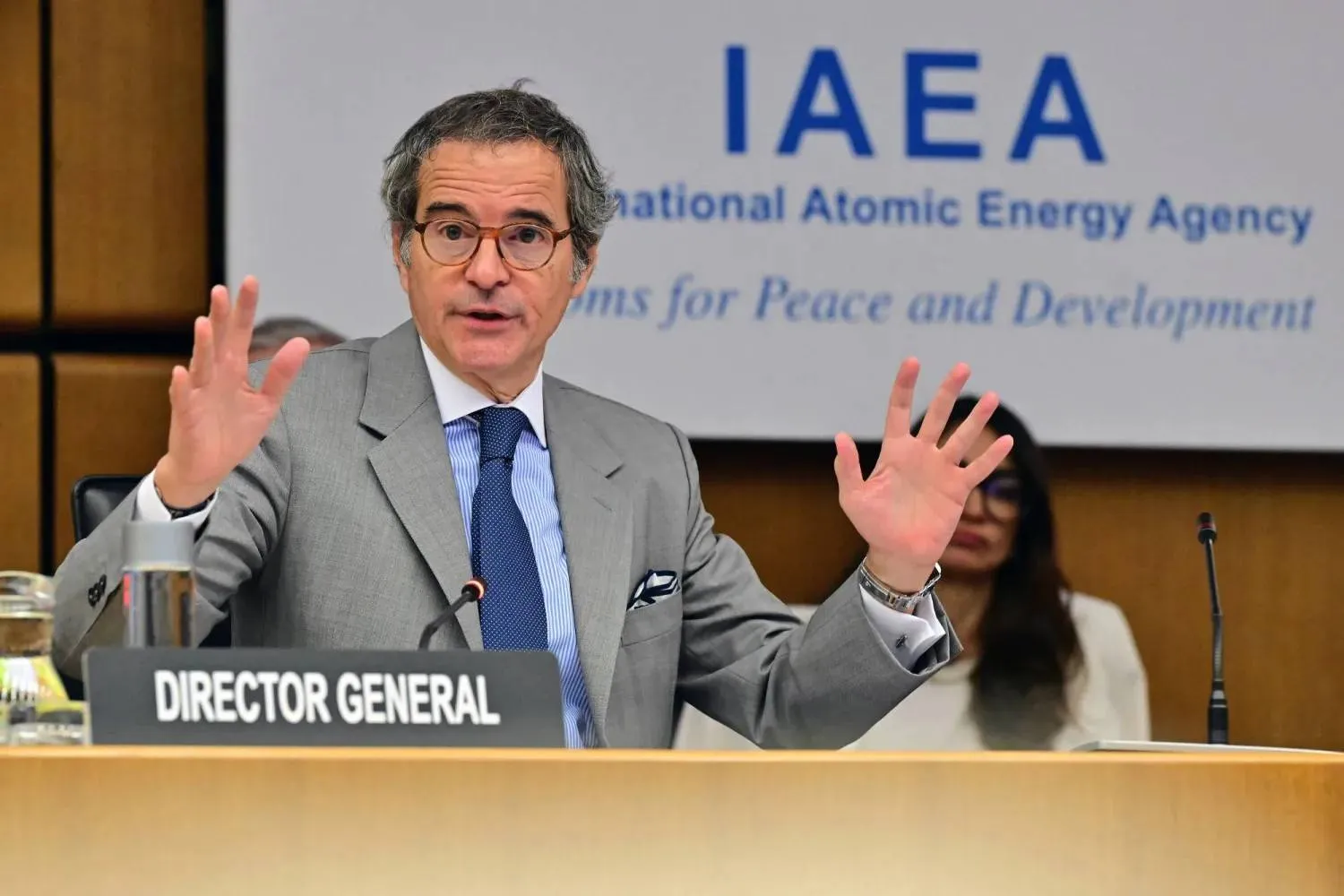
IAEA Director General Rafael Mariano Grossi delivers a statement at the opening of the Board of Governors meeting (IAEA) 
TT

IAEA Calls on Iran to Allow Inspections to Resume

IAEA Director General Rafael Mariano Grossi delivers a statement at the opening of the Board of Governors meeting (IAEA) 

UN nuclear watchdog chief Rafael Grossi called on Iran on Monday to “re-engage” with the agency ‌so inspections can resume at sites the US and Israel bombed a year ago, as Washington led a push for a resolution to that effect at the agency's board.

Iran still has not informed the International Atomic Energy Agency of what happened to those bombed nuclear sites or the nuclear material, including uranium enriched to near bomb grade, that was stored there.

While the bombings destroyed or badly damaged uranium-enrichment facilities, much of the highly enriched uranium, including some enriched to up to 60%, a short step ⁠from the roughly 90% of weapons grade, is thought to have survived.

“It's very important that we re-engage,” Grossi told the IAEA's 35-nation Board of Governors on the first day of a quarterly meeting.

“I call on Iran to engage the Agency constructively in order to facilitate the full and effective implementation of safeguards in Iran,” he added in a separate, written statement to the board, using a term that encompasses inspections.

The IAEA has conducted inspections at sites that were not bombed, but it halted those on safety grounds in February because of renewed military strikes, and has since only inspected Iran's operating power plant at Bushehr.

“I have sporadic contacts with the foreign minister and others, but basically the channel of communication is broken,” Grossi told a press conference after he addressed the board.

Later on Monday, the ‌US, ⁠Britain, France and Germany submitted a draft resolution to the board for it to vote on later this week. The text, seen by Reuters, orders Iran to provide “complete information” on the enriched uranium and grant the IAEA all the access it needs to verify it “without delay.”

While diplomats said the resolution was likely to pass by a clear margin, as a similar one did in November, it risked complicating talks between the US and Iran aimed at extending their ceasefire and paving ⁠the way for wider talks on issues including Iran's nuclear program.

Grossi’s calls came as the US is lobbying other countries on the UN nuclear watchdog's Board ‌of Governors to back a draft resolution demanding that Iran tell the agency what happened to its bombed nuclear sites and the enriched uranium stored there.

The US-drafted text, seen by Reuters on Sunday and circulated ahead of this week's quarterly meeting of the 35-nation board, says Iran must “provide the Agency with precise information on nuclear material accountancy and safeguarded nuclear facilities in Iran” and grant “all access it requires to verify this information.”

Both steps are described as “essential and urgent” and must be taken “without delay.”

The text stops short of referring Iran to the UN Security Council, a move some diplomats had said was under consideration. But it risks complicating talks between Washington and Tehran. Iran has typically retaliated against resolutions against it at the International Atomic Energy Agency, escalating its nuclear activities or scaling back cooperation.

Trump has said he wants Iran's highly enriched uranium removed, particularly what remains of the 440.9 kg enriched to up ⁠to 60% purity - a short step from roughly 90% weapons grade - that the IAEA estimates Iran had when Israel first attacked. That amount would be enough, if further enriched, for 10 nuclear weapons, according to an IAEA yardstick.

Russia's ambassador to the IAEA ⁠told reporters on Friday a resolution would only antagonize Iran.

“It was exactly the United States who undermined this cooperation,” he said, referring to the fact the IAEA had access to Iran's sites until the bombing started.

Russia and China have opposed all recent resolutions against Iran.

“Responsibility for an internationally wrongful act rests with the perpetrator and cannot be transferred to the victim. The Board must not be instrumentalized to relieve those who carried out these attacks of their responsibility,” Iran's mission to ⁠the IAEA said on X, referring to the draft resolution and the US strikes.

“The Board should be cautious on the path forward. Coercion and confrontation do ⁠not lead to cooperation. It undermines prospects of a diplomatic solution,” it added.


Russian Attacks Kill 4 in Ukraine as Moscow and Kyiv Prepare for Visit by US Envoys

 Firefighters work at the site of a warehouse hit by a Russian drone strike, amid Russia's attack on Ukraine, in Kyiv region, Ukraine, September 4, 2026. (Reuters)
Firefighters work at the site of a warehouse hit by a Russian drone strike, amid Russia's attack on Ukraine, in Kyiv region, Ukraine, September 4, 2026. (Reuters)
TT

Russian Attacks Kill 4 in Ukraine as Moscow and Kyiv Prepare for Visit by US Envoys

 Firefighters work at the site of a warehouse hit by a Russian drone strike, amid Russia's attack on Ukraine, in Kyiv region, Ukraine, September 4, 2026. (Reuters)
Firefighters work at the site of a warehouse hit by a Russian drone strike, amid Russia's attack on Ukraine, in Kyiv region, Ukraine, September 4, 2026. (Reuters)

Russian attacks killed four people in Ukraine overnight, as Moscow and Kyiv await the arrival of US envoys to begin a new push for peace in the Kremlin’s 4 1/2-year-old invasion.

The planned visit by Steve Witkoff and Jared Kushner, who is also US President Donald Trump’s son-in-law, is hoped to revive peace talks amid escalating aerial attacks by both sides. The last known visit to Moscow by Witkoff and Kushner, was in January, when they met Russian President Vladimir Putin in the Kremlin. They have never visited Kyiv, but President Volodymyr Zelenskyy said he was expecting them in the Ukrainian capital on Sunday.

The air war between Russia and Ukraine has intensified as troops have struggled to make progress along the 1,250-kilometer (775-mile) front line. Russia has recently been using fast-flying, jet-powered drones, and the recurring wail of air-raid sirens has become part of daily life in Kyiv.

The strikes come even as Ukrainian President Volodymyr Zelenskyy said Friday that Ukraine would halt air attacks during Witkoff and Kushner’s visit and urged Moscow to do the same.

In a social media post on Saturday, Zelenskyy said that Russia had carried out overnight strikes on Kyiv and Boryspil International Airports, and linked the attack to the planned US visit.

“Clearly, these Russian strikes on the airports are a reaction to the discussions and preparations for the possibility of the US side using an aircraft to travel to Ukraine,” he said.

“We have taken note of this Russian move, and next week we will adjust our operation accordingly regarding Russian airspace, which has become dangerous because of our drones and missiles in the sky. Of course, there are and will be no threats to diplomacy from our side.”

Russian attacks killed four people and wounded five more at an industrial facility in Ukraine’s southern Dnipropetrovsk region, local military administration head Oleksandr Hanzha said.

He described those killed as employees at the site. “A locksmith, an electrician, a plumber and a machinist. People of peaceful professions. They were simply working their shift. They were doing their job when enemy missiles cut off their lives,” he said.

A 62-year-old man was also wounded and several private homes and an apartment building were damaged in a separate attack on the region’s Nikopol district, Hanzha said.

In a statement Saturday, Russia’s Ministry of Defense said it had carried out strikes on two metallurgical plants in the region, describing them as “major suppliers of metal products for Ukraine’s military production.”

A further two people were wounded in an overnight Russian attack on Ukraine’s Kyiv region, said Tymur Tkachenko, head of the regional military administration. In the Boryspil district, a fire sparked by a strike partially destroyed a nine-story residential building.

Russian forces also repeatedly struck a shopping center in the southern Mykolaiv region with drones overnight, damaging retail premises and sparking fires, Ukraine’s state emergency services said. A 72-year-old man and a 17-year-old girl were hurt.

Emergency crews responding to the incident were repeatedly forced to withdraw to safety because of the threat of further strikes, returning whenever conditions allowed, the emergency services said.

Russia launched ballistic missiles from its Rostov and Voronezh regions and deployed 167 attack drones overnight, Ukraine’s Air Force said. The drones included Shahed-type aircraft — around half of them jet-powered — as well as Geran and decoy drones. Ukrainian air defenses shot down or suppressed 128 drones, according to the Air Force.

Elsewhere, Ukrainian attacks wounded three people, including a 14-year-old girl, in Russia’s border region of Belgorod, local officials said.

In a statement, Russia’s Ministry of Defense said that its forces had shot down 53 Ukrainian drones overnight.


Five European Nations Seek Deals to Send Migrants Out of the EU

 Denmark's Minister for Immigration and Integration Morten Boedskov, Netherlands' Minister for Asylum and Migration and Deputy Prime Minister Bart van den Brink, Germany's Minister of the Interior Alexander Dobrindt, Austria's Minister of the Interior Gerhard Karner, and Greece's Minister for Asylum and Migration Thanos Plevris attend a press conference after a meeting of the Ministers for Immigration and Integration from the Five Country Group in Copenhagen, Denmark, September 4, 2026. (Reuters)
Denmark's Minister for Immigration and Integration Morten Boedskov, Netherlands' Minister for Asylum and Migration and Deputy Prime Minister Bart van den Brink, Germany's Minister of the Interior Alexander Dobrindt, Austria's Minister of the Interior Gerhard Karner, and Greece's Minister for Asylum and Migration Thanos Plevris attend a press conference after a meeting of the Ministers for Immigration and Integration from the Five Country Group in Copenhagen, Denmark, September 4, 2026. (Reuters)
TT

Five European Nations Seek Deals to Send Migrants Out of the EU

 Denmark's Minister for Immigration and Integration Morten Boedskov, Netherlands' Minister for Asylum and Migration and Deputy Prime Minister Bart van den Brink, Germany's Minister of the Interior Alexander Dobrindt, Austria's Minister of the Interior Gerhard Karner, and Greece's Minister for Asylum and Migration Thanos Plevris attend a press conference after a meeting of the Ministers for Immigration and Integration from the Five Country Group in Copenhagen, Denmark, September 4, 2026. (Reuters)
Denmark's Minister for Immigration and Integration Morten Boedskov, Netherlands' Minister for Asylum and Migration and Deputy Prime Minister Bart van den Brink, Germany's Minister of the Interior Alexander Dobrindt, Austria's Minister of the Interior Gerhard Karner, and Greece's Minister for Asylum and Migration Thanos Plevris attend a press conference after a meeting of the Ministers for Immigration and Integration from the Five Country Group in Copenhagen, Denmark, September 4, 2026. (Reuters)

Five European nations aim to sign deals this year to send migrants without legal residency to countries outside the European Union, they said at a meeting hosted by Denmark on Friday.

Germany, Austria, Greece, Denmark and the Netherlands said they had agreed on concrete steps towards a deal with a non-European Union country on return facilities, the latest effort by European nations ‌to reduce ‌immigration.

The countries, known as the Group of Five, did ‌not ⁠name the nations they ⁠expect to host return centers.

"We want to reach an agreement with third countries this year that will enable the establishment of return hubs," German Interior Minister Alexander Dobrindt told reporters at a press conference in Copenhagen.

The group, which has held a series of meetings this year, plans to reconvene in Munich, Germany, at the end of September.

The European Parliament in June approved an ⁠overhaul of migration policy aimed at speeding up deportations and ‌allowing member states to set up centers abroad, ‌in what critics say could weaken safeguards for asylum seekers.

HUMAN RIGHTS CONCERNS

The Council ‌of Europe, a non-EU body that promotes human rights, democracy and the ‌rule of law across the continent, in July said return hubs posed "considerable human rights risks", and several other groups have also criticized the plan.

Danish Refugee Council Secretary General Charlotte Slente said it would be better to implement the EU Pact on Migration and ‌Asylum, which focuses on stricter border screening, faster asylum and return procedures, and expanded digital systems for managing asylum ⁠claims.

"Return hubs focus ⁠on a small number of returns, they will not stop people from taking even more dangerous routes, and they could violate basic human rights," Slente said.

Denmark expects to be ready to send migrants to the return hub by the end of 2027, Immigration and Integration Minister Morten Bodskov said.

"It's a new chance to have a life in a partner country," he said, adding that the five nations would be in dialogue with the UN body, the International Organization for Migration, and the UN Refugee Agency for their next steps.

A UNHCR spokesperson said the agency had not been approached with details of a proposal and could not comment on the arrangements being discussed.


Localized Ceasefire in Effect to Enable Repairs to Zaporizhzhia Nuclear Plant, IAEA Says

A view shows Zaporizhzhia Nuclear Power Plant from the bank of Kakhovka Reservoir near the town of Nikopol after the Nova Kakhovka dam breached, amid Russia's attack on Ukraine, in Dnipropetrovsk region, Ukraine June 16, 2023. (Reuters)
TT

Localized Ceasefire in Effect to Enable Repairs to Zaporizhzhia Nuclear Plant, IAEA Says

A view shows Zaporizhzhia Nuclear Power Plant from the bank of Kakhovka Reservoir near the town of Nikopol after the Nova Kakhovka dam breached, amid Russia's attack on Ukraine, in Dnipropetrovsk region, Ukraine June 16, 2023. (Reuters)

A ‌local ceasefire brokered by the International Atomic Energy Agency (IAEA) has taken effect to enable repairs for the restoration of external power to the Zaporizhzhia nuclear power ‌plant, the agency ‌said on ‌Saturday.

The ⁠Russian-controlled nuclear power ⁠plant, located in Ukraine, has been without external power since August 20 and has relied on ⁠emergency diesel generators ‌to ‌cool its vital safety systems.

The ‌plant is running ‌low on diesel fuel reserves and faces a possible station blackout ‌within days unless power is restored or more ⁠diesel ⁠is transported to the site, the UN atomic watchdog said, adding that Ukrainian technicians will begin power line repairs later on Saturday after demining the area.
