


Italian Commuters Find a Moment of Peace on a Cable-Guided Ferry Sketched by Leonardo Da Vinci

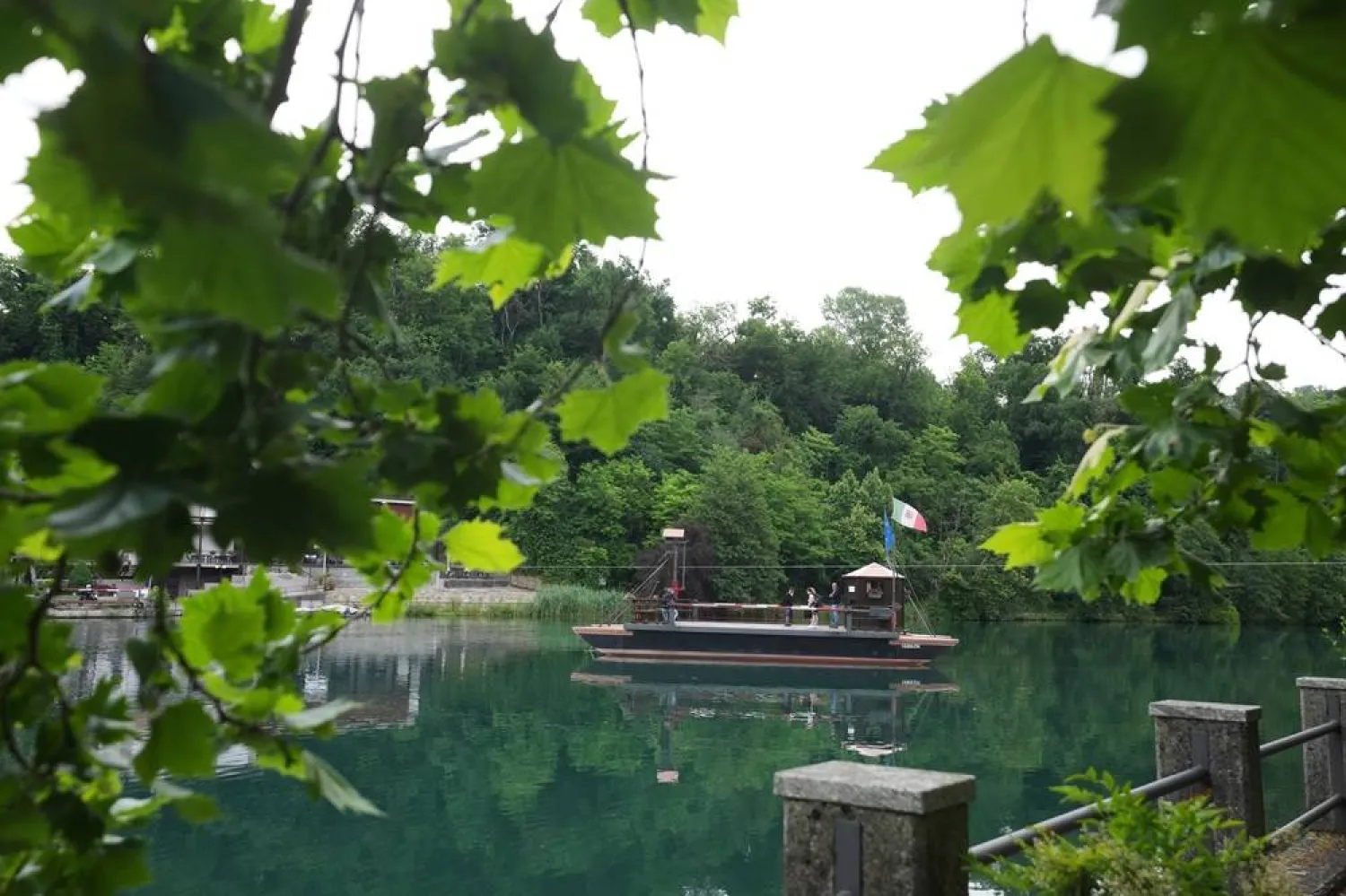
 Commuters board the “Da Vinci Ferry,” a hand-operated ferry of a type sketched by Leonardo da Vinci in the 15th century, on the Adda River between the provinces of Lecco and Bergamo, in Imbersago, Italy, Thursday, June 4, 2026. (AP)
Commuters board the “Da Vinci Ferry,” a hand-operated ferry of a type sketched by Leonardo da Vinci in the 15th century, on the Adda River between the provinces of Lecco and Bergamo, in Imbersago, Italy, Thursday, June 4, 2026. (AP)
TT

Italian Commuters Find a Moment of Peace on a Cable-Guided Ferry Sketched by Leonardo Da Vinci

 Commuters board the “Da Vinci Ferry,” a hand-operated ferry of a type sketched by Leonardo da Vinci in the 15th century, on the Adda River between the provinces of Lecco and Bergamo, in Imbersago, Italy, Thursday, June 4, 2026. (AP)
Commuters board the “Da Vinci Ferry,” a hand-operated ferry of a type sketched by Leonardo da Vinci in the 15th century, on the Adda River between the provinces of Lecco and Bergamo, in Imbersago, Italy, Thursday, June 4, 2026. (AP)

The ferry glides from one bank of northern Italy's Adda River to the other, guided by a cable and pulled by currents, offering harried commuters five minutes of serenity and an alternate route now that a bridge closure has backed up traffic.

Called “Leonardo’s Ferry,” the mechanism of the so-called reaction ferry was designed five centuries ago and immortalized by the Renaissance genius himself in a drawing preserved in Windsor Castle's Royal Collection outside of London.

It is the last remaining of its kind along the Adda River, which extends from the Alps to the Po River in the Lombardy region.

“This is a mean of transport that has been here for 500 years and has always connected the two banks of the Adda,” said Massimo Zoia, one of the volunteer ferrymen who operates the vessel. “And now it has returned to its original purpose: connecting two populations living on different banks of a river."

Despite its name, it remains unclear whether Leonardo himself actually designed the ferry. What is certain, however, is that he sketched it in 1513, as part of his famed studies of waterways, including Milan's canal system.

Leonardo was one of history’s greatest polymaths, filling notebooks with designs across a range of disciplines, including flying machines that wouldn't be realized for centuries.

The ferry’s operating principle is as simple as it is ingenious, and entirely environmentally friendly.

“The river pushes us downstream. We have a cable that binds us, and by breaking down the forces, according to the parallelogram rule, which we study in high school, the force is broken down and one part becomes resistance and the other we use for lateral movement,” Zoia said.

“The rudder is used to adjust the inclination of the ferry so that it better absorbs the stream that hits us and makes us move,” he said.

The ferry is run by the town of Imbersago, and runs to the town of Villa d’Adda on the other side. It came close to disappearing in 2023, when its operator gave up the concession. Determined to save it, Imbersago Mayor Fabio Vergani obtained a ferryman’s license himself and, together with the local tourism association, assembled a team of volunteers.

Since 2024, they have primarily transported weekend visitors from one bank of the Adda to the other.

But they added commuter service this spring after a nearby bridge was closed for maintenance to help ease traffic congestion. It now runs from 7 a.m.-7 p.m., with a two-hour lunch break at noon. Passengers pay 1.50 euros (about $1.75) if they are on foot, 2 euros ($2.30) with a bicycle, 2.50 euros ($2.88) with a motorbike and 3.50 (around $4) for a car.

Gianpaolo Graffagnino lives in Villa d’Adda and works on the other side of the river. He has started biking to work, using the ferry as a shortcut.

“Right now this is the fastest system, but above all the nicest because you get three minutes of peace,” he said.

Mauro Carnati drove his Maserati onto the ferry to bring his daughter to school on the other side, avoiding a long detour caused by the bridge closure.

“It’s true that we spend a little money, and it’s not possible every day, but the romance and added value of the Adda and the ferry are truly amazing. It makes for a better start to the day,” he said.



UN: Intense Sand and Dust Storms Struck China, US in 2025

US military officials are enveloped in a dust cloud created by the rotor wash of a landing MV-22 Osprey aircraft during the Rim of the Pacific (RIMPAC) military exercises at Marine Corps Training Area Bellows (MCTAB) in Waimanalo, Hawaii, US, July 9, 2026. REUTERS/Marco Garcia
TT

UN: Intense Sand and Dust Storms Struck China, US in 2025

US military officials are enveloped in a dust cloud created by the rotor wash of a landing MV-22 Osprey aircraft during the Rim of the Pacific (RIMPAC) military exercises at Marine Corps Training Area Bellows (MCTAB) in Waimanalo, Hawaii, US, July 9, 2026. REUTERS/Marco Garcia

China and the southern United States were hit last year by some of the worst sand and dust storms in decades, the United Nations said Friday.

The UN's weather and climate agency said these episodes affected public health and the environment, and disrupted transport and economic activity.

In its 10th annual Airborne Dust Bulletin, the World Meteorological Organization said that globally, overall average dust concentrations last year were similar to 2024 -- though with big regional variations.

"Every year, around 2,000 million tons of dust enters the atmosphere, and can be transported for hundreds of kilometers and even thousands of kilometers, across continents and oceans," the WMO said.

The main dust sources are major deserts such as the Sahara in Africa, the Gobi in Asia, and the Arabian Desert in the Middle East.

Though a natural process, poor water and land management, drought and environmental degradation "are increasingly to blame" for a hazard which affects more than 150 countries, the WMO said.

The highest annual mean dust concentrations worldwide again were in the Bodele Depression in Chad, one of the world's most active dust source regions.

"Sand and dust storms affect air quality and human health," said WMO chief Celeste Saulo.

"They reduce agricultural productivity, disrupt transport and aviation, strain water and energy systems, and damage ecosystems. No country is immune to their impacts."

The desert border region of Mexico and the United States saw exceptionally frequent, intense and prolonged dust storms in 2025.

El Paso in Texas experienced 50 days with dust weather -- more than double the annual average.

The number of dust storms was the greatest since 1935, the WMO said.

The problem peaked on March 18, with a daily average concentrations of inhalable particles (PM10) at 2,064 micrograms per cubic meter of air.

The highest hourly peak hit 8,142 micrograms -- the highest measured in Texas since hourly PM monitoring began around 27 years ago.

PM10 is particulate matter with a diameter of 10 micrometers.

The World Health Organization's air quality guideline annual level is 15 micrograms, or 45 in a 24-hour period.

In April 2025, China suffered its worst dust and sand storm in a decade, in terms of its intensity, duration and influence.

As dust swept in from Mongolia, hourly PM10 concentrations exceeded 1,000 micrograms per cubic meter in northern China.

In some places, the figure was as high as 3,000 to 4,000 micrograms.

Saulo said because sand and dust storms cross borders, countries needed to share early warning data.

The agency said artificial intelligence had the potential to improve sand and dust forecasts, but more research was needed at this stage.

Currently, some AI systems are better at forecasting short-lived, rapidly-developing local dust storms, while others are more consistent on large-scale events that develop and travel over several days.


Symbols at Old English Buildings Not ‘Witches Marks’

Every carving carries centuries of interpretation (Reuters)
TT

Symbols at Old English Buildings Not ‘Witches Marks’

Every carving carries centuries of interpretation (Reuters)

Over the years, English Heritage and Historic England have claimed to have identified large numbers of “witches’ marks” or “ritual protection symbols” on the walls of historic buildings, including medieval churches and houses.

Now a leading architectural historian has said there is “absolutely no evidence” that these marks have anything to do with witches or any “mystical meanings.”

Markings in Tithe Barn, Bradford-on-Avon, in an image released by Historic England in 2016 (English Heritage)

Daisy wheels, or hexafoils, are among symbols that are no more than the marks of stonemasons who worked on those buildings, according to Jennifer Alexander, a professor of architectural history at Warwick University and author of a new study.

She told the Guardian: “Do you remember at school when you were first given a pair of compasses and you made a daisy wheel? It’s that. There are hundreds of such marks and they tend to be [of] varying degrees of skill. It’s much more the sort of thing you would use to train apprentices with, giving them skills in using tools on intractable surfaces like stone.”

She said such marks were “practical geometry” being taught and tried out. “The daisy wheels are practices for drawing on stone and learning how to use compasses with straight edges to do geometry.”

Ridiculing their identification as “witches’ marks,” Alexander said: “Anything on a stone building that looks like a design gets picked up as these things now. There’s absolutely no evidence they were ever used like that.”

Alexander said: “There’s no evidence that these are witches’ marks. What they’re telling us is that when that barn wasn’t needed for farm produce, it was either a schoolroom or a mason’s training shop.

“There are a huge number of designs on the walls there and they vary enormously in skill. If you are drawing a circle with a pair of compasses, you get three-quarters the way round and it’s very difficult to make a nice clean line because your wrist is upside down. When you’re doing it on paper, it’s bad enough. When you’re doing it on stone, it’s even harder. So people have to be trained.”

She added: “There are things to ward off the evil eye, but they are a more generic thing ... These are parts of the mechanisms by which buildings are constructed ... Marks that look like a capital W or an M are mason ciphers. They can help put things together in the right order if you are building something. Or they can identify whose work it was.”


Ancient Cave Discovery Reshapes Scientists' Understanding of Neanderthals and Modern Humans

Modern humans and Neanderthals may have lived as friends (Instagram) 
TT

Ancient Cave Discovery Reshapes Scientists' Understanding of Neanderthals and Modern Humans

Modern humans and Neanderthals may have lived as friends (Instagram) 

Groundbreaking archaeological research from southern Türkiye suggests a surprising new narrative: modern humans and Neanderthals may have lived as friends, sharing elements of their culture.

Evidence unearthed at Ucagizli II Cave indicates that these two closely related human species coexisted between 50,000 and 60,000 years ago, adopting remarkably similar technologies, survival strategies, and even symbolic traditions between 50,000 and 60,000 years ago, according to The Independent.

The revelations could profoundly reshape scientists’ understanding of how Homo sapiens and Homo neanderthalensis interacted during a pivotal period in human evolution.

While modern humans undertook their significant “Out of African” migration into Eurasia, fossil evidence from the Levant – a crucial geographical corridor connecting the two continents – has historically remained relatively scarce.

To shed further light on this era, an international team of researchers from Türkiye, France, and Japan, including scientists from Kyoto University, embarked on extensive excavations at Ucagizli II Cave.

Over a painstaking five-year period, archaeologists meticulously excavated the site millimeter by millimeter.

Their efforts uncovered compelling proof that both Neanderthals and modern humans not only occupied the cave but also used identical stone tool technologies and employed the same hunting methods.

Crucially, researchers also discovered clear indications that the two groups engaged in shared behaviors extending well beyond the necessities of daily survival, hinting at a deeper cultural exchange.

Both Neanderthals and modern humans appear to have deliberately collected the same type of marine seashell, despite it having little or no value as a food source.

Such shells had previously been regarded as being associated only with modern humans.

The researchers say the shared preference for these non-utilitarian objects may point to the exchange of symbolic or cultural practices between the two species.

“Our findings indicate a deep level of cultural interaction,” said a corresponding author Naoki Morimoto of KyotoU.

“These two distinct but closely related human groups were not just adapting to the same environment: they were probably sharing symbolic preferences.”

The modern human remains recovered from the cave have been dated to between 50,000 and 60,000 years ago, placing them within the period when genetic evidence suggests modern humans were dispersing from Africa into Eurasia.

According to the researchers, the individuals may represent close relatives of the population that gave rise to all present-day people living outside Africa.

Alternatively, they could belong to a previously unknown population descended from an earlier migration into the Levant.

The team says the discoveries help fill a significant gap in the archaeological record, offering new insights into how modern humans and Neanderthals may have lived, interacted and exchanged ideas during a prolonged period of coexistence spanning more than 20,000 years.