
20,000 People Displaced by the Philippine Earthquake That Killed at Least 37

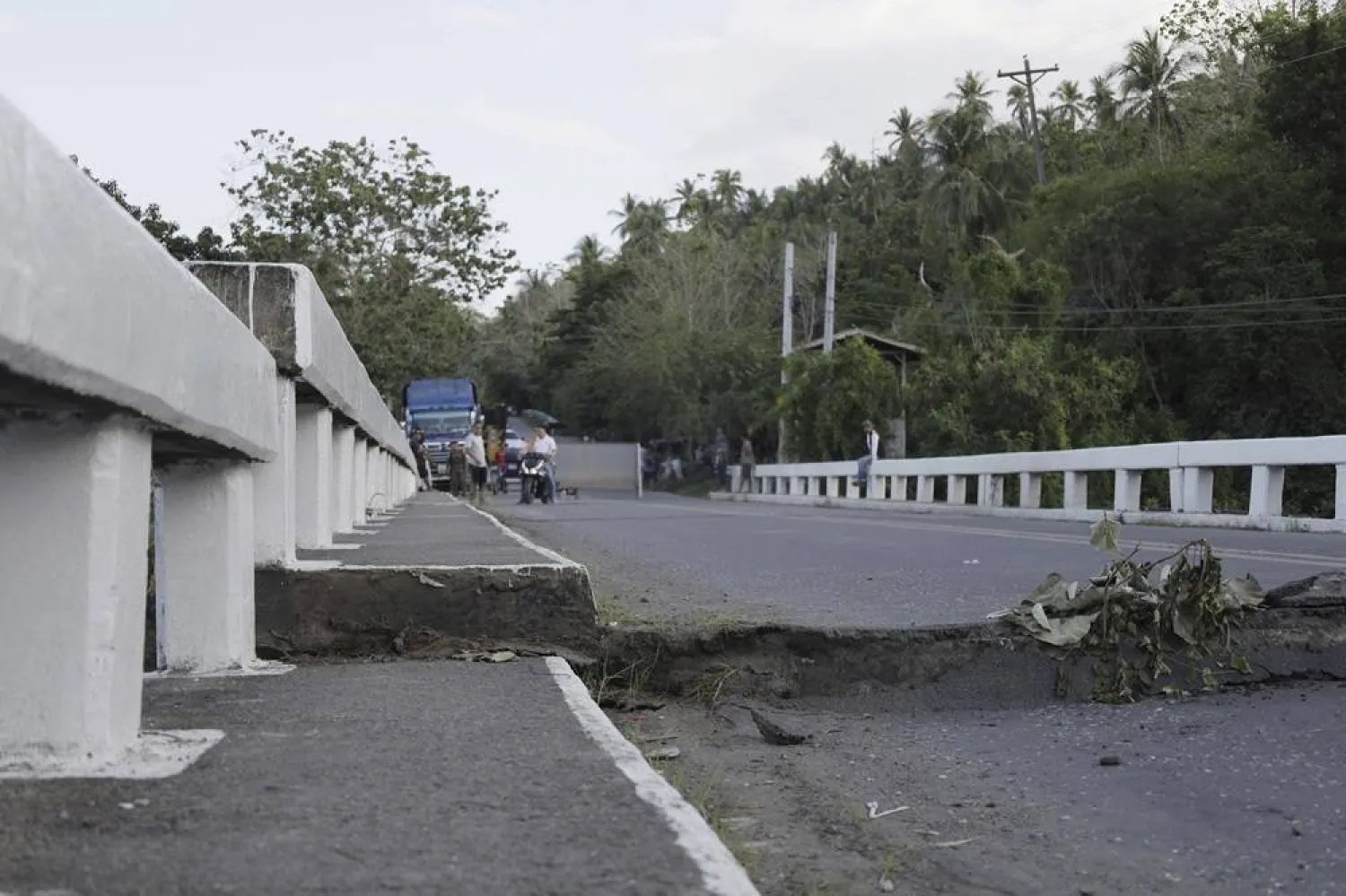
A damaged bridge closed to motor vehicles as a safety measure a day after an earthquake in Sarangani Province, southern Philippines, 09 June 2026. (EPA)
TT

20,000 People Displaced by the Philippine Earthquake That Killed at Least 37

A damaged bridge closed to motor vehicles as a safety measure a day after an earthquake in Sarangani Province, southern Philippines, 09 June 2026. (EPA)

Rescuers searched ruined buildings in the southern Philippines on Tuesday to ensure no one was still trapped a day after one of the strongest earthquakes to hit the country in a half-century killed at least 37 people and displaced more than 20,000.

Only four people were considered missing on official records in the southern provinces near where the 7.8 magnitude quake struck Monday morning, but the Office of Civil Defense acknowledged several collapsed and heavily damaged buildings must be thoroughly inspected for possible survivors or casualties.

The earthquake centered off Mindanao, the second most populous Philippine island, injured nearly 500 people and displaced more than 20,000, most of whom fled to emergency shelters.

Many people who left their homes feared a tsunami. Waves up to 1.4-meter (4.6-foot) above tide level were measured in the Philippines, but the only tsunami damage reported was to six shanties on stilts in a coastal village. Smaller waves washed ashore in Indonesia and Palau and as far away as southern Japan.

The earthquake left a trail of destruction, including in General Santos, a lively coastal city of more than 700,000 people known as the country’s tuna capital, where at least 13 people were killed in collapsed buildings and due to falling debris.

At least 18 died in Sarangani province mostly in a landslide that buried houses in the mountainside town of Glan, according to Rafaelito Alejandro of the Office of Civil Defense.

The other deaths were reported in the southern provinces of South Cotabato and Davao Occidental, and on Balut Island, disaster-response officials said.

About 2,000 houses and 117 government buildings and facilities were damaged in several provinces, according to an initial government damage assessment. The international airport in General Santos remained shut, forcing the cancellation of 63 domestic flights except for those on humanitarian mission.

About 6,000 public school buildings in quake-hit provinces must be assessed before classes can resume. The quake struck on the first day of classes nationwide after a two-month summer break and many who sustained injuries were young students who had gathered with excitement for morning flag-raising ceremonies.

Authorities have warned that buildings that sustained cracks could collapse due to aftershocks, some of them dangerously powerful.

“We cannot force the immediate reopening of schools because we have to ensure the integrity of the buildings,” Alejandro said.

Monday's earthquake was centered at sea at a depth of 33 kilometers (20 miles), about 32 kilometers (20 miles) southwest of Maasim town in Sarangani province.

It was set off by movement in the Cotabato Trench and was the strongest since the same undersea depression triggered an 8.1-magnitude quake that whipped up tsunami waves on Aug. 17, 1976, said Teresito Bacolcol, the director of the Philippine Institute of Volcanology and Seismology.

About 8,000 people died from that quake and tsunami waves of up to 8 to 10 meters (26 to 33 feet) that engulfed several towns and provinces, Bacolcol said.

The Philippine seismological institute was scheduled to commemorate the anniversary of the 1976 quake and tsunami in August by installing markers to remind vulnerable towns and cities of the need for constant vigilance, Bacolcol told The Associated Press.

A 1990 earthquake that also had a magnitude of 7.8 left more than 1,000 people dead, injured thousands and caused extensive damage in northern provinces and cities.

President Ferdinand Marcos Jr. deployed top defense-mitigation officials from Manila to help oversee search and rescue, the distribution of tens of thousands of food packs and construction materials to quake victims and assess damage to bridges, roads and other infrastructure.

The United States, a treaty ally of the Philippines, said it was coordinating with Manila and was ready to support Philippine response efforts. France, Japan and New Zealand also expressed support.

The Philippines is often hit by earthquakes and volcanic eruptions due to its location on the Pacific “Ring of Fire,” an arc of seismic faults around the ocean.

The archipelago is also battered by about 20 typhoons and tropical storms each year, making it one of the world’s most disaster-prone countries.




Kremlin Says EU Not Ready to Mediate Ukraine Peace Deal

Ukrainian rescuers work at the site of a Russian strike on a residential area in Kharkiv, Ukraine, 09 June 2026, amid the ongoing Russian invasion. (EPA)
TT

Kremlin Says EU Not Ready to Mediate Ukraine Peace Deal

Ukrainian rescuers work at the site of a Russian strike on a residential area in Kharkiv, Ukraine, 09 June 2026, amid the ongoing Russian invasion. (EPA)

The Kremlin said on Tuesday that the European Union was likely far from ready to act as a mediator in any ‌Ukraine peace ‌process and ‌appeared ⁠to be more focused ⁠on continuing the war.

Kremlin spokesman Dmitry Peskov made the comment to journalists when ⁠asked about ‌the ‌possibility of the ‌EU stepping in as ‌a mediator while US-led negotiations are on hold.

"First of ‌all, starting mediation efforts by putting ⁠forward certain ⁠conditions to Russia is likely illogical and wrong. And, of course, this is unacceptable to us," Peskov said.


Putin to Decide on Armenia’s Pashinyan Congratulations After Official Election Results, Kremlin Says

 Armenian Prime Minister and leader of the Civil Contract party Nikol Pashinyan holds a press conference following the parliamentary election at the party's headquarters in Yerevan early on June 8, 2026. (AFP)
Armenian Prime Minister and leader of the Civil Contract party Nikol Pashinyan holds a press conference following the parliamentary election at the party's headquarters in Yerevan early on June 8, 2026. (AFP)
TT

Putin to Decide on Armenia’s Pashinyan Congratulations After Official Election Results, Kremlin Says

 Armenian Prime Minister and leader of the Civil Contract party Nikol Pashinyan holds a press conference following the parliamentary election at the party's headquarters in Yerevan early on June 8, 2026. (AFP)
Armenian Prime Minister and leader of the Civil Contract party Nikol Pashinyan holds a press conference following the parliamentary election at the party's headquarters in Yerevan early on June 8, 2026. (AFP)

Russian President Vladimir Putin will decide later whether to congratulate Armenian Prime Minister Nikol Pashinyan on his election victory, the Kremlin said on Tuesday, underlining that Moscow is ‌waiting for ‌the formal outcome of ‌the ⁠vote before making ⁠any announcements.

Commenting on the parliamentary election, Kremlin spokesman Dmitry Peskov reiterated remarks made a day ⁠earlier that there had been ‌reports ‌of violations, while stopping ‌short of offering a ‌broader assessment of the vote or its legitimacy.

Armenia's governing Civil Contract ‌party won an election seen as a test ⁠of ⁠its handling of a peace deal with Azerbaijan and its growing turn to the West, despite what international election observers called blatant interference and pressure by Russia.


Hundreds Evacuated as Waves Batter New Zealand Capital

Stormy seas pound the coastline of Island Bay, a suburb of the New Zealand capital Wellington. Ben STRANG / AFP
TT

Hundreds Evacuated as Waves Batter New Zealand Capital

Stormy seas pound the coastline of Island Bay, a suburb of the New Zealand capital Wellington. Ben STRANG / AFP

Authorities evacuated hundreds of people from their seaside homes in New Zealand's capital on Tuesday as 11-meter (36-foot) waves lashed the coast.

Wellington Mayor Andrew Little declared a state of emergency on the eve of the swells for seaside residents in Owhiro Bay, Island Bay, Houghton Bay and Breaker Bay.

"You must stay away from the southern coastline," Little said in a statement, warning that emergency workers would not be coming to help anyone who stayed behind.

The evacuation order took effect on Tuesday morning, with police brought in to ensure people moved to higher ground, said AFP.

Officers set up cordons on surrounding roads to prevent people from heading to the coast.

The council said a similar event in 2021 affected many homes in Breaker Bay, and waves during that storm were about 6.5 meters.

Waves entering Wellington Harbour on Tuesday were measured at 11 meters, New Zealand's MetService said.

Wind gusts were so strong at Island Bay that two women were knocked off their feet as waves washed up over the road, an AFP journalist saw.

Some flights were cancelled at Wellington Airport where wind gusts were recorded of up to 128 kilometers per hour (80 miles per hour).

A small plane from local carrier Golden Bay Air tipped onto its side in the wind while parked at the airport with no-one aboard.

Airline boss Richard Molloy told national broadcaster RNZ that fire fighters had secured the plane to the ground.