Between Homer and Hollywood: Troy a Source of Turkish Pride

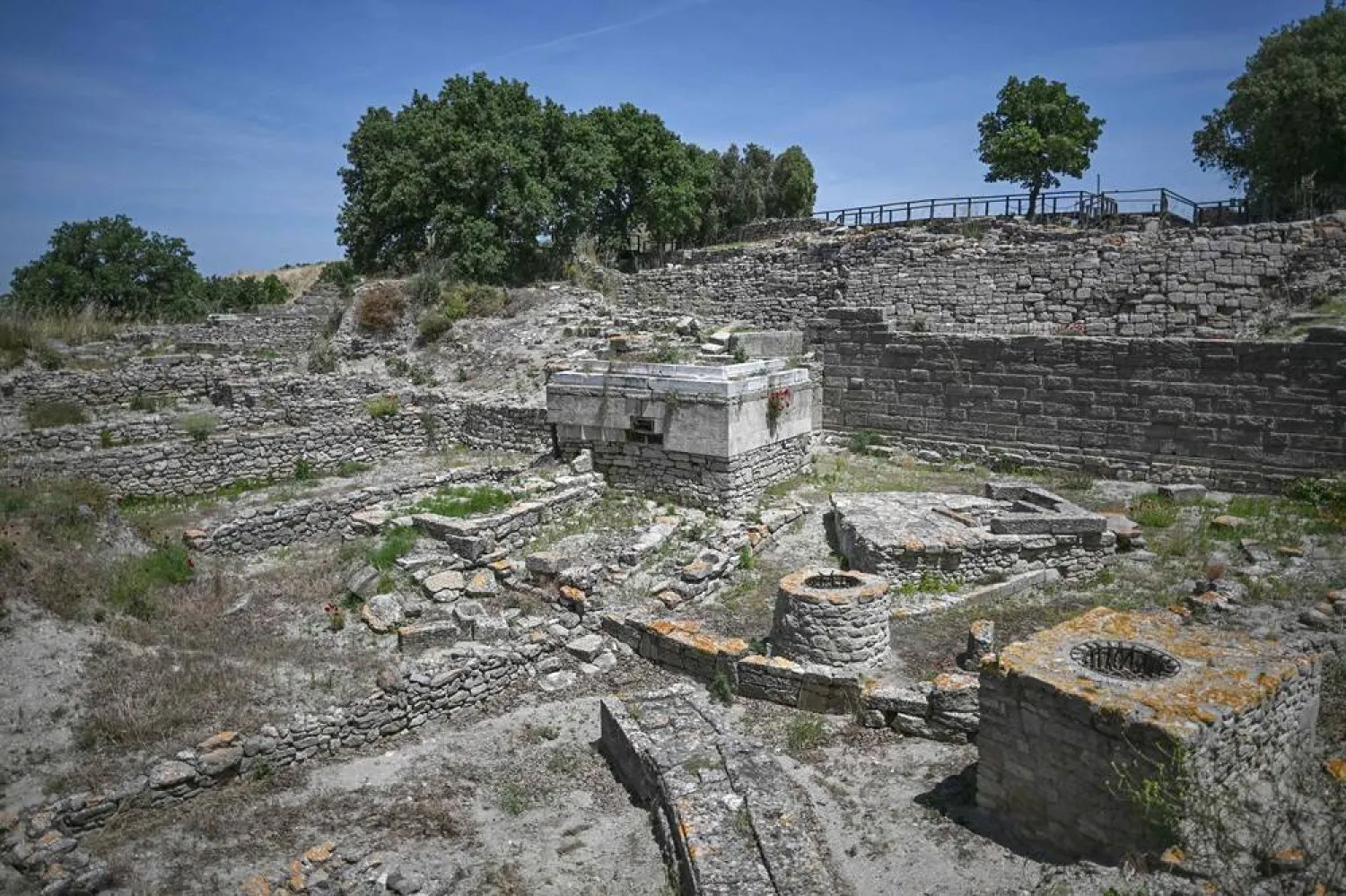
This photograph shows a general view of the ruins of the ancient city of Troy in Canakkale on June 2, 2026. (AFP)
TT

Between Homer and Hollywood: Troy a Source of Turkish Pride

This photograph shows a general view of the ruins of the ancient city of Troy in Canakkale on June 2, 2026. (AFP)

A gift from the film set of "Troy", a giant Trojan Horse replica looms over the port of Canakkale on the Dardanelles Strait in western Türkiye.

First related by Homer, then retold for the silver screen in 2004, with Brad Pitt as Achilles, the legend of the ancient city travels to Rome's Colosseum this week, where a major new exhibition opens on Friday.

Keen to showcase the city's Anatolian roots, Türkiye has loaned out more than 220 artifacts that will be on show at the exhibition, "Troy and Rome", which runs until mid-October.

"When you read Homer, you don't get a very clear idea of the Trojans' identity. But at the time of the Trojan War, they were certainly among the Anatolian peoples," said Reyhan Korpe, deputy head of the Troy excavations and an ancient history expert at Canakkale University.

Located on Türkiye's Aegean coastline, the remains of Troy are a UNESCO-listed World Heritage site comprising 185 hectares (457 acres) of stones and crumbling ramparts dotted with poppies and scampering squirrels.

For 30 years, Korpe has walked every inch of this huge site, whose layers tell the story of nine different settlements, the remains of their ramparts intertwined and layered on top of one another.
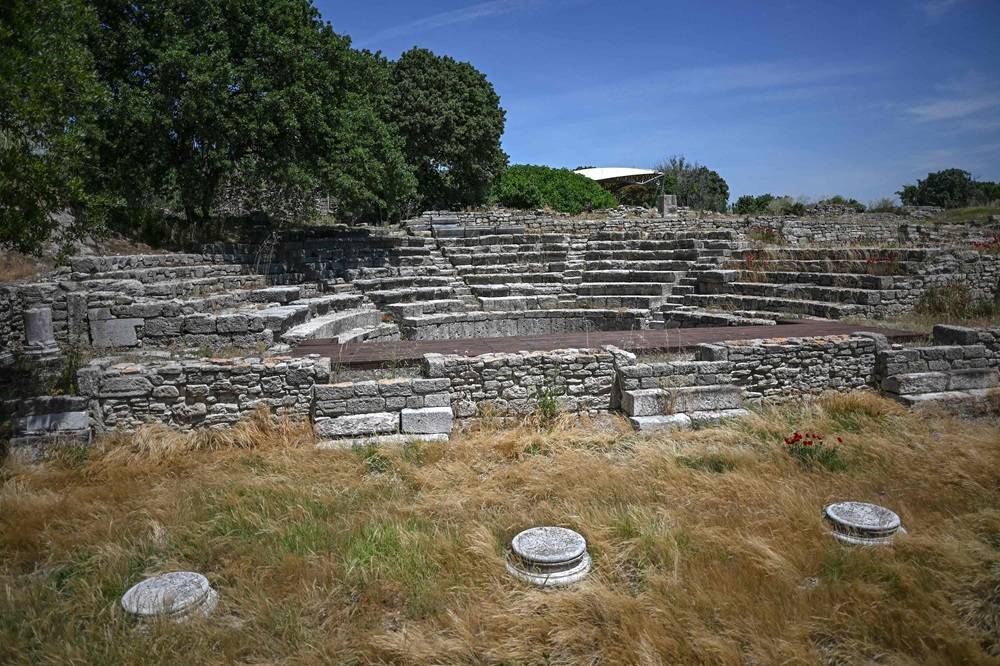
This photograph shows a view of the ancient theater in the ruins of the ancient city of Troy in Canakkale on June 2, 2026. (AFP)

- Western flank of the east -

"I spent a whole year just walking through the stones, maps in hand, trying to understand how they fit together," he told AFP.

His passion is evident for the site, which was founded in 3,000 BC and was constantly inhabited until being abandoned in the sixth century AD.

"It was the most western part of eastern civilization," which is what gave Troy its significance, Korpe said.

The Trojan War, which took place around 1,200 BC and lasted 10 years, until the siege and the city's defeat -- parts of which are recounted in the Iliad -- "was the first confrontation between the East and the West", he said of the Anatolian world and its Greek equivalent, referring to it as "the first world war".

It is an idea with strong resonance in these wooded hills, which several millennia later witnessed the World War I battles of 1915, when Allied troops suffered a bloody defeat trying to seize the Dardanelles from the Ottoman Empire.
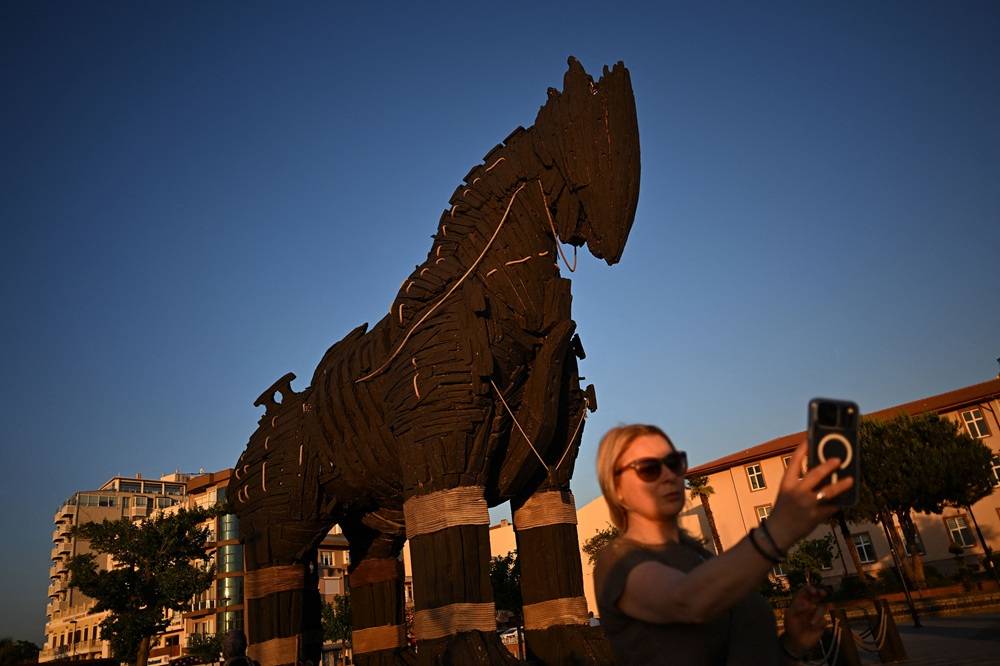
A tourist takes a selfie photograph in front of the Trojan Horse, which was donated to be displayed at Canakkale Square following the release of the movie “Troy” in Canakkale on June 1, 2026. (AFP)

- Luwian hieroglyphics -

Of the hundreds of artifacts Türkiye has loaned to the Rome exhibition, more than 100 come from the Troy museum, some of which will be on display for the first time.

One piece is a bronze seal marked with hieroglyphics that was discovered in 1995, which offers important clues about the city's Anatolian roots.

"It's the only trace of writing found at Troy that was written in an Anatolian language, which proves that the first language spoken there was that of the Luwian peoples," explained museum director Sinem Duzgoren.

The Luwians were an ancient people who lived in western and southern Anatolia during the Bronze and early Iron Ages, whose language played a major role in the Hittite empire.

- From Wilusa to Ilion -

Although Troy was not a Hittite city, it was part of the Hittite empire, which referred to it as Wilusa. That became Ilion for the Greeks -- or Ilios for Homer.

"These pieces may not be the most spectacular, but they are the most important from a historical point of view, because they bear witness to the history of Troy," Duzgoren told AFP.

Also sent to Rome are a large number of weapons for use in war -- stones for use in a sling, knives, spears and arrowheads.

"These weapons are mentioned in the Iliad and date from the same period that they were mentioned by Homer," she said.

But it is a reality that is a far cry from the epic, romanticized fighting that plays out in Wolfgang Petersen's "Troy" (2004).

Apart from bequeathing the 12-ton replica of the Trojan Horse looming over Canakkale's waterfront, the film did a lot to fuel renewed interest in Troy, Korpe said.

"Neither the producers nor the director came here, even though that was when we made some of the most significant discoveries," he said sadly.

"But the number of tourists did grow, even if they were just looking for traces of Brad Pitt among the ruins!"



Saudi Visual Arts Commission Signs MoU with Cité Internationale des Arts in Paris to Strengthen Collaboration in Visual Arts

Saudi Visual Arts Commission Signs MoU with Cité Internationale des Arts in Paris to Strengthen Collaboration in Visual Arts
TT

Saudi Visual Arts Commission Signs MoU with Cité Internationale des Arts in Paris to Strengthen Collaboration in Visual Arts

Saudi Visual Arts Commission Signs MoU with Cité Internationale des Arts in Paris to Strengthen Collaboration in Visual Arts

The Saudi Visual Arts Commission has signed a memorandum of understanding with Cité Internationale des arts in Paris to strengthen collaboration, exchange expertise in the visual arts, and explore areas of cooperation that support artists and practitioners and broaden their access to artistic, cultural, and professional exchange.

Areas of collaboration include developing visual arts-related initiatives and residency programs, exploring opportunities to involve local and international artists and talent in programs organized by both parties, and supporting Saudi artists and expanding their opportunities to connect with the global art scene, SPA reported.

The two parties will also collaborate on organizing joint initiatives and exhibitions, exchanging expertise and knowledge, and engaging experts and professionals in mentorship, professional guidance, and talent development initiatives.

The MoU forms part of the commission’s efforts to support the visual arts ecosystem in Saudi Arabia, strengthen international cultural exchange and collaboration, and expand opportunities for artists and cultural practitioners to engage and develop professionally, in line with the objectives of Saudi Vision 2030 to support the growth of the cultural sector, empower practitioners, and enhance the Kingdom’s cultural presence internationally.


Pompeii’s Grandest House Gets a $1.6 Million Restoration Funded by Private Sponsor

 In this undated handout photo provided on Tuesday, Oct. 20, 2026, by the Pompeii Archaeological Park, restorers work inside the House of Marcus Fabius Rufus in Pompeii, near Naples, Italy. (Silvia Vacca/ Pompeii Archaeological Park via AP)
In this undated handout photo provided on Tuesday, Oct. 20, 2026, by the Pompeii Archaeological Park, restorers work inside the House of Marcus Fabius Rufus in Pompeii, near Naples, Italy. (Silvia Vacca/ Pompeii Archaeological Park via AP)
TT

Pompeii’s Grandest House Gets a $1.6 Million Restoration Funded by Private Sponsor

 In this undated handout photo provided on Tuesday, Oct. 20, 2026, by the Pompeii Archaeological Park, restorers work inside the House of Marcus Fabius Rufus in Pompeii, near Naples, Italy. (Silvia Vacca/ Pompeii Archaeological Park via AP)
In this undated handout photo provided on Tuesday, Oct. 20, 2026, by the Pompeii Archaeological Park, restorers work inside the House of Marcus Fabius Rufus in Pompeii, near Naples, Italy. (Silvia Vacca/ Pompeii Archaeological Park via AP)

An ancient residence believed to be the grandest in the Pompeii archaeological site is being restored with the entire 1.4 million euros ($1.6 million) cost being covered by a private sponsor, officials announced Tuesday.

The house of Marcus Fabius Rufus, modeled after Rome’s imperial palaces and buried in the eruption of Mt. Vesuvio that destroyed the ancient city in 79 A.D., has been inaccessible to the public since 1980. Originally built on Pompeii’s city walls, it features four floors connected by a maze of corridors and staircases.

Part of it is expected to open to guided groups by Christmas, officials for the Archeological Park of Pompeii said.

The renovation is being paid for by a German entrepreneur, Frank Hoefer, who contacted the archaeological park after reading superintendent Gabriel Zuchtriegel’s 2023 book: “Pompeii: The Enchanted City.”

“Restoring the spectacular residence of Marcus Fabius Rufus ... is a project I find exciting,” Hoefer said in a release. “I also have the impression that Pompeii is very open to innovative approaches to preservation and public access.”

Zuchtriegel said the goal is to expand such sponsorships.

“This does not mean that from tomorrow on if we had 50 such sponsors we would be able to abolish the entrance ticket, putting it at just a symbolic one-euro price, but it is a perspective towards which we have to work to develop the site,” Zuchtriegel said in a video statement.

Structural work was carried out on the house from 2021-2023, and current renovations are focused on the frescoes, including the famous Venus of Pompeii located in a chapel within the residence. The owner was believed to be a magistrate or a freedman of the imperial household.

Zuchtriegel said work was also being done to make the complex more accessible, and digital technology was being developed to help people grasp the “incredible labyrinth” that makes up the house.

“At times, you feel like you are in a 19th-century palace in Naples, yet this is a Roman house from 2,000 years ago,” Zuchtriegel said.


Saudi Arabia Named Guest of Honor at Algiers International Book Fair 2026

Saudi Arabia Named Guest of Honor at Algiers International Book Fair 2026
TT

Saudi Arabia Named Guest of Honor at Algiers International Book Fair 2026

Saudi Arabia Named Guest of Honor at Algiers International Book Fair 2026

Saudi Arabia will be the guest of honor at the Algiers International Book Fair 2026, taking place from October 28 to November 7 at the Palais des Expositions in Pins Maritimes. The Kingdom's participation aims to strengthen cultural exchange with Algeria.

Saudi Arabia's selection as guest of honor reflects the strong fraternal relations between the two countries and the rapid development of the Kingdom's cultural sector, supported by the Saudi leadership. These efforts have helped strengthen the global presence of Saudi culture and raise awareness of the Kingdom's cultural heritage.

The Literature, Publishing and Translation Commission will lead the Kingdom's participation in the fair, organizing a cultural program featuring seminars, panel discussions, and poetry evenings. The events will bring together a distinguished group of intellectuals, writers, and specialists. The program will also highlight Saudi Arabia's literary scene and the creative momentum across various cultural fields.

The Saudi pavilion will feature sections dedicated to handicrafts, traditional Saudi attire, and musical instruments, alongside an exhibition of manuscripts and archaeological replicas.

It will host performances of Saudi performing arts that reflect the depth of the Kingdom's cultural heritage, as well as screenings of Saudi films.

Several government entities, authorities, and cultural organizations will participate, presenting a comprehensive picture of cultural activity across various sectors in Saudi Arabia.

The pavilion is expected to offer an integrated cultural experience that reflects the richness and diversity of Saudi identity. It will showcase cultural achievements made under Saudi Vision 2030, which seeks to establish culture as a component of quality of life and a means of fostering cultural exchange among peoples.