

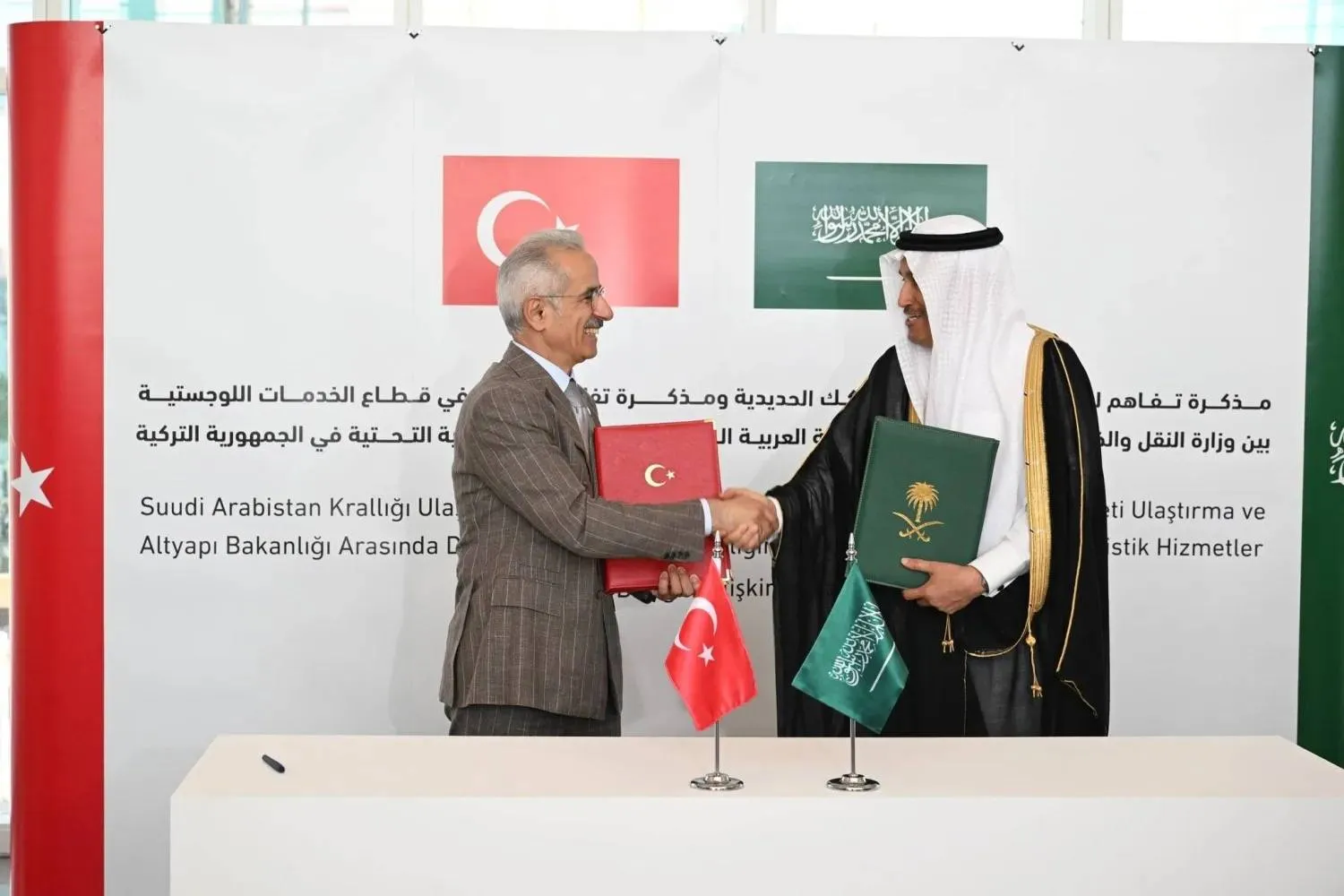

Saudi Arabia, Türkiye Sign MoUs on Railway and Logistics Cooperation, Connecting Gulf with Europe

Al-Jasser and Uraloglu shake hands after signing the MoUs. (X)
TT

Saudi Arabia, Türkiye Sign MoUs on Railway and Logistics Cooperation, Connecting Gulf with Europe

Al-Jasser and Uraloglu shake hands after signing the MoUs. (X)

Saudi Arabia and Türkiye have taken a major step toward forming a new regional logistics corridor that could reshape trade flows between the Gulf and Europe.

Saudi Transport and Logistics Services Minister Saleh bin Nasser Al-Jasser and Turkish Transport and Infrastructure Minister Abdulkadir Uraloglu signed two major memorandums of understanding on railway and logistics cooperation.

The agreements, along with other deals, point to a potential shift in international trade routes through a seamless land corridor linking the Gulf directly to Europe.

Uraloglu said in an official post on X that the memorandums, marked the start of a new phase of cooperation. He said they would strengthen the exchange of expertise and technical cooperation across areas ranging from logistics centers to modern applications.

He said both countries wanted to build railway cooperation on stronger, more sustainable foundations, particularly in technology, infrastructure, training, and human resources development.

He hoped the steps would deepen regional connectivity and support trade and development.

Al-Jasser had earlier said joint studies on a regional rail link between Saudi Arabia and Türkiye through Jordan and Syria were expected to be completed before the end of this year.

The project builds on existing infrastructure. Saudi Arabia’s national railway network already extends to the Jordanian border via the Al-Haditha crossing.

Route map

The latest push builds on routes that began to emerge after a previous agreement between the transport ministries of Türkiye, Syria, and Jordan. That agreement set a four- to five-year technical roadmap to rehabilitate damaged infrastructure.

The route would begin from Turkish networks connected to southern Europe, cross Syria for 350 km through routes in Aleppo and Damascus, reach Amman and the port of Aqaba, and then connect to Saudi Arabia’s network, which extends toward the rest of the Gulf and Oman on the Indian Ocean.

The plans are moving on two tracks.

The first is the quick activation of rail crossings between Ankara and Damascus to boost trade. The second is a long-term strategic link using fast freight trains to move containers directly from Gulf ports to the heart of Europe.

The route could cut commercial shipping time from 15 days to six days and lower costs by 20% to 30%. It would also provide supply chains with a secure land corridor that bypasses tense waterways, including the Strait of Hormuz and the Bab el-Mandab.

Damascus and Ankara

The wider strategy is moving in parallel with intensified activity along the Ankara Damascus line, aimed at securing the project’s northern corridors and preparing its infrastructure and banking systems before the launch of the continental link train.

Alongside the broader rail project, economic ties between Ankara and Damascus have entered a new phase.

Turkish Trade Minister Omer Bolat told the Anadolu City Economies Summit in the Turkish border city of Gaziantep that preparations had been completed to open the Islahiye railway crossing with Syria and that Türkiye was preparing to open the Nusaybin crossing.

He said work had also begun to study legislation that would allow Turkish banks and business institutions to open branches in Syrian cities.

Bolat outlined a plan to raise trade from $3 billion now to $5 billion in the near term and $10 billion by 2030.

Ankara’s top priority remained preserving the unity of the Syrian state and its national sovereignty, he stressed, adding that Türkiye had provided all possible diplomatic and economic support for stability in its neighbor.

Syrian Economy and Industry Minister Mohammad Nedal Alchaar presented the economic vision of what he called the “new Syria,” sending a direct message to Turkish investors and businesspeople.

He said they must target “long-term strategic partnerships aimed at building, not profit alone.”

Alchaar said Syria “today has a huge industrial opportunity that does not exist in many countries of the world, as an emerging country full of expertise and young talent.”

He said many Turkish companies had already begun operating on the ground, especially in Aleppo province, a historic industrial hub, while others were working to complete their licenses.

Alchaar said stronger economic growth in Damascus, as Ankara’s natural partner, would directly boost growth in both countries.

In the diplomatic framework shaping the emerging partnership, Turkish Ambassador to Damascus Nuh Yilmaz said the new phase rested entirely on a “win-win” principle.

He said lasting political stability in Syria would only come through renewed prosperity and economic recovery.

Yilmaz described Türkiye as “the main and safe gateway for Syrian products to global markets and Europe.” In return, he said, Syria is “the strategic and vital logistics corridor for Türkiye toward Middle Eastern markets and the depth of the Gulf.”



FII Institute Names Princess Maha bint Mishari Al Saud as CEO

Princess Maha bint Mishari bin Abdulaziz Al Saud (Asharq Al-Awsat file photo)
TT

FII Institute Names Princess Maha bint Mishari Al Saud as CEO

Princess Maha bint Mishari bin Abdulaziz Al Saud (Asharq Al-Awsat file photo)

The FII institute, run by a global nonprofit foundation of ⁠Saudi sovereign wealth ⁠fund PIF, has named ⁠Princess Maha bint Mishari bin Abdulaziz Al Saud as its CEO, according to ⁠the ⁠institute's website.

“With more than 25 years of leadership experience spanning healthcare, academia, strategic partnerships, and international engagement, Dr. Al Saud has built a distinguished career centered on creating impact through collaboration and institution-building. She has worked across the public, private, and nonprofit sectors to advance initiatives that strengthen organizations, expand opportunity, and improve lives,” the website said.

Before joining FII Institute, she served as Vice President of External Relations and Advancement at Alfaisal University.

She has helped expand strategic partnerships, deepen international engagement, and elevate the university’s global standing in education, research, and innovation.

“A recognized advocate for leadership, healthcare transformation, education, and human development, Dr. Al Saud has represented Saudi Arabia at major international forums, including the G20, and the fourth Eurasian Women’s Forum,” FII Institute said.

“Dr. Al Saud holds an MBBS degree and is certified by the American Board of Internal Medicine, having completed her residency training at George Washington University. Her executive credentials include the Senior Executive Leadership Program at Harvard Business School, IMD Business School and she holds the prestigious, peer-reviewed distinction of Master of the American College of Physicians (MACP),” it added.


Egypt Clears Arrears to Oil and Gas Companies

People walk past a shop selling football jerseys in Khan el-Khalily Bazar in Cairo on June 9, 2026. (AFP)
TT

Egypt Clears Arrears to Oil and Gas Companies

People walk past a shop selling football jerseys in Khan el-Khalily Bazar in Cairo on June 9, 2026. (AFP)

Egypt's Minister of Petroleum Karim Badawi said on Wednesday that the full settlement of arrears owed to oil and gas partners marked a turning point for the sector.

Badawi ‌said payment ‌of the arrears, "restores ‌investor confidence ⁠and paves the ⁠way for increased upstream activity and accelerated project development".

Egypt had accumulated about $6.1 billion in arrears to foreign oil companies by June ⁠30, 2024 due to ‌a ‌prolonged foreign currency shortage that delayed payments ‌and weighed on investment and ‌gas output. The shortage has since eased, though some companies have said that arrears kept ‌accumulating.

The minister said clearing the debt removed ⁠a ⁠key obstacle to new investment inflows and would support increased exploration, drilling and field development activity, including projects in the Mediterranean where development typically requires significant capital spending and years of work before production begins.


Saudi Economy Demonstrates Competitive Strength, Expands 3% in First Quarter

A view of the Saudi capital, Riyadh. (SPA)
TT

Saudi Economy Demonstrates Competitive Strength, Expands 3% in First Quarter

A view of the Saudi capital, Riyadh. (SPA)

Saudi Arabia’s economy has once again demonstrated the strength of its fundamentals and its ability to withstand regional shocks, posting real GDP growth of 3 percent year-on-year in the first quarter of 2026, despite escalating tensions across the Middle East that have disrupted supply chains and global trade flows.

The final official figures surpassed the earlier flash estimate of 2.8 percent. The upward revision reflected higher estimates from the General Authority for Statistics (GASTAT), which raised growth projections for both oil and non-oil activities to 2.9 percent. The Kingdom had recorded growth of 5.2 percent in the fourth quarter of 2025.

Saudi Arabia’s performance amid logistical challenges, including shipping disruptions through the Strait of Hormuz, recently received backing from an International Monetary Fund mission.

Following consultations in Riyadh, IMF experts said the Kingdom had successfully mitigated the effects of regional conflict and eased logistical bottlenecks through resilient infrastructure, the rapid deployment of the East-West pipeline and Red Sea ports, and strong financial buffers provided by the Public Investment Fund and a stable banking sector.

The IMF nevertheless revised its 2026 growth forecast for Saudi Arabia to 2 percent from a previous estimate of 3.1 percent, citing regional instability.

Broad-based expansion

According to GASTAT, first-quarter growth was driven by gains across all major sectors of the economy. Oil and non-oil activities each expanded 2.9 percent year-on-year, while government activities rose 1.5 percent.

On a seasonally adjusted basis, real GDP declined 1.2 percent from the fourth quarter of 2025, reflecting a 6.8 percent contraction in oil activities. Government and non-oil sectors, however, continued to post quarterly growth of 1.4 percent and 0.3 percent, respectively.

Financial services, insurance and business services recorded the strongest performance among detailed sectors, growing 5.4 percent year-on-year and 1.1 percent quarter-on-quarter.

Manufacturing activities, excluding oil refining, expanded 4 percent annually. Crude oil and natural gas activities grew 3.6 percent from a year earlier, despite a 7 percent quarterly decline linked to shipping disruptions.

Consumption and investment remain strong

Government final consumption expenditure rose 11.3 percent year-on-year and 8.5 percent quarter-on-quarter, while private consumption increased 5.3 percent annually.

Gross fixed capital formation climbed 3.9 percent year-on-year and 7.5 percent quarter-on-quarter, underscoring continued investment momentum. Exports increased 1.4 percent from a year earlier, while imports fell 5.5 percent.

Non-oil activities remained the primary driver of economic growth, contributing 1.7 percentage points to overall GDP expansion. Oil activities added 0.8 percentage points, while government activities and net taxes contributed 0.3 and 0.2 percentage points, respectively.

The IMF also praised the Saudi Central Bank (SAMA) for maintaining a countercyclical capital buffer of 100 basis points, noting that the Saudi riyal’s peg to the US dollar continues to bolster monetary-policy credibility and financial stability.

On structural reforms, the fund welcomed the recalibration of the Public Investment Fund’s 2026-2030 strategy, aimed at allocating capital more selectively and encouraging greater private sector participation.

It said continued progress toward the objectives of Vision 2030, including deeper capital markets, stronger alignment between education and labor market needs, and broader adoption of artificial intelligence and logistics technologies, remains essential to achieving sustainable economic diversification and safeguarding prosperity for future generations.