

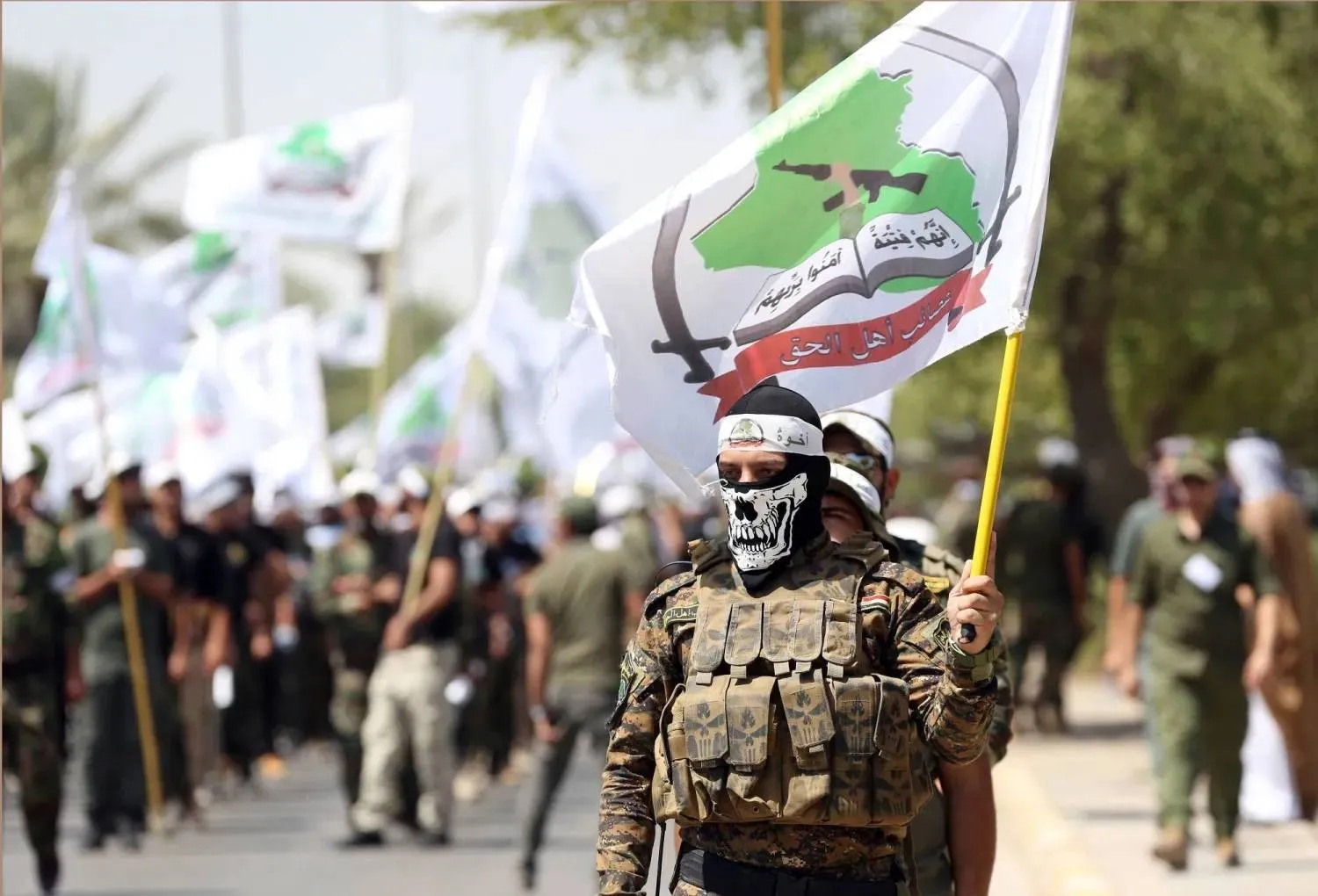

War Fears Cloud Iraq’s Drive to Bring Arms Under State Control

Members of Asaib Ahl al-Haq take part in a Quds Day march in Baghdad on July 1, 2016. (AP)
TT

War Fears Cloud Iraq’s Drive to Bring Arms Under State Control

Members of Asaib Ahl al-Haq take part in a Quds Day march in Baghdad on July 1, 2016. (AP)

The issue of weapons outside state control has returned to the center of Iraq’s political and security scene after Akram al-Kaabi, secretary-general of Harakat Hezbollah al-Nujaba, rejected any understandings with what he called “international forces backing Israel” and reaffirmed his movement’s commitment to “force and weapons.”

His comments came as the Iraqi government presses on with efforts to confine arms to the state, despite complex political and military challenges.

Kaabi’s remarks were made in a statement issued on Tuesday after recent regional developments and the military escalation between Iran and Israel.

He praised Iran’s missile strike against Israel earlier this week, calling it “discipline for the Zionist entity,” and commended Yemen’s Houthis for also firing at Israel, saying they delivered “a surprise slap to the enemy.”

Nujaba is an Iran-aligned Iraqi armed faction and one of the main pillars of an alliance of factions calling itself the Islamic Resistance in Iraq, which became directly involved in regional escalation after Hamas’ Oct. 7, 2023, attack on Israel.

Iraqi sources had said the government contacted leaders of armed factions to prevent them from joining the latest escalation, drawing on support from several factions for its plan to confine weapons to the state.

Kaabi said his movement was warning “anyone who imagines that Iraq can reach understandings with the supporters of” Israel and the United States.

“The logic of force and weapons” was the only option in dealing with them and that the movement “will never deviate from it,” he vowed.

The remarks come as debate grows in Iraq over the future of armed factions and whether all armed formations can be brought under state authority, now one of the most main issues tackled by Prime Minister Ali al-Zaidi's government.

The government has repeatedly said it is committed to the rule of law and to confining weapons to official institutions.

Influential cleric Moqtada al-Sadr announced on May 27 the integration of his military wing, Saraya al-Salam, into the state and called on the Popular Mobilization Forces factions to hand over their weapons. Asaib Ahl al-Haq and Kataib al-Imam Ali later also announced their separation from the PMF.

Split over mechanism

Figures close to armed factions rejected proposals to hand over weapons, saying they were driven by external pressure.

Abdul al-Rahman al-Jazairi, a leader in the PMF, said in remarks carried by local media that “the decision to confine weapons is not an individual decision,” calling for legislative authority to have a say over the “fateful” matter.

The remarks reflect the split over how to handle the armed factions file, which has grown more complicated after years in which armed groups expanded their influence, built military arsenals and secured independent funding sources.

Shakhawan Abdullah, head of the Kurdistan Democratic Party bloc, cited further obstacles to any disarmament plan, saying some weapons held by factions are not directly under their control.

He said one problem was that some factions “may decide to hand over their weapons, but the weapons originally belong to a regional state that considers them its property.” He added that those states may refuse to surrender such weapons, including drones.

Abdullah said some groups could transfer weapons to other formations rather than hand them over to the state. He said about 30% of armed groups fall under the PMF, while the rest are outside its framework.

Observers say the weapons file is not only a security issue. It also intersects with the economic and political interests of armed factions that have built networks of influence and their own financial institutions in recent years, making disarmament more complicated than legislation or government decisions.

Analysts say weapons for many factions are not only a military tool, but also a guarantee of political influence and a source of economic protection. That makes any response to calls for surrendering them limited unless they are paired with broader political and security arrangements.



Erdogan: Israel's Attacks on Syria, Lebanon Threaten Türkiye Too

FILED - 30 October 2025, Türkiye, Ankara: FILE PHOTO - Recep Tayyip Erdogan, President of Türkiye, speaks at the presidential palace. Photo: Michael Kappeler/dpa
TT

Erdogan: Israel's Attacks on Syria, Lebanon Threaten Türkiye Too

FILED - 30 October 2025, Türkiye, Ankara: FILE PHOTO - Recep Tayyip Erdogan, President of Türkiye, speaks at the presidential palace. Photo: Michael Kappeler/dpa

Turkish President Recep Tayyip Erdogan said on Wednesday that Israel's attacks on Syria and Lebanon had reached a point where they also threaten Türkiye, adding Israel's "aggression" ⁠posed a threat ⁠to the whole world and must be stopped.

Speaking to lawmakers in parliament, ⁠Erdogan also said there were initiatives, led by Israel, to destabilize the Mediterranean region and warned that "nobody should chase adventures" or join Israel's "boat of mischief.”

Ankara's response ⁠to ⁠moves violating the rights of Turks and Turkish Cypriots would be met with a clear and strong response, he warned.


Russia Says it is Discussing 'Reformatting' of Military Facilities in Syria

People rest outside the Kremlin on a warm summer day in downtown Moscow, Russia, 05 June 2026. EPA/MAXIM SHIPENKOV
TT

Russia Says it is Discussing 'Reformatting' of Military Facilities in Syria

People rest outside the Kremlin on a warm summer day in downtown Moscow, Russia, 05 June 2026. EPA/MAXIM SHIPENKOV

Russia's foreign ministry said on Wednesday that cooperation with Syria was developing very actively and that Moscow was discussing with Damascus a "possible reformatting" of its military facilities in Syria.

The December 2024 ousting of Syrian president Bashar al-Assad, a close Russian ally, raised questions about the future of Russia's Hmeimim airbase in Latakia and its naval facility at Tartous. But Moscow has since built relations with Ahmed al-Sharaa, who is now Syria's president.

"Russian-Syrian ⁠cooperation is developing ⁠very actively," Foreign Ministry spokeswoman Maria Zakharova said when asked about reported plans for the creation of a logistics hub in Tartous to distribute goods imported from Russia across Syria.

"Within the framework of contacts with Syrian partners, the issue of ⁠Russia's military presence in Syria is also being discussed, including in the context of a possible reformatting of the functionality of Russian military facilities,” Reuters quoted her as saying.

The bases in Syria are an integral part of Russia's global military presence: The Tartous naval base is Russia's only Mediterranean repair and resupply hub, while Hmeimim is a major staging post for military and mercenary activity in Africa.

Russia intervened militarily in Syria in ⁠2015 ⁠to back Assad in a civil war. Reuters reported in 2024 that Russia was pulling back forces from front lines in northern Syria and from posts in mountains dominated by Assad's Alawite community, but was not leaving its Mediterranean bases in Hmeimim and Tartous.


Amnesty Accuses Israel of ‘Ethnic Cleansing’ of West Bank Bedouins

An aerial view shows the Bedouin hamlet of Khan al-Ahmar in the West Bank, Jan. 24, 2023. (AP)
TT

Amnesty Accuses Israel of ‘Ethnic Cleansing’ of West Bank Bedouins

An aerial view shows the Bedouin hamlet of Khan al-Ahmar in the West Bank, Jan. 24, 2023. (AP)

Amnesty International accused Israel on Wednesday of conducting an "ethnic cleansing" campaign against Bedouin and herding communities in the occupied West Bank, saying the measures were designed to accelerate the annexation of the Palestinian territory.

A new report by the rights group found that these rural Palestinian communities are bearing the brunt of Israeli settler violence and forced displacement.

"Israeli authorities are accelerating annexation through a state-driven campaign of ethnic cleansing targeting Palestinian Bedouin and herding communities" of the West Bank, said the report released on Wednesday.

Amnesty said its research showed that 27 Bedouin and herding communities comprising hundreds of Palestinians were forcibly displaced between 2023 and 2025 or were at risk of displacement in the West Bank's Area C, which encompasses 60 percent of the territory and is under Israeli control under the 1990s Oslo agreements.

In the report titled "Erasing anything Palestinian: Israel's ethnic cleansing of West Bank Bedouin and herding communities", Amnesty accused Prime Minister Benjamin Netanyahu's government, one of Israel's most right-wing to date, of catering to the settler movement's religious nationalist agenda.

"It has accelerated settlement expansion and land grabs, increased financial and logistical support to settlements, and it has armed settlers, thereby enabling a brutal state-sanctioned campaign of settler violence," the report said.

In an apparent effort to counter arguments by Israeli officials that settler violence is caused by bad actors in that community, Amnesty pointed to "explicit calls by Israeli officials for settlement expansion" and "measures aimed at minimizing Palestinian presence in Area C".

The "ethnic cleansing campaign is state-led, and state-sponsored, not driven by rogue settlers or so-called extremist ministers", the report concluded.

- 'Unlawful deportation' -

Far-right Finance Minister Bezalel Smotrich, who himself lives in a settlement, is a vocal proponent of West Bank's annexation and on Tuesday was banned from France for actively promoting it.

In May 2026, the UN rights office had also decried indications of "ethnic cleansing" in Gaza and the West Bank.

Amnesty pointed to Israel's legal responsibilities as an occupying power in the West Bank, and its violations of international humanitarian law.

"These violations include the war crime of unlawful deportation and transfer and the crime against humanity of deportation or forcible transfer of population," the report said.

Bedouin and herders' communities, often isolated and without security services, are particularly vulnerable to the threat of violence or displacement.

Since 2023, AFP reporters have witnessed the departure of several Bedouin communities of the West Bank under pressure from settler groups, including the community of Ras Ein al-Auja in early 2026.

"What is happening today is the complete collapse of the community as a result of the settlers' continuous and repeated attacks," Farhan Jahaleen, a Bedouin from the village, told AFP in January.

Since Netanyahu's government came to power in late 2022, it has greenlighted the creation of 102 settlements in the West Bank, according to settlement watchdog Peace Now.

Excluding east Jerusalem, more than 500,000 Israelis live in settlements in the West Bank, which Israel has occupied since 1967, among some three million Palestinians.

All Israeli settlements are considered illegal under international law.

Some settlers have engaged in arson, vandalism, theft of private property in Palestinian communities, as well as physical assaults and sometimes murder, according to rights groups.

The number of such incidents steadily increased after the start of the war in Gaza in 2023, reaching an average of six per day in the West Bank in 2026, according to the UN humanitarian agency OCHA.