


Report: Alleged Spy’s Escape in Lebanon Exposes Israel’s Shadow War on Hezbollah

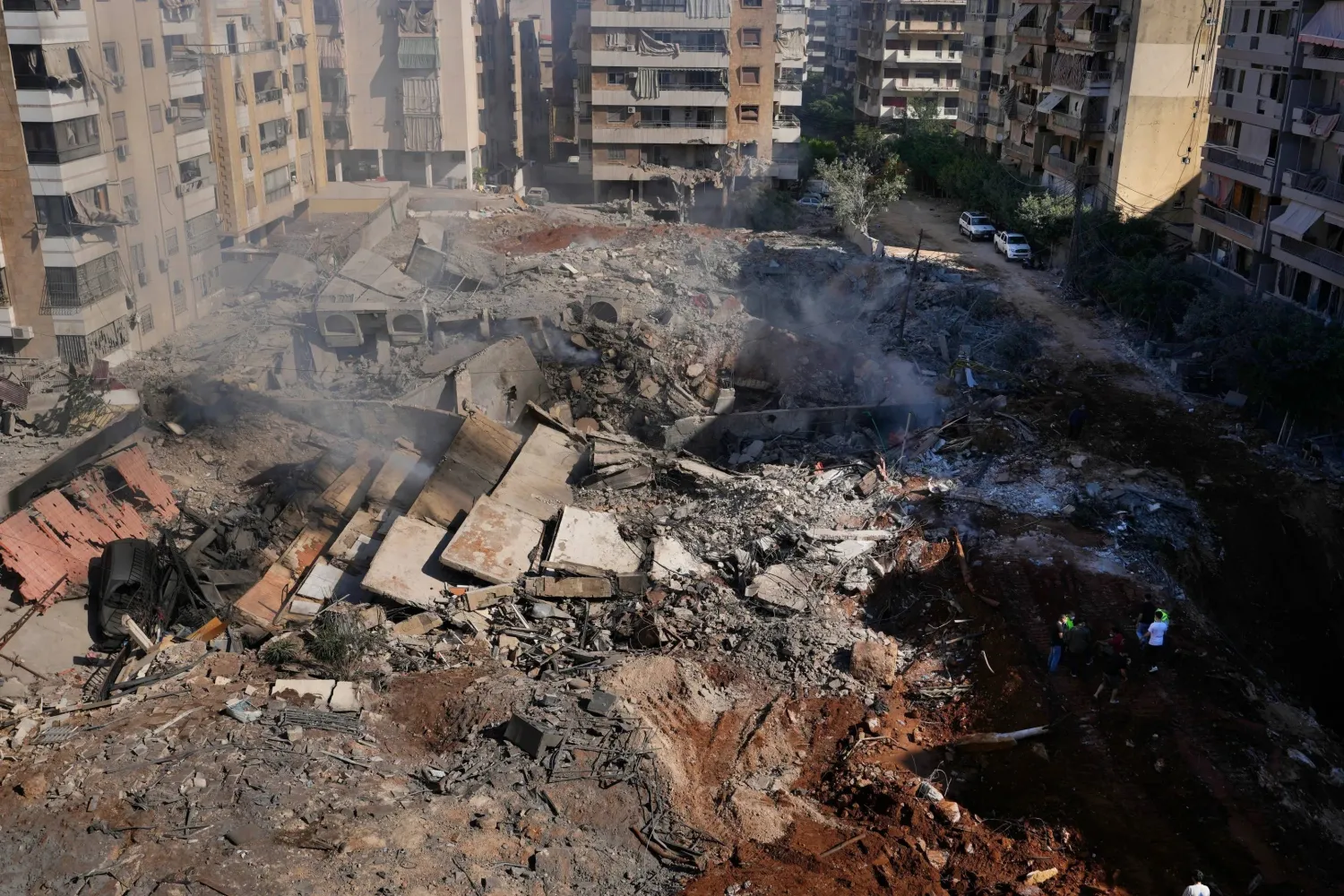
People gather at the site of the assassination of Hezbollah leader Hassan Nasrallah in Beirut’s Southern Suburbs, Sept. 29, 2024 (AP/File photo)
TT

Report: Alleged Spy’s Escape in Lebanon Exposes Israel’s Shadow War on Hezbollah

People gather at the site of the assassination of Hezbollah leader Hassan Nasrallah in Beirut’s Southern Suburbs, Sept. 29, 2024 (AP/File photo)

As Israeli warplanes pounded Beirut’s southern suburbs last March and residents fled in panic, one man found his opportunity.

Amid the chaos, he slipped out of his imprisonment in a Hezbollah cell and made his way to Baabda, the green, upscale diplomatic district overlooking the Lebanese capital, where he disappeared behind the gates of the Ukrainian Embassy.

His whereabouts remain unclear, according to The Associated Press, in a case that has become part of a broader intelligence battle as Hezbollah tries to identify alleged Israeli operatives they believe are linked to Israel.

The man identified by Lebanese officials as Khaled al-Aydi is said to be a Palestinian refugee from Syria who also holds Ukrainian citizenship.

He had been detained by Hezbollah in the Beirut suburbs and accused by Lebanese officials of being part of a thwarted Israeli intelligence plot to carry out bombings and assassinations.

Details of al-Aydi's escape and a Lebanese military court's case against him were provided by three judicial officials and two senior security officials in Lebanon who spoke on condition of anonymity because they were not authorized to comment publicly. A senior political official in Hezbollah also provided details.

Al-Aydi's disappearance could have political implications for the Lebanese government, which has largely remained silent about the case.

If evidence were to emerge that al-Aydi escaped Lebanon with help from the government, it could inflame tensions with Hezbollah's base. The government already faces scrutiny for directly negotiating with Israel, which has been engaged in fierce fighting with Hezbollah since the early days of the Iran war.

The Ukrainian Embassy asked Lebanese authorities in March to facilitate al-Aydi’s departure from the country after he escaped Hezbollah detention, according to a Lebanese official document obtained by The Associated Press. But Lebanon’s General Security agency refused, saying a judicial warrant for his arrest had been issued earlier, according to the document.

A Ukrainian official with knowledge of the case said al-Aydi is not in the Ukrainian Embassy or its compound in Lebanon. The official, who spoke on condition of anonymity because of the sensitivity of the situation, would not say where al-Aydi is — and out of concern for the security of the embassy and its personnel, would not say whether al-Aydi was ever in the embassy, or whether Ukraine helped him escape.

Using human and high-tech surveillance, Israel has cultivated far-reaching intelligence networks in Lebanon. That has helped it carry out dramatic operations against Hezbollah.

In the most elaborate example, Israel infiltrated Hezbollah’s supply chain and sent the party thousands of booby-trapped pagers and walkie-talkies. Israel remotely detonated the devices in September 2024, killing tens of people. Also, Israel's intelligence within Hezbollah allowed it to hit the group's senior leaders and field commanders “with relative ease,” analysts said.

In return, Hezbollah and Lebanese authorities have stepped up efforts against alleged spy networks.

Lebanese judicial officials said dozens of suspects have been convicted and are serving sentences, while others remain under investigation.

Cases filed in Lebanon’s military court describe operatives being paid to provide intelligence on Hezbollah weapons depots and political offices. Many of the alleged agents were recruited by Israeli handlers through social media, judicial officials said.

Other suspects are charged with providing the Mossad with maps and coordinates of key Hezbollah sites later struck in Israeli operations.

“It’s ironic that they (Hezbollah) were spending a lot of time accusing their opponents of being Israeli spies, and it turns out that the spies were actually from within the organization and its support base,” said Mohanad Hage Ali, a senior fellow at the Malcolm H. Kerr Carnegie Middle East Center in Beirut.

Al-Aydi’s Disappearance Complicates Situation

Conflicting reports emerged about the whereabouts of al-Aydi. Some security officials said the man is believed to have left Lebanon. It remains unclear whether he crossed into Syria or any other country.

The disappearance comes as relations between the Lebanese government and Hezbollah are at a low point.

The government was angered by Hezbollah’s unilateral decision to enter another war with Israel, while the party is furious the government has chosen to negotiate a ceasefire and potentially wider security and political agreement directly with Israel.

Al-Aydi’s escape could exacerbate tensions and put the Lebanese state in a difficult situation.
If Lebanese authorities refused to let al-Aydi leave the country, the US and Ukraine were “well-positioned to exert significant pressure” to secure his release, said Hage Ali.

On the other hand, if the state is seen to have let al-Aydi escape, it would inflame internal tensions, he said.



China, Jordan Call for Maintaining US-Iran Ceasefire

China's President Xi Jinping, right, and King Abdullah II of Jordan shake hands after a signing ceremony at the Great Hall of the People in Beijing, Monday, Aug. 24, 2026. (Andres Martinez Casares/Pool Photo via AP)
TT

China, Jordan Call for Maintaining US-Iran Ceasefire

China's President Xi Jinping, right, and King Abdullah II of Jordan shake hands after a signing ceremony at the Great Hall of the People in Beijing, Monday, Aug. 24, 2026. (Andres Martinez Casares/Pool Photo via AP)

China and Jordan on Monday said the ceasefire between the US and Iran should be maintained, and that the normal passage through the Strait of ⁠Hormuz should be restored, ⁠the two countries said in a jointed statement, according to China's Xinhua ⁠news agency.

Chinese President Xi Jinping met with Jordan's King Abdullah in Beijing on Monday.

China and Jordan said "a comprehensive solution capable of eliminating the root causes" of regional tensions should be reached through dialogue and negotiations.

The two ⁠also expressed "deep ⁠concern over Israel's dangerous escalatory actions in the West Bank and East Jerusalem."

China's President Xi Jinping, left, and King Abdullah II of Jordan review the honor guard during a welcoming ceremony at the Great Hall of the People in Beijing, Monday, Aug. 24, 2026. (Andres Martinez Casares/Pool Photo via AP)

Xi told King Abdullah that China values Jordan's "unique and important role in the region,” which was thrown into crisis after the United States and Israel launched strikes against Iran on February 28.

"China has always advocated for a comprehensive ceasefire (and) resolving disputes through political and diplomatic means," Xi said, according to a Chinese foreign ministry statement.

"(China) believes the sovereignty and security of regional countries including Jordan should be respected," Xi said.

The Chinese president also urged on Monday a "comprehensive, just and lasting solution to the Palestinian issue,” the foreign ministry statement said.

China supports "promoting the resumption of Israeli-Palestinian peace talks anchored on the correct direction of the 'two-state solution'," Xi said.

The two sides also signed several agreements on diplomacy, trade and supply chains, China's foreign ministry said.


Iraq Pushes Back Deadline for Factions to Disarm

This handout photograph taken and released by the Iraq's Prime Minister Media Office on August 19, 2026 shows Iran's Parliament Speaker Mohammad Bagher Ghalibaf (R) shaking hands with Iraq's Prime Minister Ali al-Zaidi before their meeting in Baghdad. (Iraq's Prime Minister Media Office / AFP)
TT

Iraq Pushes Back Deadline for Factions to Disarm

This handout photograph taken and released by the Iraq's Prime Minister Media Office on August 19, 2026 shows Iran's Parliament Speaker Mohammad Bagher Ghalibaf (R) shaking hands with Iraq's Prime Minister Ali al-Zaidi before their meeting in Baghdad. (Iraq's Prime Minister Media Office / AFP)

A senior Iraqi official pushed back a September 30 deadline for pro-Iran factions to hand over their weapons, without offering an explanation for the move or providing a new date.

Iraq has come under pressure from the United States to rein in armed factions, particularly those close to Iran.

The US and Iran have been at war since February 28, drawing in other countries in the region as well as non-state groups backed by the Islamic republic.

For several months, Iraq's government has stood by its deadline, but on Sunday, the security adviser to the prime minister, Qasim al-Araji, told state media the process would only begin at the end of next month.

"September 30 is the date for the international coalition to depart, not the deadline to hand over weapons," Araji told the Al Iraqiya broadcaster, referring to the coalition of US-led forces.

Government spokesman Haider al-Aboudi had made a similar announcement to local media on Friday, despite announcing in June that factions had until the end of September to disarm.

September 30, he said, was "the date for the international coalition to end its presence, not the deadline for armed factions... Perhaps people are confusing the two."

Since taking office in May, Prime Minister Ali al-Zaidi has pledged to ensure the armed factions that emerged in the years that followed the US-led invasion hand over their weapons to the state.

While some factions have in recent weeks said they would join state institutions, others, in particular those closer to Iran, are refusing.

"The situation is extremely complicated," a government official told AFP, requesting anonymity because he was not authorized to speak on the matter.

"The government is insisting on closing the weapons file; but faction leaders are determined to hold onto their weapons because they believe disarming would serve Israel and the United States."

The most powerful armed factions in Iraq include Kataib Hezbollah, a part of Iran's so-called "Axis of Resistance" against the US and Israel.

Another Iraqi source told AFP that Iran views its proxies in the region, "especially in Iraq, as a source of strength it refuses to give up".


Syria Sentences Assad-Era Top Muslim Cleric to Life Imprisonment

Ahmed Hassoun during proceedings before the Fourth Criminal Court in Damascus. (SANA file photo)
TT

Syria Sentences Assad-Era Top Muslim Cleric to Life Imprisonment

Ahmed Hassoun during proceedings before the Fourth Criminal Court in Damascus. (SANA file photo)

A Syrian court on Monday handed a life sentence to Ahmed Hassoun, the country's former grand mufti under ousted leader Bashar al-Assad, convicting him of crimes including inciting sectarian strife and exploiting his position. 

Hassoun, the 10th Assad-era figure to be sentenced under the new authorities, was Syria's top Muslim cleric for 16 years. 

He was known for his close ties to the former president and frequent appearances alongside him on religious occasions. 

Judge Fakhr al-Din al-Aryan said Hassoun, 77, was guilty of a raft of charges including "inciting civil war and sectarian strife", for which he was jailed for life. 

The cleric was also convicted of "incitement to intentional homicide", "principal complicity in intentional homicide", and "inciting sectarian and racial strife", for which he was handed additional terms ranging from three to 20 years. 

The court also decided to confiscate Hassoun's assets and hand them to the public treasury. 

His sentencing is the first against a religious figure since Syrian authorities began trying Assad-era officials in April. 

On August 11, Syria sentenced Bashar al-Assad, his brother Maher and five other security officials to death in absentia for atrocities committed during Syria's civil war, the first such ruling under the new authorities. 

The former president fled Syria as his government fell in December 2024 and is believed to be in Russia. 

Authorities have also handed death sentences to Atif Najib and Wassim al-Assad, cousins of the former ruler who were tried in person. 

Hassoun, a native of Aleppo whose late father was also an important religious figure, was arrested at Damascus airport in March last year as he tried to flee the country. 

Though he held the post of grand mufti for more than a decade, Hassoun lost the title in 2021 when Syria abolished the position. 

Syria began legal proceedings in April against Bashar al-Assad and other officials accused of atrocities during the civil war, which erupted in 2011 with brutal repression of pro-democracy protesters. 

More than half a million people were killed and millions displaced during the conflict, while tens of thousands disappeared.