


Saudi Decision to Resume Exports from Lebanon Widely Welcomed in Beirut

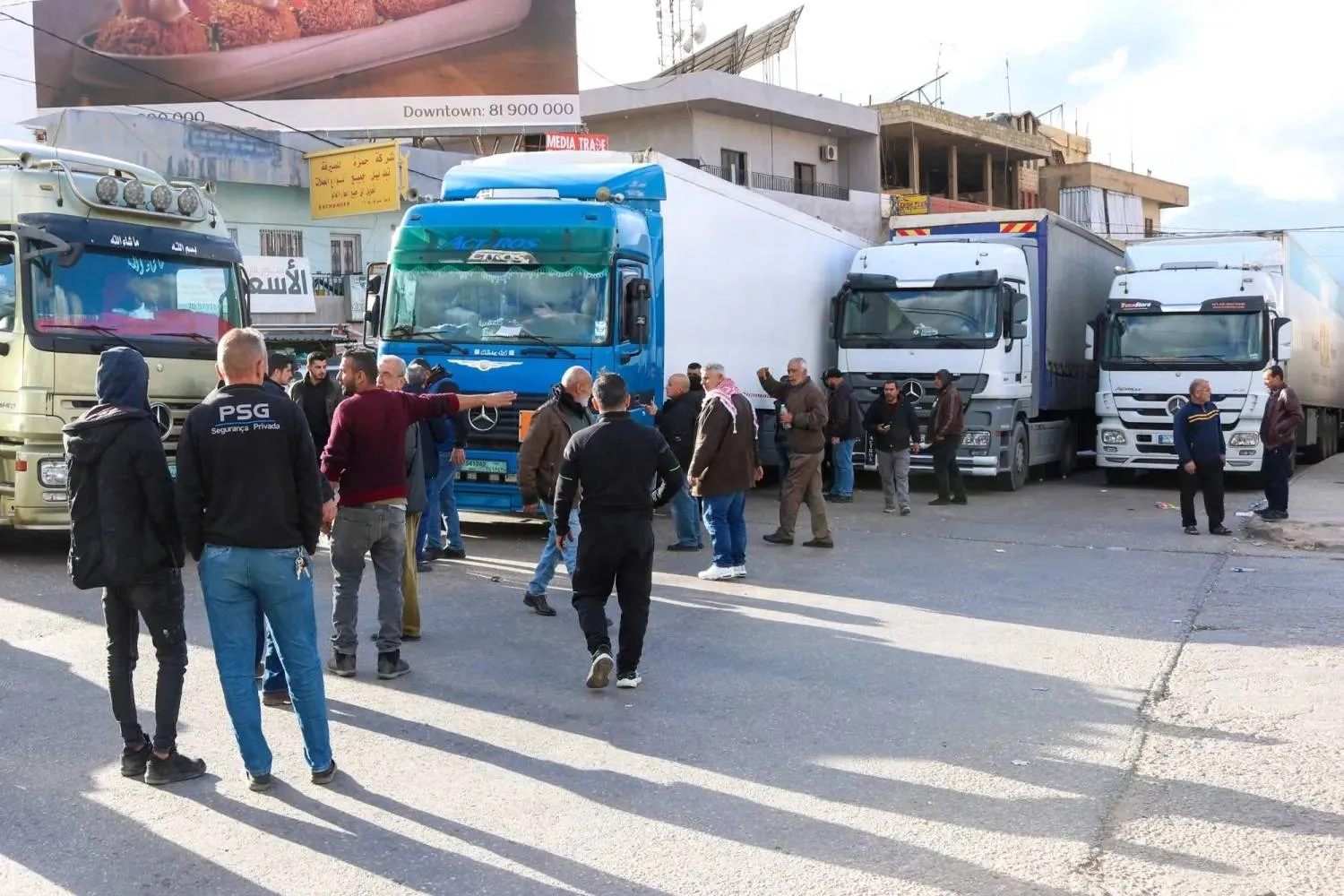
Lebanese trucks transporting goods wait at the Masnaa border crossing with Syria. AFP file photo
TT

Saudi Decision to Resume Exports from Lebanon Widely Welcomed in Beirut

Lebanese trucks transporting goods wait at the Masnaa border crossing with Syria. AFP file photo

Lebanon has welcomed Saudi Arabia's decision to lift the ban on imports in light of the “positive steps” taken by the Lebanese government to rebuild state institutions.

The Saudi Crown Prince’s decision was widely welcomed across Lebanon, nearly five years after Saudi Arabia halted all Lebanese imports, citing at the time “the importance of taking all necessary measures to protect the security of the Kingdom and its people.”

Saudi Foreign Minister Prince Faisal bin Farhan conveyed Crown Prince Mohammed bin Salman’s directive in a phone call with Prime Minister Nawaf Salam on Wednesday.

He affirmed Saudi Arabia’s support for Lebanon’s stability, sovereignty over all its territory and the well-being of its people, as well as Riyadh’s confidence that Lebanon would take all necessary measures to ensure it is not used as a platform to harm its brothers.

Lebanese President Joseph Aoun expressed deep gratitude to Prince Mohammed bin Salman, saying the decision was “a sincere expression of the depth of Arab brotherhood that binds the two brotherly countries, and an embodiment of the wise Saudi leadership’s keenness to support Lebanon and its people during the phase of recovery and revival it is undergoing.”

“This kind step will make a tangible contribution to reviving the national economy and supporting broad segments of Lebanese producers and exporters,” Aoun said.

He added that the entire Lebanese people appreciates the decision, and “views it as a gesture that strengthens the path of Lebanese-Saudi relations rooted in the bonds of history and shared destiny.”

Salam said the decision to lift the ban on Lebanese exports reflected the depth of the brotherly and historic ties between the two countries. He said it embodied Saudi confidence in Lebanon and a shared desire to strengthen economic and trade cooperation.

Salam said the move was an important step that would support Lebanon’s economy, open new opportunities for Lebanese producers and exporters, and help promote growth and stability.

He said Lebanon looked forward to continued work and coordination with Saudi Arabia to strengthen cooperation and partnership in various fields for the benefit and prosperity of both countries.

The Saudi ban began in 2021 on agricultural product imports, then extended to all goods, and was linked to the smuggling of the drug Captagon, after smugglers and criminal networks exploited Lebanon as a platform for drug smuggling into the Kingdom.

This increased pressure on the collapsing Lebanese economy, which was already suffering from a severe financial crisis in 2019, especially with agricultural exports moving away from traditional Arab Gulf markets.

Lebanese exports to Saudi Arabia reached approximately $240 million in 2020.

Minister of Interior and Municipalities Ahmed Al-Hajjar thanked “Saudi Arabia for the decision to resume Lebanese exports.”

In a television interview, Al-Hajjar considered that “this step is the beginning of trust in Lebanese state institutions,” confirming that “the necessary measures have been taken to control border crossings.”

“We are coordinating with Saudi Arabia to control drug smuggling operations,” Al-Hajjar said.

Likewise, Minister of Foreign Affairs and Emigrants Youssef Rajji stated that “the resumption of Lebanon's exports to Saudi Arabia is a bright page on the path to restoring confidence in the Lebanese state.”

For his part, Minister of Public Works and Transport Fayez Rassamni issued a statement thanking the Saudi leadership and affirming that the resumption of Lebanese exports to the Saudi market “has highly significant dimensions and constitutes direct support for the Lebanese economy.”

“It also consolidates Lebanon's position as a reliable trade partner in the region,” he said.

Minister of Industry Joe Issa El-Khoury said that with the return of Lebanese products to the Saudi market, “returns hope for a stronger Lebanese industry, more committed, and more present in its Arab environment.”



Cairo to Host Fourth Quadrilateral Meeting on Iran War

The foreign ministers of Saudi Arabia, Egypt, Türkiye and Pakistan during a meeting to discuss the progress of US-Iran negotiations (Egyptian Foreign Ministry handout). 
TT

Cairo to Host Fourth Quadrilateral Meeting on Iran War

The foreign ministers of Saudi Arabia, Egypt, Türkiye and Pakistan during a meeting to discuss the progress of US-Iran negotiations (Egyptian Foreign Ministry handout). 

Egypt is preparing to host the fourth meeting of the Quadrilateral Mechanism comprising Saudi Arabia, Egypt, Türkiye and Pakistan, as the four countries continue consultations aimed at easing tensions stemming from the conflict involving Iran.

Egyptian Foreign Minister Badr Abdelatty and Pakistan’s Deputy Prime Minister and Foreign Minister Mohammad Ishaq Dar discussed arrangements for the meeting during a phone call, according to a statement issued by Egypt’s Foreign Ministry on Thursday.

The ministers agreed on the importance of maintaining close coordination among the four countries amid what the statement described as dangerous developments in the region. They also discussed efforts to support the US-Iran negotiating track.

The first meeting of the mechanism was held in Riyadh on March 20, followed by a second meeting in Pakistan on March 29. The third meeting took place in the Turkish city of Antalya on April 17 on the sidelines of the Antalya Diplomacy Forum.

According to Egypt’s Foreign Ministry, participants at the latest meeting discussed ways to strengthen coordination in response to fast-moving regional developments, follow the course of US-Iran negotiations, and continue efforts to de-escalate tensions and contain the conflict.

They also discussed prospects for restoring regional security and stability and the future of the regional order after the current conflict.

The meeting brought together Abdelatty, Saudi Foreign Minister Prince Faisal bin Farhan Al Saud, Turkish Foreign Minister Hakan Fidan and Pakistan’s Ishaq Dar.

The ministers exchanged assessments of the conflict’s impact on the global economy and discussed ways to mitigate disruptions to international shipping, supply chains, food security, energy security, and oil prices.

Egyptian Foreign Ministry spokesman Tamim Khallaf said Abdelatty and Dar also exchanged views during their latest call on regional developments and stressed the importance of continued political and diplomatic efforts to contain the current escalation.

The two ministers also emphasized the importance of prioritizing diplomatic solutions to prevent the conflict from widening and to contain the current escalation, citing the serious security, economic and geopolitical consequences of the conflict for the region and the wider world, according to the ministry.


Egypt Holds Military Exercises with Türkiye, Oman

The joint Egyptian Turkish air exercise on Thursday (from the Egyptian Military Spokesperson’s Facebook page). 
TT

Egypt Holds Military Exercises with Türkiye, Oman

The joint Egyptian Turkish air exercise on Thursday (from the Egyptian Military Spokesperson’s Facebook page). 

Egypt has conducted military exercises with both Türkiye and the Sultanate of Oman aimed at “exchanging training expertise and unifying operational concepts.”

The Egyptian-Turkish air exercise saw the participation of a number of multirole fighter aircraft. The drills are being carried out over several days at multiple air bases across Egypt.

According to a statement issued Thursday by the country’s military spokesperson, the first phase of the exercise included a series of theoretical lectures designed to standardize combat concepts and facilitate the exchange of training experience among participating personnel. The phase also featured a number of operational training sorties intended to coordinate efforts and enhance the two sides’ ability to operate jointly.

The exercise aims to “refine the skills of the participating forces to achieve the highest levels of efficiency and readiness to carry out joint air missions effectively under various conditions,” the military spokesperson said.

In September 2025, Egypt and Türkiye resumed their joint military exercise Sea of Friendship in the eastern Mediterranean after a 13-year hiatus, as part of efforts to develop bilateral relations and strengthen interoperability.

Türkiye’s Ministry of National Defense also announced that Turkish and Egyptian special forces conducted joint training in Ankara between April 21-29, 2025.

In a statement posted at the time on X, the ministry said the drills included urban warfare training, sniper exercises, medical training, parachute operations, and helicopter-based exercises involving assault operations, fast-roping insertion, medical evacuation, special reconnaissance missions, and other designated tasks.

Meanwhile, the Egyptian-Omani exercise Mountain Fortress 2 (Qal’at al-Jabal 2) is being held with the participation of members from Egypt’s Saaqa (Thunderbolt) Forces and Oman’s special forces. The drills are taking place over several days at combat training ranges worked by Egypt’s Saaqa Forces Command.

According to the Egyptian military spokesman, the first phase of the exercise focused on unifying operational concepts and fostering integration and cohesion among participating personnel.

The exercise is also expected to include a range of practical activities and field events designed to meet planned training objectives, facilitate the exchange of tactical expertise, and maximize the benefit to participating forces, according to the spokesman.


Palestinian, Israeli Civil Society Meet in France to Urge Int'l Support for Two-State Solution

Israeli security forces stand guard along a road while behind smoke billows from an area reportedly set ablaze by Israeli settlers in the Palestinian village of Idna, west of Hebron in the occupied West Bank, on June 5, 2026. (AFP)
TT

Palestinian, Israeli Civil Society Meet in France to Urge Int'l Support for Two-State Solution

Israeli security forces stand guard along a road while behind smoke billows from an area reportedly set ablaze by Israeli settlers in the Palestinian village of Idna, west of Hebron in the occupied West Bank, on June 5, 2026. (AFP)

Palestinian and Israeli civil society groups will meet in France on Friday to urge the international community not to abandon a two-state solution, as Paris seeks to keep the issue alive amid the Middle East war.

The meeting, attended by foreign ministers and senior officials from dozens of countries, marks one year since the UN-backed New York Declaration, which set out a roadmap toward Palestinian statehood and prompted around a dozen countries, including France, Britain and ‌Canada, to recognize ‌a Palestinian state.

"Given the current situation in the region, marked ‌by seemingly ⁠endless conflicts, too ⁠many civilian casualties and a cycle of violence, and in light of the stalled implementation of the Gaza ceasefire ... we believe this conference is now more essential and urgent than ever,” France's Foreign Ministry spokesperson told reporters on Thursday.

The gathering will end with an eight-point “Call for Action” urging a permanent ceasefire, a halt to settlements, Gaza reconstruction, governance reforms and stronger international backing for civil society.

It will be delivered to the G7 leaders who ⁠meet in the French Alps from Monday.

"The region continues to ‌fracture. Gaza is devastated, Israel remains under threat. ‌Settler terrorism, settlement expansion, and de facto annexation and threats to the Palestinian Authority continue to undermine ‌the viability of a future Palestinian state," according to the action plan seen ‌by Reuters.

"Israelis and Palestinians alike remain trapped in fear, insecurity, and trauma. We return because, as the G7 convenes in Évian, this conflict risks once again being set aside. The window for a solution remains open; but it is narrowing."

ANGER IN WEST OVER SETTLER VIOLENCE

The conference comes ‌amid escalating violence by Israeli settlers in the occupied West Bank and underscores anger in many Western countries toward Prime ⁠Minister Benjamin Netanyahu’s government, ⁠which has expanded settlements.

Diplomats say that expansion is aimed at undermining prospects for a Palestinian state.

A key concern is Israel’s plan to build a settlement east of Jerusalem, known as the E1 project, which would bisect the West Bank and cut it off from East Jerusalem, fragmenting territory Palestinians seek for an independent state.

Britain, Canada, France and Norway announced new coordinated sanctions on Tuesday against Israeli networks involved in financing, enabling and carrying out violence in the Israeli-occupied West Bank.

Israel and the United States declined to attend the meeting.

"The ambassador was invited but will not attend the conference, as it has nothing to do with promoting peace," the Israeli embassy said in a statement.

"France cannot act as a mediator between Israel and the Palestinians. Regarding the two-state solution, the ambassador recalls that the Palestinians have rejected proposals to establish a Palestinian state on five occasions," it alleged.