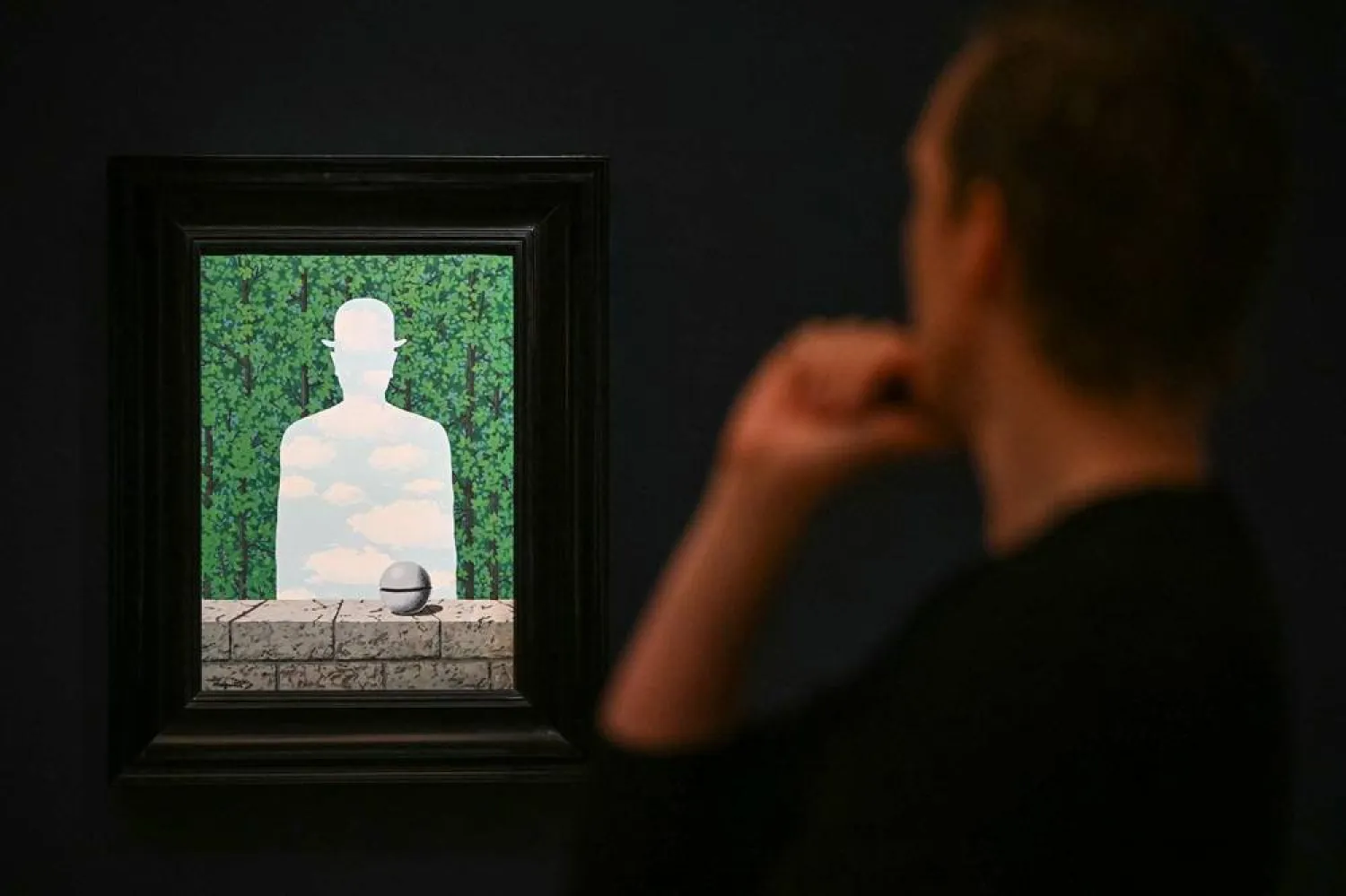
Ex-Tottenham Owner Sells Art Collection in Blockbuster Auction

A staff member poses next to René Magritte’s "La Belle promenade", during a media preview by Sotheby's in central London on June 11, 2026, to highlight masterpieces from the Lewis Collection, estimated to be worth some 200 million pounds (267 million USD). (Justin Tallis / AFP)
TT

Ex-Tottenham Owner Sells Art Collection in Blockbuster Auction

A staff member poses next to René Magritte’s "La Belle promenade", during a media preview by Sotheby's in central London on June 11, 2026, to highlight masterpieces from the Lewis Collection, estimated to be worth some 200 million pounds (267 million USD). (Justin Tallis / AFP)

Works by artists including Picasso, Magritte and Klimt, amassed by the ex-owner of Tottenham Hotspur Football Club, head to auction this month with a total sales estimate of £200 million ($267 million).

They were collected by Joe Lewis, an 89-year-old British billionaire, who transferred his majority stake in the London football club to a family trust in 2022 and is now worth £5.8 billion, according to The Sunday Times Rich List.

A total of 48 works from the Lewis Collection will go on sale, including a once-scandalous nude painting by Amedeo Modigliani with an estimate of over £45 million and a bronze sculpture of a dancer by Impressionist artist Edgar Degas with an estimate of £18-25 million.

Lewis also bought paintings by artists of the Vienna Secession movement such as Gustav Klimt and Egon Schiele, and modernist and surrealist works by Rene Magritte and Pablo Picasso.

The most recent works are paintings by British artists Lucian Freud and Francis Bacon.

"There's never ever been a collection of this magnitude that's ever been offered (for sale), actually, either in the UK or indeed in Europe," Oliver Barker, chairman of Sotheby's Europe, told AFP.

The estimate of over £200 million is "the most valuable pre-sale estimate that's ever been put on a private collection offered anywhere in Europe", said the auctioneer.

- Public display -

The most highly valued works include Klimt's "Portrait of Gertrud Loew" from 1902 -- expected to sell for £20-30 million.

Modigliani's "Nu assis au collier" (Seated nude wearing a necklace), which scandalized Paris when it was unveiled in 1917, is anticipated to sell for over £45 million.

Other highlights include Picasso's "Buste de femme" (Bust of a woman) from 1938, depicting French artist Dora Maar, valued at £12-18 million.

Meanwhile "Sleeping by the Lion Carpet", painted by Freud in 1995-96, a nude depiction of his model and muse Sue Tilley, has been priced at £25-35 million.

This is "arguably... the greatest Lucian Freud painting ever to make its way to market", said Barker.

The lots are on display at Sotheby's until June 23, with free public access.

The 25 most valuable works will go under the hammer late on June 24, the others the next day.

Auctioning the collection will mark a "new beginning" for Lewis -- recently pardoned by US President Donald Trump after he pleaded guilty to insider trading in 2024 -- and his family, according to Barker.

Lewis's daughter, Vivienne Lewis, is also a collector and is "very committed to the young and avant-garde contemporary artists", he added.

Regarding the Lewis Collection, Barker describes the figure of £200 million as "very moderately estimated", with hopes it could fetch more.

In March, four other paintings from the Lewis Collection by British artists from the School of London group, including Freud and Bacon, sold for £35.8 million in a packed Sotheby's saleroom.

In a return to blockbuster art sales, auctions in New York this spring set record prices for works by Jackson Pollock, Constantin Brancusi and Mark Rothko.

"You know there's been a great deal of wealth creation around the world at the moment and I think more of it has been driven to the art market," said Barker.

The upward trend follows a slump in sales, blamed by experts on economic uncertainty and a lack of high-value works on sale.

"The market has been so starved of true masterpieces, and so the opportunity to acquire works of this caliber truly is a great opportunity," Barker said.


Food Industry Pushes Back on WHO Guidance for Products with Added Color, Sweeteners

Around 11 million deaths a year are linked to unhealthy diets, according to the agency, based on data from a global study. (Getty Images)
TT

Food Industry Pushes Back on WHO Guidance for Products with Added Color, Sweeteners

Around 11 million deaths a year are linked to unhealthy diets, according to the agency, based on data from a global study. (Getty Images)

Governments should consider regulating foods that include added colors, flavors or sweeteners designed to make the product more appealing to consumers, according to new draft World Health Organization guidance that has sparked swift pushback from the food industry.

The WHO draft aims to help governments identify which foods should be consumed in moderation as part of a healthy diet – and which products could be subject to measures like warning labels or taxes, depending on national priorities.

The new draft food-profiling model, published last week, marks the first time the UN health agency has included this type of ‌ingredient in its guidance, ‌previously only focused on nutritional content, including fat and salt.

“This draft ‌goes ⁠beyond traditional nutrient ⁠profiling by recognizing that foods may need to be considered not only for their nutrient content, but also for other aspects of their formulation” in order to prevent diet-related disease, said Katrin Engelhardt, technical officer at the WHO's department of nutrition and food safety.

Around 11 million deaths a year are linked to unhealthy diets, according to the agency, based on data from a global study.

The proposed new model is also the WHO’s attempt to guide member states through an increasingly polarized debate ⁠about ultra-processed foods (UPFs), a class of food or drink made using processing ‌techniques, additives and industrial ingredients, which often contain little ‌whole food. Examples include carbonated soft drinks or instant noodles.

BEYOND NUTRIENTS ALONE

Many food scientists say UPFs pose ‌numerous health risks but others – and the food industry – say they are defined too widely, ‌which risks demonizing healthy products.

The International Food and Beverage Alliance, an organization representing major multinational food and beverage companies, said it was concerned the proposed approach shifts attention away from nutritional quality and could capture more products for potential regulation.

"Of particular concern is the potential to undermine established nutrition priorities and reformulation ‌efforts,” said IFBA Secretary General Rocco Renaldi.

Other concerns for the food industry are higher costs from reformulating products or stringent labelling requirements, as well ⁠as the risk ⁠of class-action lawsuits as seen in the United States, and higher taxes for processed food companies.

Broadly, the WHO said the model covers “industrially-produced foods to be consumed in moderation” and is a bridge between its healthy diet recommendations and government policy on individual food products.

Lindsey Smith Taillie, co-director of the Global Food Research Program at the University of Chapel Hill, North Carolina, said the point of the model was to target unhealthy foods, combining both nutrients and UPFs.

“These two frameworks have never been mutually exclusive and can and should be used by policymakers as the starting place,” she said, adding that healthiness is measured by multiple criteria.

Kraft Heinz CEO Steve Cahillane last week told Reuters that industry players should have a say.

"We're in the food business and we care about consumers deeply," Cahillane said. "And so we ought to have a seat at the table as these discussions evolve."

The WHO proposal is out for consultation until November 27.


Pakistan Farmers in Long Fight to Make German Firms Pay for Flood Damage

Dozens of Pakistani farmers are suing German firms RWE and Heidelberg Materials in a rare bid to make big polluters pay damages for climate impacts. Aamir QURESHI / AFP
TT

Pakistan Farmers in Long Fight to Make German Firms Pay for Flood Damage

Dozens of Pakistani farmers are suing German firms RWE and Heidelberg Materials in a rare bid to make big polluters pay damages for climate impacts. Aamir QURESHI / AFP

In a Pakistani village nestled in rice fields, Abdul Hafeez Khoso remembers the vast industrial zones he saw in Germany when he visited to file a pioneering climate legal case.

"They're spreading pollution: up in the sky there are no borders, it can affect anywhere," the 43-year-old said, describing areas far larger than his village of 800 people.

"This is a problem for the whole world -- that is why it should be resolved at the global level."

Khoso and 38 other farmers from Pakistan's southern Sindh province who were devastated by "apocalyptic" flooding in 2022 are suing German energy firm RWE and cement maker Heidelberg Materials in a rare bid to make big polluters pay damages for climate impacts.

The companies are being targeted not over specific operations in Pakistan, but because of their climate-warming emissions. They are headquartered in Germany, where a recent legal case opened the door to such suits.

The litigation argues that the companies' emissions contributed to climate change and turbo-charged rain that wiped out their crops, livestock and homes.

"The year 2022 was an apocalyptic scene -- not even our elders had ever witnessed such weather," Khoso, who lives in the district of Jacobabad with his wife and toddler, told AFP.

"We had nothing left."

Both firms, which the plaintiffs estimate contributed 0.68 percent and 0.12 percent to global industrial emissions respectively, deny wrongdoing.

Khoso's case is backed by Pakistani and European organizations hoping to win compensation and build on nascent but vigorous international efforts to extract climate damages from corporations.

"We always blame natural disasters, and sometimes we blame God, but science tells us that climate change is increasing the risks and intensity of extreme weather events," said Mir Keerio, a development expert at Pakistan's HANDS Welfare Foundation, which mobilized communities for the lawsuit.

"Those who have contributed significantly to this crisis must be held accountable... we realized we must take our fight for climate justice to the major polluters."

- Debt and damages -

Climate litigation is a growing field globally, but action has so far largely targeted governments, with only a handful of firms such as Shell and cement maker Holcim facing suits for climate disaster compensations.

Lawyers say a ruling requiring a company to pay out compensation proportionate to its greenhouse gas emissions would mark a major breakthrough.

Germany's judiciary moved towards that principle last year in a case brought by a Peruvian farmer, also against RWE.

His compensation claim was rejected, but the courts left the door open to holding emitters liable.

Roda Verheyen, a German lawyer involved in both cases, told AFP the Pakistani farmers' lawsuit builds on that ruling and further accuses companies of "wrongful behavior".

"Large companies knew about the general impacts of climate change since the 1960s," said Verheyen.

"They should have exercised due diligence and actually at least tried to reduce emissions, which they didn't do enough."

The lawsuit also draws on research documenting farmers' losses in the floods, which hit a third of the country, killed 1,700 and affected 30 million Pakistanis.

Munawar Khatoon, a rare female landowner in a conservative area, said the floods struck just before the wheat harvest, submerging seeds and wiping out her family's main source of income.

"We worry about how the next generation will manage to live if this continues," the 43-year-old told AFP in her village Usman Samtio.

"Now when the rainy season comes, we feel fear."

In nearby Dadu district, litigant Abdul Khalique Laghari said the floods affected the region for years.

"To this day, we are unable to repay our debt," said the 55-year-old, who estimates he lost $14,000 in assets including his house, 40 acres (16 hectares) of crops and livestock.

"When we wake in the morning, we start getting calls from the people we owe money to," he said, pointing to crumbling walls and the remnants of flood-damaged houses.

"This has caused us serious mental harm."

- 'For justice' -

RWE and Heidelberg Materials both call the claims in the suit "unfounded".

Heidelberg Materials told AFP its operations were compliant with German laws and that firms could not be expected to retroactively face different standards.

RWE referred AFP to a statement describing the lawsuit as "yet another attempt to shift climate policy demands to German courtrooms".

"It would be a contradiction in terms if the state allowed CO2 emissions, regulated them by law and even demanded them in some cases, but at the same time allowed retroactive civil liability for them," it said.

Even if the case succeeds, an uphill battle remains for millions across Pakistan, ranked among the countries most affected by climate change despite contributing less than one percent of global emissions.

The case will be considered in a civil process likely to take years. But for the litigants, the attempt is worth it.

"This case is for justice," said Khatoon. "We hold these companies responsible for our destruction."


This Year Set to Be One of Four Hottest on Record, UN Report Says

A tourist holds an umbrella to shelter from the sun while walking on a hot day in Tokyo on July 15, 2026. (AFP)
TT

This Year Set to Be One of Four Hottest on Record, UN Report Says

A tourist holds an umbrella to shelter from the sun while walking on a hot day in Tokyo on July 15, 2026. (AFP)

This year is ‌on track to be one of the four hottest on record, driven by a powerful El Niño and perpetuating a warming streak of more than a decade, a UN report showed on Monday.

Countries are preparing to meet in Türkiye from November 9 to 20 for the next round of climate talks and the World Meteorological Organization "State of the Climate" report provides the latest available data ‌to inform ‌their discussions.

Between January and September ‌this ⁠year, the global average ⁠temperature was 1.47 degrees Celsius above the pre-industrial average and could rise further due to a major El Niño, the report showed.

The WMO report, which encompasses nine data sets, showed that each of the past 12 years, including 2026, ⁠was ranked among the 12 warmest ever ‌recorded since records began ‌in around 1850.

“Every indicator here is telling the ‌same story. We're seeing the heat trapped by greenhouse ‌gasses is showing up in the ocean, in the atmosphere, in the melting of ice and the rising of sea levels,” WMO Head of Climate Information John Kennedy ‌told reporters in Geneva ahead of the conference.

The EU's Copernicus climate ⁠service ⁠already said 2026 was all but certain to become the second calendar year after 2024 to exceed the threshold of 1.5 degrees Celsius above pre-industrial levels set in the 2015 Paris Agreement.

The planet is increasingly accumulating heat, the UN report said, with ocean temperatures continuing to rise this year from 2025 all-time highs.

Global mean sea levels have also reached a record this year as glaciers and ice sheets melt and seawater expands as it heats, the report said.