Japan Flagship Rocket Carrying 6 Satellites Successfully Lifts Off
An H3 rocket carrying small satellites lifts off from the Tanegashima Space Center in Tanegashima, southwestern Japan, 12 June 2026. EPA/ Jiji Press)
TT
TT
Japan Flagship Rocket Carrying 6 Satellites Successfully Lifts Off
An H3 rocket carrying small satellites lifts off from the Tanegashima Space Center in Tanegashima, southwestern Japan, 12 June 2026. EPA/ Jiji Press)
Japan's flagship H3 rocket carrying six small satellites lifted off Friday, live footage showed.
Friday's launch comes after the H3 rocket failed to launch a geolocation satellite into orbit in December due to engine failure.
"The second stage combustion, action control and trajectory are all normal," the Japan Aerospace Exploration Agency (JAXA) said in a live YouTube broadcast, about six minutes after lift-off.
The satellites loaded onto the rocket include Tokyo University of Science's "Umitsubame" which observes the Earth and other targets with a high-performance camera, and Shizuoka University's "Shiraito" that is testing space debris capture technology, JAXA said.
Mount Fuji Ends Hiking Season with Landslide, Two Rescueshttps://english.aawsat.com/varieties/5316729-mount-fuji-ends-hiking-season-landslide-two-rescues
Vehicles buried by mud and debris after a landslide swept into the parking lot at Fifth Station of Mount Fuji's Fujinomiya Trail. Shizuoka Prefecture/AFP
Mount Fuji Ends Hiking Season with Landslide, Two Rescues
Vehicles buried by mud and debris after a landslide swept into the parking lot at Fifth Station of Mount Fuji's Fujinomiya Trail. Shizuoka Prefecture/AFP
A landslide struck a car park on Japan's Mount Fuji, with the final day of the volcano's summer climbing season on Thursday marred by downpours and dense mist.
Three vehicles belonging to people working on the mountain were partially buried Wednesday, as powerful gusts and torrential rain battered the popular hiking destination, a local official told AFP.
No injuries were reported in the incident, which occurred in a parking lot at one of the 3,776-meter (12,388-foot) volcano's four main access gates, said Hisayuki Motohashi, a road maintenance official for the Shizuoka regional government.
Separately, Shizuoka police said on Thursday they had been called to help rescue two hikers.
A man who appeared to be in his 30s or 40s was found collapsed near the summit Wednesday while another man who appeared to be in his 60s was found fallen on a trail the same day, according to a local police official, who spoke on condition of anonymity.
She did not provide details about the condition of both individuals.
The local Shizuoka government and official mountain guides posted video clips and photos from the mountain Thursday morning, showing access roads and gravel trails covered with dense mist and rain.
Mount Fuji attracts more than 200,000 hikers every year during its official opening period from July through September.
Local police rescue dozens of people and report a few deaths every year.
In recent years, communities around the popular mountain have tightened access rules to Mount Fuji to ease severe overtourism problems.
They have also tried to stop poorly equipped climbers from summitting and mandating that visitors spend at least one night at one of the huts on the trails.
On Tuesday, hundreds of Asian Games athletes in Japan were briefly evacuated from their accommodation as record rainfall lashed host city Nagoya.
Iceland to Propose Whaling Ban, Leaving Norway and Japan Isolatedhttps://english.aawsat.com/varieties/5316723-iceland-propose-whaling-ban-leaving-norway-and-japan-isolated
Iceland to Propose Whaling Ban, Leaving Norway and Japan Isolated
FILE PHOTO: Workers cut up a finwhale at a port in Reykjavik June 18, 2013. REUTERS/Sigtryggur Johannsson/File Photo
Iceland's government will submit a bill in February to ban whaling, a move that would leave Norway and Japan as the only two countries in the world to continue commercial whaling.
Whaling in Iceland has sparked years of protests from animal welfare campaigners and Hollywood celebrities.
The bill will include "a permanent ban on whaling," the government, which has a majority in parliament, said on its website late on Wednesday.
In this year's hunting season, which runs from June to around the end of September, 80 fin whales were caught as of September 9, according to Humane World for Animals, an animal welfare group that tracks the catches.
The quota allows 150 fin whales to be killed this year, Reuters reported.
"There is considerable political and public support for this bill to ban commercial whaling, and compelling ethical, veterinary, legal and conservation reasons to hope it succeeds," said Wendy Higgins, a Humane World for Animals spokeswoman.
Fin whales, the primary target of Iceland's whaling industry, are classified by the International Union for Conservation of Nature as vulnerable.
In 2024, Iceland's interim government issued a five-year license to its sole remaining whaling company.
Only Iceland, Norway and Japan have conducted commercial whaling in recent years, according to the International Whaling Commission's catch list.
Norway resumed commercial whaling in 1993 and Iceland in 2006, despite an international moratorium that took effect in 1986 to protect whale populations.
Japan withdrew from the International Whaling Commission in 2019 and resumed commercial whaling in its territorial waters and exclusive economic zone.
The moratorium allows indigenous peoples in certain parts of the world, such as Greenland and Alaska, to hunt whales because whale products play a vital role in their nutritional and cultural lives.
August Hottest Month Ever Recorded Globallyhttps://english.aawsat.com/varieties/5316683-august-hottest-month-ever-recorded-globally
A huge thermometer mounted on a wall of the headquarters of the United Nations Framework Convention on Climate Change (UNFCCC) shows a temperature of 39 degrees Celsius, during an Europe-wide heatwave, in Bonn, Germany July 1, 2025. REUTERS/Wolfgang Rattay
A huge thermometer mounted on a wall of the headquarters of the United Nations Framework Convention on Climate Change (UNFCCC) shows a temperature of 39 degrees Celsius, during an Europe-wide heatwave, in Bonn, Germany July 1, 2025. REUTERS/Wolfgang Rattay
The EU's climate monitor said Thursday that August was the hottest single month ever recorded globally, with ocean temperatures also reaching unprecedented highs as western Europe capped its warmest summer.
In response to the assessment by the Copernicus Climate Change Service, the UN warned that until humanity weaned off fossil fuels, the planet would only push deeper into uncharted territory.
Copernicus observations go back to 1940 but other evidence -- such as ice cores, tree rings and coral skeletons -- allow scientists to place today's climate against a much longer historical context.
"Humans haven't seen temperatures as hot as today for, arguably, at least the last 100,000 years," Samantha Burgess from the European Centre for Medium-Range Weather Forecasts, which oversees Copernicus, told AFP.
Global average air temperatures in August were 16.96C, Copernicus said -- surpassing by 0.01C the previous all-time monthly record set in July 2023.
Copernicus said it considered the two months joint-highest given the narrow difference.
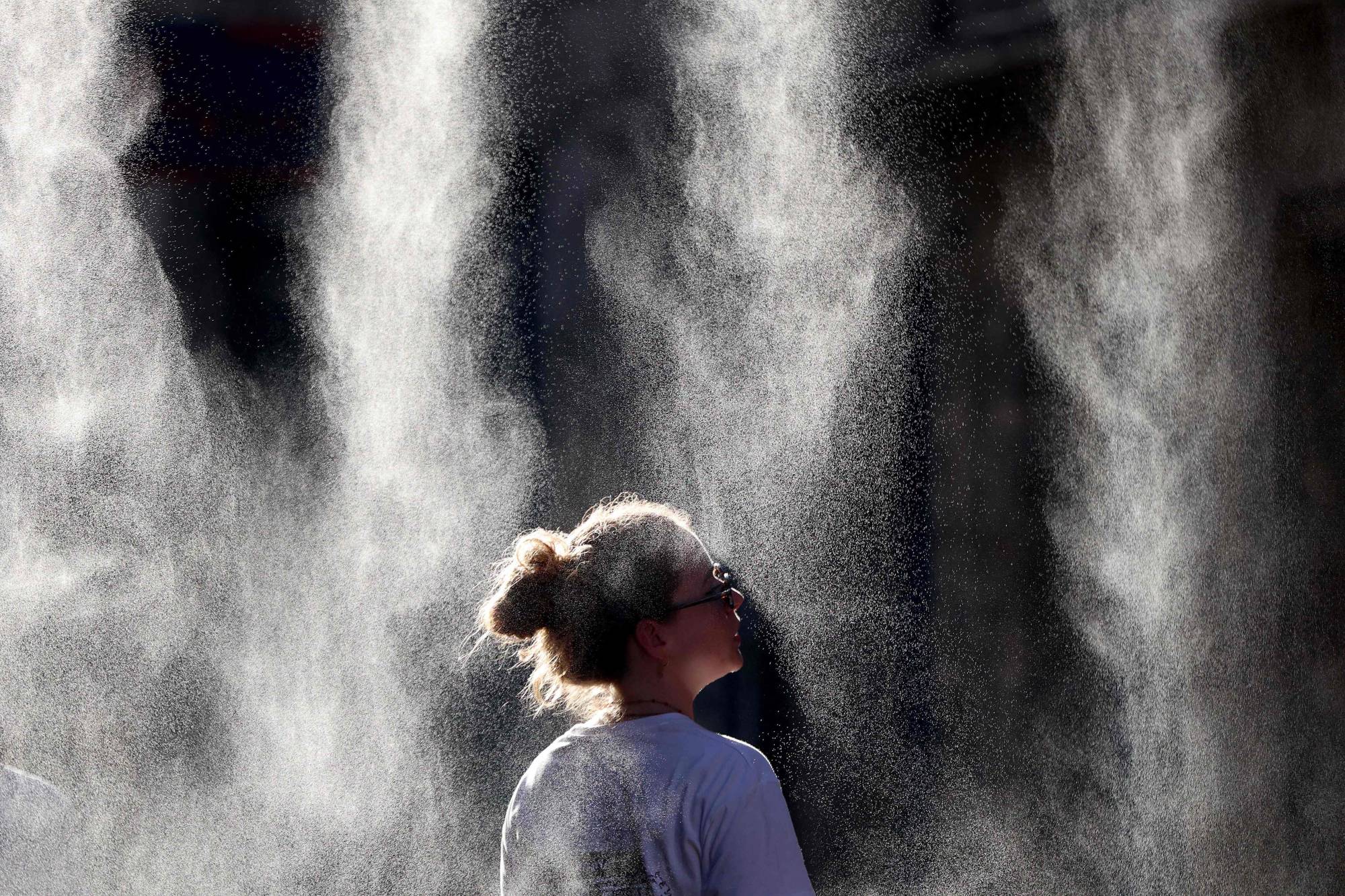
A woman cools off under a water mist during a music festival amidst a heatwave in Bordeaux, southwestern France (AFP)
Scientists say that human activity -- primarily the burning of coal, oil and gas -- has warmed the planet by roughly 1.4C since pre-industrial times and increased the severity and likelihood of extreme weather.
Yet heat-trapping greenhouse gas emissions rose to new highs in 2025.
"The evidence is irrefutable: this is the spiraling price of humanity's fossil fuel addiction, and the global climate crisis it is fueling," United Nations climate chief Simon Stiell said of the Copernicus report.
Global sea surface temperatures also set a new daily high and tied equal-hottest for August, extending a three-month streak of record-breaking warmth across the world's oceans.
More than 90 percent of excess heat trapped by greenhouse gas emissions has been absorbed by the oceans, sparing land from warming but at severe cost to marine life, reefs and coastal communities.
Records tumbled in overheated basins like the Atlantic and Mediterranean and also the tropical Pacific, where the strongest El Nino weather pattern in the modern era is fast accumulating strength.
These events are marked by unusually warm Pacific waters but raise the odds of wild weather thousands of miles away, from floods in Peru to droughts in Africa and wildfires in Australia.
The warmer phase of a natural climate cycle, El Nino episodes usually deliver a temporary spike in global temperatures already elevated by long-term background warming.
Scientists expect records to keep falling in the months ahead as this "super" El Nino approaches peak intensity around December and for 2027 -- and maybe even 2026 -- to become the hottest years ever observed.
"Climate change makes every El Nino hotter, and until we stop burning coal, oil, and gas these record-shattering months will simply keep on coming," said Friederike Otto, a climate scientist from Imperial College London.
A traditional fast-food shop worker tries to cool down a person by pouring water over his head, along Nakamise Street in the Asakusa district, a popular sightseeing spot, in Tokyo, Japan, July 22, 2026. REUTERS/Issei Kato
Copernicus also said that August "marked the end of western Europe's warmest summer" that surpassed the long-standing record set in 2003.
The June to August season was defined by severe, back-to-back heatwaves that shut schools, dried up rivers and primed the land for devastating wildfires.
Between mid-July and mid-August, the continent's EuroMomo monitoring platform estimated that Europe saw more than 32,000 excess deaths.
Scientists from the World Weather Attribution network concluded that a particularly strong heatwave in June would have been "virtually impossible" without the influence of climate change.
But extraordinary heat was felt around the globe.
On Wednesday, the National Oceanic and Atmospheric Administration said the contiguous United States has endured its hottest summer on record.
And regions home to around 900 million people lived through the hottest July ever observed, according to AFP analysis of Copernicus data.
"We've had an exceptional summer -- not only in Europe, but other parts of the world where records that have existed for close to a century have fallen," said Burgess, an ocean scientist and strategic lead for at ECMWF.
The climate would "continue to get more extreme unless we turn off the tap to global emissions", she added.
لم تشترك بعد
انشئ حساباً خاصاً بك لتحصل على أخبار مخصصة لك ولتتمتع بخاصية حفظ المقالات وتتلقى نشراتنا البريدية المتنوعة