


Ahead of G7, Carney Softens Tone toward Trump with Trade Talks at Stake

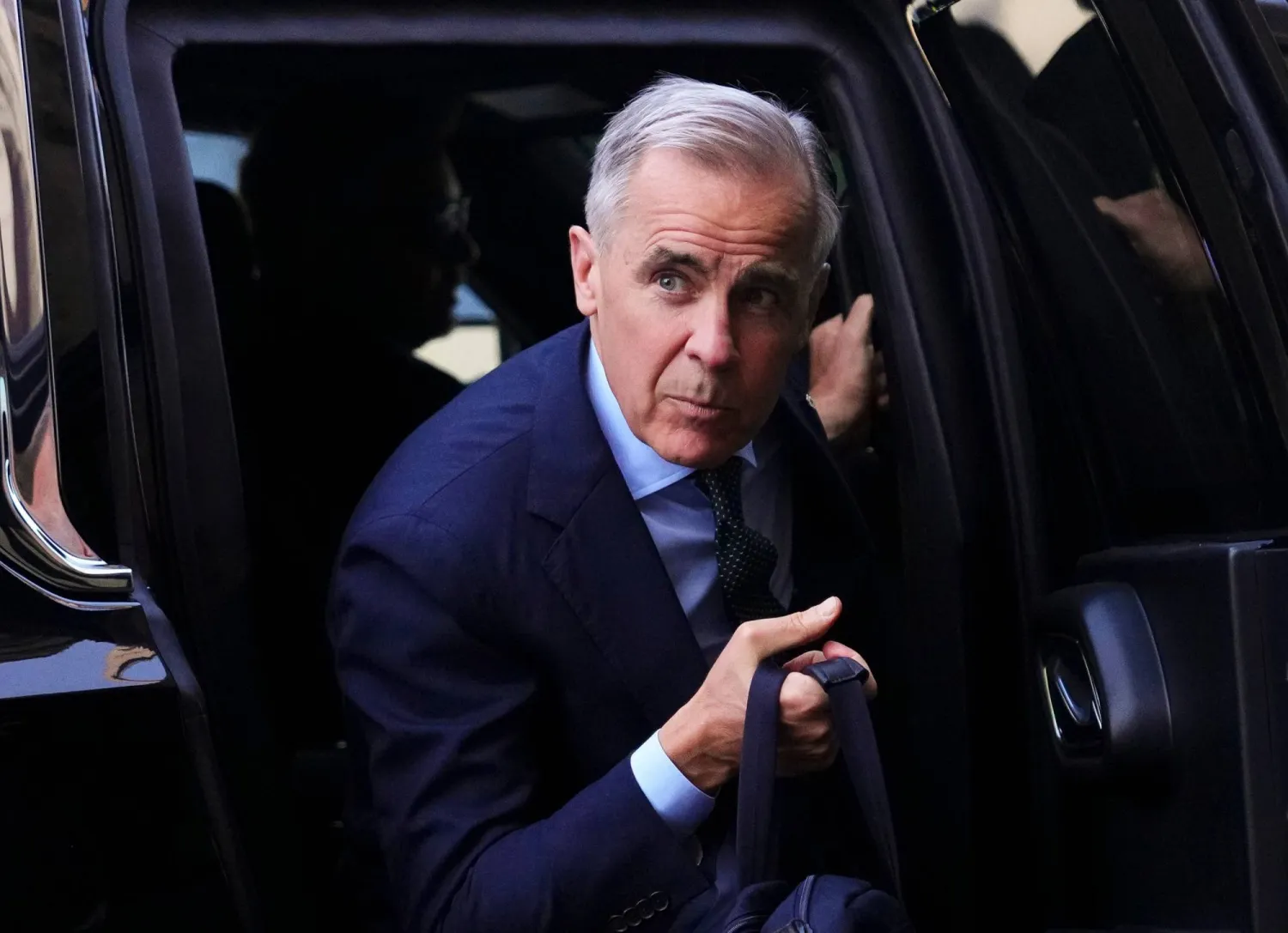
Canadian Prime Minister Mark Carney arrives to Parliament Hill in Ottawa on Tuesday, May 26, 2026. (Sean Kilpatrick/The Canadian Press via AP)
TT

Ahead of G7, Carney Softens Tone toward Trump with Trade Talks at Stake

Canadian Prime Minister Mark Carney arrives to Parliament Hill in Ottawa on Tuesday, May 26, 2026. (Sean Kilpatrick/The Canadian Press via AP)

Canadian Prime Minister Mark Carney became a symbol of middle power resistance after a celebrated speech earlier this year, but he is expected to be more muted in his criticism of US President Donald Trump at an upcoming summit in Europe.

Carney's speech at the World Economic Forum in Davos, Switzerland, helped make him an international political star in January, when he declared the global rules-based order over and condemned coercion by great powers on smaller countries. The prime minister received widespread praise and attention for his remarks and upstaged Trump at the gathering.

But the Group of Seven summit of industrialized democracies that begins Monday in France comes ahead of the scheduled July 1 review of the US-Mexico-Canada Agreement, or USMCA, the latest iteration of the North American free-trade pact that has intertwined the economies of the United States, Mexico and Canada since the early 1990s. It is a crucial moment in trade talks, and Trump said this week that he may not renew the deal.

More than 70% of Canada’s exports go to the US, so preserving the accord is critical for Canada.

Canadian historian Robert Bothwell said Trump is more of a problem for Carney “than anybody else because we are more exposed to the United States than anybody else.”

Trump leaves for the G7 summit right after he hosts UFC fights at the White House on Sunday for his 80th birthday.

The summit will unfold as tensions are ramping up between Trump and Canada. One of the world’s most durable and amicable alliances — born of geography, heritage and centuries of common interests — is broken, as seen in several recent examples of tension between leaders.

Ontario Premier Doug Ford, the leader of Canada's most populous province, had a reception with the US Chamber of Commerce in Washington canceled Monday at the last minute. Vic Fedeli, one of Ford's ministers, said if Trump forced the chamber to cancel, “Ford should be wearing that as a badge of honor.”

Trump said again this week that the US doesn't need anything that Canada has. Carney has set a goal for Canada to double its non-US exports in the next decade, saying Trump’s trade war is causing a chill in investment.

In other developments, the opening of a major Canadian bridge across the Detroit River that Trump previously threatened to block was delayed Thursday due to unresolved issues.

Trump’s actions, including launching a trade war and suggesting Canada become the 51st US state, have infuriated Canadians and created the political environment for Carney to win the job of prime minister after promising to confront Trump.

Trump administration officials keep noting that only two countries, China and Canada, retaliated against America in the trade war. US Trade Representative Jamieson Greer says Canada’s retaliatory measures are a major issue in talks.

Daniel Béland, a political science professor at McGill University in Montreal, said Carney seems to have moderated his tone toward the Trump administration to avoid worsening relations.

“There is a clear tension between what Prime Minister Carney said in his Davos speech about middle powers standing up to hegemons and his attempt to nudge the US administration ‘in the right direction’ with regard to the USMCA review and trade policy more generally,” Béland said.

Carney has downplayed Trump’s most recent comments about Canada becoming the 51st state.

Canada and Mexico want the USMCA to be renewed for another 16 years. Trump has mused about withdrawing from it. More likely it will be subject to annual reviews for the next 10 years.

Carney arrived in Paris on Friday morning and will meet with French President Emmanuel Macron in the evening, a few days before the summit in Évian-les-Bains, France.

The prime minister will also travel to Ireland this weekend to meet with the Irish prime minister in a bid to diversify trade away from the US.

This is Carney's ninth trip to Europe in the 15 months since he became prime minister in March 2025.

The US “will clearly remain Canada’s largest trading partner for the predictable future,” Béland said, calling it an inescapable reality that Carney “must keep front of mind even as he seeks to make Canada somewhat less dependent on trade with the US.”



Israel Reportedly Shared Intel About ‘New’ Iran Plot to Kill Trump

People attend a funeral procession for Iran's late Supreme Leader Ali Khamenei, who was killed on February 28 in Israeli and US airstrikes, in Qom, Iran, July 7, 2026. Office of the Iranian Supreme Leader/WANA (West Asia News Agency) via REUTERS
TT

Israel Reportedly Shared Intel About ‘New’ Iran Plot to Kill Trump

People attend a funeral procession for Iran's late Supreme Leader Ali Khamenei, who was killed on February 28 in Israeli and US airstrikes, in Qom, Iran, July 7, 2026. Office of the Iranian Supreme Leader/WANA (West Asia News Agency) via REUTERS

Israel shared intelligence with the United States this week about a new and “specific” plan by Iran to assassinate President Donald Trump, US media reported Thursday.

The reports come as renewed US and Iranian attacks raised fears of a return to all-out war, and after Trump’s puzzling use of an old plane to depart from Türkiye after the NATO summit.

Washington has monitored “a steady drumbeat” of intelligence about possible plans to assassinate Trump, “but the warning from Israel was new and concerned a specific plot,” CNN reported, citing unnamed sources familiar with the matter.

The Wall Street Journal, also citing unidentified sources, said the intelligence described a “fresh” plot.

Tehran has for years vowed to hit back at Trump for ordering the assassination of Iranian general Qassem Soleimani in January 2020, during his first term.

When AFP contacted the White House about the reports, an unidentified official pointed to Trump’s remarks from Wednesday.

“They want to take out the US leader – me. I’m on whatever list. I saw this morning I’m on every single one of their lists,” Trump told reporters aboard Air Force One as he flew home from a NATO summit.

Trump used his old Air Force One plane to leave Türkiye, where the summit took place, sending his new Qatari-gifted jet on ahead to Britain, where he switched planes for the journey to Washington.

The switch from the new jet on its maiden foreign trip sparked speculation it was because its security features were lacking – particularly as the US launched fresh strikes against Iran, which borders Türkiye.

The New York Times reported late Wednesday that the switch was made at the request of the US Secret Service “as a security precaution.”

In a press conference, Trump sidestepped safety questions but alluded to previous alleged assassination attempts by Iran.


Pacific Islands Reject Missile Test in 'Blue Continent'

Monitors and Pacific officials say the Chinese ballistic missile test landed in the heart of their shared 'blue continent'. TORSTEN BLACKWOOD / AFP
TT

Pacific Islands Reject Missile Test in 'Blue Continent'

Monitors and Pacific officials say the Chinese ballistic missile test landed in the heart of their shared 'blue continent'. TORSTEN BLACKWOOD / AFP

Pacific Islands denounced China's ballistic missile test because they say it landed in the heart of their shared "blue continent", politicians and analysts told AFP.

Even Pacific nations indebted to Beijing joined criticism of Monday's submarine-launched ballistic missile test, which reached far into the Pacific Ocean.

The term "Blue continent" is used by Pacific Islands to describe a joint home and shared stewardship of the ocean, said AFP.

The nuclear-capable missile fitted with a dummy warhead landed somewhere between Nauru, Tuvalu and the Solomon Islands, according to monitors and Pacific officials.

The reported landing spot lies amidst the Pacific islands, but in one of the few patches between them that is not part of an exclusive economic zone (EEZ).

China said the missile test "was not directed at any country" and breached no international law.

But Palau President Surangel Whipps, who will host an annual meeting of Pacific leaders next month, said the missile landed "right between our EEZs".

"We have missiles going right into the heart of the Pacific, unannounced," he said in an interview with AFP.

China's Pacific envoy had days earlier met with the Pacific Islands Forum, after Beijing donated $1 million to the regional bloc, but made no mention of a looming test.

The forum's 18 members see themselves as custodians of 20 percent of the earth's surface, jointly managing fisheries and fighting climate change, within combined EEZs spanning 25 million square kilometers (10 million square miles).

The missile appeared to have landed in a "narrow corridor of international waters" between the surrounding islands' EEZs, said the director of the Pacific Islands program at the Lowy Institute, Oliver Nobetau.

"It begs the question, why couldn't it have been tested to the north of the Pacific Ocean, where there is an expanse of international waters?" he said.

- 'Living fabric' -

A dozen Pacific countries have protested the missile test, including small nations that borrowed from China for their infrastructure, and its closest Pacific security partner, the Solomon Islands.

International maritime law expert Donald Rothwell said while vast EEZs give island states control over ocean resources and coast guard patrols, they don't prohibit missile tests.

Ruth Cross Kwansing, a government minister in Kiribati, said the concept of a "Blue Pacific continent" is fundamental to the region, and is driving the indignation.

"What happens in any part of this ocean vibrates through all of us," she told AFP.

"You have to shift your perspective from a map of dispersed and isolated islands to one where the ocean itself is the living fabric that binds us all together," she said.

"Our seas are not an empty void or a buffer zone between global powers -- they are our estate, our livelihood, and our identity as stewards of the sea."

Anna Naupa, a Pacific security expert at the Australian National University, said despite colonial history fragmenting the map, the idea of a contiguous Pacific continent had re-emerged as island states amplified their collective voice on climate change.

"The Pacific upset is consistent with defending the Ocean of Peace principles," Naupa said, referring to a declaration made by leaders last year that the region stay free of nuclear weapons testing.

The short notice of the test China gave only a handful of countries was seen as disrespectful, she added.

- 'Still haunted' -

Papua New Guinea's Prime Minister James Marape said Monday it should be the "last such missile test conducted in Pacific waters", a message extended not only to China, but all military powers.

The United States conducted 67 nuclear detonations between 1946 and 1958 in the Marshall Islands, and continues to conduct ballistic missile tests there under a defense compact. The Marshall Islands' President Hilda Heine cited the weight of these historical nuclear scars in criticizing China's missile.

France and Britain also conducted Pacific nuclear tests prior to 1996.

All missile testing in the region, including China's, will be discussed at next month's Pacific leaders meeting, said Kiribati's Kwansing.

Many Pacific islands are "still haunted by the legacy of World War II fought in the region, as well as the long term effects of nuclear testing", said Nobetau.

"What strikes the fear in Pacific leaders is that it's a clear demonstration of the reach of Chinese capabilities, but also a preview to what kinetic warfare would look like," he said.


Eleven Killed in Fast-moving Southern Spain Wildfire

An emergency worker looks on during a wildfire in Almeria, Spain, in this screengrab taken from a handout video released on July 10, 2026.   @Plan_INFOCA via X/Handout via REUTERS
An emergency worker looks on during a wildfire in Almeria, Spain, in this screengrab taken from a handout video released on July 10, 2026. @Plan_INFOCA via X/Handout via REUTERS
TT

Eleven Killed in Fast-moving Southern Spain Wildfire

An emergency worker looks on during a wildfire in Almeria, Spain, in this screengrab taken from a handout video released on July 10, 2026.   @Plan_INFOCA via X/Handout via REUTERS
An emergency worker looks on during a wildfire in Almeria, Spain, in this screengrab taken from a handout video released on July 10, 2026. @Plan_INFOCA via X/Handout via REUTERS

Eleven people were killed in a wildfire in Almeria in southern Spain, as 150 firefighters battled to bring the blaze under control, Andalusia's head of emergencies, Antonio Sanz, said.

Sanz said the fire had spread extremely rapidly in a wooded area around the town of Los Gallardos in Almería province in Spain's southern region of Andalusia, affecting particularly the nearby hamlet of Bedar.

He said the authorities had told residents to stay in their homes and that the deaths appeared to have occurred when people decided to try to evacuate in their cars.

Four people, who he said ⁠appeared to be ⁠British as the steering wheel of their car was on the right-hand side, died in one vehicle, Sanz said, while seven others were found dead after apparently abandoning their cars and attempting to escape on foot along a route that was not part of the evacuation plan.

Another four people were being treated in hospital for serious burns, Sanz said. He urged residents to follow ⁠official instructions and avoid taking risks as authorities focused on saving lives. Authorities were continuing search operations amid concerns that more people could be missing, Reuters reported.

The death toll makes it Spain's deadliest wildfire since 2005, when 11 firefighters were killed in a blaze in the central province of Guadalajara that was sparked by a barbecue and burned thousands of hectares of forest.

That disaster, considered one of the country's worst wildfire tragedies, prompted major changes to Spain's wildfire prevention and emergency response systems.

Prime Minister Pedro Sanchez said he felt "enormous sadness and devastation" over the consequences of the fire, offering his condolences to the families of ⁠those killed and ⁠wishing a speedy recovery to the injured.

In a post on X, he said emergency services, security forces and the military emergency unit (UME) had been mobilized to combat the blaze and urged residents to exercise caution.

The latest blaze comes after a wildfire burning out of control in southern France earlier this week forced the evacuation of over 10,000 people from two dozen small towns and villages near the Spanish border.

Early summer heatwaves across western Europe in May and June have parched vast areas of land, making them particularly vulnerable to wildfires this year.

Europe is warming at more than twice the global average, the World Meteorological Organization has said, making prolonged heat episodes increasingly likely.