Two Men Charged Over England World Cup 'Heist'

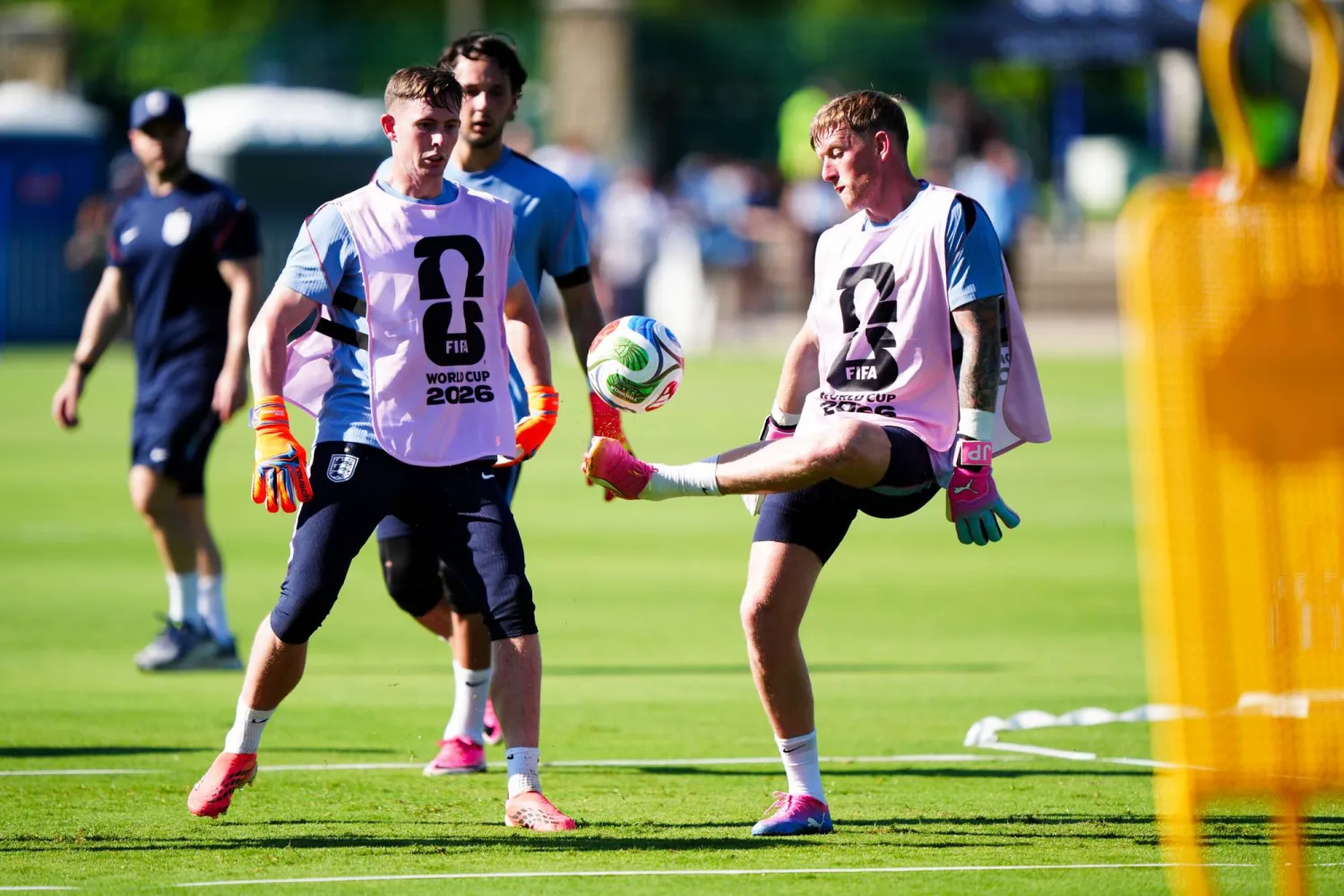
13 June 2026, US, Kansas: England goalkeeper Jordan Pickford and Dean Henderson in action during the team's training session at Swope Soccer Village ahead of Wednesday's 2026 FIFA World Cup Group J soccer match against Croatia. Photo: Bradley Collyer/PA Wire/dpa
TT

Two Men Charged Over England World Cup 'Heist'

13 June 2026, US, Kansas: England goalkeeper Jordan Pickford and Dean Henderson in action during the team's training session at Swope Soccer Village ahead of Wednesday's 2026 FIFA World Cup Group J soccer match against Croatia. Photo: Bradley Collyer/PA Wire/dpa

Two men were charged Saturday over the theft of $18,000-worth of kit and equipment from the England team at the World Cup, a US prosecutor said.

Mustafa Salik and Erfan Kamal each face one count of receiving stolen property, according to a statement from the office of Jackson County Prosecutor Melesa Johnson.

The offence under Missouri law carries a prison sentence of up to seven years.

The equipment was stolen from vehicles as it was transferred from England's training camp in Florida to their World Cup base in Kansas City.

According to AFP, Johnson's office said in a statement that the stolen property is estimated to be worth about $18,000.

"Jackson County will not tolerate any criminal activity that targets World Cup visitors, including the international teams that have traveled here to compete," Johnson said.

"We thank the Kansas City Police Department and our on-call attorneys for their quick work investigating this incident and filing charges immediately."

Kansas City mayor Quinton Lucas praised the police and the prosecutor's office "in resolving an investigation across several states, helping crime victims recover goods stolen in transit.”

Earlier, England reserve goalkeeper Dean Henderson said he had his boots back after it was reported that most of the items had been recovered.

"I got them back, so it's all good," the Crystal Palace goalkeeper said after England's first training session at Swope Soccer Village.

"I think they got everything back, so it's all good."

Defender Dan Burn was relaxed about the episode.

"Obviously it was to do with the police," he said. "So I don't know how much people know about it. We didn't know a lot about it, but I've got all my kit and all my boots."

Thomas Tuchel's England, among the favorites to win the World Cup, had a gentle training session in front of scores of watching fans on Saturday.

They open their World Cup campaign against Croatia on Wednesday, before further games in Group L against Ghana and Panama.


Australia’s Wild Macadamias... a Rare Gene to Cope with Climate, Illnesses

Australia’s wild macadamias (Shutterstock)
TT

Australia’s Wild Macadamias... a Rare Gene to Cope with Climate, Illnesses

Australia’s wild macadamias (Shutterstock)

While grown in huge numbers commercially, macadamias are a vulnerable crop. A group of wild Australian nut hunters is seeking to change that, according to The Guardian.

Ian McConachie has always been partial to a macadamia nut. As a boy in Brisbane in the 1940s he used to climb fences to steal them from people’s back yards. “We’d put them in a little hole in the concrete under the house and hit them with a hammer.”

Now 90, he has spent much of his life devoted to the nut, including developing a tree that has raised $2 million in royalties for the Macadamia Conservation Trust, which seeks to preserve this scrappy rainforest plant.

Today macadamias are a $2 billion global industry, grown in industrial quantities in subtropical climates in Hawaii, the Americas, Africa and Asia. But there was a time when Aboriginal people traded them for rum and tobacco with the white settlers here on this country.

“It is the world’s finest nut,” McConachie said. “It is an Australian icon and our only native plant that has become a commercial food.”

A couple of kilometers from here lives Macadamia integrifolia, which genetic testing has shown is the genesis tree of 70% of macadamia trees grown commercially around the world.

There are three other species: M tetraphylla is also grown commercially, while M ternifolia and M jansenii are almost inedible, wild and rare.

Macadamias have been cultivated commercially since the 1920s, starting in Hawaii.

Australia didn’t start commercial production until the 1960s. Only two to three generations out of the wild is “terribly young in the world of horticulture”, McConachie said. “So we simply don’t know what the potential of the wild macadamia tree is.”

All four macadamia species are native to a tiny patch of Australian subtropical rainforest in south-east Queensland and northern NSW.

“Which is pretty much where everyone wants to live,” said Denise Bond, executive director of Wild Macadamia Conservation. “They [the trees] like expensive real estate, which makes them incredibly endangered because we’ve got so little rainforest left.”

Wild trees may hold the key to the next generation of climate- and disease-resilient nuts.

McConachie said for commercial macadamia farming, “one of the very few things Australia has got going for it is the wild trees and their genetic potential.”

But more than 80% of the habitat that these trees evolved in over 120 million years is reduced to remnant now.

One of the macadamia species, M jansenii, is seriously endangered, so rare “a bushfire could totally wipe them out,” McConachie said.

Their locations are kept secret to protect them. While the nuts are too bitter to eat, “it could be a major tool in terms of climate change because it is so hardy.” The other three species are listed as threatened or vulnerable.

McConachie has spent decades walking the remnant rainforests not far from where he lives, to find and document wild macadamias in situ. In August, he and fellow macadamia conservationist Russell Bennet took The Guardian on one of their hunts.

Bennet, a Kabi Kabi man, custodian and elder, who is driving, is known for his ability to spot them. “It’s some genetic ability handed down through the ancestors, I reckon,” he said.

First Nations Australians, though, have received vanishingly little financial benefit from the nut’s global popularity.

When he finds a new undocumented tree, Bennet said: “it’s almost like finding gold. You can go through a lot of rainforest and not see one.”

Except in September, when they flower and put on a show. The rest of the year, their dark leaves retreat into the rainforest, easily overlooked.

In 1981, McConachie and his wife, Jan, bought a rundown dairy farm near Wolvi. He flirted with other trees, mangoes, lychees, stone fruit, but quickly came back to his great love.

After an extensive selection trial, he found a particularly hardy and accommodating tree, named it MCTI and secured planter breeding rights.

“It has sold about a million and a half trees,” he said, “and raised about $2 million in royalties.”

All of that has been donated to Wild Macadamia Conservation.

“We’re probably all a bit eccentric,” he said of the group, “but we’re passionate about the need to conserve the wild genetics.”



London's Natural History Museum Reopens Hall Closed for 83 Years

The skeleton of a blue whale hanging from the ceiling in the Hintze Hall at the Natural History Museum in London, England (Natural History Museum)
TT

London's Natural History Museum Reopens Hall Closed for 83 Years

The skeleton of a blue whale hanging from the ceiling in the Hintze Hall at the Natural History Museum in London, England (Natural History Museum)

A gallery that has remained closed to the public since World War Two is to reopen at London's Natural History Museum next month, according to BBC.

The gallery, which has remained hidden from view since 1943, will reopen from September 16, featuring 50 objects which show our evolving relationship with the natural world.

The exhibition, named Nature and Us, is part of a transformation project called NHM150, which aims to open a new or revamped showcase every year until the museum's 150th anniversary in 2031.

Dr. Doug Gurr, director of the NHM, said: “For the first time in over 80 years, visitors will be able to step into this beautiful historic space and explore our changing relationship with the natural world.”

The museum describes the display as “experimental” during the initial 18-month period, with visitors invited to share their views on what they would like to see in the permanent gallery, which is due to open in 2029.

The exhibition is located on the second floor of the museum's main Waterhouse Building. It was originally used as an osteology and mammals gallery.

However, after the museum's original herbarium was damaged during World War Two, the space was repurposed to house the botanical collections and closed to the public.

Among the key specimens on display is a miniature model of a Crystal Palace dinosaur, alongside other objects that show how early scientists and artists understood the prehistoric world.

Other items include a Victorian skeleton of a monk seal named Jenny, highlighting how wild animals were once exploited for entertainment, as well as the jaw of one of Britain's earliest known domesticated dogs, dating back about 14,300 years.

The Natural History Museum in South Kensington is free to visit and open seven days a week.


The Sunhat is Everywhere in Athens as Crowds Grow Larger at Ancient Sites

Tourists wearing hats take photographs on the rocky Areios Pagos Hill next to the Acropolis in Athens, Greece, Friday, Aug. 14, 2026. (AP Photo/Thanassis Stavrakis)
TT

The Sunhat is Everywhere in Athens as Crowds Grow Larger at Ancient Sites

Tourists wearing hats take photographs on the rocky Areios Pagos Hill next to the Acropolis in Athens, Greece, Friday, Aug. 14, 2026. (AP Photo/Thanassis Stavrakis)

Outside the Acropolis, a sea of hats bobs up and down the hill to the ancient site: straw boaters, Panama hats, baseball caps and bucket hats in the relentless heat.

Hat racks are hard to miss in central Athens this summer. Kiosks and stores keep outdoor stands piled high as more tourists seek relief from the midday heat.

The Acropolis drew about 4.6 million visitors in 2025, a record year for Greek tourism. Many spend hours in mid-30s Celsius (mid-90s Fahrenheit) temperatures with little shade. Even a carriage horse at the foot of the ancient monument has joined in, sporting a brown bucket hat with holes cut for its ears.

“You need a hat. I’m already red as it is,” said Jack Yosif, an Australian tourist wearing a black baseball cap. “It’s a bit more of a common thing nowadays, and people are a bit more aware.”

Scorching temperatures didn't deter a record 38 million visitors last year, the most recent for which there is data. The combination of extreme heat and high demand for sites — which means not everyone can visit in the morning — is adding urgency to sun protection.

Greek health campaigners have welcomed a growing awareness of the dangers of ultraviolet exposure and risk of heat stroke. Red Cross volunteers at the Acropolis hand out kits with sunscreen, water, information leaflets and red caps, The Associated Press reported.

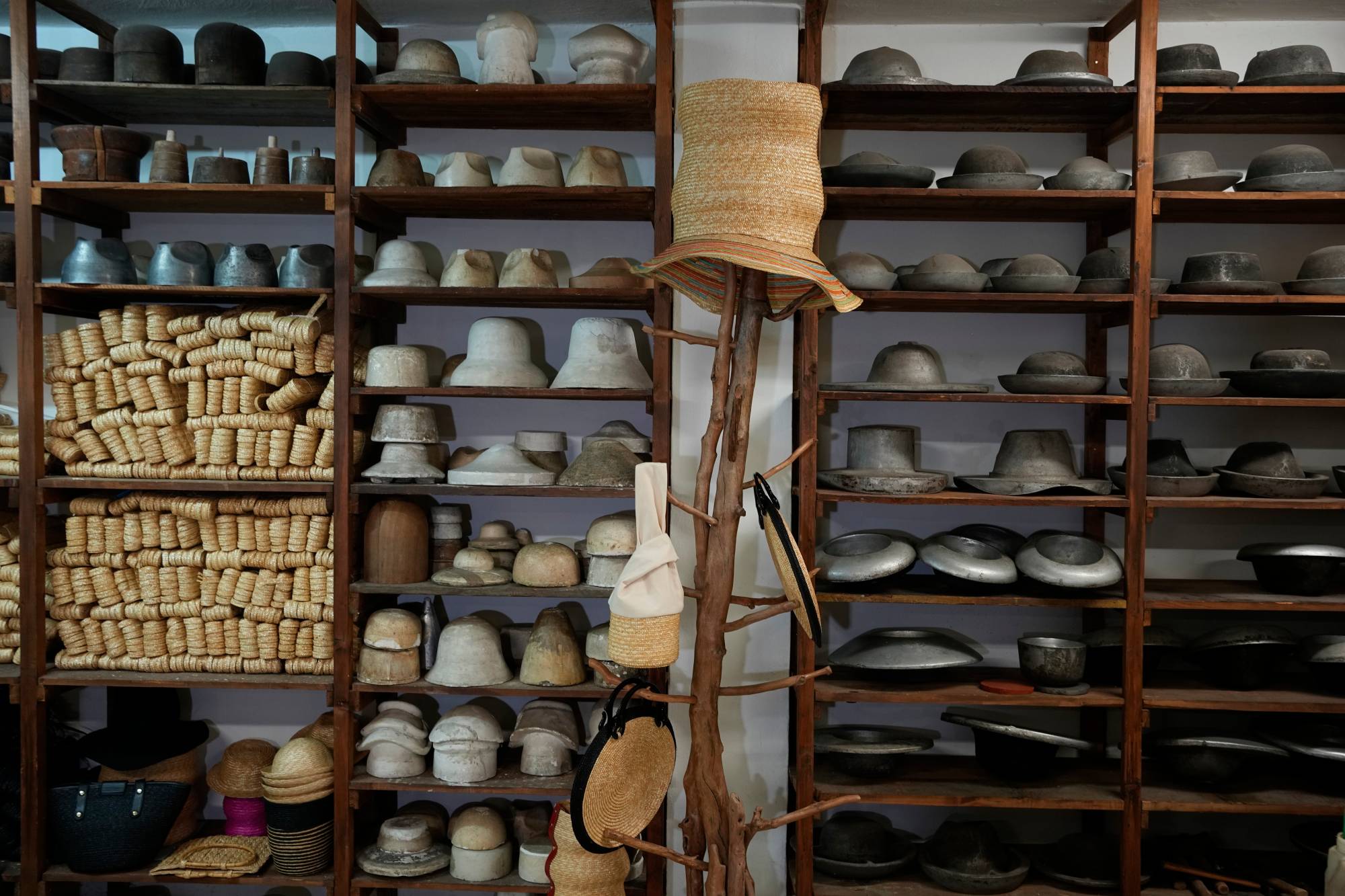
Hats are displayed alongside materials using in their production on hangers and shelves at a shop in Athens, Greece, Tuesday, Aug. 11, 2026. (AP Photo/Thanassis Stavrakis)

On nearby Syntagma Square, kiosk owner Konstantinos Mallios says hat sales have risen in recent years. His stylish and souvenir models run up to 20 euros ($24) while the cheapest costs 6 euros. Available elsewhere is semi-disposable headgear: mass-produced hats made using compressed paper pulp.

And there are more ostentatious options. At her basement workshop, hatmaker Lisa Sarigiannidou turns straw braids into boaters using century-old presses and molds in a matter of minutes. Her hats start at around 50 euros, with elaborate designs costing more than 100 euros.

“People’s attitudes toward hats have changed,” said Sarigiannidou, who was trained by her hatmaker father. “In the past, when a young woman tried on a hat and looked at herself in the mirror, she usually laughed. Now they try them on seriously ... and they wear them straight out the door.”