


Gulf Investors Shape Wall Street’s Biggest-Ever IPO

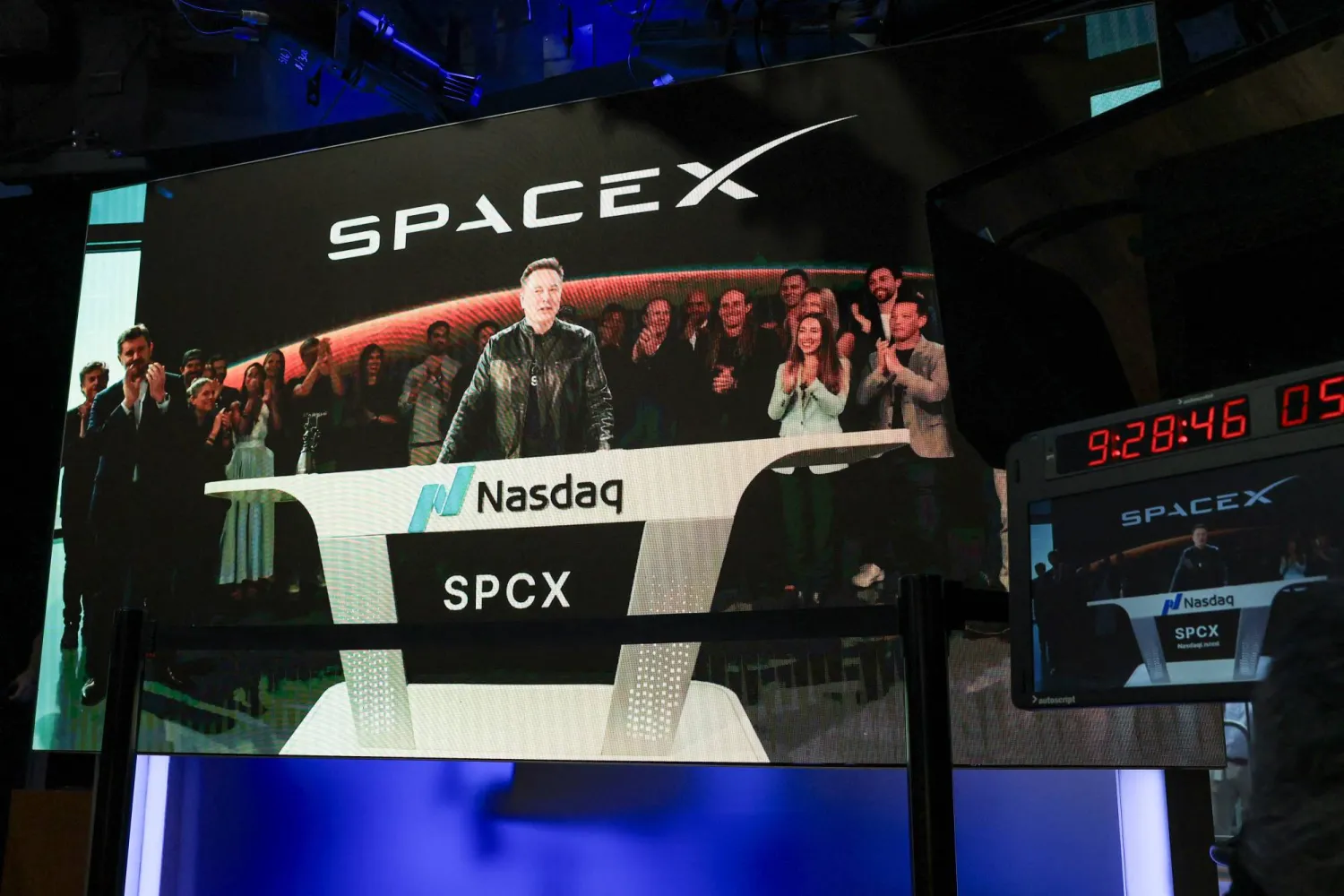
SpaceX CEO Elon Musk, displayed on a screen remotely from SpaceX headquarters in Starbase, Texas, speaks before the launch of SpaceX's initial public offering (IPO) at the Nasdaq MarketSite in New York on June 12, 2026. (Photo by TIMOTHY A. CLARY / AFP)
TT

Gulf Investors Shape Wall Street’s Biggest-Ever IPO

SpaceX CEO Elon Musk, displayed on a screen remotely from SpaceX headquarters in Starbase, Texas, speaks before the launch of SpaceX's initial public offering (IPO) at the Nasdaq MarketSite in New York on June 12, 2026. (Photo by TIMOTHY A. CLARY / AFP)

SpaceX shares began trading on Nasdaq at a market value of $1.78 trillion, turning Gulf capital's role from market speculation into a documented fact.

Last-minute disclosures and the IPO prospectus revealed a striking economic reality: sovereign wealth funds and investors from Gulf Cooperation Council countries were not peripheral participants.

They were the backbone of the largest fundraising exercise in financial market history. This $75 billion deal made the Gulf a historic partner in shaping the future of space and artificial intelligence.

Global hedge funds saw their orders sharply cut after demand topped $250 billion. But Britain’s Financial Times, citing people familiar with the order book, reported that sovereign funds and family offices were given priority. SpaceX placed Gulf funds at the front of its list of strategic subscribers.

According to the newspaper, the official Gulf allocation put the region among the biggest subscribers.

Saudi Arabia’s Public Investment Fund, the Qatar Investment Authority and the Kuwait Investment Authority each received final allocations worth more than $1 billion. Those figures approached the scale of the $5 billion stake sought by US asset management giant BlackRock.

The rush was also driven by “fast-entry” rules approved by global index providers such as Nasdaq and FTSE Russell.

These rules allow shares to be added to major indexes, including the Nasdaq 100, within five to 15 trading days. For funds, securing stock from the first book became a preemptive fight.

The rise of the Kingdom’s stake

The case of Prince Alwaleed bin Talal and Kingdom Holding Co. offers the clearest example of how Gulf investors booked historic paper gains through long-standing strategic ties with Elon Musk.

It also gave practical meaning to Musk’s 2024 pledge, when he wrote on his platform: “Loyalty deserves loyalty,” promising priority to long-term investors.

The relationship began in 2011, when Prince Alwaleed invested $300 million in Twitter, now X. When Musk acquired the platform in 2022, Kingdom Holding and its chairman, Prince Alwaleed bin Talal, made a decisive call: they rolled over the stake instead of cashing out.

Later, as Musk merged X with his artificial intelligence startup xAI and then folded the combined entity under SpaceX, that historic holding was converted into direct equity in the rocket and satellite communications company, according to IPO documents.

The result was a dramatic paper gain. Kingdom Holding said in a separate official filing to the Saudi stock exchange that the estimated value of its joint stake with Prince Alwaleed had risen to more than $10.6 billion, based on the final IPO price of $135 a share.

The effect was not confined to the company’s books. The valuation quickly moved into the market, sparking a rally that sent Kingdom Holding shares on Saudi Arabia’s Tadawul exchange to their highest level in a decade.
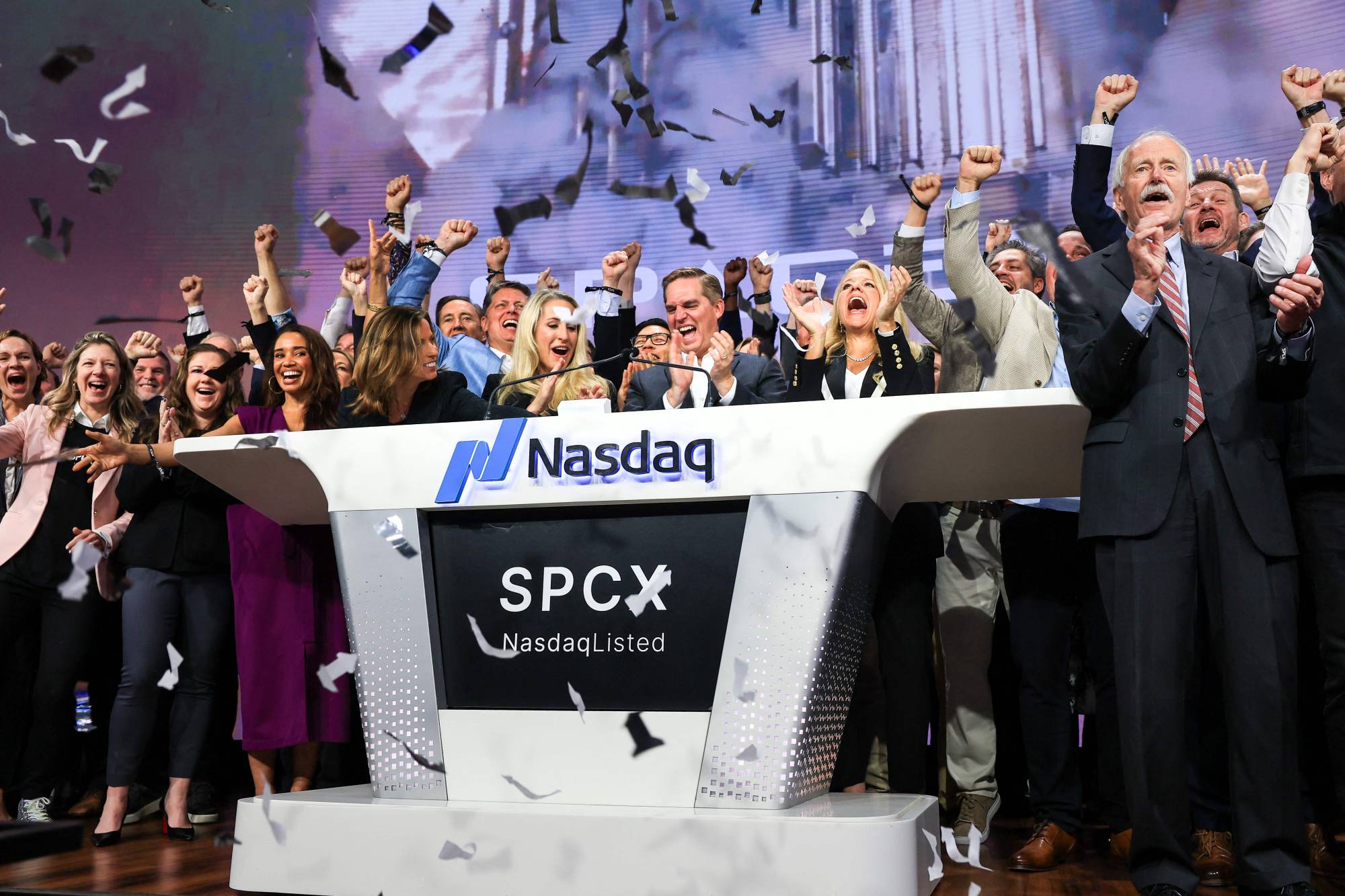
Bret Johnsen (C), SpaceX Chief Financial Officer, and Gwynne Shotwell (center R), SpaceX President and Chief Operating Officer, celebrate as they ring the opening bell at the Nasdaq MarketSite to celebrate the launch of SpaceX's initial public offering (IPO) in New York on June 12, 2026. (Photo by TIMOTHY A. CLARY / AFP)

The AI equation

The gains tell only part of the story. Published operating data and SpaceX’s combined deals show Gulf investors have shifted the rules of the traditional investment game.

Regional capital is no longer silent money waiting for dividends. It has become a strategic force, demanding the localization of advanced technology and the construction of computing and artificial intelligence infrastructure on Arab soil. The goal is knowledge transfer and digital sovereignty, not merely returns captured in Silicon Valley.

HUMAIN enters the picture

That strategy is clearest in the moves of Saudi Arabia’s HUMAIN, a company wholly owned by the Public Investment Fund and focused on providing comprehensive artificial intelligence capabilities globally.

According to the company’s official statement, HUMAIN invested $3 billion in xAI’s Series E funding round. The investment came just before SpaceX’s larger acquisition and merger in early February.

Under that transaction, HUMAIN’s stake was converted into declared, direct equity in the parent company, SpaceX, making it a significant minority shareholder with strategic weight.

The statement shows the partnership was not improvised. It followed a broad agreement signed in November 2025 during the US-Saudi Investment Forum.

Under the agreement, HUMAIN and xAI committed to jointly developing next-generation artificial intelligence infrastructure and data centers with more than 500 megawatts of computing capacity, while localizing and deploying advanced Grok models in Saudi Arabia.

At the time, HUMAIN Chief Executive Tareq Amin said the investment showed the company’s ability to deploy major capital behind exceptional technology platforms that combine technical excellence with long-term vision.

He said the merger of xAI with SpaceX’s vast infrastructure created a unique platform for accelerated growth and long-term investment value across four areas: next-generation technology centers, hyperscale cloud, advanced models and transformative AI solutions.

The United Arab Emirates built its own technology alliance along similar lines. Abu Dhabi secured a strategic seat through its specialized technology arm, MGX, in Musk's merged entities, in cooperation with G42.

At the same time, it moved ahead with a large data center complex in Abu Dhabi, supported by parallel strategic partnerships, including a $15.2 billion investment commitment from Microsoft for Khazna, the group’s data center company.
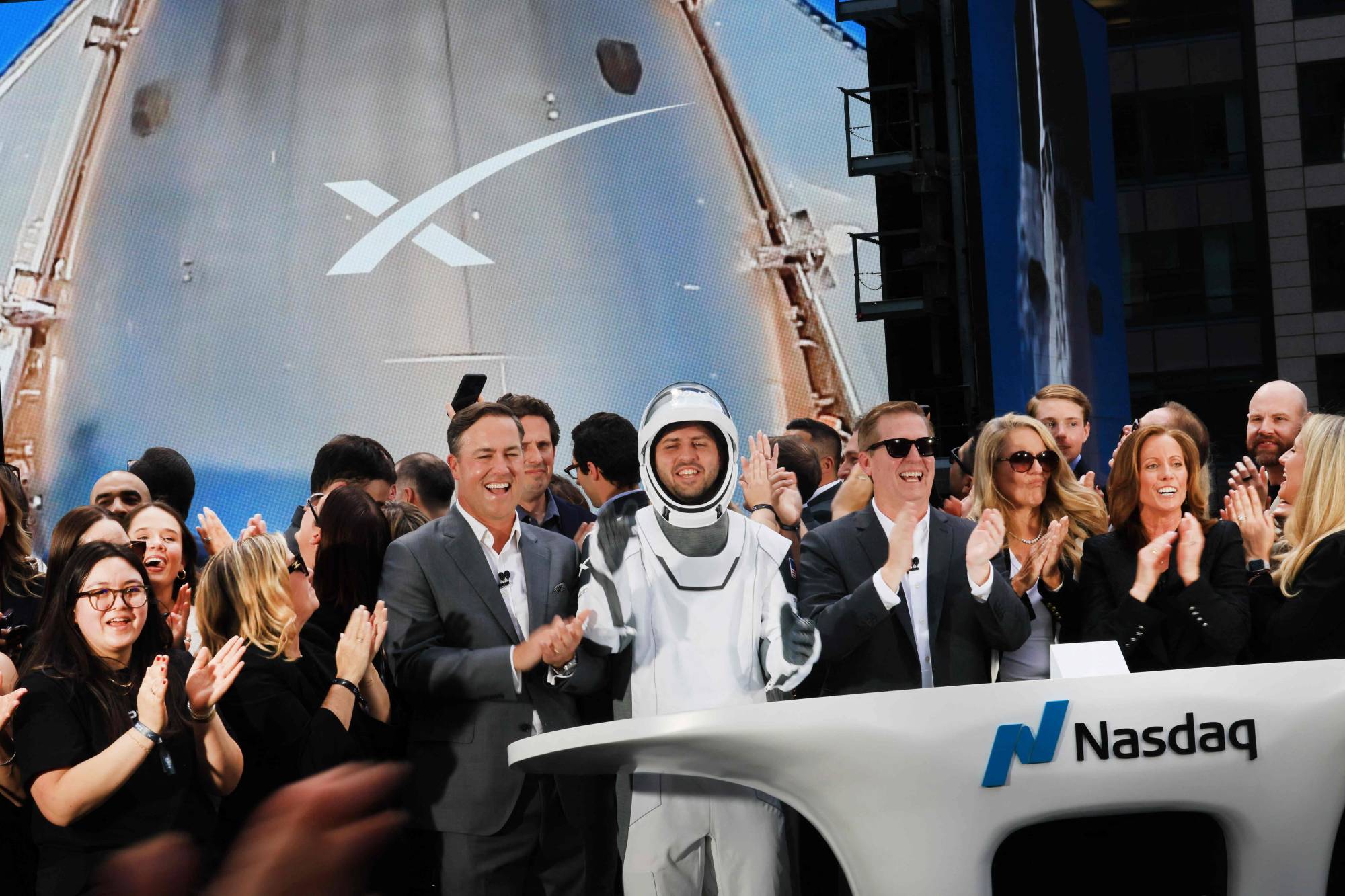
NEW YORK, NEW YORK - JUNE 12: SpaceX employees celebrate the market close of the SpaceX initial public offering (IPO) at the Nasdaq Marketsite on June 12, 2026, in New York City. Spencer Platt/Getty Images/AFP

Financial engineering and the space bet

Official data cited by Britain’s Financial Times set out the spending plan for the IPO proceeds. SpaceX will immediately use $20 billion of the gross proceeds to repay a bridge loan the group drew in March.

The loan covered debt tied to the integration of Musk’s artificial intelligence and social media businesses, xAI and X, under SpaceX’s financial umbrella.

The remaining liquidity, backed significantly by cash flows and Gulf billions from the top of the order book, will fund the next stage of growth.

At the center of those plans is a project Musk disclosed to the head of JPMorgan during the IPO roadshow and which the British newspaper reported: building artificial intelligence data centers in outer space.

The plan involves launching giant satellites with 70-meter wingspans as a strategic solution to the limits of Earth's electricity resources.

Steel-like confidence

The scale of the Gulf position has drawn attention on Wall Street because SpaceX’s current numbers defy traditional market equations.

The company went public with a financial commitment that included repaying a $20 billion loan before the offering to cover obligations from the merged xAI and X businesses under SpaceX’s unified structure.

Its valuation was even more striking: 92 times annual revenue of $19 billion. In simple terms, standard market practice usually ties large-company valuations to current revenue. SpaceX’s market value therefore places it in a rare position among the world’s largest technology groups relative to the size of its existing business.

Even so, banking circles described the approach of Gulf sovereign wealth funds and family offices as a strategic vision that looked past conventional market concerns. Investment managers told the Financial Times they had offered Gulf clients financial hedging options as a standard precaution when trading began. All rejected hedging outright.

That stance reflects a more mature regional investment mindset. Gulf investors are no longer relying only on immediate readings and short-term indicators. They are trying to seize future monopolistic opportunities.

That view draws on forecasts by Goldman Sachs, the lead IPO manager, which predicted a 100-fold jump in SpaceX’s artificial intelligence revenue to $322 billion by 2030, allowing it to dominate a targeted global market worth $28.5 trillion.

In the end, SpaceX’s historic IPO showed that the region’s funds have become strategic partners with the power to impose operational conditions, localize future technology and shape a new financial geopolitical landscape stretching from the deserts of the Middle East to outer space.



India Says Will Keep Expanding Oil Refining Capacity

File photo: Storage tanks of an oil refinery of Essar Oil, which runs India's second biggest private sector refinery, are pictured in Vadinar in the western state of Gujarat, India, October 4, 2016. REUTERS/Amit Dave/File photo
TT

India Says Will Keep Expanding Oil Refining Capacity

File photo: Storage tanks of an oil refinery of Essar Oil, which runs India's second biggest private sector refinery, are pictured in Vadinar in the western state of Gujarat, India, October 4, 2016. REUTERS/Amit Dave/File photo

India will continue to build new crude oil refineries in order to ensure supply chain security even as Western nations shut processing units, Prime Minister Narendra Modi said.

“No new refinery has come up in the US in the last five decades and capacity in Europe has also been constantly declining,” Bloomberg quoted Modi as saying on Saturday, as he inaugurated the country’s first new refinery in a decade. He said India will continue to expand capacity.

The 180,000-barrels-a-day greenfield refinery in the heart of Rajasthan’s Thar desert, which has 2.4 million tons a year of petrochemical capacity and was built at a cost of $8.3 billion, is likely to be the only new refinery commissioned globally this year, according to BloombergNEF analysts.

The facility expands India’s refining capacity at a time when much of the West is shutting plants and investment elsewhere has slowed, highlighting New Delhi’s strategy of betting that robust domestic fuel demand, slower-than-expected electric-vehicle adoption and exports of refined products will continue to justify billions of dollars in new oil-processing infrastructure.

Meanwhile, traders have sold gasoline produced by Indian refiner Nayara Energy to Russia, which is grappling with fuel shortages triggered by Ukrainian attacks on its energy infrastructure, two sources with direct knowledge of the matter said on Thursday.

Reuters reported on Wednesday that Russia had begun seaborne imports of gasoline from India, without naming the supplier.

Reuters said that at least ⁠60,000 ⁠metric tons of gasoline had been dispatched from India to Russia, citing an industry source, with another source saying that two tankers, carrying 30,000 to 40,000 tons each, had been sent.


Egypt Expects €1.5 billion from EU Assistance Package in Coming Days

The Central Bank of Egypt in downtown Cairo (Asharq Al-Awsat)
TT

Egypt Expects €1.5 billion from EU Assistance Package in Coming Days

The Central Bank of Egypt in downtown Cairo (Asharq Al-Awsat)

Egypt expects to receive €1.5 billion ($1.72 billion) from the European Union in the coming days, the first of two remaining tranches of a €5 billion macro-financial assistance package, Foreign Minister Badr Abdelatty said on Saturday.

Speaking at a press conference in Egypt's new administrative capital alongside European Commissioner for the Mediterranean Dubravka Suica, Abdelatty said the outstanding €3 billion would be disbursed in two equal tranches of €1.5 billion each, Reuters reported.

He said Cairo hoped the last payment would be transferred by the start of the autumn.

The EU has so far disbursed €2 billion of the package, having transferred an initial €1 billion tranche in January 2025 and a second €1 billion earlier this year.

The macro-financial assistance forms part of a broader €7.4 billion funding deal the EU announced in 2024, which also includes €5 billion in concessional loans.


Saudi Hospitality Boom: 50 Global Brands Race Ahead with $120 Billion in Investments

Jeddah Corniche stands out as one of the Kingdom's premier destinations for landmark tourism and hospitality developments (SPA).
TT

Saudi Hospitality Boom: 50 Global Brands Race Ahead with $120 Billion in Investments

Jeddah Corniche stands out as one of the Kingdom's premier destinations for landmark tourism and hospitality developments (SPA).

Saudi Arabia continues to cement its position as one of the fastest-growing hospitality markets in the region and the world, driven by the rapid expansion of mega tourism projects and emerging destinations. This momentum is prompting the world's leading hotel companies to accelerate their investments and launch unprecedented projects across the Kingdom.

During the first half of this year, Saudi Arabia's hospitality sector continued to attract major investments, with leading international hotel groups announcing new hotel openings and signing record expansion agreements across the Kingdom's cities and flagship developments.

This activity coincides with Saudi Arabia maintaining the largest hotel pipeline in the Middle East, driven by pioneering destinations such as NEOM, the Red Sea, Qiddiya, and Diriyah, alongside continued growth in Riyadh, Makkah, and Madinah.

An Asharq Al-Awsat review found strong alignment between the expansion plans of these hospitality brands and the objectives of Saudi Vision 2030. According to the latest Ministry of Tourism data, more than 50 global hospitality brands are expanding in the Kingdom through investments exceeding $120 billion, with plans to add more than 200,000 new hotel rooms. The private sector plays a pivotal role, contributing around 50 percent of these investments to meet growing demand and cater to the diverse preferences of travelers, from luxury hotels and coastal resorts to heritage and rural accommodations.

In this context, investors and tourism industry experts said the momentum reflects a qualitative transformation that is enhancing service standards and strengthening competitiveness, supported by an attractive investment environment and flexible regulatory frameworks that have successfully streamlined the investment journey for both foreign and domestic investors.

Global Investments

At the beginning of 2026, Marriott announced an agreement to add five new hotels in Jeddah, Makkah, and Madinah, providing more than 2,700 rooms.

Sofitel, the French luxury hospitality brand owned by Accor, also announced the official opening of the Sofitel Riyadh Hotel & Convention Center.

Knowledge Economic City also announced a DoubleTree by Hilton hotel, the first property within the city's master plan. Designed to offer a new level of comfort and connectivity in Madinah, the project comes as Red Sea Global recently officially opened the SLS Red Sea Resort on Shura Island, marking the brand's first property in the Kingdom. The resort features 150 luxury accommodations, including guestrooms, suites, and private pool villas, in addition to a full-service spa, a cinema, and a range of vibrant leisure facilities.

Meanwhile, Saudi-based Blacksand and Marriott International signed an agreement to develop 10 new hotels across the Kingdom, adding more than 1,300 hotel rooms over the next four years. The deal reflects the strong momentum in Saudi Arabia's hospitality and tourism sectors in line with the objectives of Saudi Vision 2030.

In April, the King Abdullah Financial District Development and Management Company (KAFD DMC), the entity responsible for managing and operating the district, opened W Riyadh – KAFD, marking the debut of the W Hotels brand in Saudi Arabia.

In the latest of these developments, The Ascott Limited recently announced plans to open Ascott Villas Riyadh in the fourth quarter of 2026. The project will be the company's first villa community in the Kingdom and will comprise 86 villas in Riyadh's Hittin district.

The announcement also reflects The Ascott Limited's broader expansion strategy, as the company seeks to strengthen its presence in the Saudi market as part of its plan to reach 15,000 units across the Kingdom by 2030, capitalizing on the continued growth of the tourism and business sectors in Riyadh and other major cities.

Reflecting the growing appeal of the Saudi market to leading international investors, Dar Global announced a strategic partnership with The Trump Organization to develop Trump International Tower Jeddah. The landmark luxury project, which will feature a five-star hotel and high-end branded residences, underscores the transformation of the Red Sea coastline into a magnet for some of the world's most prestigious hospitality and luxury brands.

A rendering of the new Ascott Villas Riyadh project (Asharq Al-Awsat).

Investor Confidence

Majed Al Hokair, a businessman and investor in the tourism and entertainment sector, told Asharq Al-Awsat that the Kingdom's growing success in attracting global hotel brands reflects a qualitative transformation in its tourism sector.

"The focus is no longer simply on increasing the number of hotels. It is now about building an integrated tourism ecosystem that caters to a wide range of visitor segments," he said.

Al Hokair said the entry and expansion of prestigious international brands in cities such as Riyadh, Jeddah, Makkah, and Madinah reflects investors' confidence in the future of the Saudi market. It also enhances service quality and raises the level of competition, ultimately improving the visitor experience.

He added that tourists' preferences have evolved in recent years, and the Kingdom is increasingly able to meet those changing expectations through a diverse portfolio of hospitality offerings, including luxury hotels, boutique hotels, resorts, rural accommodations, and heritage accommodations, all distinguished by high standards of quality.

National Talent

For his part, tourism investor Nasser Abdulaziz Al Ghaylan told Asharq Al-Awsat that the continued momentum in the entry and expansion of global hotel brands will position Saudi Arabia among the region's leading tourism and investment destinations in the years ahead, particularly with the rollout of major developments such as NEOM, the Red Sea, Qiddiya, and Diriyah, alongside the objectives of Saudi Vision 2030.

Al Ghaylan said the long-term success of these investments will depend on continued investment in developing Saudi talent, enhancing the visitor experience, and providing a diverse and sustainable range of tourism offerings, ensuring balanced growth that further strengthens the Kingdom's position on the global tourism map.

The Ministry of Tourism recently released a report titled Global Investments in Saudi Tourism to coincide with its participation in the Future Hospitality Summit, held in Riyadh from June 22 to 24. The report highlighted the growing interest among international investors in entering the Saudi tourism market and expanding their presence in the Kingdom.

Mövenpick Resort Al Khobar enhances the appeal of tourism destinations along the Eastern Province's coastline (SPA).

The report notes that more than 50 global hospitality brands are expanding across the Kingdom, supported by growing tourism demand and a comprehensive investment environment that has positioned Saudi Arabia as the Middle East's largest tourism market in terms of tourism development projects.

It highlights key indicators reflecting the sector's accelerating momentum, including investments exceeding $120 billion and the addition of more than 200,000 new hotel rooms by 2030, with around 50 percent of those projects expected to be financed by the private sector.

The report also highlights the investment environment underpinning the sector's growth, pointing to significant improvements in the tourism sector's regulatory framework, streamlined licensing procedures, investment incentives, digital services, and business centers that help shorten the investor journey, enhance clarity around regulatory requirements, and facilitate access to the relevant government entities.