


Report: Iran Sealed Uranium Cache with Mines

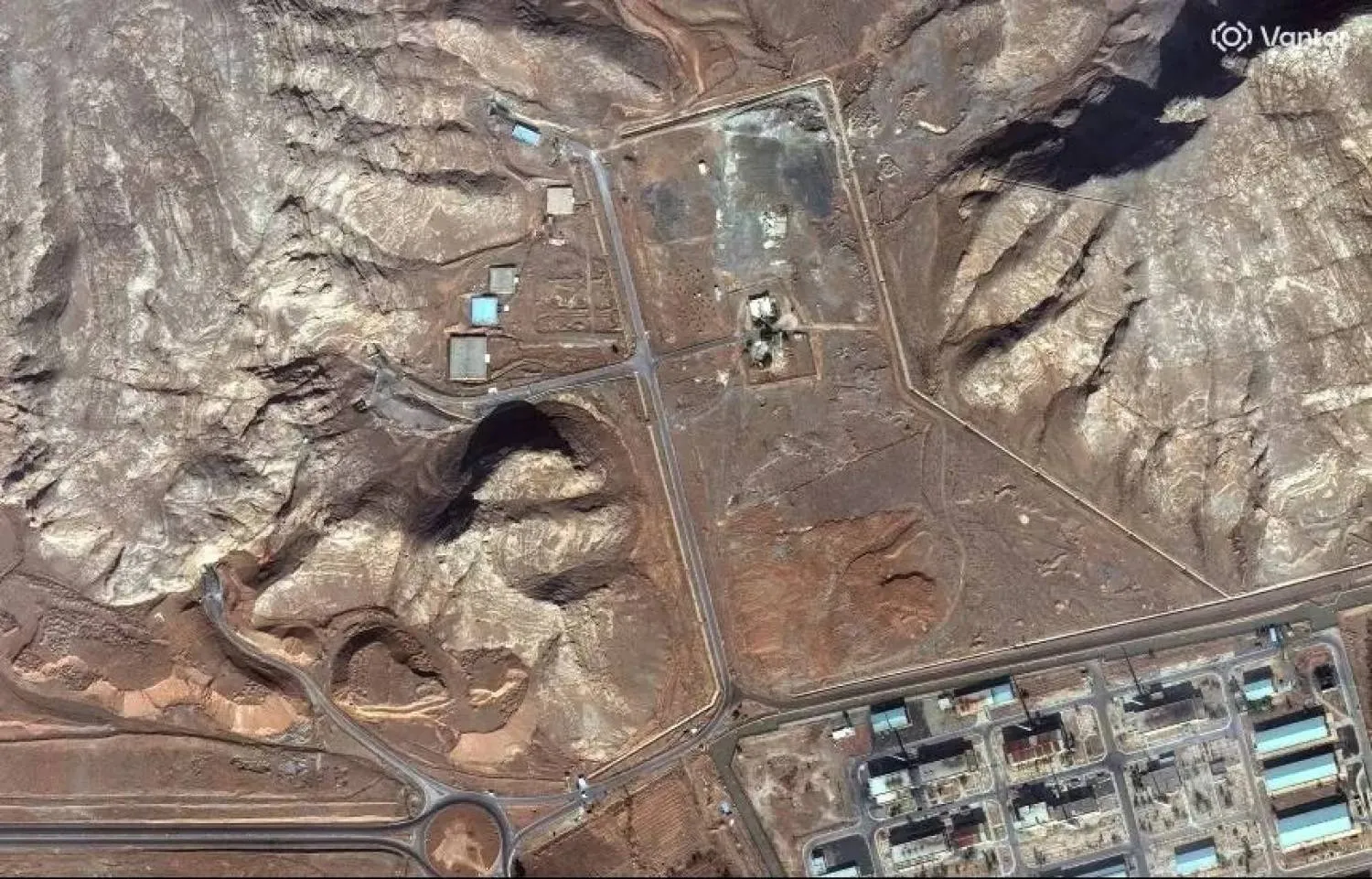
Satellite imagery shows an overview of a tunnel complex carved into rocky terrain near a developed facility area in Isfahan, Iran, on November 11, 2025. Maxar/DigitalGlobe/Getty Images
TT

Report: Iran Sealed Uranium Cache with Mines

Satellite imagery shows an overview of a tunnel complex carved into rocky terrain near a developed facility area in Isfahan, Iran, on November 11, 2025. Maxar/DigitalGlobe/Getty Images

In recent weeks, Iran has dramatically escalated efforts to seal off its cache of near bomb-grade uranium, deliberately collapsing tunnels and booby-trapping entrances with explosive mines, five sources familiar with US intelligence told CNN on Saturday.

Getting to the roughly half-a-ton of highly-enriched uranium is now far more difficult, dangerous and time-consuming than it already was just a month ago, when President Donald Trump was publicly signaling that he might order the US military to seize it, the sources said.

The new fortifications by the Iranians add an additional layer of complexity to the Trump administration’s proposed deal with Tehran to remove and destroy its uranium, and the move raises questions about who will take on the dangerous task of digging it out.

Trump has repeatedly stated that securing the material is a priority for the US in the ongoing negotiations to end the war and re-open the Strait of Hormuz, which Iran has effectively closed.

And according to a senior administration official who briefed reporters Friday, the two sides are inching closer to a deal that would require Iran to turn its enriched uranium over to the US. It would be destroyed on site and then taken out of the country, according to that official.

But US and Iranian officials have offered conflicting accounts of the tentative deal, and its precise terms remain unclear. The purported text of a draft deal leaked to a semi-official Iranian news agency Friday, triggering an angry outburst from Trump on social media.

Difficult and Dangerous Mission

Even for the Iranians themselves, several of the sources said, removing the enriched material would now be difficult and dangerous. It would require heavy excavation equipment and de-mining efforts — which are difficult and risky.

“If this reporting is true, it would definitely complicate ... retriev[ing] the HEU,” said Scott Roecker, who headed the National Nuclear Security Administration’s Office of Nuclear Material Removal from 2017 to 2021.

It could also offer an opportunity for Iran to obfuscate its compliance efforts.

If negotiators “require that Iran bring the entire stockpile to a central location for verification and ultimately to remove or downblend the material,” that would place the onus on Tehran to access and “provide the full inventory” of enriched uranium, Roecker said.

But, “in this scenario, I would worry that Iran would claim that some portion of the HEU was irretrievable,” Roecker said. “We wouldn’t have full confidence that Iran couldn’t retain access to it at some point in the future.”

The international community believes most of the stockpile is in collapsed tunnels at the Isfahan nuclear complex in central Iran, with some additional material held at other sites.

In mid-May, the military was prepared to conduct an operation to seize the nuclear material that was ultimately deemed to be too high-risk, CNN has previously reported
But in the time since then, Iran has only further fortified the sites where its highly enriched uranium is believed to be buried underground.

Protection of Nuclear Material

Trump has previously acknowledged the dangerous nature of retrieving the uranium by force, and he expressed skepticism in a May appearance on Fox News that the Iranians would ever be capable of accessing and retrieving the buried nuclear material without detection from US intelligence.

“We know exactly what’s happening,” Trump told Fox host Sean Hannity of the site. “Nobody’s even gotten close to it.”

But by publicly discussing the uranium as a possible target, two of the sources noted, the president may have provided Iran with the impetus to better defend its own assets.

Now, even if the agreement between Tehran and Washington is signed in the coming week, additional technical negotiations to hammer out the details on the future of Iran’s nuclear program are expected.

Removing the uranium from the country would likely require the deployment of a specialized mobile uranium facility organized under the National Nuclear Security Administration at Oak Ridge National Laboratory, Tennessee.

But even the world’s top nuclear removal experts would need significant time to complete their task — Trump told reporters earlier this month that removal would take at least two weeks to complete.



Macron Presents UK’s Starmer with France’s Highest Award

Britain's Prime Minister Keir Starmer arrives for the annual Bastille Day military parade on the Champs-Elysees Avenue in Paris on July 14, 2026. (AFP)
TT

Macron Presents UK’s Starmer with France’s Highest Award

Britain's Prime Minister Keir Starmer arrives for the annual Bastille Day military parade on the Champs-Elysees Avenue in Paris on July 14, 2026. (AFP)

Britain's outgoing Prime Minister Keir Starmer has been awarded France's highest honor, in recognition of his work on the security of Europe and Ukraine.

President Emmanuel Macron's office said he presented Starmer with the Legion d'honneur on Monday in Paris, where he was attending a summit of Ukraine's allies.

Starmer, who has been prime minister since winning a landslide election victory in July 2024, is the first UK prime minister to receive the award.

He is due to leave office within days after losing the confidence of his governing Labour party over a slew of domestic policy U-turns that hit his popularity.

In contrast, he is held in high regard by many foreign leaders on issues from Ukraine to forging closer European ties.

Starmer is due to be replaced as Labour leader and prime minister by Andy Burnham, a veteran former minister, who is also a pro-European centrist.

Starmer, 63, attended the annual July 14 military parade in central Paris as a guest of Macron, alongside other Ukraine allies.

Presenting the former human rights lawyer and chief state prosecutor with the legion d'honneur, Macron praised his "personal leadership" and "commitments" to "the security of Europe, Ukraine, the bilateral relationship" and his "decency".

Starmer and Labour's return to power, after 14 years in opposition, marked a sea-change in relations with Britain's closest European allies, including France.

Under the Conservatives, Britain left the European Union after a divisive 2016 referendum on membership.


UN Warns of Cracks in Global Immunization System

 Djoumessi Mabel, right, mother of a nine-month-old, attends a malaria vaccination session at the Soa District Hospital in Yaounde, Cameroon, Wednesday, April 29, 2026. (AP)
Djoumessi Mabel, right, mother of a nine-month-old, attends a malaria vaccination session at the Soa District Hospital in Yaounde, Cameroon, Wednesday, April 29, 2026. (AP)
TT

UN Warns of Cracks in Global Immunization System

 Djoumessi Mabel, right, mother of a nine-month-old, attends a malaria vaccination session at the Soa District Hospital in Yaounde, Cameroon, Wednesday, April 29, 2026. (AP)
Djoumessi Mabel, right, mother of a nine-month-old, attends a malaria vaccination session at the Soa District Hospital in Yaounde, Cameroon, Wednesday, April 29, 2026. (AP)

Global infant vaccination levels improved slightly last year, the UN said Wednesday, but warned that drastic funding cuts, conflicts and misinformation were deepening dangerous coverage gaps and allowing outbreaks to surge.

In 2025, 90 percent of infants globally, or nearly 116 million, received at least one dose of the vaccine against diphtheria, tetanus and pertussis (DTP), while 85 percent completed the full three-dose series, according to data published by the World Health Organization (WHO) and UNICEF, the United Nations' health and children's agencies.

On the surface, those numbers look promising, with both indicators up one percentage point from 2024 and up four points since 2021.

But they remained one point below the levels in 2019 -- before the Covid pandemic wreaked havoc on global vaccination programs.

This means "millions of vulnerable children are still being left unprotected due to conflict, displacement, and poverty", UNICEF chief Catherine Russell said in a statement.

"No child should suffer from a disease that a simple vaccine can prevent," she insisted.

According to the data, an estimated 13.5 million so-called zero-dose children did not receive a single shot in their first year during 2025.

That was 750,000 fewer than in 2024, and around one million fewer than in 2023.

- 'Unprecedented numbers of outbreaks' -

The UN agencies warned that a growing number of children, mainly in poorer countries, start on the vaccine schedule but do not complete it.

Globally, the data showed that an estimated 7.3 million infants had received their first DTP dose in the first months of life, but did not go on to receive their first measles dose, usually given at between nine and 12 months.

While there can be many reasons for such dropouts, "we think that this is clearly related in some settings to false information, misinformation that is provided around measles vaccination", the WHO's vaccines director Kate O'Brien told reporters, adding that this was of "very significant concern".

Dropouts have contributed to measles coverage stalling at 84 percent of children globally receiving their first measles dose, and just 77 percent receiving the second dose -- far short of the 95 percent needed to avert the spread of the highly contagious disease.

"The consequence is being felt now," O'Brien said, pointing out that "57 countries reported in 2025 large or disruptive measles outbreaks".

Overall, the world saw "unprecedented numbers of outbreaks" last year, she said, with "more diphtheria outbreaks, more cholera outbreaks", in addition to the measles spread.

- Surveillance 'considerably impacted' -

O'Brien cautioned that this was a first hint in the data of the impact of dramatic aid cuts by the United States but also other countries since US President Donald Trump's return to office last year.

"We don't think that the impact of those funding cuts is showing up yet fully in the 2025 data," she said, adding that "our concerns are very much for what's happening in programs in 2026 and what is yet to come".

The outbreaks were however already indicating "real cracks in the system now for immunization", she warned.

UNICEF's immunization chief Ephrem Lemango agreed, cautioning that funding cuts were taking a toll on the data systems needed to track the effect of such cuts.

"Our ability to have a strong surveillance of outbreaks has been considerably impacted," he told reporters.

Only 18 national immunization surveys were undertaken and submitted for 2025, down from 50 a year earlier.

On a positive note, Wednesday's report showed that vaccine coverage against a range of diseases had hit a record high in the 57 low-income countries supported by the vaccine alliance Gavi.

But that organization warned that dwindling funding for its operations risked taking a dire toll down the road.

"We believe that 600,000 lives that could have been saved will be impacted", Gavi's chief country delivery officer Thabani Maphosa told reporters.


Iran Hangs Man Convicted for Part in January Protests

Iranian women walk past a mural of late Iranian Supreme Leader Ali Khamenei on a street in Tehran, Iran, 15 July 2026. (EPA)
TT

Iran Hangs Man Convicted for Part in January Protests

Iranian women walk past a mural of late Iranian Supreme Leader Ali Khamenei on a street in Tehran, Iran, 15 July 2026. (EPA)

Iran hanged a man on Wednesday, the judiciary announced, after finding him guilty of taking part in anti-government protests that rocked the country over the winter.

"Mohammad Amini Dehaghani, a collaborator with the enemy, was hanged this morning after confirmation of the verdict by the supreme court," the judiciary's press agency reported.

He was found guilty of "moharebeh" (war against God in Persian) and "corruption on earth".

The condemned had "thrown a Molotov cocktail on January 9 outside the governor's office in Dehaghan, set it alight and destroyed public property as well as the town's police station," state media added.

At the end of December, protests against the cost of living in Iran spread rapidly across the country and expanded to include political demands.

The protests were met by a crackdown that rights groups say killed thousands.

Iranian authorities have portrayed the protests as riots backed by the United States and Israel, and said the violence killed around 3,000 people.

Rights groups abroad put the toll higher and accused the security forces of firing at demonstrators.

The number of executions has surged since the start of the Middle East war, begun by the United States and Israel against Iran on February 28.

According to Amnesty International, Iran conducts the second most executions of any country, after China.