


June 26 Revolution: Calls for Gaza Protests Against Hamas

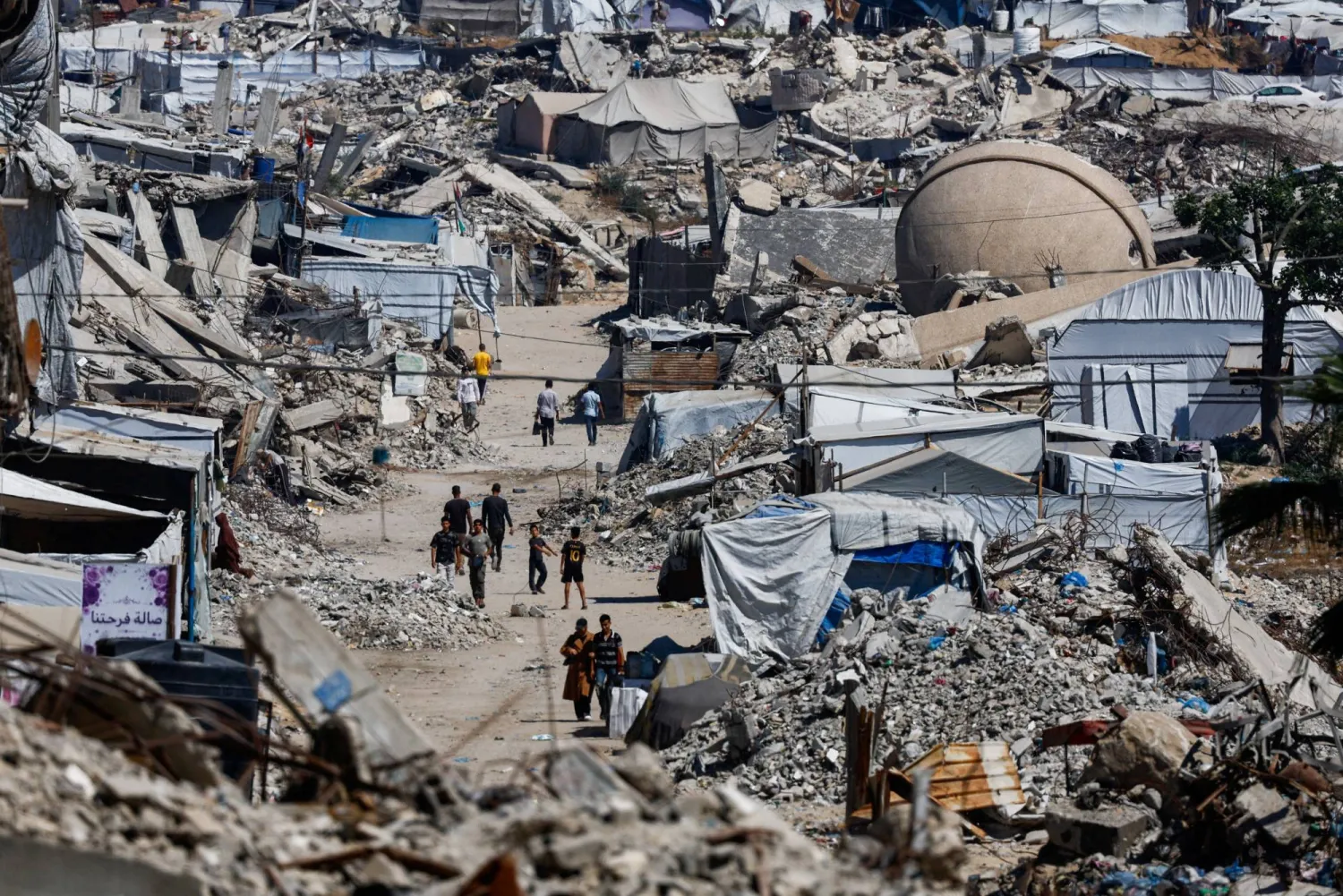
Palestinians walk past the rubble of residential buildings destroyed during the war, at the Jabalia refugee camp in the northern Gaza Strip, June 12, 2026. REUTERS/Mahmoud Issa
TT

June 26 Revolution: Calls for Gaza Protests Against Hamas

Palestinians walk past the rubble of residential buildings destroyed during the war, at the Jabalia refugee camp in the northern Gaza Strip, June 12, 2026. REUTERS/Mahmoud Issa

Palestinian activists have called on social media for mass protests against Hamas and its continued rule over the Gaza Strip, setting June 26 as a day of demonstrations across the enclave, in a repeat of earlier movements that were suppressed in past years.

The activists have named the campaign the “June 26 Revolution,” calling on people to take to the streets to demand a dignified life under the slogan: “For a better life and a promising future ... the people’s right to decide their fate.”

Facebook debate

Journalist and activist Abdul Hamid Abdul Ati was the first to call for and adopt the movement. A Gaza resident, he left for Egypt with his family during the war after a previous bombardment killed and wounded many of his relatives.

In a series of posts and tweets to his thousands of followers, Abdul Ati said: “The movement is not against anyone. It is for the public interest and to save what can be saved from a reality that weighs heavily on the people of Gaza ... We are one people, bound by pain and a shared fate. Our aim is to extend a helping hand to our people and search for a way out of this harsh predicament. Difference of opinion does not justify threats, and unity remains the shortest path to protecting everyone.”

Activists known for opposing Hamas, including some who joined or called for similar movements years ago, backed Abdul Ati’s call and urged Gazans to take part. The appeal triggered a storm of reactions, some critical and others supportive.

Most of those calling for participation are now outside the strip, having left during the war or, in some cases, years earlier, after being detained by the Hamas government over similar events. Fewer voices inside Gaza have backed the movement, most of them less influential than other figures who remain in the enclave and have stayed silent.

Accusations and intimidation

As public debate widened, Hamas-affiliated media kept trying to discredit the movement and those behind it. Hamas controls part of the Gaza Strip after Israel seized more than 60% of the territory.

Activists aligned with the group mounted similar campaigns, accusing the organizers of serving foreign agendas and exploiting Israel’s escalation to launch the movement. They said those outside the strip had no right to speak for people living in displacement tents, shelters and other sites while they themselves lived abroad.

Abdul Ati said the accusations by Hamas and its supporters against him and other organizers abroad were an attempt to dodge the core issue.

“A Palestinian remains Palestinian wherever he is, whether in Gaza, the West Bank or the diaspora, and he has the right to speak about his people’s suffering and express his opinion freely,” he told Asharq Al-Awsat.

He said, “The movement has no foreign agendas and does not seek to serve one side at the expense of another. It is born of a reality people live every day and of clear popular demands everyone knows: dignity, justice, genuine representation and an end to collapse. It is not a conspiracy, but a natural right of any people.”

He said Gaza’s accumulated crises had pushed him and many journalists, activists and others to raise their voices. He strongly denied that they were trying to exploit the current situation in the strip as Israeli escalation continues.

“What is needed is not to exploit anyone, but to listen to people and respect their right to express their opinions and legitimate demands,” he said.

Abdul Ati added: “The goal of the movement at this stage is to carry the voice of the people and their real suffering to the world, and to demand their right to a dignified life, security and stability. We believe confronting Israeli aggression is a national priority, but that does not cancel citizens’ right to express their pain and legitimate demands after long years of war, poverty, displacement and suffering ... The revolution is not against the people or their steadfastness. It is a movement for the Palestinian person and his right to a better future, for strong national institutions, sound political life, and a popular will that is heard and respected.”

Abdul Ati and other activists played down threats they said had targeted their families, saying they would press ahead with the movement.

Right to protest

Activists rejected claims that the movement betrayed the sacrifices of Palestinians killed during the war. They said residents had the right to protest and demand a dignified life, adding that those expected to take to the streets were the same people who had lost children and homes, were living in tents, and were queuing for water and charity kitchens.

Dr. Jamil Abdul-Nabi, a leader in Islamic Jihad in northern Gaza, said in a Facebook post that residents had the right to express their anger after disasters that words could not describe. He has repeatedly said his positions represent him personally.

“The least we can do is give them the right to scream from the intensity of the pain,” he said, describing accusations of “treason” against such a movement as part of dictatorship and a justification for repression.

Hamas anger

The movement’s reverberations appear to have moved beyond exchanges of accusations between activists on both sides, and even beyond interventions by activists affiliated with other factions such as Fatah. They have reached the official level inside Hamas, where the group has shown anger.

Hamas spokesman Hazem Qassem said in a press statement: “There are those who are rushing the fall of our great movement, relying on the promises of a stupid enemy. All of them will wait a long time, then be surprised by a movement that is more deeply rooted in its people and more present. These are authentic people who always stand with their blessed sons who are sincere in their love for their homeland. They will remain so, and these great people will remain loyal to them.”

A day later, Qassem said Hamas places the higher interest of the Palestinian people at the heart of its political and diplomatic activity, in a way that would allow the war to stop, open a new horizon for reconstruction, and enable the national committee for Gaza to be managed professionally to launch a real relief operation easing the scale of the catastrophe in the enclave.

That appeared to be an indirect reference to the movement’s demands for a better life, especially an end to the suffering of people living in displacement tents.

Analysts and media figures aligned with Hamas and factions close to it, including Hassan Lafi, said the movement could harm efforts to pull Gaza out of its crises and could create “major internal strife in Gaza under the title of undermining what remains of civil and social peace.”

Asharq Al-Awsat has learned that the security services of the Hamas government have been ordered to remain on alert on the day set for the protests and to intervene only when necessary, in a way that protects personnel from Israeli attacks.

Israeli forces have frequently targeted police officers and government security personnel recently as they tried to control security and resolve disputes between families, killing and wounding many of them.


Meeting between al-Zaidi, Trump Raises Questions in Baghdad

Iraqi Prime Minister Ali al-Zaidi meets with US President Donald Trump in New York on September 23, 2026. (Iraqi government)
TT

Meeting between al-Zaidi, Trump Raises Questions in Baghdad

Iraqi Prime Minister Ali al-Zaidi meets with US President Donald Trump in New York on September 23, 2026. (Iraqi government)

A meeting between US President Donald Trump and Iraqi Prime Minister Ali al-Zaidi in New York has raised questions due to the complete absence of the Iraqi delegation, coming just one day after Baghdad’s announcement that it would complete the plan to impose state monopoly over arms in June 2027.

The plan was supposed to be complete by the end of September, but it was postponed to next year.

A photograph released by the Iraqi government's media office on Wednesday showed al-Zaidi alone during the meeting, which was attended by Trump alongside senior US administration officials, including US Secretary of State Marco Rubio and Treasury Secretary Scott Bessent.

Al-Zaidi's office said that he discussed with Trump efforts by Iraq and the US to boost regional and international security and stability.

The government offered no explanation about the absence of the Iraqi delegation, which included the ministers of foreign affairs, finance, and electricity, and other officials.

Iraqi observers said al-Zaidi attended the meeting alone due to American suspicions that the discussions may be leaked to other delegation members, who are members of the Iran-aligned Coordination Framework coalition.

An Iraqi politician close to the State Administration coalition said the way the meeting was held “reflects American unease, especially by Trump, over the stalled process to impose state monopoly over weapons.”

According to official statements, September 30 will not mark the completion of the arms control process, but it will instead serve as the launching point for a new phase extending until June 2027.

Iraqi Prime Minister Ali al-Zaidi meets with US Secretary of State Marco Rubio in New York. (Iraqi government)

Al-Zaidi has evidently managed to convince the Americans to grant an additional grace period for the arms control plan, particularly after the new deadline was backed by US envoy to Iraq Tom Barrack.

Independent Iraqi politician Salah al-Arbawi said it remains to be seen whether the timetable that will be announced at the end of the month will tip the balance in favor of any political parties in the dispute over the factions’ weapons.

In remarks to Asharq Al-Awsat, he said the political parties must handle the factions’ weapons “rationally and calmly.”

He noted that al-Zaidi has managed to restore his control over the plan after it encountered obstacles in recent weeks.

Experts believe that recent discussions on the amendment of the arms control plan could turn into an opportunity to improve Iraqi-American relations.

Researcher Abbas Abboud said that the Iraqi-American relationship is being “restructured” by Barrack.

Baghdad’s relations with Washington’s allies in the region hinge on “decoupling Iraq from Iran”, he told Asharq Al-Awsat.

US Secretary of State Marco Rubio had issued a direct warning to Baghdad to "disarm the militias to avoid the balkanization of Iraq."

Rubio underlined US support for al-Zaidi's government in its efforts to consolidate state authority, urging the need to dismantle armed factions.


Lebanon PM Tells Iran President Country Cannot Be Arena for Regional Wars

Lebanese Prime Minister Nawaf Salam and Iranian President Masoud Pezeshkian meet on the sidelines of the UN General Assembly in New York. (NNA)
TT

Lebanon PM Tells Iran President Country Cannot Be Arena for Regional Wars

Lebanese Prime Minister Nawaf Salam and Iranian President Masoud Pezeshkian meet on the sidelines of the UN General Assembly in New York. (NNA)

Lebanese Prime Minister Nawaf Salam told Iranian President Masoud Pezeshkian on Thursday that his country did not want to be an arena for regional wars, after Tehran-backed Hezbollah drew it into the Middle East conflict.

Lebanon has repeatedly accused Iran of interfering in its affairs, especially since the start of the latest war, saying that Tehran was using it as a "bargaining chip" in talks with the United States.

Salam's office said in a statement that he met with Pezeshkian on the sidelines of the United Nations General Assembly in New York.

Salam "stressed that Lebanon has paid a heavy price in terms of its security, stability and economy, and that it does not want to become an arena for regional conflicts or a venue for the exchange of messages between others", it said.

Hezbollah dragged Lebanon into the broader Middle East war, which began with Israeli-US strikes on Iran, by attacking Israel in support of Tehran on March 2.

Israel responded with major airstrikes and a ground invasion that killed more than 4,300 people.

The war followed a 2023-2024 conflict between Hezbollah and Israel, which started when the group attacked Israel in support of its ally Hamas in the Gaza Strip.

Violence declined following a June framework agreement between Lebanon and Israel and a wider US-Iran deal, but Israel has continued to carry out attacks on its northern neighbor.

Salam said his country looked forward "to turning a new page" in its ties with Iran.

He called for "building a sound state-to-state relationship based on mutual respect for each country's sovereignty and independence, non-interference in each other's affairs and shared interests".

Salam said the priority was for "Israel to fully withdraw from Lebanese territory and cease its attacks, and for Lebanon to move forward with extending the authority of the Lebanese state over all of its territory".

He said Lebanon needed to ensure "that weapons are held exclusively by the state", in a jab at Hezbollah, which has so far refused to lay down its arms.

In an interview with AFP last week, Lebanese President Joseph Aoun said bilateral relations "must be based on mutual respect and non-interference".


US to Hand Over Center at Baghdad Airport, Says Iraqi FM

A man walks past a billboard displaying the Iraqi flag in Baghdad's central Tahrir Square on September 22, 2026. (AFP)
TT

US to Hand Over Center at Baghdad Airport, Says Iraqi FM

A man walks past a billboard displaying the Iraqi flag in Baghdad's central Tahrir Square on September 22, 2026. (AFP)

The United States will transfer to Iraq a diplomatic and logistics hub at Baghdad airport that was repeatedly targeted by Iran-backed groups during the Middle East war, the foreign ministry said Thursday.

It said an agreement was signed with the US charge d'affaires Steven Fagin "to hand over the diplomatic support center affiliated with the US embassy at Baghdad International Airport to the Iraqi government".

The move, it added, was part of efforts to end the US-led coalition's military presence in Iraq, with the remaining troops set to complete their exit by September 30.

For years, Iran-backed armed groups that have long called for the withdrawal of foreign troops have targeted US facilities and coalition forces in Iraq.

During the Middle East war, those groups targeted US sites more than 600 times, including the Baghdad airport facility.

An Iraqi security official and a diplomatic source told AFP earlier this month that US troops have already evacuated the site.

Baghdad and Washington agreed in 2024 to end the coalition's mission against the ISIS group in Iraq.

Coalition forces are now only present at Erbil airport after having withdrawn from other bases.

The coalition's presence, especially after the defeat of ISIS, has been a persistent point of friction between Iraqi authorities and Tehran-backed factions in the country.

Since taking office this year, Prime Minister Ali al-Zaidi has pledged to reinforce the state's monopoly on arms and ensure that armed factions hand over their arms to the state.

Authorities say that ending the coalition's mission removes a key justification used by those groups to keep their weapons.