



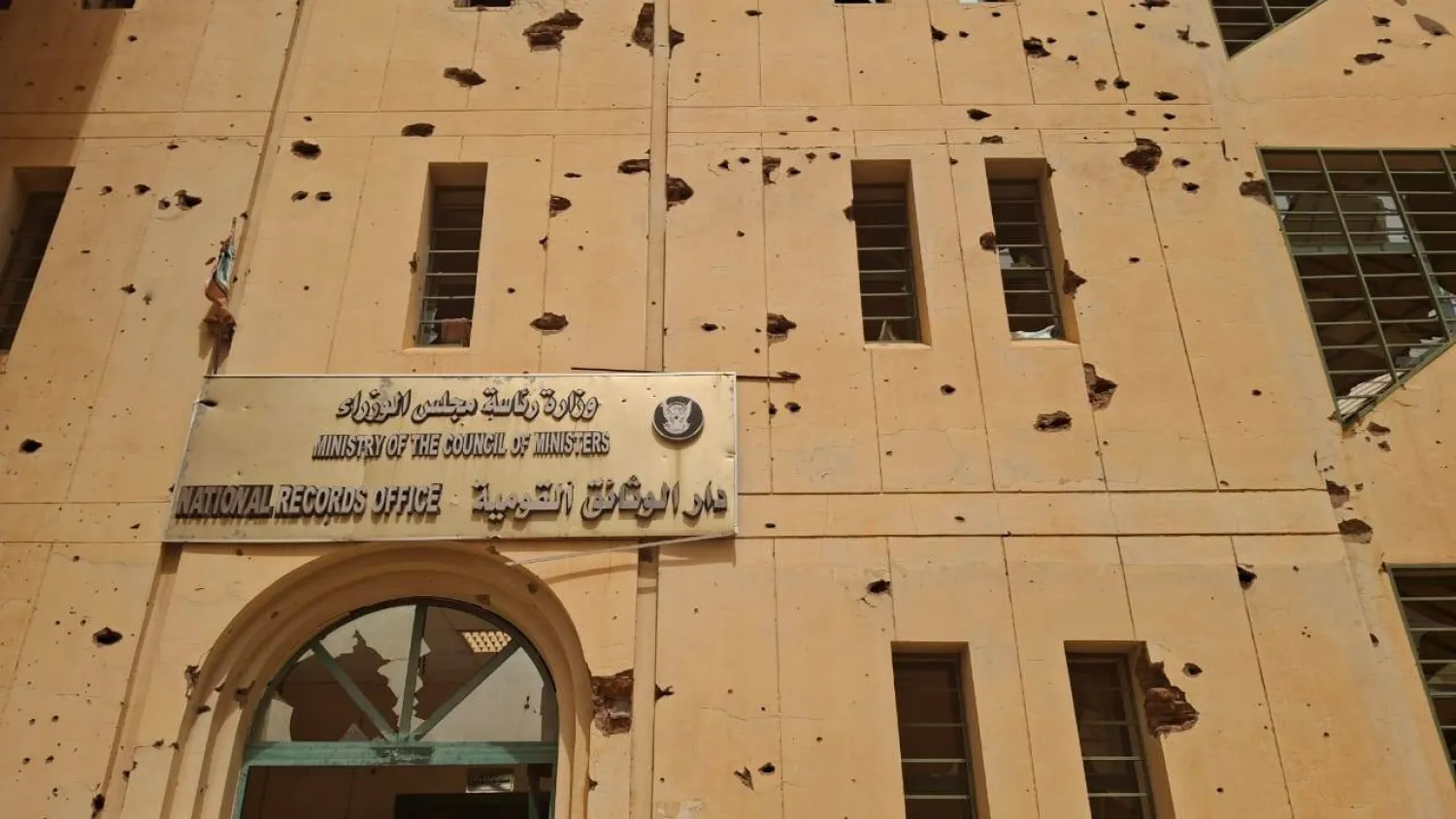

Near the Sudanese army’s general command in Khartoum, millions of documents chronicling more than five centuries of Sudanese history sit inside the National Records Office, exposed to harsh wartime conditions.
Rubble and dust surround the building, which now faces the risk of further damage after sustaining extensive destruction.
The National Records Office fell under the control of the Rapid Support Forces in the first hours of the war in April 2023. Fierce fighting around the site left visible scars on the four-story building, including fire damage, destruction and structural harm that still reflect the intensity of the battles in the area.
The office holds more than 30 million historical documents collected since 1505, forming a comprehensive record of Sudan’s political, administrative and social history.
Although most of the documents survived fires that swept through large parts of the building, their continued storage in a damaged and unsuitable environment threatens their long-term survival.
Dr. Nagwa Mahmoud, director of the National Records Office, told Asharq Al-Awsat that most of its contents had survived the wartime fires. But she warned that keeping them in a damaged building could destroy old documents and manuscripts, especially those already weakened by age and fragility.
She said the office’s electronic archive had been lost, adding that the administration had prepared a digital transformation plan to begin once the documents are organized.
“We have contacted the Ministry of Communications and relevant government bodies to provide the necessary support to implement the plan, ensuring that this national heritage is protected from future risks,” she said.
After the Sudanese army regained control of Khartoum state in March 2025, the government issued a decision to relocate several state institutions from the capital's center. The decision included the National Records Office.
Mahmoud said the office had asked the Council of Ministers to exempt it from the relocation decision, stressing that the current building had been constructed in accordance with special standards for preserving historical documents and the national archive.
She said moving more than 30 million documents would pose a major logistical challenge and require an alternative site with the same technical specifications to protect them from damage and environmental factors.
Mohamed Youssef, director of the office’s General Documentation Department, voiced concern about the risks facing the documents as the rainy season approaches. He said shells that struck the building had left large openings in the ceilings, which could allow rainwater to leak into halls and storage rooms.
He said the office had memorandums of understanding with archival institutions in several Arab and African countries. He noted that important Sudanese documents were preserved at Egypt’s National Archives, along with other archives at the Arab League, particularly in documentation and archiving departments.
Documents on the floor
Inside the building, the traces of war are visible in every corner. Old manuscripts lie scattered across the floor, documenting different stages of Sudan’s history. Nearby are images of leaders who ruled the country since independence, along with documents from the Mahdist state and the Anglo-Egyptian period.
The building also contains a vast archive of Sudanese journalism spanning decades.
The ground floor, which once housed specialized laboratories and dozens of computers, was completely looted, according to officials at the office. Yet the last book digitized just days before the war began remains in place, capturing the contrast between what survived and what was lost from the country’s memory.
Despite the scale of the challenges facing the institution, officials are holding on to hopes of securing government approval to remain in the current headquarters, rehabilitate the building and restore its role in preserving Sudan’s national memory.
The roots of the National Records Office date back to 1916, when official documents were managed through the office of Sudan’s governor-general, with the participation of the financial, judicial and administrative secretaries, who preserved documents issued by state institutions at the time.
In 1965, the National Records Office Law granted the institution national status and independent legal personality. It gave the office responsibility for preserving and managing official documents produced by state institutions, as well as civil and private documents of historical value, making it the official guardian of Sudan’s national memory.


