


Iraq Accelerates Efforts to Resolve Armed Factions Issue, Complete Government Formation

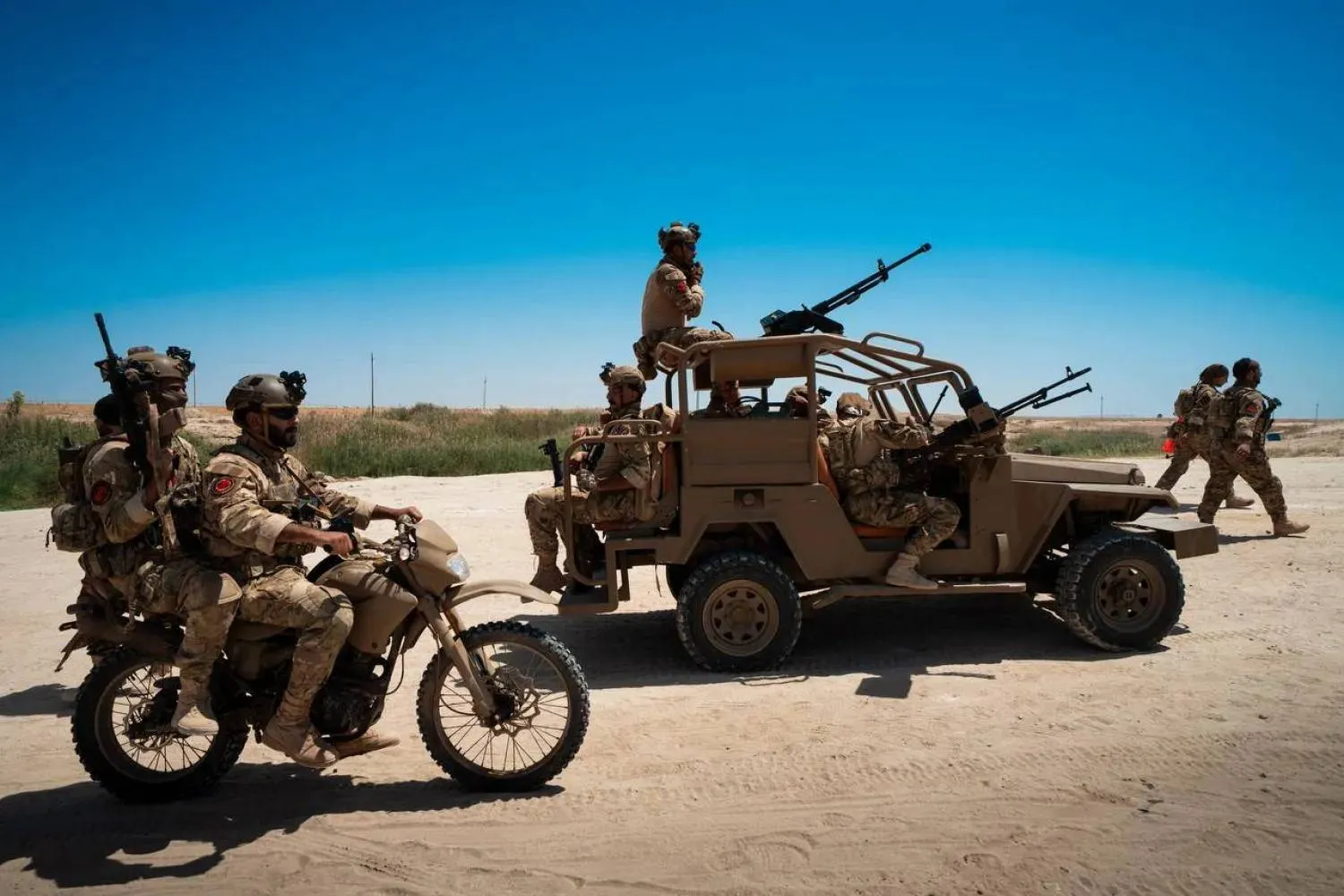
A patrol of Iraq's Popular Mobilization Forces (file photo - Popular Mobilization Forces website)
TT

Iraq Accelerates Efforts to Resolve Armed Factions Issue, Complete Government Formation

A patrol of Iraq's Popular Mobilization Forces (file photo - Popular Mobilization Forces website)

As Baghdad prepares to finalize the proposed agenda for Iraqi Prime Minister Ali Al-Zaidi’s visit to the United States, in coordination with Washington, an Iraqi official source told Asharq Al-Awsat that the expected visit of US envoy Tom Barrack to Iraq will “determine the final agenda for the visit and its key areas of discussion across different sectors and fields.”

The same source said that “work is underway to prepare all bilateral concerns and issues, whether those already agreed upon and ready to be turned into agreements and memorandums of understanding, or those that remain under discussion, foremost among them the details of disarming the armed factions and the US veto on some armed political groups participating in the government, despite their declared willingness to disarm and hand over their weapons to the state.”

Asked whether Barrack’s visit to Baghdad is intended to discuss the prime minister’s Washington agenda or had already been scheduled, the official source said: “Tom Barrack coordinates relations between Baghdad and Washington and therefore visits Baghdad periodically for that purpose. He also discusses unresolved issues between the federal government and the Kurdistan Regional Government, which the US administration is keen to see resolved, particularly those related to oil.”

The source added that Barrack’s upcoming visit falls within that framework, as he will also travel to Erbil.

“Accordingly, the remaining unresolved issues, especially oil, will be on the agenda because they are among the issues the Iraqi delegation will take with it to Washington.”

Regarding completion of the cabinet, which still lacks roughly nine ministers, the source said the prime minister is holding talks with political forces to fill the remaining posts, hoping the government lineup will be completed before the Washington visit.

He added that this issue will also be discussed with Barrack in Baghdad, particularly because some ministerial portfolios are expected to go to political groups that won substantial parliamentary representation and therefore qualify for more than one ministry. Resolving the matter requires discussions with the US side to lift its veto after those groups decided to hand over their weapons to the state.

On unresolved issues with the Kurdistan Region, the government source explained that there are two categories of disputes with Erbil.

“One category is longstanding and repeatedly resurfaces. It is related to constitutional matters and is not expected to be resolved, nor is it likely to feature prominently during Barrack’s visit to Baghdad and Erbil. The second category concerns normal political disagreements, including oil exports through the region’s outlets, the region’s share of federal ministries, and disputes between the two main Kurdish parties and their impact on relations with Baghdad.”
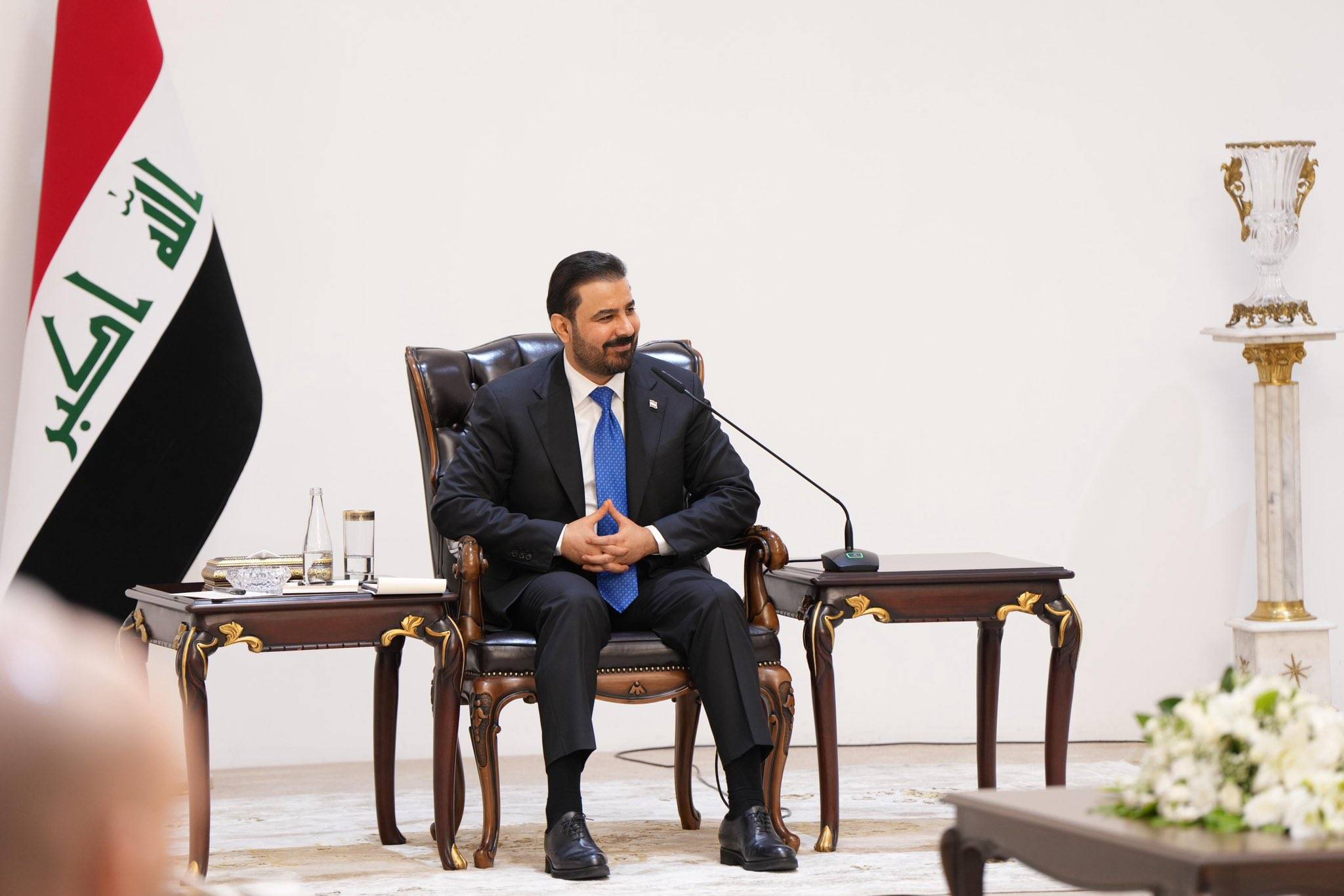
Popular Mobilization Forces Chairman Falih Al-Fayyadh (Iraqi Prime Minister's Office)

Meanwhile, Popular Mobilization Forces Chairman Falih Al-Fayyadh on Sunday called on Prime Minister and Commander-in-Chief of the Armed Forces Ali Al-Zaidi to relocate PMF camps outside urban areas.

Speaking at the official central ceremony marking the 12th anniversary of the PMF’s establishment, Al-Fayyadh said the force “stands against sectarianism and has contributed to building a national partnership in which members of all communities and religions fight in the same trench, contrary to claims that it is a sectarian project.”

He stressed that the PMF “represents all Iraqis and has enabled minority groups to defend their own areas.”

Al-Fayyadh called on the government and relevant authorities to “provide suitable alternative camps for the Popular Mobilization Forces, ensuring the completion of their full deployment outside city centers and provincial capitals.”

For his part, Mokhtar Al-Moussawi, a member of the Iraqi parliament’s Foreign Relations Committee, said the issue of factional weapons in Iraq is not a matter of a “direct handover” but rather part of broader regional and international calculations. He noted that “the US administration understands the nature of the game just as the armed factions do.”

Al-Moussawi said there is division within the Popular Mobilization Forces structure and that the factions are not united in their positions. Some have expressed readiness to hand over their weapons or sever organizational ties, while others categorically reject such steps.

He added that Iraq’s political landscape is closely linked to regional developments.

“Iraq’s foreign policy remains unstable, and at this particular stage we are seeing a path of understandings between Iran and the United States moving toward an agreement. If such an agreement is signed, there will be an entirely different approach to dealing with the weapons issue in Iraq.”

Al-Moussawi, a lawmaker from the Badr bloc, which is included in the disarmament process, said Iraq does not have full control over the matter and that a large part of the understandings is managed in Washington and Tehran.

He added that factional weapons are directly linked to the outcome of any potential US-Iran agreement. He also stressed that what is currently taking place amounts to temporary political balancing and that the weapons file could be revisited in a different manner after any agreement is signed between the two sides.

Separately, Baghdad has provided security guarantees to Erbil regarding the protection of oil fields in the Kurdistan Region from attacks periodically carried out by armed factions.

According to a political source who disclosed details of a military delegation’s visit to Erbil led by Chief of Staff Lt. Gen. Abdul Amir Rashid Yarallah, the delegation held a series of meetings and field visits to several oil fields to assess security conditions and discuss measures needed to protect facilities and personnel.

The source added that the delegation provided direct security assurances to oil companies operating in the region, affirming that attacks targeting oil sites would not be repeated.

Kurdistan Region Prime Minister Masrour Barzani received the delegation. According to an official statement, the delegation chief briefed him on the objectives of the visit, which was undertaken under directives from the federal prime minister to follow up on efforts to maintain security and stability, particularly the protection of oil companies and the prevention of attacks against them.

Barzani expressed his appreciation to Al-Zaidi for his follow-up efforts and assurances regarding the security and stability of the Kurdistan Region, reaffirming the regional government's full support for these steps.

He also renewed his call for stronger cooperation and coordination between the Peshmerga forces and the Iraqi army to address shared security and military challenges and threats.



Palestinian Authorities Say Israeli Army Kills Teen in West Bank

Mourners carry the body of Palestinian Islam Ajouri, 14, at Rafidia Hospital in Nablus in the Israeli-occupied West Bank, on August 23, 2026. (Photo by JAAFAR ASHTIYEH / AFP)
TT

Palestinian Authorities Say Israeli Army Kills Teen in West Bank

Mourners carry the body of Palestinian Islam Ajouri, 14, at Rafidia Hospital in Nablus in the Israeli-occupied West Bank, on August 23, 2026. (Photo by JAAFAR ASHTIYEH / AFP)

Israel's military killed a Palestinian teenager in the occupied West Bank on Sunday, Palestinian health authorities said, while an Israeli and a Palestinian were wounded in separate incidents.

Israeli gunfire killed Islam Ahmad Maher Ajouri, 14, in the Askar refugee camp where he lived, outside Nablus in the north of the West Bank, the Palestinian health ministry announced.

Mohammed Abu Kashk, head of the Askar camp services committee, told AFP that the teenager was killed by Israeli forces during a raid on the camp.

"There were no clashes or confrontations that would justify shooting a child and killing him," he said.

According to a source from the Palestinian Red Crescent, Ajouri was hit in the chest by live ammunition. He was pronounced dead at Nablus National Hospital.

At his funeral, his uncle Ahmed Mohamed Zamzoum told AFP that the boy went outside during the army raid. "Every time the Israeli forces enter, one or more martyrs are killed," he said.

The Israeli army told AFP it was verifying the information.

In a separate incident, the army said it apprehended a man suspected of stabbing an Israeli earlier on Sunday in Al-Auja, in the central West Bank.

Israeli rescue service Magen David Adom said the 24-year-old victim had "a penetrating wound".

The man was evacuated to a hospital in Jerusalem, and his condition was described as "moderate".

According to the initial findings of the investigation, the victim parked near a shopping center and was "attacked from behind and stabbed in the shoulder", Israeli police said in a statement.

Hani Najum, the head of the Al-Auja village council, told AFP that "the Israeli army raided the village, deployed in its streets" and imposed a curfew.

In a third incident, the army reported that a "terrorist" attempted "to steal a weapon from an IDF soldier" near the Palestinian town of Taybeh, northeast of Ramallah, and that forces opened fire at the man, saying he was "neutralized".

Palestinian sources told AFP that the man, Aws Akram Maatan, from the village of Burqa east of Ramallah, suffered an injury to his foot and was taken to a Jerusalem hospital for treatment.

The head of the Burqa village council, Sayel Kanaan, said in a statement that Maatan had been shot "without justification".

Violence has surged in the West Bank, which Israel has occupied since 1967, since the start of the war in Gaza sparked by Hamas's October 2023 attack on Israel.

Israeli soldiers or settlers have killed at least 1,100 Palestinians since then, according to an AFP tally based on data from the Palestinian health ministry.

Over the same period, at least 48 Israelis have been killed in Palestinian attacks or during Israeli military operations, according to Israeli figures.


Tunisia Says Recovered 11 Migrants' Drowned Bodies

African migrants rescued by the Tunisian coast guard in October (AFP)
TT

Tunisia Says Recovered 11 Migrants' Drowned Bodies

African migrants rescued by the Tunisian coast guard in October (AFP)

The Tunisian national guard said Sunday it recovered 11 bodies from the sea after a boat carrying migrants sank off the country's southeastern coast, with three people still missing.

The boat was carrying 15 people, only one of whom was rescued after it sank some 14 nautical miles off the shore of Zarzis on Friday night.

"Search operations resulted in the recovery of three bodies yesterday and eight bodies today, bringing the total to 11," the national guard said in a statement.

Searches for the three remaining missing passengers were ongoing, it added.

On Saturday night, residents in Ben Guerdane -- the marginalized city near the Libyan border where 14 of the migrants were from -- staged protests, blocking roads and setting tires on fire over the shipwreck.

Tunisia, whose coast is some 145 kilometers (90 miles) from the Italian island of Lampedusa, is a key departure point for migrants seeking to make the perilous journey across the Mediterranean in search of better lives in Europe.

The central Mediterranean crossing is the deadliest migration route in the world, according to the International Organization for Migration (IOM).

The IOM said earlier this month that the number of migrant deaths on the central Mediterranean route had more than doubled in the first four months of 2026 compared to the same period last year.

At least 914 migrants have died or gone missing along the route this year, according to the IOM.

In 2023, Tunisia signed a 255-million-euro ($290 million) deal with the European Union, nearly half of which was earmarked for tackling irregular migration.

The deal, strongly supported by Italy's hard-right government, aimed to bolster Tunisia's capacity to prevent boats leaving its shore.


The 'Ali al-Taher' Battle: A Test of Hezbollah’s Capabilities

A protester shouts slogans while holding a portrait of the late Hezbollah leader Hassan Nasrallah during a protest against the backdrop of Lebanon-Israel talks and the normalization of relations, in Beirut, Lebanon, Friday, Aug. 7, 2026. (AP Photo/Hussein Malla)
TT

The 'Ali al-Taher' Battle: A Test of Hezbollah’s Capabilities

A protester shouts slogans while holding a portrait of the late Hezbollah leader Hassan Nasrallah during a protest against the backdrop of Lebanon-Israel talks and the normalization of relations, in Beirut, Lebanon, Friday, Aug. 7, 2026. (AP Photo/Hussein Malla)

The battle for the “Ali al-Taher” heights is placing Hezbollah before a difficult test that goes beyond its ability to defend the hill and prevent its fall. It also tests the effectiveness of the military strategies it has recently developed after conventional strategies failed over the past two years to counter Israel’s military and technological superiority.

Can Israel, through firepower, air power and surveillance, suffocate the force deployed in the area and undermine the conditions needed for its survival? Or can the underground fortifications, tunnels, storage facilities and combat capabilities prepared by Hezbollah give it room to continue wearing down Israeli forces and prolong the confrontation?

Ability to Maneuver

Retired Brigadier General Bahaa Hallal says that, regarding Hezbollah’s military position, “the land still has strategic value for it, but its defensive value automatically declines if it shifts from a controlled area to an exposed area under surveillance.” He explains: “The party’s core strength is not simply holding the hilltop, but its ability to operate in depth and particularly in the surrounding area, while Israel seeks to turn its air and intelligence superiority into permanent ground superiority.”

Hallal told Asharq Al-Awsat that “the main challenge facing Hezbollah is maintaining its ability to maneuver. If Israel manages to establish a presence, impose a buffer zone around the hill and prevent the party from moving, the balance of power will gradually begin to shift in its favor.”

In this context, underground fortifications are among the most important tools available to the defender. They can reduce the impact of air superiority, preserve a degree of continuity and survivability, and prevent the battle from being decided simply by control of the ground surface. Hallal cautions, however, that fortifications that provide protection from bombardment can become a burden if the area around them becomes besieged or isolated.

Isolated Pockets?

According to Hallal, this raises the central question in the “Ali al-Taher” battle: “Do the underground facilities still constitute an integrated network for maneuvering and communication, or have they become isolated pockets?”

Hallal says the ability to make decisions, communicate and implement them, while maintaining communication channels under pressure, will be among the main challenges facing Hezbollah. However, Hezbollah’s model, historically based on a degree of decentralization and flexibility, may mean that targeting a local position or commander would not necessarily be enough to bring down the entire system.

Hallal says the party’s strengths include geographical knowledge, organizational depth, the ability to exploit the mountainous terrain, and the capacity to continue operating despite losing positions. By contrast, he identifies Israel’s superiority in surveillance and air power, as well as the risk of isolation, as its main weaknesses.

He says that if Israel succeeds in separating “Ali al-Taher” from Hezbollah’s broader operational theater, the force there will face a more difficult defensive situation. He also considers the destruction of villages, roads and homes to be a major strategic pressure because it strikes part of the social and geographical environment in which any local force operates.

A Network of Tunnels

Retired Brigadier General George Nader describes the “Ali al-Taher” hill as being of major tactical importance because it overlooks a wide area north of the Litani River and large parts of the area south of it. He also points to its historical significance, as it was previously under Israeli occupation.

Nader told Asharq Al-Awsat that, according to the information on which he relies, the hill is an important position for the command of the Radwan Forces. It contains underground facilities and a network of tunnels linked to ammunition, logistics, missiles, drones, fighters and operations rooms.

A Bargaining Chip in Negotiations

Nader believes that Israeli control of the hill would give Israel greater leverage and a greater ability to impose its terms in future rounds of negotiations, particularly if it manages to turn military control into an established reality on the ground.

He believes Israel’s destructive and technological capabilities make the targeting of these facilities and tunnels a possibility, warning that the presence of large quantities of ammunition and missiles in the area could mean that any large-scale destruction operation would have major repercussions.

Major Israeli Attack

Based on this, Nader expects a major Israeli attack to seize the hill, considering that the objective could have political implications for Israeli Prime Minister Benjamin Netanyahu, who seeks to use control of the site to demonstrate that he has succeeded in striking Hezbollah’s command center in the south, thereby enhancing the security of the northern settlements on the eve of Israeli electoral events.

As for Hezbollah’s options in response, Nader believes they appear limited given the difficulty of movement south of the Litani River. This, in his assessment, makes it difficult to divert Israeli forces or force them to disperse their efforts by opening other fronts of movement in the area.