

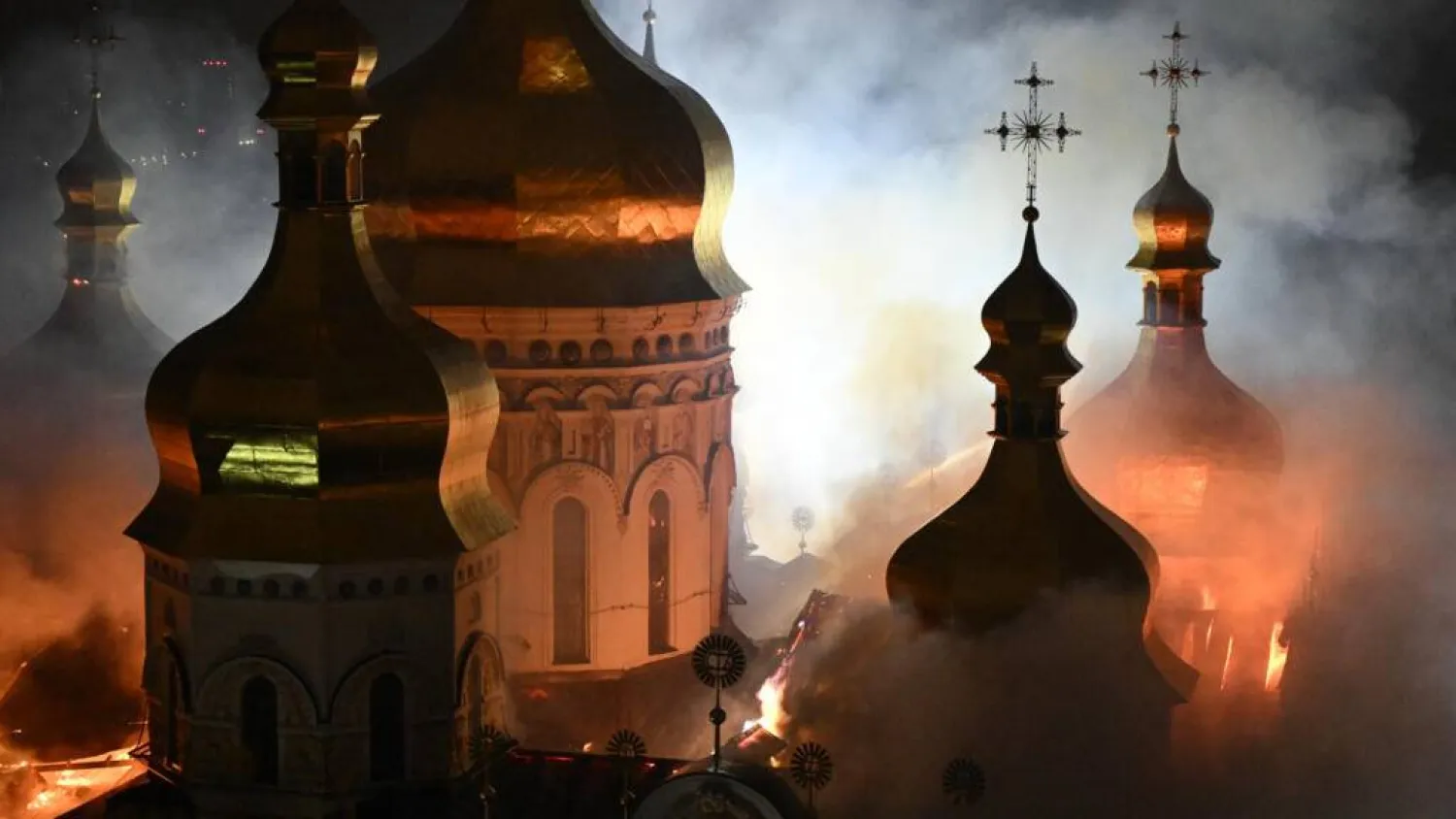

Deadly Strikes on Ukraine Leave Kyiv Cathedral in Flames

Smoke and fire rises from the Dormition Cathedral in the Orthodox in Kyiv. Genya SAVILOV / AFP
TT

Deadly Strikes on Ukraine Leave Kyiv Cathedral in Flames

Smoke and fire rises from the Dormition Cathedral in the Orthodox in Kyiv. Genya SAVILOV / AFP

Russia fired a barrage of missiles at several major Ukrainian cities, setting Kyiv's historic Dormition Cathedral on fire and killing nine, while Ukraine strikes claimed three lives south of Moscow.

The wave of attacks came as news of a US-Iran deal started to open a path to peace in the Middle East war, highlighting the lack of progress toward an end to over four years of fighting in Ukraine.

Five rescue workers were killed during firefighting operations in northeast Ukraine, while at least five others were wounded after Russian strikes hit the city of Kharkiv, Interior Minister Igor Klymenko said Monday.

The violence killed another four people in the capital, where fire broke out on the grounds of the UNESCO world heritage site Kyiv-Pechersk Lavra and the roof of the Dormition Cathedral was on fire.

Residents were seen running through the streets seeking shelter as projectiles were intercepted in the sky and glowing debris fell across the city, AFP journalists in the capital witnessed.

More than a dozen fire trucks surrounded the cathedral with firefighters working tirelessly to extinguish the blaze from the inside and from aerial platforms, an AFP journalist saw.

A gaping hole could be seen on one side of the church, with flames visible from the roof which has been partially destroyed.

- 'Repeated Russian strikes' -

Russian attacks damaged several buildings in the complex in January, the Ministry of Culture reported at the time.

The Kyiv Pechersk Lavra, a monastery with emblematic golden domes, had made headlines in recent years after the expulsion of its monks, who were accused of having ties with Moscow.

The Orthodox Church of Ukraine officially broke away from Russia in 2022 and two years later the Ukrainian government went so far as to ban the Ukraine branch of the Orthodox Church linked to Moscow.

Institutionally, the Russian Orthodox Church has stood full-square behind President Vladimir Putin since he launched Russia's offensive on Ukraine in 2022.

Head of the local military administration, Tymur Tkachenko, condemned the "direct strike" on the site.

Kyiv's Metropolitan Epiphanius also denounced the attack as a "crime against humanity, history and Christianity."

At least 23 people have been reported to have been injured in the capital and 140,000 residents in the northern districts left without electricity.

The major city of Kharkiv, in the northeast, also came under missile attack.

"Five State Emergency Service rescuers were killed during firefighting operations as a result of a repeated Russian strike," Interior Minister Igor Klymenko said on Telegram. At least nine people were also injured.

The head of the military administration in the Dnipropetrovsk region, Oleksandr Hanzha, said that the city of Dnipro had also been targeted, with one person wounded.

The head of the Sumy region, Oleg Grygorov, said three people had been wounded in the northeastern district, including a child.

A Ukrainian drone strike killed three people and wounded three others in the Russian city of Tula, around 200 kilometers (120 miles) south of Moscow, the regional governor Dmitry Milyaev said on Monday.

- Peace talks -

Ukrainian President Volodymyr Zelensky and Russian leader Vladimir Putin both called their US counterpart Donald Trump on Sunday to discuss the conflict in Ukraine.

Zelensky said on X that he had "discussed things that could help bring about peace now," while his adviser Dmytro Lytvyn told the press he was pleased with a "quite substantive conversation about everything" between the leaders.

The Kremlin, for its part, said that the conversation between Putin and Trump focused on peace negotiations with the United States and Iran.

Russia's invasion of Ukraine has turned into Europe's worst conflict since World War II, with thousands of civilians and hundreds of thousands of troops killed.

Amid near-daily pummeling of its cities by Russian drones and missiles, Ukraine has in recent weeks stepped up its own aerial attacks, which it says mostly target Russia's oil infrastructure to sap its profits that fund the war.

Kremlin adviser Yury Ushakov told the press that "US presidential special representatives Steve Witkoff and Jared Kushner, who are currently closely involved in Iranian affairs, will return to Russia soon".



UN Human Rights Chief Welcomes US-Iran Deal, Urges Restraint in the Region

An Iranian woman walks past an anti-Israeli mural, after US and Iranian officials said they had reached a deal to end their war and reopen the Strait of Hormuz, in Tehran, Iran, June 15, 2026. Majid Asgaripour/WANA (West Asia News Agency) via Reuters
TT

UN Human Rights Chief Welcomes US-Iran Deal, Urges Restraint in the Region

An Iranian woman walks past an anti-Israeli mural, after US and Iranian officials said they had reached a deal to end their war and reopen the Strait of Hormuz, in Tehran, Iran, June 15, 2026. Majid Asgaripour/WANA (West Asia News Agency) via Reuters

The United Nations' human rights chief on Monday welcomed the announcement of a peace deal between the United States and Iran, and urged for maximum restraint by all sides in the region.

"I welcome the announcement that the United States and Iran have agreed on a peace deal ‌that provides ‌for an immediate and permanent ceasefire, ‌the ⁠reopening of the ⁠Strait of Hormuz, and a framework for further negotiations," said human rights chief Volker Turk.

"At this fragile moment it is clear all sides need to exercise maximum restraint and work to implement the agreement reached quickly ⁠and in good faith," he ‌added.

His comments come ‌as US and Iranian officials said they had reached ‌an agreement to end their war ‌and reopen the Strait of Hormuz, a preliminary pact that sent oil prices falling but leaves the fate of Tehran's nuclear program to further negotiations.

While ‌still a framework, the deal marked the biggest breakthrough towards resolving the ⁠conflict ⁠that has killed thousands and upended energy markets since it began with joint US-Israeli strikes on Iran in February.

The UN rights chief also voiced alarm over Israeli strikes on populated areas and infrastructure in Lebanon, as well as cross-border attacks by Hezbollah.

He called for an immediate end to hostilities, Israel's withdrawal from Lebanese territory and investigations into alleged violations of international law by all parties.


China Says Welcomes US-Iran Deal, Commends Pakistan Mediation

People walk on a street in Tehran, Iran, June 14, 2026. Majid Asgaripour/WANA (West Asia News Agency) via Reuters
TT

China Says Welcomes US-Iran Deal, Commends Pakistan Mediation

People walk on a street in Tehran, Iran, June 14, 2026. Majid Asgaripour/WANA (West Asia News Agency) via Reuters

China welcomed on Monday an agreement announced by the United States and Iran to end the Middle East war, commending Pakistan for its mediation efforts.

"China welcomes the agreement reached between the United States and Iran... and expresses appreciation for the mediation efforts made by Pakistan," foreign ministry spokesperson Lin Jian told a news briefing, adding that Beijing hopes the deal would be signed as scheduled.

US and Iranian officials said they had reached an agreement to end their war and reopen the Strait of Hormuz, a preliminary pact that sent oil prices falling but leaves the fate of Tehran's nuclear program to further negotiations.

While still a framework, the deal marked the biggest breakthrough towards resolving the conflict that has killed thousands and upended energy markets since it began with joint US-Israeli strikes on Iran in February.

Pakistani Prime Minister Shehbaz Sharif, whose country has served as a mediator, announced a deal had been struck early on Monday local time.

The memorandum of understanding is scheduled to be officially signed on Friday in Switzerland.

The precise terms were not immediately known. Sharif said in a post on X that the pact called for "the immediate and permanent termination of military operations on all fronts, including in Lebanon."

Lebanon has been a sticking point in negotiations, with Israel and Hezbollah ignoring calls from Trump and others to stop their attacks on each other in recent weeks.

Israel’s defense minister said Monday that Israel won’t withdraw from land occupied in Lebanon as the interim deal between Iran and the United States is pending.

Katz said Israel plans to stay “indefinitely” in lands it holds in Lebanon, as well as Syria and the Gaza Strip.


Israel Concerned about US-Iran Deal but Does Not Want to Anger Trump

Israeli Prime Minister Benjamin Netanyahu seen at the Knesset on June 3. (Reuters)
TT

Israel Concerned about US-Iran Deal but Does Not Want to Anger Trump

Israeli Prime Minister Benjamin Netanyahu seen at the Knesset on June 3. (Reuters)

While Israeli Prime Minister Benjamin Netanyahu has been forced to praise the US-Iran deal and to choose words that appease US President Donald Trump, Israeli military and political officials expressed deep concern over the emerging agreement, likely to be officially signed next Friday.

Israeli officials fear the deal may fail to eliminate the threats posed by Iran's nuclear and ballistic missile programs and could also restrict Israel's freedom of action against Hezbollah in Lebanon.

Officials said Israel cannot return to the reality before the October 7, 2023, attack, when it says its hands were tied while threats built up along its borders.

Current Israeli government officials have said little about the Trump-Iran understanding, apparently for fear of upsetting the US leader. Instead, the Israeli military leaked statements on behalf of a “senior military source” expressing concern about the cessation of operations in Lebanon.

Israeli officials said the text of the agreement remains “an enigma,” not explicitly speaking about the dismantling of the Iranian nuclear program, the obliteration of Iran’s ballistic missile arsenal and production capacity, and Iran’s ability to connect itself to its proxies. They listed Israel’s five main problems with the proposal:

First, there are no clear answers regarding the treatment of Iran’s stockpile of enriched uranium, and not enough curbs on Iran’s nuclear program.

Second, the text of the deal does not clearly mention Iran’s intention to stop the production of ballistic missiles.

Third, the key unresolved question is how much funds Iran will receive. A compromise has been reached: Iran will not receive cash, but will be able to purchase medicine and food using frozen funds. The Americans insist that frozen assets will not be released before the uranium stockpiles are addressed, but that issue will be negotiated later.

Fourth, the deal lays out no clear mechanism for forcing Iran to halt its support for its proxy forces, including Hezbollah, the Houthis and Hamas.

Fifth, Israel had not been a party to the Trump administration’s negotiations with Iran and is being left out of the potential peace.

Yedioth Ahronoth quoted a senior Israeli official saying on Saturday evening that the agreement expected to be signed between the United States and Iran is “not a good deal,” warning that Israel has little ability to influence the process despite the direct impact it could have on its security.

The official said the deal would be followed by negotiations expected to last 60 days. The resources Iran would receive during the roughly two months of negotiations and afterward could, at least in theory, allow the regime to rebuild its nuclear project and its ballistic missile program.

The newspaper said the American president is acting according to his own political and US interests.

“The frequent calls between Netanyahu and Trump appear to have only marginal influence. Israel is not only failing to shape the talks, it also does not really know what is happening inside them,” it wrote.

Trump and Netanyahu spoke by phone about the emerging deal with Iran, according to the Prime Minister’s Office.

In a statement that intended to downplay the significance of the potential agreement, Netanyahu’s office said the two spoke about “the emerging memorandum of understanding with Iran regarding entry into negotiations.”

In the conversation, Netanyahu expressed a rather optimistic take on an agreement, according to his office.

“Although Israel is not a party to the memorandum of understanding,” his office said, “the prime minister expressed his appreciation for President Trump’s commitment that the final agreement reached at the conclusion of the negotiations will include the removal of enriched material, the dismantling of enrichment infrastructure, limitations on missile production, and the cessation of Iran’s support for its terrorist proxies in the region.”