


Obama Doubts Trump-Iran Deal Will Make Improvement Over His 2015 Pact

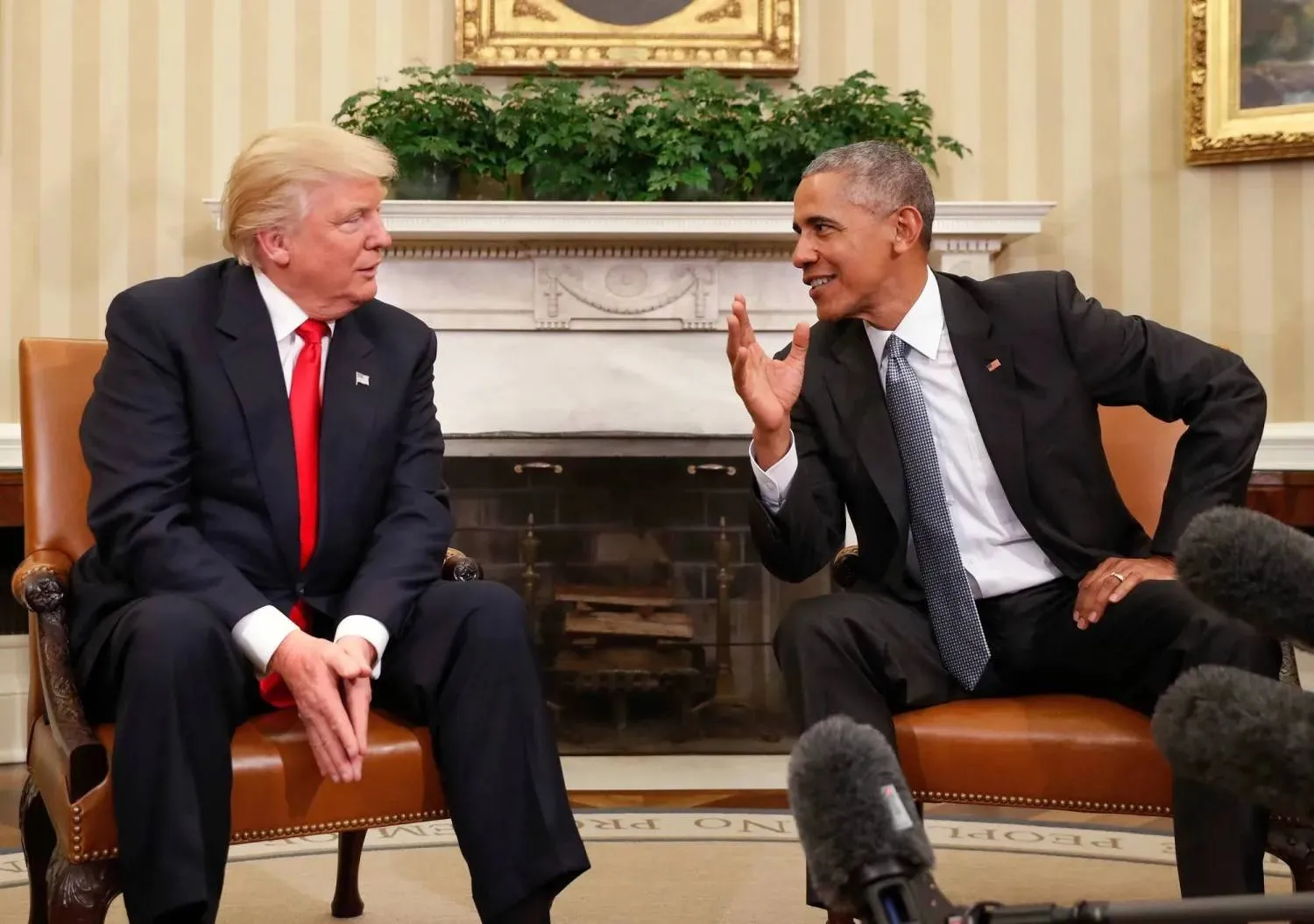
President Obama meets with President-elect Donald Trump in the Oval Office of the White House in Washington, November 2016 (AP) 
TT

Obama Doubts Trump-Iran Deal Will Make Improvement Over His 2015 Pact

President Obama meets with President-elect Donald Trump in the Oval Office of the White House in Washington, November 2016 (AP) 

Former US President Barack Obama said it was unrealistic to expect that any deal between US President Donald Trump and Tehran would mark a “significant improvement” over his own nuclear pact 11 years ago.

In interview excerpts released Sunday on ABC News talk show “This Week,” the former President also suggested it was better to negotiate a deal that falls short of all of Washington's requirements in order to avoid an outright war.

“It is doubtful that any agreement that arises is going to be significantly different or a significant improvement from the deal that we had in the first place,” Obama said, referring to 2015's landmark pact that Trump abandoned, according to AFP.

Obama added that his own deal “had worked for a long stretch of time before... the United States pulled out of it.”

US and Israeli forces sparked the Middle East war in late February when they launched strikes against Iran. For months, Trump has bandied about a potential peace deal with the Iranian republic.

The US President has stressed the deal would forever block Iran's ability to produce a nuclear weapon and would lead to the immediate opening of the blockaded Strait of Hormuz.

According to Obama, the troubled progress of a new US-Iran deal is a reminder that Washington can not “just bully our way or bomb our way to solutions” instead of engaging in comprehensive diplomacy.

“You'd think we would have learned that lesson by now,” Obama said.

On Monday, US and Iranian officials said they had agreed on a framework to end their war, halt the US blockade of Iran and reopen the Strait of Hormuz, a preliminary pact that sent oil prices falling but leaves the fate of Iran's nuclear program to further negotiations.

“The Deal with the Islamic Republic of Iran is now complete,” Trump wrote on his Truth Social platform around ‌5:30 pm ET local time in Washington (2130 GMT) on Sunday. His post came shortly after Pakistani Prime Minister Shehbaz Sharif, whose country has served as a mediator, announced a deal had been struck early on Monday local time, according to Reuters.

The memorandum of understanding is scheduled to be officially signed on Friday in Switzerland.

Before the deal was announced, a senior Iranian official told Reuters that, ⁠under the terms of the draft, the US would agree to release $25 billion of frozen Iranian assets. The Trump administration has previously said any release of Iranian money would only take place once Iran has fulfilled certain conditions under a peace deal.

A US official, also speaking before the announcement, said the agreement would ultimately lead to the dismantling of Iran's nuclear program, with its stockpile of highly enriched uranium to be destroyed and removed. The senior Iranian official said the draft deal would allow Iran, which denies seeking a nuclear bomb, to dilute its enriched uranium inside the country.


Congo Reports Record One-Day Increase in Ebola Cases, a Month After Outbreak’s Declaration

Dz'na Lipe Jean‑Marie, secretary of the displacement camp, speaks during an Ebola awareness session as humanitarian agencies intensify efforts to contain a new Ebola outbreak involving the Bundibugyo strain, at Kpangba displacement camp where Ebola cases were observed, Djugu territory in Ituri province, Democratic Republic of Congo, June 13, 2026. (Reuters)
TT

Congo Reports Record One-Day Increase in Ebola Cases, a Month After Outbreak’s Declaration

Dz'na Lipe Jean‑Marie, secretary of the displacement camp, speaks during an Ebola awareness session as humanitarian agencies intensify efforts to contain a new Ebola outbreak involving the Bundibugyo strain, at Kpangba displacement camp where Ebola cases were observed, Djugu territory in Ituri province, Democratic Republic of Congo, June 13, 2026. (Reuters)

Congolese authorities have reported one of the highest increase in Ebola cases in one day, as weak contact tracing, insecurity and funding gaps continue to hinder the response a month after the outbreak was declared.

The Congolese Ministry of Health said Sunday 72 new cases were reported in a 24-hour period, bringing the total number of confirmed cases to 782. This includes 181 confirmed deaths, after 32 new deaths were confirmed.

However, the number of cases in Congo is believed to be higher because the outbreak was confirmed on May 15, weeks after it is suspected to have begun, and the contact tracing coverage rate is at 56%, a sharp decrease from last week.

The latest Ebola outbreak is caused by the rare Bundibugyo virus, which has no approved vaccine or treatment, unlike the Zaire virus, which was responsible for most of Congo’s past 16 outbreaks of the disease.

Fifty-six people have recovered, and the current fatality rate of the outbreak is 23%, the ministry said.

The World Health Organization said Sunday it is intensifying testing and contact tracing and treatment.

Africa's top health body said the same day it is deploying technical expertise and supporting laboratory systems, active case finding and community engagement efforts to accelerate the response to the disease outbreak.

“We remain committed to supporting affected countries until transmission is stopped. We call on partners and donors to urgently mobilize resources to strengthen the response and save lives,” said the head of the Africa Centers for Disease Control and Prevention, or Africa CDC, Jean Kaseya.

The outbreak is concentrated in Congo’s eastern province of Ituri, which accounts for more than 90% of the cases. Cases have also been recorded in the North Kivu and South Kivu provinces, and have spread across the border to Uganda.

Nearly a million people have been displaced by conflict in Ituri, according to the UN humanitarian office, making contact tracing difficult as people flee attacks or move frequently in the vast province with dense forests, poor roads and remote villages that can take days to reach.

Tracing is also difficult among the thousands of artisanal miners who regularly move between remote sites in the mineral-rich region.


Iran's Fars News Agency Says Hormuz Maritime Fees Added to US Deal Last Minute

Vessels at the Strait of Hormuz, as seen from Musandam, Oman, June 14, 2026. REUTERS/Stringer
TT

Iran's Fars News Agency Says Hormuz Maritime Fees Added to US Deal Last Minute

Vessels at the Strait of Hormuz, as seen from Musandam, Oman, June 14, 2026. REUTERS/Stringer

Iran's Fars news agency said on Monday, quoting what it said was an informed source, that Tehran added a clause on imposing maritime service fees to the framework deal with the United States shortly before its announcement.

"In the final moments of the negotiations, the text of the memorandum of understanding was amended to clearly and explicitly emphasize the issue of the Iranian-Omani sovereignty over the Strait of Hormuz," said Fars, citing the unidentified source.

"The use of the term 'maritime services' means that the United States has accepted that fees will be paid to Iran," it added.


UN Human Rights Chief Welcomes US-Iran Deal, Urges Restraint in the Region

An Iranian woman walks past an anti-Israeli mural, after US and Iranian officials said they had reached a deal to end their war and reopen the Strait of Hormuz, in Tehran, Iran, June 15, 2026. Majid Asgaripour/WANA (West Asia News Agency) via Reuters
TT

UN Human Rights Chief Welcomes US-Iran Deal, Urges Restraint in the Region

An Iranian woman walks past an anti-Israeli mural, after US and Iranian officials said they had reached a deal to end their war and reopen the Strait of Hormuz, in Tehran, Iran, June 15, 2026. Majid Asgaripour/WANA (West Asia News Agency) via Reuters

The United Nations' human rights chief on Monday welcomed the announcement of a peace deal between the United States and Iran, and urged for maximum restraint by all sides in the region.

"I welcome the announcement that the United States and Iran have agreed on a peace deal ‌that provides ‌for an immediate and permanent ceasefire, ‌the ⁠reopening of the ⁠Strait of Hormuz, and a framework for further negotiations," said human rights chief Volker Turk.

"At this fragile moment it is clear all sides need to exercise maximum restraint and work to implement the agreement reached quickly ⁠and in good faith," he ‌added.

His comments come ‌as US and Iranian officials said they had reached ‌an agreement to end their war ‌and reopen the Strait of Hormuz, a preliminary pact that sent oil prices falling but leaves the fate of Tehran's nuclear program to further negotiations.

While ‌still a framework, the deal marked the biggest breakthrough towards resolving the ⁠conflict ⁠that has killed thousands and upended energy markets since it began with joint US-Israeli strikes on Iran in February.

The UN rights chief also voiced alarm over Israeli strikes on populated areas and infrastructure in Lebanon, as well as cross-border attacks by Hezbollah.

He called for an immediate end to hostilities, Israel's withdrawal from Lebanese territory and investigations into alleged violations of international law by all parties.
