


Israel Concerned about US-Iran Deal but Does Not Want to Anger Trump

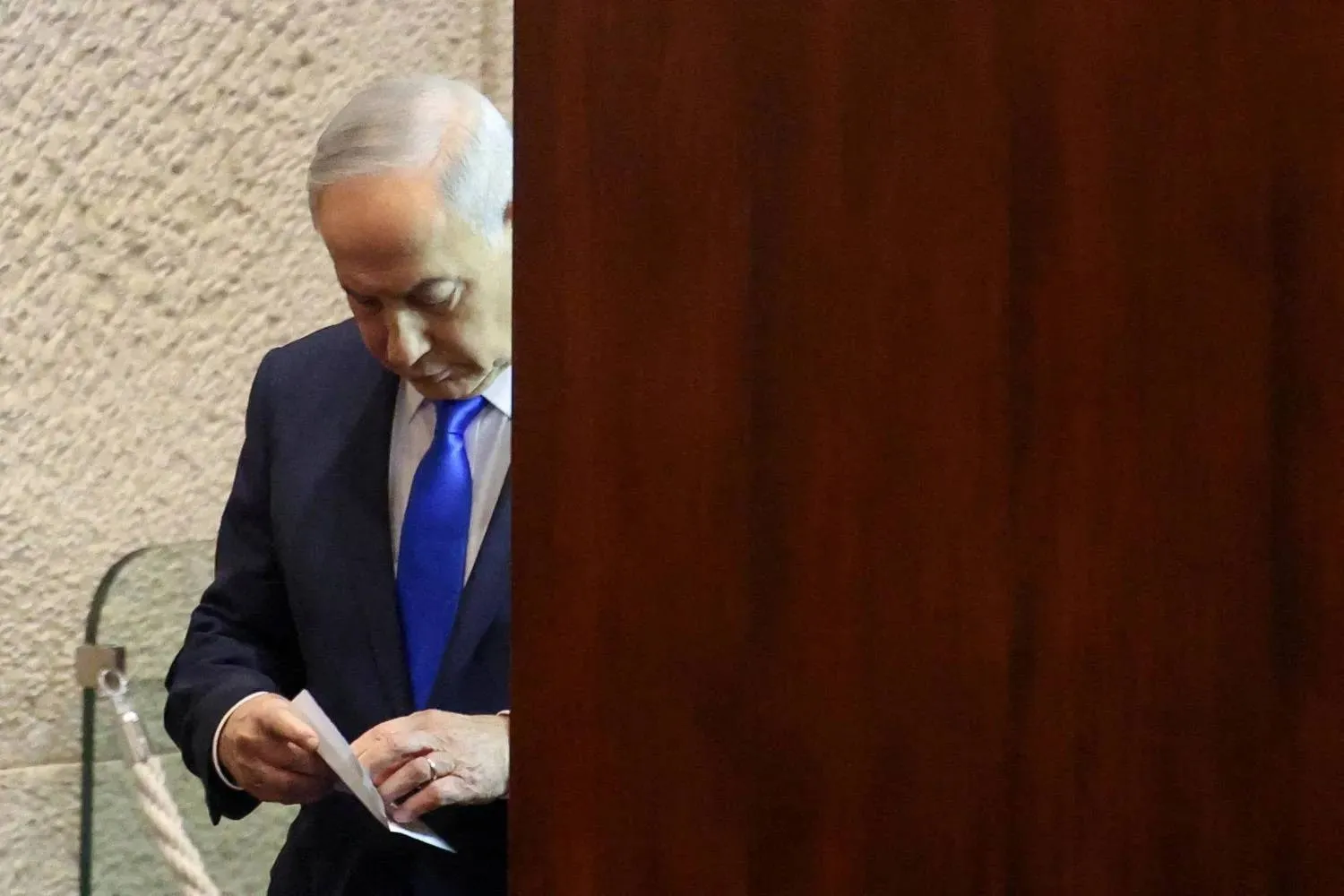
Israeli Prime Minister Benjamin Netanyahu seen at the Knesset on June 3. (Reuters)
TT

Israel Concerned about US-Iran Deal but Does Not Want to Anger Trump

Israeli Prime Minister Benjamin Netanyahu seen at the Knesset on June 3. (Reuters)

While Israeli Prime Minister Benjamin Netanyahu has been forced to praise the US-Iran deal and to choose words that appease US President Donald Trump, Israeli military and political officials expressed deep concern over the emerging agreement, likely to be officially signed next Friday.

Israeli officials fear the deal may fail to eliminate the threats posed by Iran's nuclear and ballistic missile programs and could also restrict Israel's freedom of action against Hezbollah in Lebanon.

Officials said Israel cannot return to the reality before the October 7, 2023, attack, when it says its hands were tied while threats built up along its borders.

Current Israeli government officials have said little about the Trump-Iran understanding, apparently for fear of upsetting the US leader. Instead, the Israeli military leaked statements on behalf of a “senior military source” expressing concern about the cessation of operations in Lebanon.

Israeli officials said the text of the agreement remains “an enigma,” not explicitly speaking about the dismantling of the Iranian nuclear program, the obliteration of Iran’s ballistic missile arsenal and production capacity, and Iran’s ability to connect itself to its proxies. They listed Israel’s five main problems with the proposal:

First, there are no clear answers regarding the treatment of Iran’s stockpile of enriched uranium, and not enough curbs on Iran’s nuclear program.

Second, the text of the deal does not clearly mention Iran’s intention to stop the production of ballistic missiles.

Third, the key unresolved question is how much funds Iran will receive. A compromise has been reached: Iran will not receive cash, but will be able to purchase medicine and food using frozen funds. The Americans insist that frozen assets will not be released before the uranium stockpiles are addressed, but that issue will be negotiated later.

Fourth, the deal lays out no clear mechanism for forcing Iran to halt its support for its proxy forces, including Hezbollah, the Houthis and Hamas.

Fifth, Israel had not been a party to the Trump administration’s negotiations with Iran and is being left out of the potential peace.

Yedioth Ahronoth quoted a senior Israeli official saying on Saturday evening that the agreement expected to be signed between the United States and Iran is “not a good deal,” warning that Israel has little ability to influence the process despite the direct impact it could have on its security.

The official said the deal would be followed by negotiations expected to last 60 days. The resources Iran would receive during the roughly two months of negotiations and afterward could, at least in theory, allow the regime to rebuild its nuclear project and its ballistic missile program.

The newspaper said the American president is acting according to his own political and US interests.

“The frequent calls between Netanyahu and Trump appear to have only marginal influence. Israel is not only failing to shape the talks, it also does not really know what is happening inside them,” it wrote.

Trump and Netanyahu spoke by phone about the emerging deal with Iran, according to the Prime Minister’s Office.

In a statement that intended to downplay the significance of the potential agreement, Netanyahu’s office said the two spoke about “the emerging memorandum of understanding with Iran regarding entry into negotiations.”

In the conversation, Netanyahu expressed a rather optimistic take on an agreement, according to his office.

“Although Israel is not a party to the memorandum of understanding,” his office said, “the prime minister expressed his appreciation for President Trump’s commitment that the final agreement reached at the conclusion of the negotiations will include the removal of enriched material, the dismantling of enrichment infrastructure, limitations on missile production, and the cessation of Iran’s support for its terrorist proxies in the region.”



EU Aviation Agency Tells Operators to Avoid Iran, Iraq and Lebanon Airspaces Until August 31

Motorbikes and cars pass through an intersection in downtown Tehran, Iran, May 17, 2026. (AP)
TT

EU Aviation Agency Tells Operators to Avoid Iran, Iraq and Lebanon Airspaces Until August 31

Motorbikes and cars pass through an intersection in downtown Tehran, Iran, May 17, 2026. (AP)

The European Union Aviation Safety Agency said on Wednesday that airlines should not operate within the airspace of Iran, Iraq, and Lebanon, amid ongoing tensions and the potential for further military action, as the US and Iran exchanged fresh attacks.

The EASA said its bulletin for the airspaces of ‌Iran, Iraq ‌and Lebanon was valid until ‌August ⁠31.

The ‌agency's latest advisory comes after Iran's Revolutionary Guards ‌said they targeted US military sites ‌in Bahrain and Kuwait on Wednesday.

Those attacks followed a wave of US military strikes on Iran after tankers were hit in the Strait ‌of Hormuz.

President Donald Trump had said on Monday that the US ⁠would either ⁠reach a deal with Iran or "finish the job," renewing his threat of military action.

EASA said the implementation of the US-Iran ceasefire remained fragile, and its advisory decision was based on "ongoing high level of tensions and the potential for further military action."

The European agency also added that should the existing truce break down, Iranian airspace was likely to be exposed to "imminent threats".


New Attacks Complicate Talks to End Iran War, EU’s Kallas Says

EU High Representative for Foreign Affairs and Security Policy Kaja Kallas arrives at the NATO Defense Industry Forum in Ankara, Türkiye , 07 July 2026. (EPA)
TT

New Attacks Complicate Talks to End Iran War, EU’s Kallas Says

EU High Representative for Foreign Affairs and Security Policy Kaja Kallas arrives at the NATO Defense Industry Forum in Ankara, Türkiye , 07 July 2026. (EPA)

The new attacks by Iran and the United States in the Middle East have complicated talks to end the war, EU foreign policy chief Kaja Kallas said on Wednesday.

"The exchanges of ‌fire between ‌the US and ‌Iran ⁠further complicate already fraught ⁠talks to end the war. Iran's attacks on Bahrain and Kuwait are unacceptable," Kallas said in a post on ⁠X.

"Next Monday, EU Foreign ‌Ministers ‌will meet with their ‌Gulf counterparts to discuss how ‌we can work together to support the implementation of the agreement and preserve freedom ‌of navigation in the Strait as well as ⁠the ⁠Red Sea."

The US military unleashed a new wave of strikes against Iran on Tuesday and revoked a license allowing Iran to sell oil after three tankers were hit by projectiles in the Strait of Hormuz.

US President Donald Trump said an interim agreement to end the ‌war with ‌Iran was "over" on Wednesday after ‌Tehran ⁠carried out new attacks.

Asked before a NATO summit in Türkiye ⁠whether the ⁠memorandum of understanding reached last month was over, Trump said: "It's a very interesting question. To me, I think it's over. I don't want to deal with them."⁠


New US Attacks on Iran Were Absolutely Necessary, NATO Chief Says

NATO Secretary General Mark Rutte speaks upon arrival at the 2026 NATO summit in Ankara, Türkiye, 08 July 2026. (EPA)
TT

New US Attacks on Iran Were Absolutely Necessary, NATO Chief Says

NATO Secretary General Mark Rutte speaks upon arrival at the 2026 NATO summit in Ankara, Türkiye, 08 July 2026. (EPA)

The new attacks by the US on Iran were "absolutely necessary," NATO Secretary General Mark Rutte said on Wednesday.

The US military unleashed a new wave of strikes against Iran on Tuesday and revoked a license allowing Tehran to sell oil after three tankers were hit by projectiles in the Strait ‌of Hormuz, putting pressure ‌on an already fragile ‌ceasefire.

"When ⁠you have a ⁠ceasefire and Iran is basically violating the ceasefire, I think it is totally crucial that the US forcefully react," Rutte told reporters before a summit of NATO leaders in Ankara.

At their summit, European ⁠leaders aim to convince Donald Trump ‌to re-commit ‌to the military alliance, after the US president revived ‌his disputes with them over the ‌Iran war and Greenland.

Rutte said there could be no doubt over the "complete commitment of the United States to NATO," which he said ‌also works to protect the United States.

"But there's also the expectation ⁠that ⁠the Europeans and the Canadians will equalize their spending with the United States, which I think is completely fair," he added.

"The good news is that this is the big win today. It's the loss for Putin, it is a win for President Trump that the Europeans and the Canadians are doing exactly that."