One Syrian Security Member Killed in ISIS Attack in Raqqa

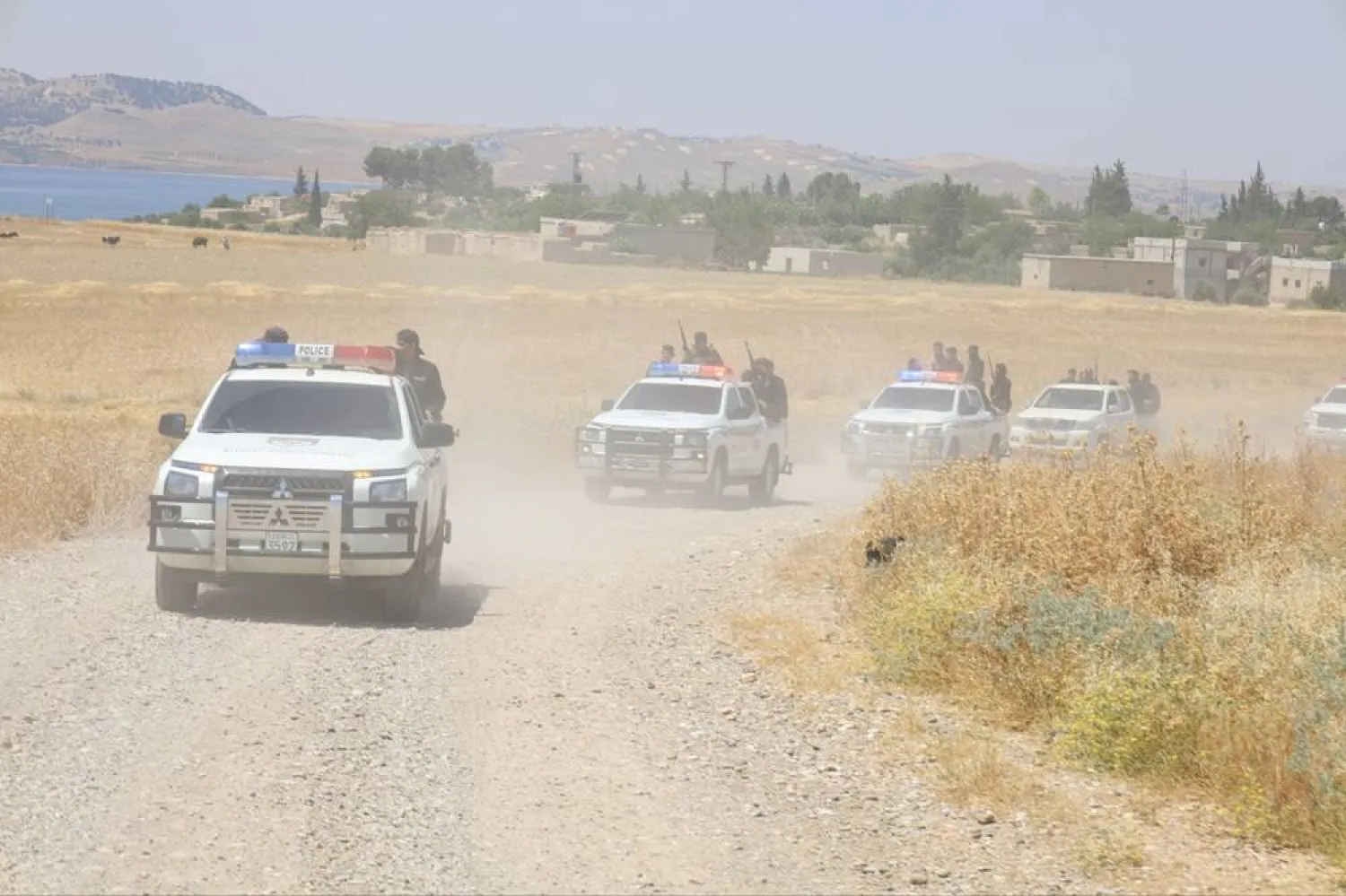
Syrian Internal Security vehicles patrol near Ain al-Arab in eastern Aleppo province after authorities said 20 suspects were arrested in connection with attacks on security checkpoints and facilities. (SANA file)
TT

One Syrian Security Member Killed in ISIS Attack in Raqqa

Syrian Internal Security vehicles patrol near Ain al-Arab in eastern Aleppo province after authorities said 20 suspects were arrested in connection with attacks on security checkpoints and facilities. (SANA file)

Syria's Interior Ministry said on Monday that one of its security personnel had been killed as its forces thwarted an attack by two ISIS militants on a command headquarters of the country's internal security forces in the city of Raqqa.

According to a ministry statement, two suicide attackers attempted to storm the facility. Security ‌personnel engaged the pair, ‌neutralizing one of them, ‌while ⁠the second detonated ⁠an explosive vest after being surrounded.

Three security personnel were also wounded in the attack, the statement added.

Earlier, the Syrian state news agency had cited the Interior Ministry's spokesperson as saying that preliminary information indicated at least ⁠two ministry personnel were killed in ‌a suicide attack on ‌a ministry camp in Raqqa.

In February, ISIS ‌declared a new phase of operations against ‌the government of President Ahmed al-Sharaa and has since carried out a spate of attacks, including one that killed four Syrian security personnel near ‌Raqqa.

Last year, Sharaa's government joined the US-led coalition fighting ISIS.

At the peak of its power during the Syrian civil war a decade ago, ISIS controlled around a quarter or more of Syria, before being driven out of the territory by a US-led coalition and other foes.


Yemen Parliament Approves General Mobilization Against Houthis

This frame grab taken from AFPTV video footage shows Yemeni government fighters engaging in clashes with Houthis in Al-Jawf province on September 15, 2026.  (Photo by AFPTV / AFP)
This frame grab taken from AFPTV video footage shows Yemeni government fighters engaging in clashes with Houthis in Al-Jawf province on September 15, 2026. (Photo by AFPTV / AFP)
TT

Yemen Parliament Approves General Mobilization Against Houthis

This frame grab taken from AFPTV video footage shows Yemeni government fighters engaging in clashes with Houthis in Al-Jawf province on September 15, 2026.  (Photo by AFPTV / AFP)
This frame grab taken from AFPTV video footage shows Yemeni government fighters engaging in clashes with Houthis in Al-Jawf province on September 15, 2026. (Photo by AFPTV / AFP)

The confrontation between the Yemeni government and the Iran-aligned Houthi group has entered a new phase, following Parliament's approval of a request by Chairman of the Presidential Leadership Council Rashad al-Alimi to declare a general mobilization.

Authorities said the move is aimed at strengthening the capabilities of state institutions and the armed forces in confronting the Houthi escalation, and protecting the republican system and the country's sovereignty.

The parliamentary decision came after an expanded meeting held by the council under the chairmanship of Speaker Sultan al-Barakani via videoconference to discuss military and political developments in the country, as well as al-Alimi's memorandum requesting approval for the declaration of general mobilization. The request was based on constitutional provisions and laws governing mobilization, general reserve, and civil defense.

Under the decision, general mobilization takes effect from the date it is announced and will remain in place until the reasons that prompted it have ended. It will be implemented in accordance with the constitution, the power transfer decision, and the laws governing the general reserve, the National Defense Council, and civil defense.

During a meeting with several governors, attended by Prime Minister Shaya al-Zindani and military and security leaders, al-Alimi presented general mobilization as a measure that goes beyond simply recruiting fighters or reinforcing the front lines. He said it encompasses human, material, and moral resources, as well as strengthening the ability of state institutions, the armed forces, and security forces to carry out their duties.

Yemeni Presidential Leadership Council Chairman Rashad al-Alimi during a videoconference with military and civilian leaders (government media)

Al-Alimi praised Parliament's response to his request, saying that the legislature's approval reflects an understanding of the scale of the challenges facing the country and provides a constitutional framework for unifying the capabilities of state institutions in the coming phase.

The decision comes amid a broad military escalation on several fronts, at a time when the government says its forces have regained the initiative in a number of areas. Fighting, however, continues in parts of Taiz, Lahj, Marib, Al-Jawf, and Al-Bayda, as well as on northern fronts.

"Safe Return"

Alongside the mobilization, al-Alimi proposed another course of action based on what he called a "safe return," urging residents of areas under Houthi control not to send their children to the battlefronts.

He said the state is asking them only to align themselves with the values of the republic and its institutions, stressing that the announced guarantees and procedures cover those who leave the group and stop fighting or working on its behalf.

He explained that the process also includes settling the status of members of the armed forces and security forces and safeguarding their legal rights, in an effort to open a channel for withdrawing from the Houthi ranks while simultaneously increasing military pressure.

The Yemeni Parliament based its decision on Article 37 of the constitution concerning the declaration of general mobilization, Article 38 concerning the National Defense Council, and Article 119 concerning the president's powers to declare a state of emergency and general mobilization in accordance with the law.

The council also cited the Law Establishing the National Defense Council, the General Reserve Law, and the Civil Defense Law.

The decision stipulates that the National Defense Council will remain in continuous session once general mobilization is declared and will oversee mobilization matters and its implementation in accordance with the relevant laws.

The measure follows a September 25 speech by al-Alimi calling for general mobilization, at a time when the government is seeking to rally state institutions and political and military forces behind a unified position in confronting the Houthis.

Parliament said its decision came amid what it described as risks threatening the lives and property of citizens, as well as their security and stability. It also pointed to the regional and international repercussions of the Yemeni conflict.

A Message to the Country and Abroad

The parliamentary decision also carried a political message extending beyond the military dimension. It called for overcoming divisions, unifying ranks, and coordinating with the coalition supporting the legitimate government, led by Saudi Arabia.

The council renewed its condemnation of Houthi attacks targeting Saudi Arabia, considering threats to the security and sovereignty of countries in the region to have repercussions for regional and international security and stability.

It also praised Saudi support for Yemen and the role played by the coalition in supporting the government and forces aligned with it.

Al-Alimi, meanwhile, stressed that the coming phase requires governors to treat residents of areas under Houthi control as part of Yemeni society, rather than as a party separate from the state. He emphasized that the government wants to restore its institutions, security, and stability in those areas.

Parliament's decision gives the general mobilization a formal framework for shifting the government's response from separate military measures to a broader institutional mobilization policy encompassing the armed forces, security forces, human and material resources, and state agencies.

The impact of the decision, however, will remain linked to the mechanisms for its implementation and the ability of government institutions and allied military forces to operate under more coordinated leadership, given the number of formations and forces on the ground and the differences in their areas of deployment.


Sources Confirm to Asharq Al-Awsat that Senior Hamas Commander Killed in Gaza

Izz al-Din ​Al-Beik, the head of Hamas armed wing in the northern Gaza Strip
TT

Sources Confirm to Asharq Al-Awsat that Senior Hamas Commander Killed in Gaza

Izz al-Din ​Al-Beik, the head of Hamas armed wing in the northern Gaza Strip

Four Hamas sources in the Gaza Strip confirmed on Tuesday that Israel assassinated the commander of the Al-Qassam Brigades' Northern Brigade, Izz al-Din al-Beik, in an airstrike in the Al-Nasr neighborhood, northwest of Gaza City.

The sources said in separate statements to Asharq Al-Awsat that al-Beik, known by the nom de guerre of "Ashmawi," was killed on the spot after being targeted in a strike that hit a residential apartment with three missiles.

Israeli Prime Minister Benjamin Netanyahu and Defense Minister Israel Katz announced the operation, confirming al-Beik's assassination.

The attack occurred at 3:30 AM, as witnessed by the Asharq Al-Awsat reporter, who noted that fire consumed the apartment and continued burning for more than half an hour until Civil Defense crews managed to extinguish it.

The attack took place adjacent to another residential building subjected to a similar daytime attack about two months ago. During that strike, Adham Nassan, commander of operations in the Gaza Brigade of the Al-Qassam Brigades and one of those who played a prominent role in the October 7, 2023 attack, was assassinated.

Previous Assassination Attempt

Al-Beik had previously survived an assassination attempt end of May, just days after the killing of Izz al-Din al-Haddad and Muhammad Awad, who successively led the Al-Qassam Brigades in the Gaza Strip, succeeding Muhammad al-Sinwar.

Imad Islim, deputy commander of the Gaza Brigade and commander of the Zeitoun Battalion, was killed in that raid. Sources told Asharq Al-Awsat at the time that a meeting was set to take place between Islim and al-Beik, along with the new commander of the Gaza Brigade, Muhannad Rajab, but the latter two had not arrived at the location when the raid was executed.

This operation came about two weeks after the assassination of the commander of the Khan Younis Brigade in Al-Qassam, Muhammad al-Yazouri, and the commander of the Rafah Brigade, Nael Abu Obeid.

Who is al-Beik

Izz al-Din al-Beik, 48, a resident of the Faluja area in Jabalia camp - one of Hamas's most prominent strongholds - had been a top activist in the movement for many years.

With the outbreak of the Second Al-Aqsa Intifada, he began working with the Al-Qassam Brigades and was heavily active in operations confronting Israeli incursions into the camp and the town of Beit Lahia. He was among the first to use "Al-Yassin" anti-armor shells to counter a major Israeli military operation targeting Jabalia camp in 2004.

According to Hamas sources speaking to Asharq Al-Awsat, al-Beik led the first special forces unit in Al-Qassam in Jabalia camp, currently known as "Elite" (Nukhba). For many years, he led the "Imad Aql" (Western) Battalion in the Jabalia camp area before leaving it to become the head of the intelligence apparatus for the Northern Brigade.

Following the assassination of Ahmad al-Ghandour in November 2023, he became the commander of the Northern Brigade.

Sources say that during his time as head of intelligence for the Northern Brigade, he was described as the "spoiled boy" of Muhammad Awad, who was then head of the intelligence corner for the entire Gaza Strip. The two shared a special relationship and were both residents of Jabalia camp.

The sources clarify that he led the operation that foiled what was called the "Generals' Plan" during the recent war, which aimed to displace the residents of the northern Gaza Strip, and he stood ground alongside his fighters in face-to-face battles against the Israeli army.

One Hamas source who knew him well described him as a skilled sniper who also took responsibility for operations management in the Northern Brigade for a certain period.

Both before and during the war, al-Beik survived several assassination attempts. One occurred inside Jabalia camp during which his bodyguard was killed.


Syria Tightens Public Spending Amid Rising Regional Tension

Syrian Finance Minister Mohammed Yisr Barnieh participates in the launch of an electronic link between the Popular Credit Bank and Al-Haram Transfer Company (minister’s account)
TT

Syria Tightens Public Spending Amid Rising Regional Tension

Syrian Finance Minister Mohammed Yisr Barnieh participates in the launch of an electronic link between the Popular Credit Bank and Al-Haram Transfer Company (minister’s account)

The General Secretariat of the Syrian Presidency has approved a series of measures to control and rationalize public spending, aimed at safeguarding the state budget.

Syrian Finance Minister Mohammed Yisr Barnieh said Monday that the measures would not affect salaries, wages or essential expenditures, particularly in the health, education, water, energy, security, public safety and operational maintenance sectors.

As Syrians fear a harsh winter that could revive memories of the difficulties they faced during the war and shortages of basic necessities, the Syrian government is increasingly concerned about continued regional escalation and rising energy production and fuel costs.

Sources close to the government told Asharq Al-Awsat that there was concern over continued escalation in the region, particularly the wars in Iran and Yemen, and its impact on Arab Gulf states, which have become Syria’s new financial lifeline.

They said the escalation was casting a dark and direct shadow over the country’s political and economic landscape and threatening recovery efforts, amid the possibility of declining support and investment.

Barnieh explained in a Facebook post Monday that the measures include limiting nonessential expenditures and reprioritizing spending and investment projects, while postponing projects that can be deferred according to their necessity, readiness and financial, economic and social impact.

The financial measures are aimed at improving the efficiency of public spending by directing available resources toward projects with a direct impact, strengthening the budget’s ability to withstand current pressures and preserving fiscal sustainability, according to the minister.

The launch of the public spending rationalization plan coincides with preparations for the 2027 budget, amid challenges related to containing the current year’s fiscal deficit.

Public spending during the first half of this year reached about $3.7 billion, compared with total public revenue of around $2.7 billion, according to the state budget’s fiscal performance report issued last August, which estimated the fiscal deficit at approximately $1 billion.

Compared with the first half of 2025, public revenue rose by about 111%, while public spending increased by around 331%.

The government says the increase in spending was primarily linked to higher salaries and wages, expanded spending on government priorities and higher costs for a number of goods, services and inputs as a result of regional developments and rising import prices.

The government is working to cover the budget deficit through financial instruments such as short-term bonds and efforts to attract foreign investment, as living conditions worsen and the gap between salaries and wages and the cost of basic necessities widens.

The government raised fuel prices on Sept. 13 by between 25% and 40%, covering gasoline, diesel and household gas.

More than 90% of Syrians live below the poverty line, while 65% live in extreme poverty, according to UN figures.

Estimates indicate that a Syrian family of five needs more than $500 a month — nearly 6 million Syrian pounds at prevailing valuations — to meet minimum basic needs. By contrast, salaries in the public and private sectors often do not exceed $100 to $150.