


A Rare First Edition of ‘Wuthering Heights’ Complete with Spelling Mistakes Is up for Auction

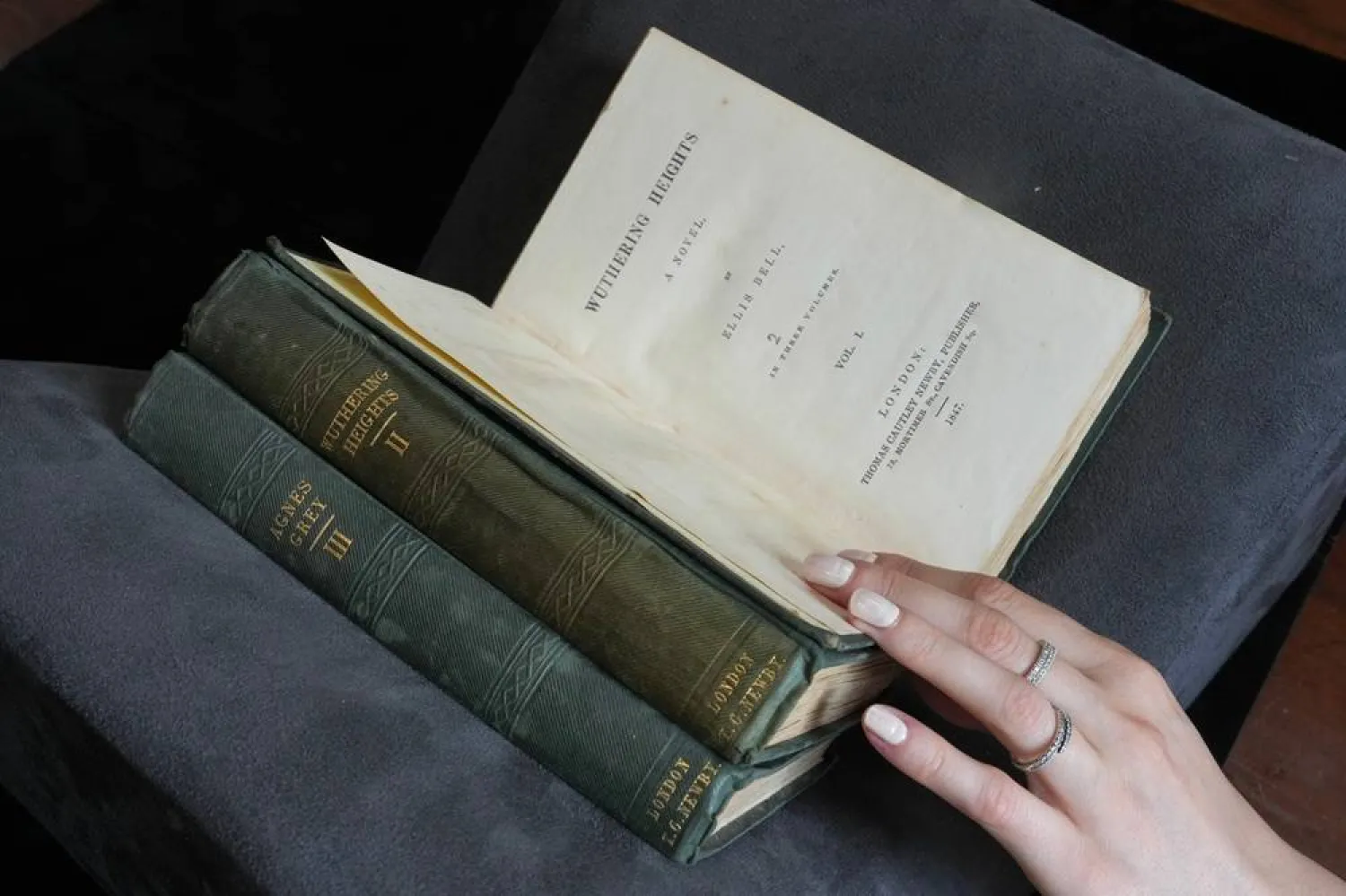
 A first edition of Emily Bronte's "Wuthering Heights", is on display for sale at Christie's auction house in London, Monday, June 15, 2026. (AP)
A first edition of Emily Bronte's "Wuthering Heights", is on display for sale at Christie's auction house in London, Monday, June 15, 2026. (AP)
TT

A Rare First Edition of ‘Wuthering Heights’ Complete with Spelling Mistakes Is up for Auction

 A first edition of Emily Bronte's "Wuthering Heights", is on display for sale at Christie's auction house in London, Monday, June 15, 2026. (AP)
A first edition of Emily Bronte's "Wuthering Heights", is on display for sale at Christie's auction house in London, Monday, June 15, 2026. (AP)

A rare first-edition copy of “Wuthering Heights,” complete with spelling mistakes, is up for auction for the first time in more than a century, as Emily Brontë’s tragic, tempestuous romance gains new fans through a big-screen adaptation.

Christie’s auction house said Monday that it's the first copy of the novel in the publisher’s original cloth binding to be auctioned since 1908. Only about 250 copies of the first edition were printed, and this one has been in a private library since shortly after its publication in 1847.

“The vast majority of surviving copies were rebound for collectors or libraries, meaning original cloth examples are now extremely scarce,” said Christie’s books and manuscripts specialist Mark Wiltshire.

Being sold along with a copy of sister Anne Brontë’s “Agnes Grey,” it’s expected to sell for between 400,000 pounds and 600,000 pounds ($540,000 and $800,000) at a June 30 auction in London. Both books carry the male pen names the sisters adopted to get published: Ellis Bell for Emily and Acton Bell for Anne.

“Wuthering Heights” was rushed to publication after the success of Charlotte Brontë’s “Jane Eyre,” and the first edition is notorious for its typographical errors including, Wiltshire noted, the occasional misspelling of the word “heights.”

Emerald Fennell ’s recent movie with Margot Robbie and Jacob Elordi as mismatched pair Cathy and Heathcliff is the latest work to be inspired by — and take liberties with — Brontë’s brooding, Gothic tale.

The novel shocked some critics when it was published, with one in 1848 decrying its “vulgar depravity and unnatural horrors.”

Since then, Wiltshire said, it has “moved beyond literature to become a cultural touchstone,” inspiring art, music — notably Kate Bush’s pop-operatic 1978 song — and multiple film adaptations.

“It remains a work that artists return to again and again because of its emotional force, its atmosphere, and its psychological intensity, ensuring its place not only in literary history but in wider cultural imagination,” Wiltshire said.



Red Sea Film Foundation Extends 48-Hour Film Challenge Deadline to July 4

Red Sea Film Foundation Extends 48-Hour Film Challenge Deadline to July 4
TT

Red Sea Film Foundation Extends 48-Hour Film Challenge Deadline to July 4

Red Sea Film Foundation Extends 48-Hour Film Challenge Deadline to July 4

The Red Sea Film Foundation has extended the application deadline for the sixth edition of the 48-Hour Film Challenge to July 4, 2026, allowing more young Saudi citizens and residents the opportunity to take part in the initiative aimed at discovering and supporting emerging filmmakers, SPA reported.

Organized in partnership with the Red Sea International Film Festival, the French Consulate General in Jeddah, and Alliance Française, the challenge is open to aspiring filmmakers aged 18 to 25, SPA reported.

Participants will form creative teams and compete to produce a short film within 48 hours after completing specialized mentorship workshops.

The two winning teams will receive awards, while their team leaders will earn an artistic residency in France in 2027. The winning films will also be screened at the next edition of the Red Sea International Film Festival.


The 91-Year-Old Weaving Venezuelan Ancestral Tradition into Art

 Venezuelan weaver Margarita Mora. (The New York Times)
Venezuelan weaver Margarita Mora. (The New York Times)
TT

The 91-Year-Old Weaving Venezuelan Ancestral Tradition into Art

 Venezuelan weaver Margarita Mora. (The New York Times)
Venezuelan weaver Margarita Mora. (The New York Times)

Though electric machines are now standard, the Venezuelan weaver Margarita Mora has clung to a mix of ancestral Indigenous and Spanish practices to create surprisingly modern work, reported the New York Times.

As she sat at her loom on the rooftop of her home in Mucuchies, a town high in the Venezuelan Andes, Margarita Mora, recalled the morning when, at 5, she delivered some wool her mother had spun to a local weaver in nearby Mitivivó. It was her first encounter with the very loom she would use for decades to come.

“This loom has made me very happy,” she said during an interview at her home in 2024. “When I learned to weave, I was able to buy my own clothes and shoes.”

It was also how she discovered the craft that she has dedicated her life to. All those decades ago, Mitivivó was a remote settlement with just a few families, set where the mountains met the sky. It was here that she began selling her weavings.

In most parts of the world, electric machines have replaced ancient weaving techniques, but Mora, who is 91 and tiny, wearing head scarves around her weathered face, has clung to a mix of ancestral Indigenous and Spanish traditions.

Her weavings have gained her a modest level of fame in Venezuela. For years, she was an instructor at the Moconoque School of Trade, Arts and Crafts, a nonprofit with the mission of preserving and promoting traditional crafts.

In 2008, her face adorned a huge billboard on the facade of a convention center hosting an art exposition in the city of Mérida, southwest of Mucuchies, along with two other weavers and former president Hugo Chávez. She has also received multiple honorary degrees.

*Silvia Benedetti for the New York Times


David Hockney, the British Artist Who Went in Search of Californian Color, Dies at 88

British artist David Hockney poses as he unveils his painting "Bigger Trees Near Water", the largest painting ever shown at the Royal Academy's Summer Exhibition, London, Friday, May 25, 2007. (AP)
TT

David Hockney, the British Artist Who Went in Search of Californian Color, Dies at 88

British artist David Hockney poses as he unveils his painting "Bigger Trees Near Water", the largest painting ever shown at the Royal Academy's Summer Exhibition, London, Friday, May 25, 2007. (AP)

As a child growing up in gloomy northern England, David Hockney noticed the sharply ‌defined shadows in the Hollywood films of comedy duo Laurel and Hardy.

"Strong shadows meant a lot of sun," the painter recalled to BBC television in 2009. "So I thought, well, wherever that is, it's always sunny."

Two decades later, Hockney moved to Los Angeles to immerse himself in that dazzling light.

The artist, whose brightly colored renditions of California would go on to make him one of the most celebrated artists of the 20th and 21st centuries, has died, Sky News reported on Friday. He was 88.

No cause of death was given.

'HERE I FELT FREE'

Initially, almost as much as his paintings, Hockney was known for his own image — thick-rimmed spectacles, peroxide hair, shiny gold jacket — which became a symbol of Britain's Swinging Sixties.

As an art student in the northern English city of Bradford — where he was born to an accountancy clerk father and a devout Methodist mother — Hockney rebelled against convention.

To continue his studies, in 1959 he moved to London where he had a meteoric rise in the British pop art movement and rubbed shoulders with stars from dancer ‌Rudolf Nureyev to ‌Mick Jagger.

But Hockney yearned for the excitement he saw in the work of American artists. Using money ‌from ⁠the sale of ⁠his art, he visited New York for the first time in 1961 — where he became a friend of Andy Warhol — and moved to California three years later.

"I thought people who produced such work must live in color, so I went in search of it," he is quoted as saying in a biography written by art critic and friend Peter Adam.

"I had spent the first 20 years of my life in the gothic gloom of the North. Here I felt free."

His pictures of swimming pools became icons of a sun-drenched lifestyle that he documented with luminous acrylic paint before dividing his time between Los Angeles, London and Paris in the late 1960s and 1970s.

He remained unpretentious despite his success.

"I am actually still a ⁠student," he told Adam. "I just happen to have quite a lot of credit cards in my pocket."

In ‌1985, when he was invited to the White House to dine with President Ronald Reagan, ‌Prince Charles and Princess Diana, he was held up for half an hour by security officers because he was the only guest to arrive on foot, ‌his biographer wrote.

'YOU DON'T RETIRE DOING THIS'

Hockney's images of love and material wealth led to claims by some art critics that ‌his work was trivial. But he won greater renown than any other British artist of the 20th century.

One of his most famous paintings, "Portrait of an Artist (Pool with Two Figures)" sold for $90.3 million in 2018, the most expensive work by a living artist sold at auction at the time.

As he grew older and his life turned more domestic, dogs replaced men in Hockney's work, at a time when many ‌of his friends were dying of AIDS.

He said he cried for two days when Stanley, one of his beloved dachshunds, died in 2001, having been immortalized in scores of paintings and sketches.

In the late ⁠1990s, Hockney began returning more frequently to ⁠visit his mother in the northern English county of Yorkshire, where he had grown up, and a terminally ill friend encouraged him to paint the local landscapes.

Feeling increasingly lonely, he moved from California to the seaside town of Bridlington on England's North Sea coast. For a decade he painted clumps of bare trees in winter, fields full of ripe crops and tracks stretching towards the gentle rolling hills of the Yorkshire Wolds region.

It was the most productive period of his entire career as he rushed to capture scenes that, he said, changed more dramatically with the seasons than did those of California.

"You don't retire doing this," he told the BBC in his broad Yorkshire accent when asked about his unflagging energy. "You just do it until you fall over."

The former enfant terrible of British art, a cigarette almost always in his hand, never stopped trying new techniques. He used faxes to share his work and then iPads to produce it. His Yorkshire paintings led to a stained-glass window for Westminster Abbey, in central London.

In 2018, Hockney bought a farmhouse in Normandy, in northern France, and turned his eye to the fields and flowers of his garden there. The 90-meter-long "A Year in Normandie" frieze was inspired by the nearly 1,000-year-old Bayeux Tapestry.

Hockney's work ethic — instilled in him from getting up daily at 6 o'clock to work in hospitals for two years, when he refused to do his military service in the army — barely relented in his later years.

"I tend to think that you should work every day," he said. "And I do."