


Trump Says Iran Deal Has Been Signed, Text to Come Soon

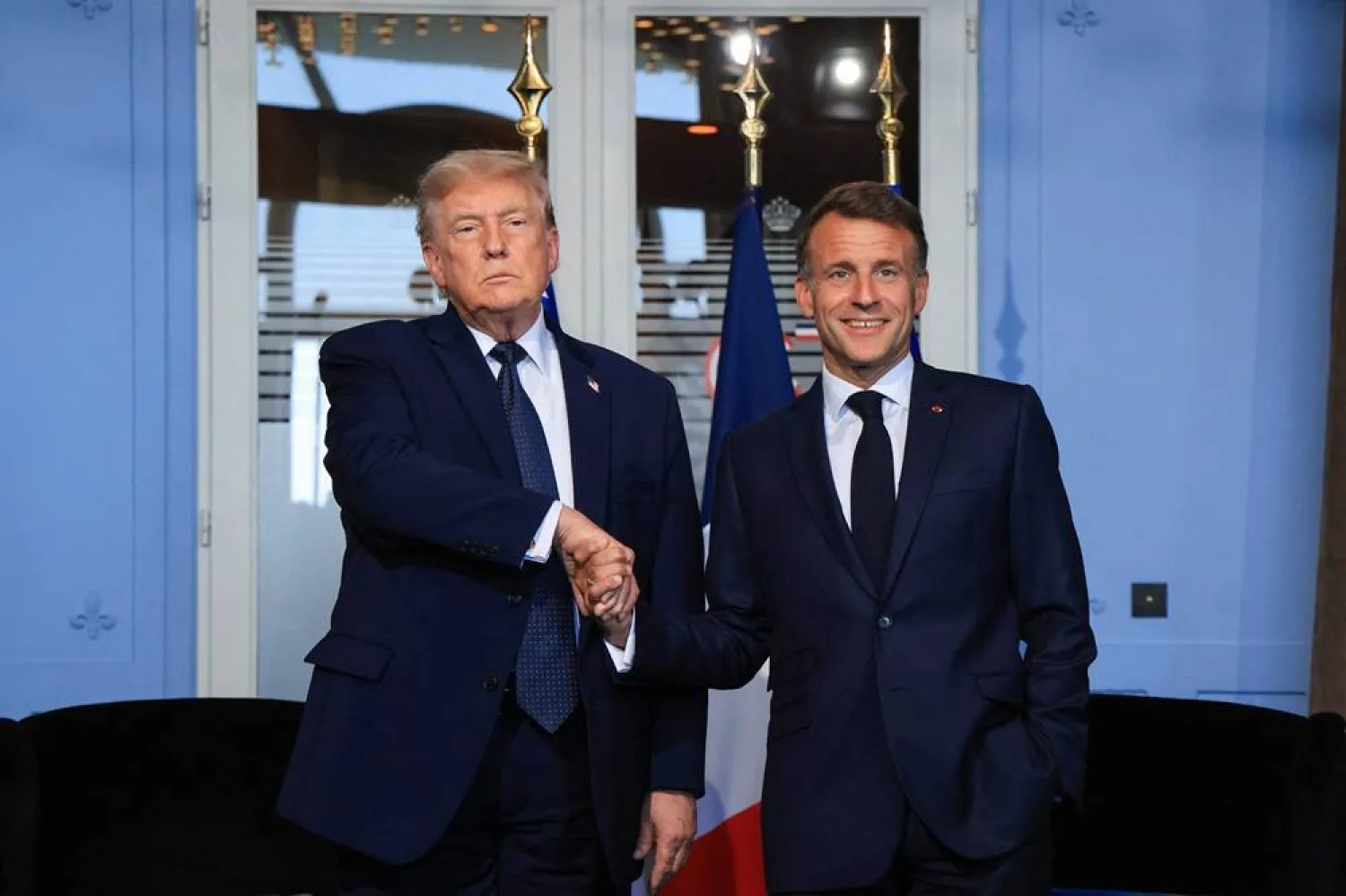
US President Donald Trump (L) shakes hands with France's President Emmanuel Macron during a bilateral meeting on the sidelines of the G7 summit, in Evian, central-eastern France on June 15, 2026. (AFP)
TT

Trump Says Iran Deal Has Been Signed, Text to Come Soon

US President Donald Trump (L) shakes hands with France's President Emmanuel Macron during a bilateral meeting on the sidelines of the G7 summit, in Evian, central-eastern France on June 15, 2026. (AFP)

US President Donald Trump on Monday said an agreement with Iran has been signed and that the text of the deal would be released sometime after a formal signing on Friday, adding that the Strait of Hormuz would also be fully open.

Speaking alongside ‌French President ‌Emmanuel Macron ahead of this ‌week's ⁠G7 meeting, Trump ⁠said he did not know if he would attend the Friday ceremony expected in Geneva, but that US Vice President JD Vance would be there.

"The deal's all signed. ⁠And the strait is ‌already partially opened, ‌as you know," Trump told reporters shortly ‌after arriving in Evian, France. "On Friday, ‌it'll be completely open."

Vance earlier on Monday said the agreement had been signed digitally on Sunday and that no funds ‌were released.

Asked when the text of the memorandum of ⁠understanding ⁠would be made public, Trump said: "Probably pretty soon. I would say after sometime after Friday... I think sometime in the very near future."

Trump said any sanctions relief for Tehran was "really a behavioral thing. If they do what they're supposed to do, that starts taking effect."

There was no immediate response from Tehran to the report that the agreement, which both sides announced overnight, had already been signed. Previous reports from both sides had suggested it would be signed officially at a ceremony in Geneva on Friday.  

In an early reminder of the agreement's fragility, Israel - which launched the war alongside the United States in February and was not consulted on the talks to end it - struck a car with a drone in southern Lebanon, where it has been battling the Iran-aligned Hezbollah movement. Iran has said the deal must bring a full cessation of hostilities there. 

The terms of the memorandum of understanding, reached after more ‌than two months of ‌negotiations, have yet to be published. A US official, speaking on condition of anonymity, said ‌he expected ⁠the terms would ⁠be made public in the next 24-48 hours. 

Oil prices tumbled on the prospect of an end to disruption to global energy supplies, and share prices soared, some hitting new records. 

Trump, who had earlier said the blockaded Strait of Hormuz would be open on Friday, said on Monday that ships had already begun transiting it. However, the US military told shippers it had not yet lifted its blockade of Iranian ports. 

60-DAY NEGOTIATION PERIOD 

According to accounts from both sides, the agreement would reopen the blockaded strait and extend a ceasefire for a 60-day negotiation period, when contentious issues such as the future of Iran's nuclear program are due to be decided. 

Meanwhile, ‌the immediate fate of the pact could hinge on Lebanon, where Israel has been battling the Iran-aligned Hezbollah armed group in parallel with the wider ‌war that it launched alongside the United States against Iran in February. 

Iran has said the preliminary agreement requires a cessation of ‌hostilities on all fronts, including in Lebanon. Israel, which was not consulted on the preliminary deal, has said it reserves the right to act in Lebanon against Hezbollah threats. 

Security sources said fighting in southern Lebanon had tamped down on Monday after the agreement was announced but had not ceased entirely. 

In the first strike of its kind since the announcement, an Israeli drone struck a car in the southern Lebanese town of Kfar Tebnit, killing the ‌driver, Lebanese state media reported. There was no immediate comment from the Israeli military on the strike. 

LEBANON HAS BEEN A STICKING POINT  

While the US and Iran had largely ceased hostilities ⁠in early April, fighting has not ceased ⁠in Lebanon, where Hezbollah opened fire on Israel in support of Tehran on March 2 and Israel responded with an air campaign and ground invasion that has uprooted some 1.2 million people. 

Iran's Foreign Minister Abbas Araqchi said there must be a complete halt to Israeli attacks against Lebanon and wrote on Telegram that the US bears responsibility for implementing the framework deal. 

Hezbollah welcomed the deal and said the inclusion of Lebanon reflected Iran's commitment to securing a halt to the war and preserving Lebanon's rights. 

Israeli Prime Minister Benjamin Netanyahu has yet to respond publicly to the US-Iran agreement. But Defense Minister Israel Katz said that Israel would remain "indefinitely" in areas it is occupying in southern Lebanon to eliminate what it perceives as militant threats.  

Privately, Israeli officials' views of the deal have been negative. One senior Israeli official told Reuters on condition of anonymity that the agreement was "terrible for Israel," and that this assessment was shared throughout the government from Netanyahu on down. 

The reopening of the Strait of Hormuz would help solve a global energy crisis precipitated by the war, which has hurt Trump's political fortunes by forcing up gasoline prices in the United States. 

"Ships of the World, start your engines. Let the oil flow!" he wrote on Sunday. 

On Monday he announced: "Ships are starting to move, many loaded up with Oil, out of the Strait of Hormuz." 


Trump Says ‘Very Negative Forces’ Raising Exaggerated Concerns Over AI

 A message reading "AI artificial intelligence", a keyboard, and robot hands are seen in this illustration taken January 27, 2025. (Reuters)
A message reading "AI artificial intelligence", a keyboard, and robot hands are seen in this illustration taken January 27, 2025. (Reuters)
TT

Trump Says ‘Very Negative Forces’ Raising Exaggerated Concerns Over AI

 A message reading "AI artificial intelligence", a keyboard, and robot hands are seen in this illustration taken January 27, 2025. (Reuters)
A message reading "AI artificial intelligence", a keyboard, and robot hands are seen in this illustration taken January 27, 2025. (Reuters)

US President Donald Trump said on Sunday a lot of "very negative forces" are bringing things up about AI that won't happen and said that he wanted to make sure that the United States remains the industry leader.

"We're leading China in AI. We're the most sophisticated country in the world, and frankly I want to keep it that way because whoever wins AI wins," Trump, at ‌his Ireland ‌golf course, told reporters when asked if ‌the ⁠AI industry should ⁠slow down or be more regulated.

"We could put guardrails. We can do this and that. But I think you have a lot of very negative forces that are bringing it up that shouldn't be bringing it up and they're bringing up things that won't happen."

Trump has resisted ⁠stirring concerns about AI.

His latest comments ‌come after a week of ‌concerns in the United States after two Anthropic researchers issued ‌warnings that rapidly progressing artificial intelligence could lead to the ‌extinction of the human race in the not-too-distant future.

In his second term, Trump's administration has largely embraced AI firms. These AI leaders and other technology companies have also supported Trump's initiatives.

Yet, ‌the Pentagon earlier this year warned of risks from Anthropic's model.

After the researcher warnings, ⁠some AI ⁠CEOs are pushing for slowing advancement of the models.

Anthropic CEO Dario Amodei on Saturday outlined a three-step framework intended to pace development and create more time to manage its risks.

Jacob Coxon, one of the Anthropic researchers who resigned and then issued the warnings, pushed for the US to work with other countries to ensure pace.

"I feel we need international coordination, or else we risk running the same race with China, which could be equally dangerous," Coxon said on NBC's Meet the Press.


Trump Says Zelensky ‘Has to Stop’ Attacking Russian Refineries

US President Donald Trump waves during a visit to Trump International Golf Links and Hotel in Doonbeg, Ireland, 13 September 2026. (EPA)
TT

Trump Says Zelensky ‘Has to Stop’ Attacking Russian Refineries

US President Donald Trump waves during a visit to Trump International Golf Links and Hotel in Doonbeg, Ireland, 13 September 2026. (EPA)

US President Donald Trump said Sunday he had warned Ukrainian President Volodymyr Zelensky to "stop knocking out diesel fuel" refineries in Russia because it was causing shortages and "hurting" other countries.

"Mr. Zelensky has to do one thing," Trump told reporters while on a visit to Ireland. "He has to stop knocking out diesel fuel in Russia.

"Let him go after targets, but not diesel fuel, because he's causing a shortage of diesel. This isn't done by the Middle East, this is done by what's happening with Russia and Ukraine."

Trump added he had spoken to Ukraine's leader about the country's stepped-up attacks on such sites over recent months.

"There are plenty of other targets. Don't hit diesel fuel because that's hurting. That's hurting the world. We don't want him to hit diesel fuel... He's hitting diesel refineries."

Ukraine has hit numerous Russian oil refineries hundreds of kilometers from its border with Russia, while Moscow has also intensified its long-range attacks in recent months, leading to a jump in civilian deaths.

Kyiv has been firing record numbers of drones at Russia, while Moscow has been launching all-time high missile attacks.

On Sunday, a Russian drone struck a Warsaw-bound passenger train from Kyiv but caused no casualties, both Warsaw and Kyiv said, as Zelensky said western regions had come under attack.

The strikes came days after US envoys visited both Moscow and Kyiv in an effort to revive talks led by Washington on ending Europe's worst conflict since World War II.

With conflict again intensifying in the Middle East, oil prices have spiked, in turn raising American fuel costs and inflation.

That has prompted speculation that the Federal Reserve will hike interest rates just as voters in the US prepare to vote in key midterm elections in November.


France Apologizes for UN Diplomatic Spat with Washington

11 September 2026, US, New York: France's Permanent Representative to the UN, Jerome Bonnafont, speaks during a UN Security Council meeting marking the 25th anniversary of the 11 September 2001 terrorist attacks and examining the evolving global terrorist threat and international efforts to counter terrorism. Photo: Bianca Otero/ZUMA Press Wire/dpa
TT

France Apologizes for UN Diplomatic Spat with Washington

11 September 2026, US, New York: France's Permanent Representative to the UN, Jerome Bonnafont, speaks during a UN Security Council meeting marking the 25th anniversary of the 11 September 2001 terrorist attacks and examining the evolving global terrorist threat and international efforts to counter terrorism. Photo: Bianca Otero/ZUMA Press Wire/dpa

The French UN mission said it regretted an online post criticizing how the United States voted during a UN General Assembly meeting, with US officials telling AFP on Saturday that Washington appreciated the statement.

France's permanent mission to the UN published the apology Friday, saying it regretted a post on X criticizing the United States' commitment to human rights.

"France and the United States recently took different positions on a vote at the United Nations General Assembly. This difference concerned one vote, and not the defense of human rights," the mission said in an English statement on its website.

"Public differences of opinion on one vote do not stand in the way of close dialogue with the United States, and do not call into question our historical alliance, nor our ability to work together to advance peace, stability and prosperity, including within multilateral forums," the statement continued.

The mea culpa was well-received by Washington, which has been holding up the appointment of France's next US ambassador as a result of the dispute.

"We note and appreciate France's statement and look forward to working together to further shared values and interests," a US State Department official told AFP on condition of anonymity.

The US State Department has held up the approval of Aurelien Lechevallier, French President Emmanuel Macron's choice as France's next envoy to Washington, replacing Laurent Bili.

Lechevallier is currently French Foreign Minister Jean-Noel Barrot's chief of staff.

US approval of a choice of French envoy is usually a formality but has remained in limbo since the dispute.

On July 24, the United States was one of 10 countries to vote in the UN General Assembly against extending Volker Turk's term as UN human rights chief, joining the ranks of North Korea, Russia and Nicaragua, among others.

"The US used to be a beacon of human rights. Not anymore," the French mission wrote in a post on X after the United States strongly opposed another term by Turk, who has repeatedly questioned US policies under President Donald Trump.

The criticism was met with immediate backlash from Washington, with the US representative walking out of a UN Security Council meeting days later when France's ambassador took the floor, in protest of the comments.
