Scientists Identify 64,000 sq Miles of Coral Reef Capable of Surviving Climate Crisishttps://english.aawsat.com/varieties/5284658-scientists-identify-64000-sq-miles-coral-reef-capable-surviving-climate-crisis
Scientists Identify 64,000 sq Miles of Coral Reef Capable of Surviving Climate Crisis
FILE PHOTO: Fish swim at a coral reef inside a 'Rahui' or restricted area in Teahupo'o, Tahiti, French Polynesia, August 4, 2024. REUTERS/Carlos Barria/File Photo
Scientists Identify 64,000 sq Miles of Coral Reef Capable of Surviving Climate Crisis
FILE PHOTO: Fish swim at a coral reef inside a 'Rahui' or restricted area in Teahupo'o, Tahiti, French Polynesia, August 4, 2024. REUTERS/Carlos Barria/File Photo
Scientists have identified nearly 166,000 sq km (64,000 sq miles) of coral reefs that are capable of surviving and recovering from climate change, three times more than previously estimated, research showed on Tuesday.
The world's coral reefs, which sustain a quarter of all marine life, have come under severe stress as a result of violent tropical storms, pollution and mass "bleaching" events caused by soaring ocean temperatures, with some scientists warning that they are facing irreversible decline.
But an analysis of 45,000 coral surveys together with decades of climate and ocean data has identified climate-resilient reefs across 71 countries and 100 territories, including in parts of the Caribbean and the Pacific and Atlantic oceans that have not previously been recognized.
"Coral reefs are often framed as ecosystems beyond saving," said Emily Darling, director of coral conservation at the Wildlife Conservation Society (WCS) and one of the report's authors.
"This research shows otherwise: we know where the hope is and what we need now is political will."
Countries are currently drawing up action plans aimed at bringing 30% of their land and marine environments under formal protection by the end of the decade, a target known as "30 by 30", and the new research will enable governments to consider the location of coral reefs in their planning.
"Only 28% of the reefs currently fall within protected and conserved areas, so the opportunity is clear, and so is the urgency, especially as we face an upcoming super El Nino event," Reuters quoted Darling as saying at a briefing.
Stacy Jupiter, co-author and executive director of the WCS's Global Marine Program, said the data could give governments the information required to decide where limited funds are deployed and give the more resilient reefs the best possible chance of surviving.
"In certain cases, where reefs are below certain benchmarks for ecosystem function, it may be a case of triage, where we may need to leave those places," she said.
Spectacular But Squawky, Starlings Get Icy Welcome in Romehttps://english.aawsat.com/varieties/5343881-spectacular-squawky-starlings-get-icy-welcome-rome
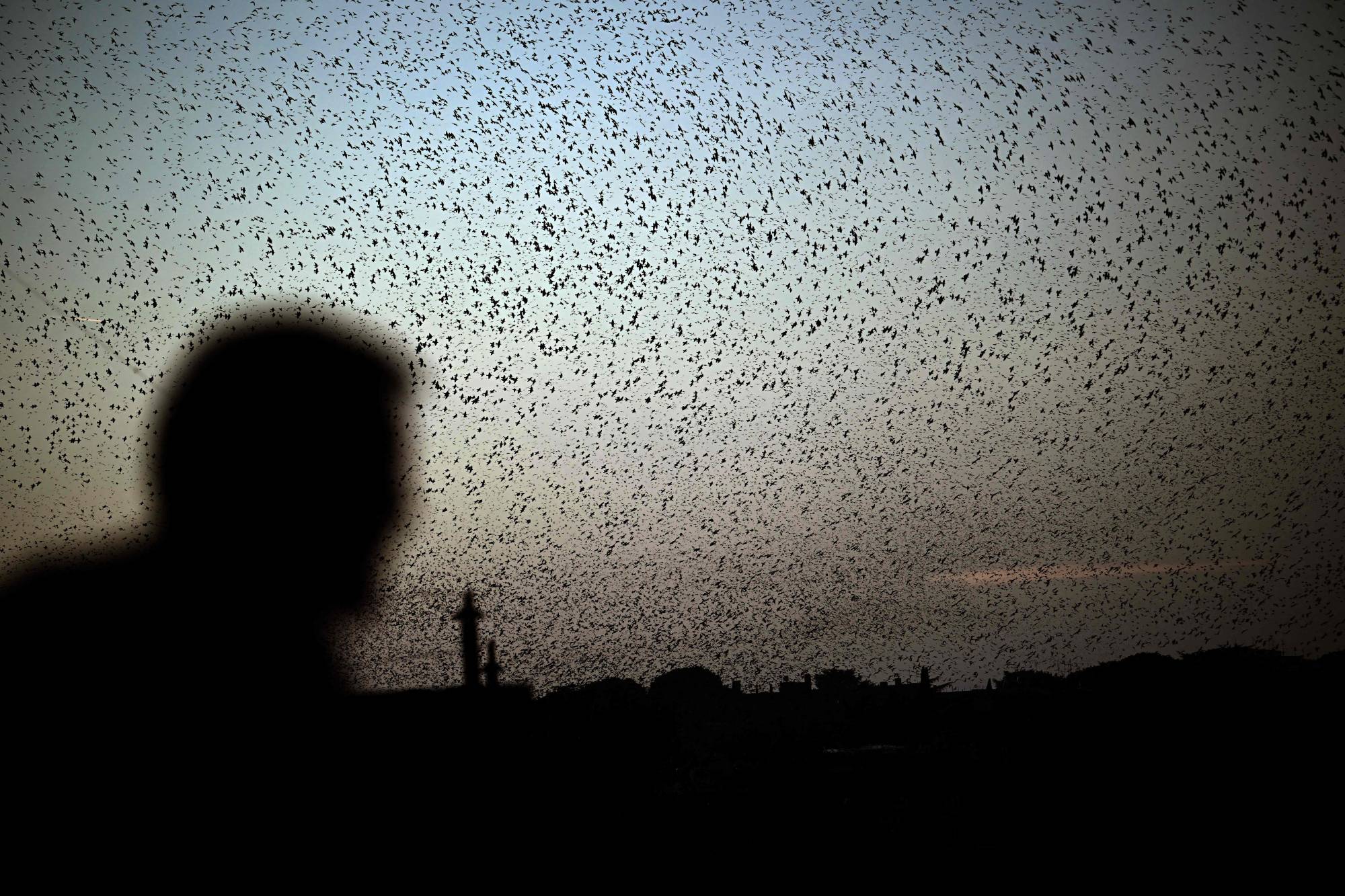
Starlings fly by the moon before spending the night in the trees of Rome during their autumn migration on November 19, 2026. (Photo by Filippo MONTEFORTE / AFP)
Spectacular But Squawky, Starlings Get Icy Welcome in Rome
Starlings fly by the moon before spending the night in the trees of Rome during their autumn migration on November 19, 2026. (Photo by Filippo MONTEFORTE / AFP)
All roads lead to Rome, including for raucous starlings whose noisy, messy habits have left residents of the capital determined to send them flying.
Known for their spectacular aerial displays, a behavior known as murmuration, and for their exceptional vocal mimicry, starlings migrate in the millions to Italy from northern Europe in winter in search of warmth.
For years, the city has tried in vain to chase the unwelcome visitors from the trees in busy areas where they rest to build up strength before the breeding season.
A three-day experiment this week in a northeast Roman neighborhood may have worked, with shopkeepers and citizens blaring an ear-shattering noise simulating a starling distress call from their windows, in the hope it would deter them from settling in.
"It's nature. They're birds flying in trees, so I don't think we can claim the right to get rid of them," Matteo Zocchi, the councilor charged with environmental issues for Rome's third administrative borough, told AFP.
Zocchi said officials were realistic about what could be done about the "hundreds of thousands" of starlings in his neighborhood, with the goal being just to "push them away a bit to give this area some breathing space".
"The problem has been huge because we've had to clean the streets constantly," he said.
Mesmerizing in the air but disruptively loud at bedtime, the social, polka-dotted birds swoop down from the sky at dusk to roost in leafy trees, their cacophonous chatter impossible to ignore.
When the birds fly off at dawn to feed in open fields, pavements and cars are covered by slippery guano, an unpleasant by-product of their visit.
Some residents and shoppers on Rome's hard-hit Viale Jonio have taken to using umbrellas as protection.
Residents look at starling flocks that come to spend the night in the trees of their neighborhood, in Rome on November 19, 2026. (Photo by Filippo MONTEFORTE / AFP)
Roberto Benenato, 29, who works at a pastry shop underneath the avenue's line of plane trees, said it's been impossible to park on the street for fear of returning to a guano-covered vehicle.
"But the worst thing... is really the horrible stench of guano we've had these past weeks. It would get right up your nose, into your head. You couldn't breathe properly. Really unpleasant, let's say," he said.
Timing is everything when it comes to disrupting the starlings.
Once snug on their branches to rest overnight, the birds don't budge -- meaning that the moment to dissuade them from settling in is immediately after arrival.
In the past, city officials used just the distress call to ward off the starlings.
But given the perceived increase in their numbers this year, they chose a multi-pronged effort, including lights from lasers directed into the trees.
More impressive was a raptor named Geronimo who was calmly promenaded on the arm of his falconer beneath the trees, never once leaving his perch.
For three days this week, city residents and shopkeepers were invited to tune into the live broadcast of the distress calls and point their stereo speakers, laptops or cellphones towards the trees for an hour beginning at 4:15 local time (1515 GMT).
Starlings in Rome are a draw for tourists and photographers mesmerized by their murmurations.
They choose the city to roost because it affords better protection from predators than open countryside.
But no one knows exactly how many arrive in the city each winter -- either from northern and eastern Europe or from other parts of Italy.
A 2021 study by conservation coalition BirdLife International found their numbers were decreasing moderately in the country as a whole.
Starling expert Alessandro Montemaggiori of Rome's Sapienza University says they have been migrating to Rome for 80 years.
A decade ago, there were an estimated one million in the city at night in winter. By some accounts, that number may have fallen by half now.
From a rooftop on Thursday at sunset, one could see several murmurations weaving through the sky and then gathering in the distance.
Suddenly the birds were directly overhead, the sky nearly black as the piercing noise from distress calls blasted out from rooftops and balconies.
As Zocchi and other officials held their breath during the dramatic display, some starlings who had dived into the tops of nearby trees quickly took off again.
The murmurations reformed and gradually moved away, appearing to settle somewhere in the distance.
"This is the greatest result we could have hoped for," smiled Zocchi.
Maine Parents Sue Town Over Autistic Daughter’s Metal Rooster Statueshttps://english.aawsat.com/varieties/5343864-maine-parents-sue-town-over-autistic-daughter%E2%80%99s-metal-rooster-statues
Pyper Leblanc examines a pair of tin roosters after they were set up at the Hilton Winn Farm in Ogunquit, Maine, Wednesday, July 22, 2026. (AP Photo/Robert F Bukaty, File)
Maine Parents Sue Town Over Autistic Daughter’s Metal Rooster Statues
Pyper Leblanc examines a pair of tin roosters after they were set up at the Hilton Winn Farm in Ogunquit, Maine, Wednesday, July 22, 2026. (AP Photo/Robert F Bukaty, File)
A fight over whether giant metal roosters in Maine are illegal advertising or artwork that comforts an autistic child has landed in federal court.
David and Sara LeBlanc sued the town of Ogunquit this week, alleging that enforcement of its sign code violates their First Amendment rights, according to AP.
They want to display the roughly 1.8 meters ornaments for their daughter, Pyper, but the town considers them advertising for the couple’s adjacent restaurant, the Omelette Factory.
“The roosters are a symbol of one thing: How much we love our daughter,” David LeBlanc said in a statement. “But the town made up an entirely different meaning for them.”
After issuing multiple fines, the town granted the couple a disability variance that allows them to keep two roosters but specifies that they must be attached to a railing.
More fines followed when the couple declined to build a railing and chained them to two posts instead. They have since removed all of the tin statues, according to the lawsuit, which points out that other local businesses display lobster buoys, antique farm equipment and large tiki statues without incurring fines.
“This is governmental discrimination based on the content of speech and the identity of the speaker,” the lawsuit states. “Such discrimination is presumptively unconstitutional, and the Town cannot justify it.”
The LeBlancs are represented by the Institute for Justice, which won a similar case in New Hampshire in 2025 when a judge sided with a bakery owner in a dispute over a large mural high school students painted on his building.
The town of Conway had argued the mural featuring doughnuts and other baked treats was a regulated sign, but the judge found the town infringed on the bakery owner’s free speech rights.
Ogunquit’s town clerk, Christine Murphy, did not respond to a message seeking comment Wednesday. Meanwhile, many of the LeBlancs’ original roosters have been adopted by local residents and businesses, and their supporters around the world have been buying their own to display.
“Every time Pyper spots another rooster in someone’s yard, her face lights up,” Sara LeBlanc said in a statement. “This town has embraced her. We wish the town government would, too.”
Astronomers Observe a Huge Puffy Star Merge with Smaller Companionhttps://english.aawsat.com/varieties/5343562-astronomers-observe-huge-puffy-star-merge-smaller-companion
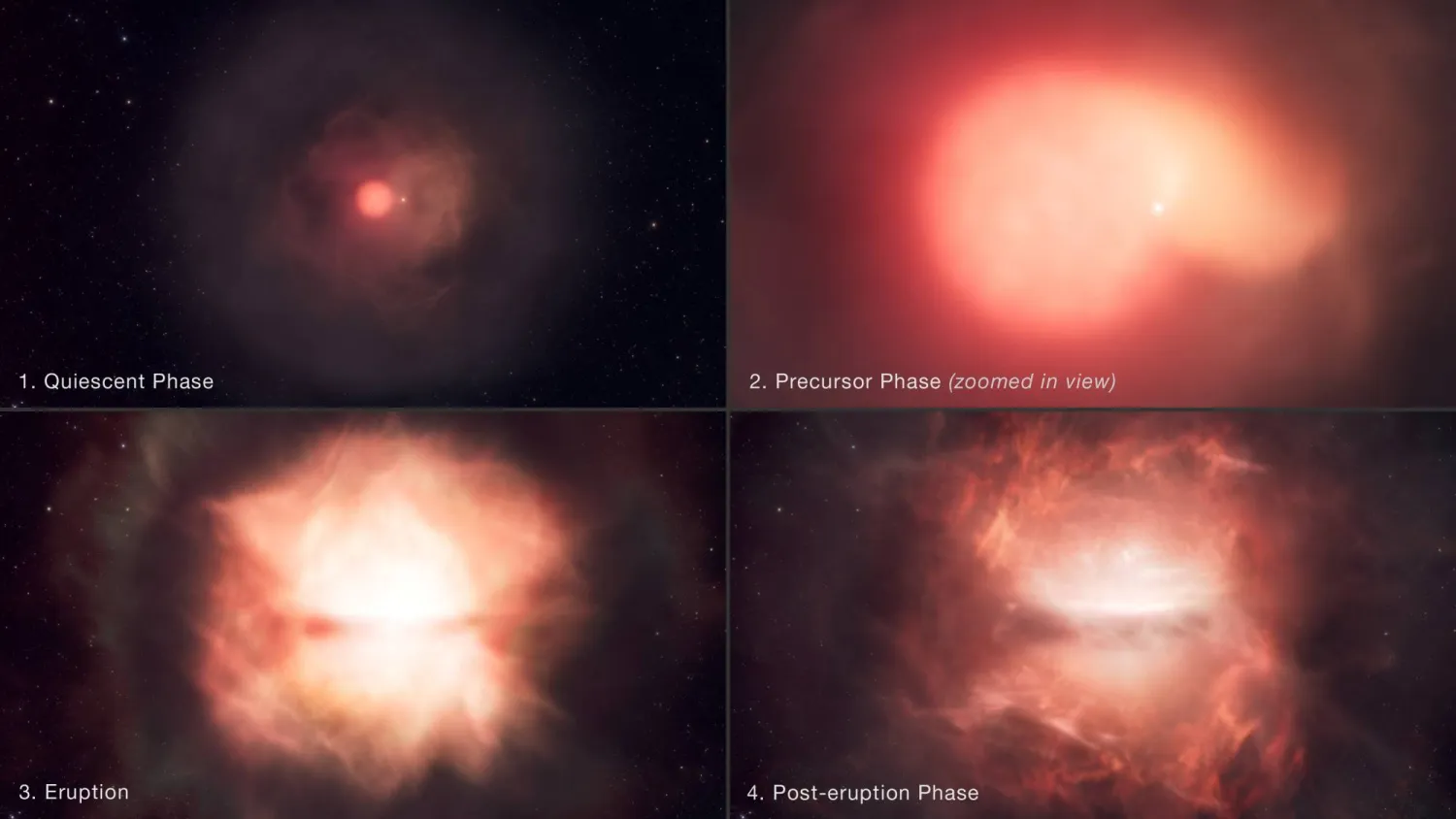
An artist's concept depicts, clockwise from top left, two stars in the Andromeda Galaxy surrounded by a dust shell before their merger. NASA, ESA, CSA, STScI, Leah Hustak (STScI); Science: Viraj Karambelkar (Columbia)/Handout via REUTERS
Astronomers Observe a Huge Puffy Star Merge with Smaller Companion
An artist's concept depicts, clockwise from top left, two stars in the Andromeda Galaxy surrounded by a dust shell before their merger. NASA, ESA, CSA, STScI, Leah Hustak (STScI); Science: Viraj Karambelkar (Columbia)/Handout via REUTERS
Astronomers have observed a large dying star, seven times more massive and 18,000 times brighter than the sun, engulfing a smaller companion in a stellar merger unlike any other previously witnessed.
The merger involved a pair of stars that were bound gravitationally — known as a binary system — in which the larger one greatly expanded in its death throes into what is called a puffy supergiant and enveloped the smaller one, with the two stars then combining into one.
This cosmic connection occurred about 2.5 million light-years from Earth on the outskirts of the Andromeda Galaxy, one of our Milky Way's closest galactic neighbors. A light-year is the distance light travels in a year, 5.9 trillion miles (9.5 trillion km).
The researchers identified the impending engulfment nearly three years before it occurred and then watched as the merger unfolded, step by step.
"Giant stars engulfing their companion stars have been theorized for many decades, and understanding the outcomes of this process has important implications for explaining a wide range of systems that we see today in the universe," said Viraj Karambelkar, a postdoctoral researcher and NASA Hubble Fellow at Columbia University in New York, lead author of the research published in the journal Nature.
"The system presented in this study provides the first direct observations of this process happening — the first time a giant star engulfing its companion was caught in the act," Reuters quoted Karambelkar as saying.
Large stars near the end of their lifespan can swell up as their cores run out of fuel and shrink while the inner stellar heat pushes the outer layers outward. The larger star in this study puffed up to 350 times the sun's diameter. The smaller star, whose diameter was about 70% that of the sun, orbited its companion at roughly the same distance as between Mars and the sun, and was engulfed in the bigger star's expansion.
The researchers detected brightening when this occurred in 2018, and the smaller star began to spiral inward toward the core of the bigger star over the next seven years. Toward the end of 2025, the smaller star finally merged with the core of the larger one, triggering an eruption a million times brighter than the sun in what Karambelkar called "a unification event."
"This violent collision set off a bomb inside the star, producing the bright eruption that we saw," Karambelkar said.
The researchers first spotted the stars using data from the infrared WINTER telescope at Palomar Observatory in California and NASA's NEOWISE space telescope, then watched the events with the orbiting SPHEREx and James Webb space telescopes and various ground-based observatories.
"We have observed mergers of stars in the past," said Columbia astrophysics professor and study co-author Kishalay De.
"The difference is in the nature of the stars that merged. In the past, stellar mergers were observed from two stars that were fairly small and compact, and their merger was almost inevitable once they came into physical contact. However, the bigger star in this event was a very puffed-up star where its outer envelope was loosely bound. This configuration is exactly the kind in which a merger may or may not happen," De said.
In some cases, an engulfed smaller star might release enough energy to blow away the larger star's puffy outer layers, leaving behind the remaining core of the original bigger star orbiting the smaller one, De said.
While the larger of the two stars in this instance was nearing the end of its life, the merger may have produced a rejuvenated star with a new lease on life, the researchers said.
The researchers gave the merged star the nickname Bao, the name of popular steamed buns in Chinese cuisine.
"The auto-assigned name to this eruption was AT2025abao — 'Astronomical Transient in 2025 abao.' We called it Bao as an affectionate term derived from this. The similarity with the Chinese buns definitely encouraged us to adopt the nickname," Karambelkar said.
لم تشترك بعد
انشئ حساباً خاصاً بك لتحصل على أخبار مخصصة لك ولتتمتع بخاصية حفظ المقالات وتتلقى نشراتنا البريدية المتنوعة