


Trump Calls for Russia Deal with Zelenskiy, Vague on Pressure

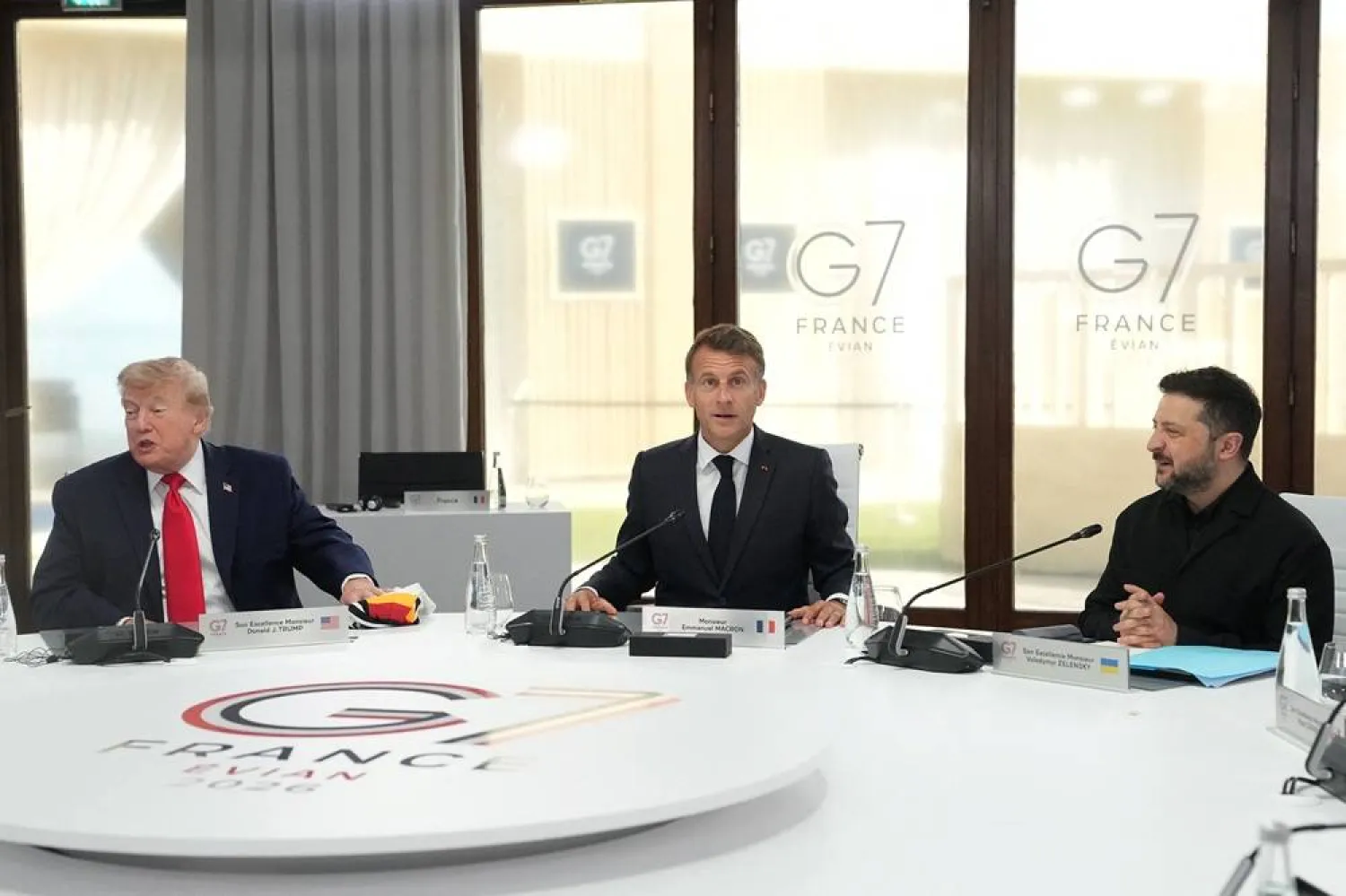
US President Donald Trump, French President Emmanuel Macron and Ukrainian President Volodymyr Zelenskiy during a working session at the G7 summit in Evian-les-Bains, France, June 16, 2026. (Reuters)
TT

Trump Calls for Russia Deal with Zelenskiy, Vague on Pressure

US President Donald Trump, French President Emmanuel Macron and Ukrainian President Volodymyr Zelenskiy during a working session at the G7 summit in Evian-les-Bains, France, June 16, 2026. (Reuters)

US President Donald Trump said Russia should make peace with Ukraine after a "very good" meeting with President Volodymyr Zelenskiy on Tuesday, but there were few details of any concrete steps to raise the pressure on Moscow.

Trump, who arrived at the G7 summit in the French lakeside resort of Evian-les-Bains brandishing a preliminary deal to end his war with Iran, said he would do what he could do to end the conflict in Ukraine, now deep into its fifth year.

"Look, Russia should make a deal," Trump told reporters, adding that too many young men were dying on the battlefield on both sides. "I'm gonna do whatever I can."

After the group meeting with Trump, Zelenskiy told Reuters that G7 leaders agreed that Russia was not winning the war. He said they also ‌discussed additional sanctions ‌targeting Russia's oil exports, its banking sector and its military production to bring Moscow to the ‌negotiating ⁠table.

Zelenskiy and his ⁠European allies want to underline to Trump how Ukraine's battlefield fortunes have shifted, hoping he will lean harder on Russia to gain leverage in eventual peace talks.

Zelenskiy said on Monday he had offered to meet Russia's Vladimir Putin at the G7 summit, but a Kremlin aide said on Tuesday that did not come up in a call between Trump and Putin.

Trump was due to have face-to-face talks with Zelenskiy later on Tuesday. Earlier, Ukraine's presidency shared images of Zelenskiy in conversation with Trump and US Secretary of State Marco Rubio on the summit's sidelines.

POSITIVE TALKS ON UKRAINE

Two European diplomats said that, during the meeting, Zelenskiy showed Trump images ⁠of the aftermath of a Russian strike on Monday on Kyiv's Pechersk Lavra monastery.

Trump expressed ‌disapproval of the strike, one of the European diplomats said, while the other ‌said that it had been "psychologically" a good move by Zelenskiy to show the images.

European diplomats said the tone of the ‌meeting had been constructive.

But two of the diplomats said Trump had been noncommittal on imposing further US sanctions on Moscow, ‌as European leaders want.

Trump told reporters Washington was now in a position to let Russian oil waivers lapse after an interim accord to end the Iran war soothed markets, but he did not address the question of broader punitive measures.

European leaders have wanted to convince Trump that previous US positions on the possible terms of a deal were overly favorable towards Moscow, particularly now that Ukraine's drone incursions into Russia have ‌improved its fortunes.

"The tide is turning for Ukraine," European Commission President Ursula von der Leyen posted on X. "Russia's fatigue is openly showing. That's the time to double down on ⁠our support."

A French diplomat ⁠said G7 leaders had agreed that the battlefield dynamic was now in Ukraine's favor, and committed to providing Kyiv with more air defense capabilities - a key priority for Zelenskiy as he grapples with increased civilian strikes from Russia.

G7 TO EXAMINE HORMUZ SHIPPING PROBLEM

European leaders were also set to warn Trump that an interim deal with Iran risks entrenching Tehran's nuclear and ballistic missile programs. President Emmanuel Macron said the priority was to ensure there was a "solid, serious agreement that is finalized".

Tuesday's working lunch focused on the safe reopening of the Strait of Hormuz, which Iran largely closed at the end of February. Leaders also sought to identify alternative routes to bypass the waterway, which Trump said would be "completely open" on Friday.

The interim deal should open a 60-day window for complex technical negotiations that would include the fate of Iran's stockpile of highly enriched uranium and the lifting of international sanctions.

However, European allies fear that an inexperienced US negotiating team may fail to secure a robust nuclear agreement or address Iran's ballistic missile program in the next phase, potentially creating a prolonged standoff.

Trump said the deal stated "loud and clear" that Iran would not develop a nuclear weapon - something Iran has long denied seeking to do.



Trump Says Strait of Hormuz Has Been Demined, Warns Iran Not to Plant More

Vessels in the Strait of Hormuz are visible near the beach of Bandar Abbas, Iran, August 25, 2026. Majid Asgaripour/WANA (West Asia News Agency) via REUTERS
TT

Trump Says Strait of Hormuz Has Been Demined, Warns Iran Not to Plant More

Vessels in the Strait of Hormuz are visible near the beach of Bandar Abbas, Iran, August 25, 2026. Majid Asgaripour/WANA (West Asia News Agency) via REUTERS

US President Donald Trump said on Tuesday that all mines had been detonated or removed from international waters of the Strait of Hormuz and that Iran has been told that any ship or boat placing new mines will be destroyed.

In a post ⁠on Truth Social, ⁠Trump said the United States, through its Space Force, was watching "every square inch" of the Strait, a key waterway in the global energy supply chain.

"There is ⁠a Zero Tolerance policy on mine placement in full force and effect," Trump said.

The US and Iran have not conducted air strikes on each other's militaries for weeks, but attacks on vessels in the Strait of Hormuz have continued as the two sides vie for ⁠control of ⁠the narrow maritime passage.

Oil transits through the strait were at 5 million barrels per day on Monday, provisional data from shiptracker Vortexa showed, down from more than 20 million per day before the war or about one of every five barrels consumed worldwide.


Ukraine’s Zelenskiy Sees Window for US Mediation Until Summer 2027

 Ukraine's President Volodymyr Zelenskiy attends a press conference following a meeting of the so-called Coalition of the Willing group, amid Russia's attack on Ukraine, in Kyiv, Ukraine August 24, 2026. (Reuters)
Ukraine's President Volodymyr Zelenskiy attends a press conference following a meeting of the so-called Coalition of the Willing group, amid Russia's attack on Ukraine, in Kyiv, Ukraine August 24, 2026. (Reuters)
TT

Ukraine’s Zelenskiy Sees Window for US Mediation Until Summer 2027

 Ukraine's President Volodymyr Zelenskiy attends a press conference following a meeting of the so-called Coalition of the Willing group, amid Russia's attack on Ukraine, in Kyiv, Ukraine August 24, 2026. (Reuters)
Ukraine's President Volodymyr Zelenskiy attends a press conference following a meeting of the so-called Coalition of the Willing group, amid Russia's attack on Ukraine, in Kyiv, Ukraine August 24, 2026. (Reuters)

Ukraine sees a window of opportunity for US mediation to end Russia's war in Ukraine until the end of next summer and has drafted one page of ideas with US and European officials to be presented to Moscow, President Volodymyr Zelenskiy said.

Zelenskiy said that a ceasefire and a previously discussed US proposal for a free economic zone in Ukraine's eastern Donbas area — to be administered by a third party — were among the ideas in the ‌document.

"It contains ‌one of the ideas for a ceasefire — that ‌is ⁠the main point. The ⁠second part concerns what the Americans proposed regarding a free economic zone," Zelenskiy told reporters in a weekend briefing.

Zelenskiy said that he saw a window to end the nearly four-and-a-half years of fighting that stretched from the G20 summit in the US in December this year until the end of summer 2027, given the looming campaign for the ⁠2028 presidential election in the US.

Zelenskiy said earlier this ‌month that Ukraine had handed proposals to ‌US negotiators for a plan to end the war, without providing more detail.

US-led ‌peace talks fell apart earlier this year as Ukraine refused Russian ‌demands to cede more territory and as Washington became increasingly preoccupied with the conflict with Iran.

US negotiators Steve Witkoff and Jared Kushner were last in Moscow in January and have not yet visited Kyiv.

Zelenskiy said the third ‌element in the draft proposal was the role that the European Union and NATO would play and ⁠what "Ukraine is ⁠prepared to do to achieve this". He did not elaborate further.

"These three ideas I've mentioned are not exclusively Ukrainian ideas," Zelenskiy said, adding they were developed jointly with the Americans and the Europeans, with some stemming from previous talks US negotiators had with Ukraine and Russia.

Russia was open to listening to new proposals on how to reach a settlement on the Ukraine conflict, but they should reflect the "realities on the ground", a senior Russian diplomat said in an interview published last week.

Moscow's key objective is capturing the remainder of Donbas, where it has been making a push to advance into Ukraine's so-called fortress belt of eastern cities.


UN, Red Cross Chiefs: World Must Rein in Autonomous Weapons

FILE PHOTO: United Nations Secretary-General Antonio Guterres leaves after a press conference at a UN compound in the Nicosia airport area, Cyprus, July 29, 2026. REUTERS/Yiannis Kourtoglou/File Photo
TT

UN, Red Cross Chiefs: World Must Rein in Autonomous Weapons

FILE PHOTO: United Nations Secretary-General Antonio Guterres leaves after a press conference at a UN compound in the Nicosia airport area, Cyprus, July 29, 2026. REUTERS/Yiannis Kourtoglou/File Photo

The United Nations and Red Cross warned Tuesday the world is "dangerously close" to a future where autonomous weapons -- so-called "killer robots" -- could target humans, and issued an urgent appeal for international regulations.

The warning follows a call in 2023 from UN Secretary General Antonio Guterres and Mirjana Spoljaric, president of the International Committee of the Red Cross, for countries to establish specific bans and restrictions on the rapidly developing technology by this year.

"Today, we renew this call with even greater urgency," they said in a joint statement, adding that while their "fundamental concerns remain unchanged... the risks have intensified.”

"We are now dangerously close to crossing a moral red line: the autonomous targeting of humans by machines," they warned.

Lethal autonomous weapon systems are generally understood as weapon systems that select targets and apply force without human intervention.

There has to date been no confirmed use of fully autonomous weapons.

But with global tensions soaring and conflicts raging in the Middle East and Ukraine, where drone warfare has become a major feature of the battlefield, fears abound that it could soon happen.

There is currently no specific treaty on autonomous and artificial intelligence-enabled weapons.

"Autonomous weapon systems are not part of a distant future: a race towards greater autonomy in weapons systems is already well under way," AFP quoted Guterres and Spoljaric as saying.

"Future generations will ask whether leaders acted when there was still a chance to set limits before these weapons proliferated beyond control."

They highlighted that scientists and engineers involved in developing such systems had, in many cases, raised the alarm themselves.

"When the architects of this technology are calling for limits, states cannot afford to remain passive," they said.

Discussions have been running for a decade around a possible future treaty regulating the use of autonomous weapons.

After three years of discussions, countries are due to decide in November whether to launch full-on treaty negotiations.

The UN and Red Cross chiefs called for "political courage,” saying: "A failure to act quickly and decisively will cost lives."

The need for clearly defined rules was "urgent,” they said, insisting that "innovation must serve humanity -- not endanger it.”