

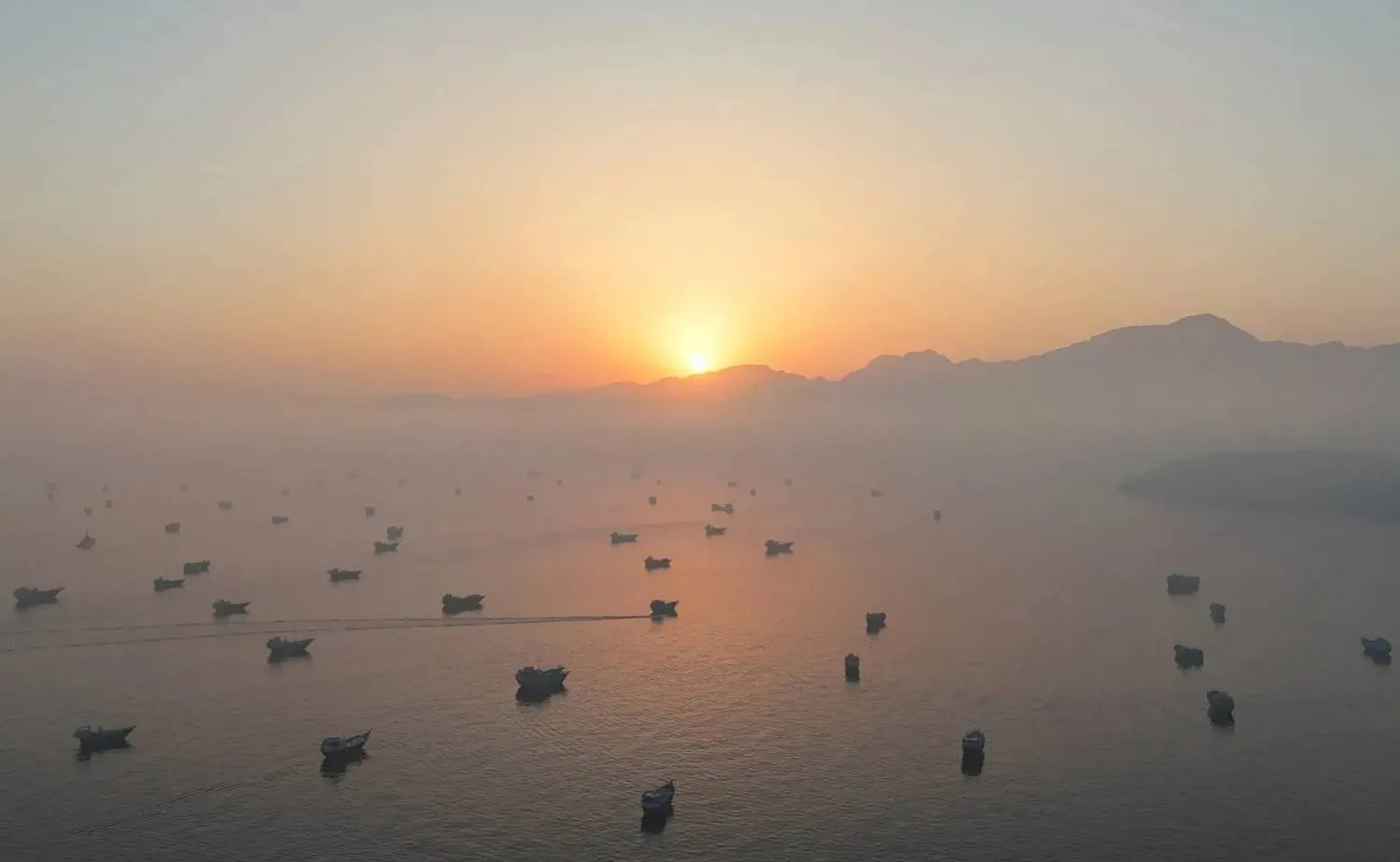

Energy Sector Clears ‘Hormuz’ After US-Iran Deal, Risk Premium in Focus

Ships wait to transit the Strait of Hormuz on June 15. REUTERS
TT

Energy Sector Clears ‘Hormuz’ After US-Iran Deal, Risk Premium in Focus

Ships wait to transit the Strait of Hormuz on June 15. REUTERS

The energy sector and the global economy have avoided the worst-case scenario: oil at $150 a barrel.

That was the level many financial institutions and international companies had used in shaping their investment assumptions. International officials and governments also expected it and aligned with those forecasts.

For the global economy, $150 oil would have meant an energy sector slipping out of control, with damaging consequences for other industries. That did not happen. Brent crude is now trading at about $80 a barrel, roughly $70 below that feared level and above its pre-war price of $70.

With shipping through the Strait of Hormuz resuming after a preliminary peace agreement reached by the United States and Iran, expected to take effect next Friday, energy is again moving to the center of the global economic picture. For years, the sector has supported global growth, development and market stability, helping shield international markets from sudden shocks.

What comes after the agreement?

Since the preliminary US-Iran agreement was announced, oil prices have fallen by nearly $20 a barrel. That is a major cost relief for countries that import crude, and one that is likely to feed through to many other goods, given oil’s role as a basic input in finished products.

Stock markets rose in parallel, lifted by optimism over the reopening of the Strait of Hormuz and the return of shipping to normal. The prospect of commodity prices easing back toward pre-war levels could support corporate earnings and the wider global economy.

But Mamdouh Salameh, an international energy expert, said prices would not return to pre-war levels so easily.

“The current situation indicates that Iran controls 20% of global oil and gas supplies as a result of its closure of the Strait of Hormuz. Therefore, oil prices after the agreement must take into account a permanent price premium because of Iran’s control of the Strait of Hormuz,” Salameh told Asharq Al-Awsat.

Speaking from London, Salameh said that even after the strait reopens, “the volume of oil flowing through it will fall to half its pre-war level because of the damage sustained by oil production facilities in the Arabian Gulf.”

He expected repairs to some facilities to take about eight to 12 months. “For this reason, Brent crude will not return to its pre-war level of $60 to $65 a barrel, but will range between $85 and $90 for many years to come,” he said.

Spot premiums for crude oil and some refined products in Asian markets fell on Tuesday, settling at pre-war levels after the announcement of the preliminary agreement between Washington and Tehran. Still, caution over the timeline for restoring normal navigation has so far placed a floor under energy prices, preventing a sharper decline.

Supply and demand

Saudi Aramco President Amin Nasser estimated that the oil market loses about 100 million additional barrels for every week the Strait of Hormuz remains closed, after the crisis had already removed about 1 billion barrels from supply.

Nasser said in remarks in mid-May that the gap was being covered through withdrawals from strategic and commercial inventories.

About 20% of global oil supplies pass through the Strait of Hormuz. Its closure has tested the depth of strategic inventories worldwide and posed a major challenge to the global energy sector. That was clear in moves by the International Energy Agency and its members to draw from strategic reserves.

Estimates of global demand growth this year range from 700,000 to 900,000 barrels per day. That suggests demand will remain strong long after Hormuz reopens, driven by daily oil needs for power generation and normal consumption, as well as the need to rebuild inventories.

Asia is the most exposed. The US Energy Information Administration estimates that 84% of the crude oil and condensates that passed through Hormuz in 2024 went to Asian markets, led by China, India, Japan and South Korea.

Against this backdrop, Aramco, the Saudi oil giant, said its maximum production capacity remains intact and that the company can, if requested by the government and within allocated quotas, return to maximum sustained capacity in less than three weeks.

QatarEnergy, among the hardest hit, said it expects to raise natural gas production to about 50% of capacity one month after safe passage through the Strait of Hormuz is restored.

The world is now waiting for the terms of the preliminary agreement between the United States and Iran to be disclosed, so implementation can begin. Only then can a timeline be set for ships to reach “zero waiting,” followed by the return of Gulf production capacity.

Haitham El-Gendy, an international markets expert, said, “The matter depends on how quickly navigation through the Strait of Hormuz returns to pre-war levels, and how quickly supplies from the Gulf region resume. Both issues depend primarily on hostilities not resuming during the 60-day negotiation period.”

“If we assume that things will proceed well, a return to normal will require weeks, given the scale of tanker congestion around the strait and the need to remove mines,” El-Gendy told Asharq Al-Awsat. “As for Gulf supplies, this will also require varying periods depending on the extent of the damage to each country’s energy facilities.”

According to Wood Mackenzie, halted crude production fields in the region will return to 70% of their previous output within three months and about 90% within six months. For liquefied natural gas, of which Qatar produces one-fifth of global supply, a return to full production capacity will take several months and could stretch into years after damage to the Ras Laffan facility.

On crude prices, El-Gendy said that if tensions do not flare again, oil could move in the $80-a-barrel range, with room to rise, as countries replenish inventories and strategic reserves depleted in recent months and Chinese demand recovers to pre-war levels.



Syria Signs Gas Sector Contract with US Energy Giant

A screen displays the logo for ConocoPhillips on the floor of the New York Stock Exchange (NYSE) in New York City, US, April 6, 2022. REUTERS/Brendan McDermid
TT

Syria Signs Gas Sector Contract with US Energy Giant

A screen displays the logo for ConocoPhillips on the floor of the New York Stock Exchange (NYSE) in New York City, US, April 6, 2022. REUTERS/Brendan McDermid

Syria on Tuesday signed a contract involving US oil giant ConocoPhillips to develop the country's gas sector, state media reported, as Damascus seeks to attract international energy investment.

Damascus previously signed memoranda of understanding on energy with international companies including Chevron as well as HKN Energy, which has begun managing and operating oil fields recently handed over to the government by Syrian Kurdish authorities.

State news agency SANA reported that the state-owned Syrian Petroleum Company signed "a contract with US companies ConocoPhillips and Novaterra with the aim of developing a number of gas fields in Syria and increasing production from existing fields".

The move seeks to "contribute to supporting the energy system and strengthening gas supplies required for the electricity sector and other vital sectors," it said.

In Washington last week, Syrian Petroleum Company CEO Youssef Qablawi said it would be "the biggest contract" to be signed since the new authorities took power after the December 2024 ouster of longtime ruler Bashar al-Assad.

At the signing ceremony in Damascus, Qablawi said the move was "an important step in the process of developing the gas sector in Syria".

"Through this cooperation, we look forward to increasing production, improving operational capabilities and supporting the energy system," he added.

A Syrian delegation headed by Energy Minister Mohammad al-Bashir held talks in Washington last week on investment prospects in energy and infrastructure in Syria and possible partnerships with the US private sector.

After years of civil war that fractured the country and ravaged its industries and infrastructure, Syria is seeking to modernize its energy infrastructure, attract investment and boost development as it pushes on a path of economic recovery, particularly after the lifting of Assad-era sanctions.

Syria aims to produce one million barrels of oil per day by 2030 and is seeking to broaden international cooperation on exploration and production.

Last month, Syria signed a memorandum of understanding with ConocoPhillips, France's TotalEnergies and Qatar's QatarEnergy, on offshore oil and gas exploration.

In February, it also signed a preliminary deal with US energy giant Chevron and Qatari firm Power International for offshore energy exploration.

Damascus now controls all the country's oil and gas fields, after taking over areas previously under Kurdish control in the north and northeast this year.

The deputy governor of the northeastern Hasakah province, Ahmed al-Hilali, on Monday said HKN Energy had begun managing and operating those fields.


Oil Drops About 4% to Three-month Low as Markets Weigh US-Iran Deal

AUSTIN, TEXAS - JUNE 15: In an aerial view, oil storage tanks are seen at the Sunoco LP Fuel Supply Terminal on June 15, 2026 in Austin, Texas.  Brandon Bell/Getty Images/AFP
AUSTIN, TEXAS - JUNE 15: In an aerial view, oil storage tanks are seen at the Sunoco LP Fuel Supply Terminal on June 15, 2026 in Austin, Texas. Brandon Bell/Getty Images/AFP
TT

Oil Drops About 4% to Three-month Low as Markets Weigh US-Iran Deal

AUSTIN, TEXAS - JUNE 15: In an aerial view, oil storage tanks are seen at the Sunoco LP Fuel Supply Terminal on June 15, 2026 in Austin, Texas.  Brandon Bell/Getty Images/AFP
AUSTIN, TEXAS - JUNE 15: In an aerial view, oil storage tanks are seen at the Sunoco LP Fuel Supply Terminal on June 15, 2026 in Austin, Texas. Brandon Bell/Getty Images/AFP

Oil prices fell about 4% on Tuesday to fresh three-month lows as markets weighed prospects for a resumption of supplies through the Strait of Hormuz alongside weaker physical demand and scant details on a preliminary deal to end the Iran war.

Brent crude futures were down $3.20, or 3.85%, at $79.97 a barrel at 1253 GMT. They earlier touched $79.61, the lowest since March 3, and the first time they have fallen below $80 since that day.

US West Texas Intermediate was down $3.52, or 4.36%, at $77.23 a barrel. WTI's intra-day nadir of $76.88 was the lowest since March 10.

Before the war started on February 28, Brent and WTI futures were trading around $65-70 per barrel.

Oil prices sank nearly 5% on Monday after US President Donald Trump announced an interim deal to end the US-Israeli war with Iran, though full details have not been released.

Iranian Foreign Minister Abbas Araqchi said on Tuesday that Iran and the US would start a new round of talks in Switzerland on Friday to reach a final agreement.

"Near-term downside risks remain as the market prices a faster reopening of the Strait and a return of stranded barrels," Saxo Bank analyst Ole Hansen said.

However, depleted inventories, seasonal demand, strategic stock rebuilding and lingering geopolitical uncertainty suggest the path back to pre-war prices may be far less straightforward than current market optimism implies, Hansen said.


Gold Rises over 1% as US-Iran Peace Deal Optimism Eases Rate Hike Bets

Two people look at gold jewelry outside a shop in the Grand Bazaar in Istanbul (AFP)
TT

Gold Rises over 1% as US-Iran Peace Deal Optimism Eases Rate Hike Bets

Two people look at gold jewelry outside a shop in the Grand Bazaar in Istanbul (AFP)

Gold prices rose more than 1% on Tuesday as expectations of an interest rate hike from the US Federal Reserve this year eased, following an interim US–Iran peace deal that sent oil prices and inflation fears lower.

Spot gold was up 0.9% at $4,343.51 per ounce as of 9:10 a.m. ET (1310 GMT). Prices touched their highest level since June 5 in the previous session.

US gold futures delivery added 0.2% to $4,358.90.

The interim deal announced by US President Donald Trump would extend a tenuous ceasefire agreed upon in April by another 60 days and reopen the Strait of Hormuz, which Iran has effectively blocked since the US and Israel attacked Iran in February.

"Supporting the market over the last two sessions has been the prospects of an agreement between the US and Iran in regards to ending the war," said David Meger, director of metals trading at High Ridge Futures, Reuters reported.

"What we've seen as a result of that has been short-term interest rates drop, energy prices come down, and less likelihood that the Fed will need to raise interest rates later this year."

Brent crude futures have dropped below $80 a barrel for the first time since early March, after sinking nearly 5% on Monday after the announcement of the interim deal.

Markets have pared back expectations for a Fed rate hike in December to 58% from around 70% earlier, according to the CME FedWatch tool.

Bullion has been under pressure since the onset of the US-Israeli war against Iran, as rising oil prices fuel expectations of prolonged high interest rates. Despite being an inflation hedge, non-yielding gold suffers in a high interest rate environment.

Market participants are now awaiting a series of central bank meetings this week, including the Fed's rate decision on Wednesday, the first under new Chair Kevin Warsh.

Spot silver rose 0.7% to $70.51 per ounce. Platinum gained 2.7% to $1,812.76, and palladium climbed 0.9% to $1,360.75.