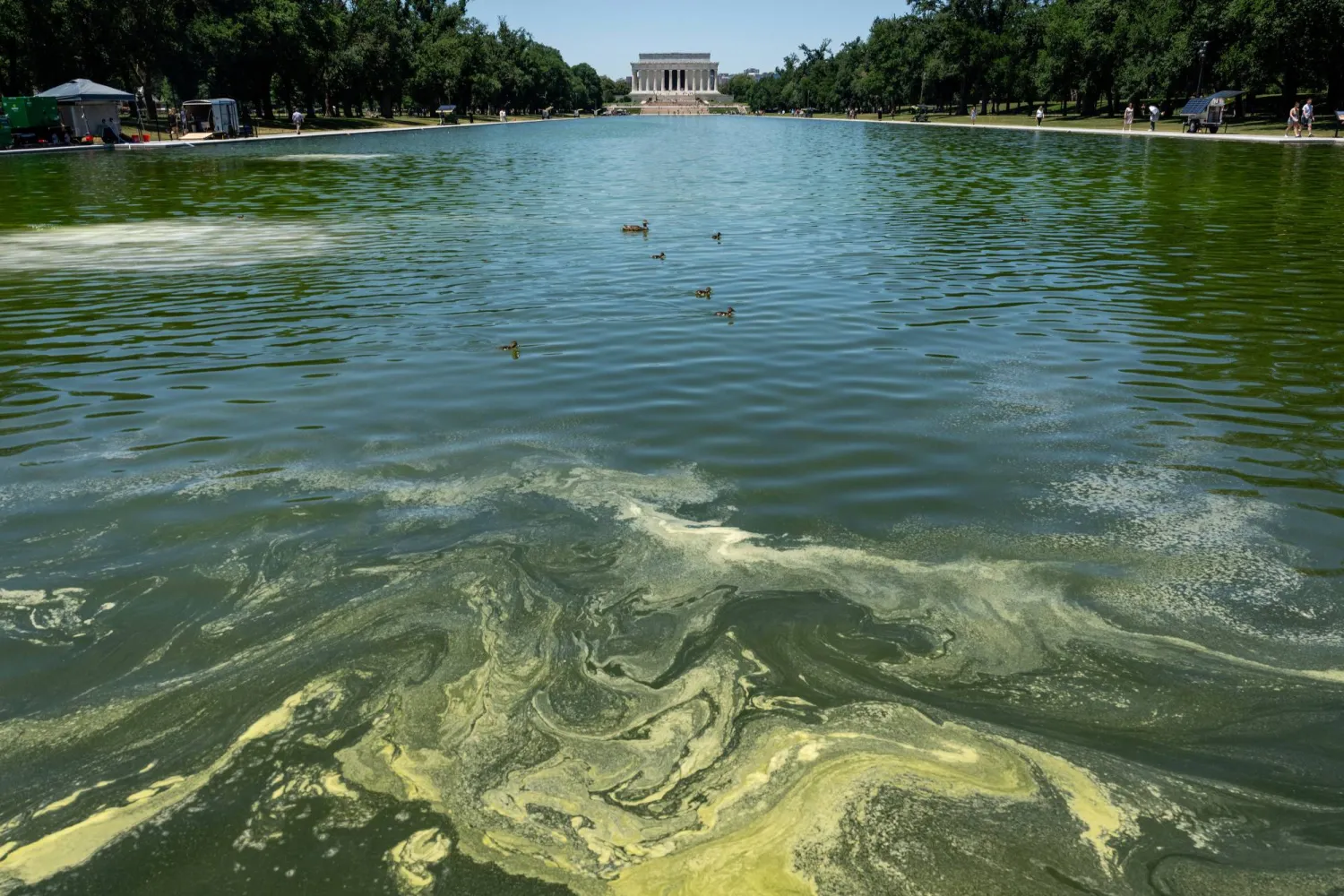
Crews Battle Algae Bloom in Washington's Newly Repainted Reflecting Pool

Ducks swim through algae in the Lincoln Memorial Reflecting Pool, after recent renovations following a directive from US President Donald Trump to paint it blue ahead of the 250th anniversary of US Independence, in Washington, D.C., US, June 16, 2026. REUTERS/Eric Lee
TT

Crews Battle Algae Bloom in Washington's Newly Repainted Reflecting Pool

Ducks swim through algae in the Lincoln Memorial Reflecting Pool, after recent renovations following a directive from US President Donald Trump to paint it blue ahead of the 250th anniversary of US Independence, in Washington, D.C., US, June 16, 2026. REUTERS/Eric Lee

Work crews poured hydrogen peroxide into the newly repainted Lincoln Memorial Reflecting Pool on Tuesday to combat an algae bloom, a little over a week after it was repainted as part of President Donald Trump's campaign to revamp some of Washington's major monuments.

National Park Service workers were seen emptying jugs labeled "12% hydrogen peroxide" into the visibly green water of the nearly century-old basin that stretches between the Lincoln Memorial and the Washington Monument on the National Mall.

A spokesperson for ⁠the Interior Department ⁠said the pool is being treated with "high-tech nanobubble ozone technology" that kills algae, pathogens including E. coli, and other contaminants. According to Reuters, the department said hydrogen peroxide is also being used, saying it's "a milder treatment than chlorine" that is used in spas and natural swimming pools.

Christopher ⁠Gobler, a professor at Stony Brook University in New York who has studied harmful algal blooms for more than 30 years, said hydrogen peroxide is a common short-term treatment for algae that is not likely to have major health effects on the ducks and geese that frequent the pool.

"It's most harmful to animals that are 100% in the water," Gobler said, adding the chemical can create low oxygen conditions that ⁠can ⁠be lethal to fish.

It might not be a long-term fix, though, he warned.

"There's always going to be a rebound of the algae," Gobler added. "Hopefully it works as a quick fix, but these algae do tend to rebound."

The reflecting pool was refilled with water starting on June 5 as part of a renovation project directed by Trump that involved draining, cleaning and resurfacing it. The bottom of the pool was repainted in a color Trump calls "American flag blue."


Scientists Make New Discovery about Northern Ireland’s Giant’s Causeway

People explore the basalt columns of the Giant’s Causeway on Northern Ireland’s north coast on March 20, 2025. (AFP via Getty Images)
TT

Scientists Make New Discovery about Northern Ireland’s Giant’s Causeway

People explore the basalt columns of the Giant’s Causeway on Northern Ireland’s north coast on March 20, 2025. (AFP via Getty Images)

The geological timeline for Northern Ireland's iconic Giant’s Causeway has been dramatically revised following new scientific research, according to The Independent.

New findings indicate that the volcanic activity responsible for the distinctive 40,000 basalt columns occurred over a significantly condensed period.

Scientists now believe the region's volcanic events, including those forming the Causeway, transpired in just 5.5 million years – a staggering eight million years less than earlier estimations.

Dr. Simon Tapster, geochronologist at the British Geological Survey (BGS), said: “Fundamentally, what we’ve done is by piecing together this tapestry of volcanic rocks all across the North Atlantic, but focusing on Northern Ireland, we have been able to reassess a major globally impacting volcanic event.”

“In doing that, and in reassessing the timescales, we have shown that actually it occurred in a much shorter duration,” he added.

The Giant’s Causeway’s distinctive landscape was formed during intense volcanic activity which forced molten rock up through cracks in the earth. Thick lava flows then cooled, contracted and cracked, creating about 40,000 basalt columns.

Tapster said the cutting-edge research by the Geological Survey of Northern Ireland (GSNI) and the BGS, has reconstructed a new timeline for volcanic activity across Northern Ireland.

It has allowed researchers to place the volcanic activity that led to the formation of the Giant’s Causeway within a much more precise global context for the first time.

The research has significantly updated the understanding of when specific volcanic events happened in Northern Ireland.

As a result, scientists can more confidently connect those events to activity and landmarks elsewhere, including Scotland.

It also connects the processes that caused the development of the Giant’s Causeway to a globally significant volcanic event seen in rocks as far away as Greenland about 60 million years ago.

The first lava flows of Northern Ireland’s Antrim Plateau previously were thought to have occurred millions of years before the Staffa basalts and the formation of Fingal’s Cave, but they can now be connected much more definitively as part of the same volcanic activity.

Researchers said it is the same for the Giant’s Causeway with formations on Rum, the Mourne Mountains, and magmatism in Skye.

Tapster said: “By looking at the timescales and the high resolution timeline, we’re able to match it up with various other locations, particularly in the Inner Hebrides in Scotland, the volcanics of Mull, Rum, the Isle of Skye, and taking a bigger view, looking at Greenland and the Faroe Islands.”

The research is part of a wider initiative at the British Geological Survey to improve the understanding of the UK’s geology through better quantifying geological time in the rocks.


Japan Puts the Heat on Suspected Ice Cream Cartel

This illustrative picture shows ice cream in a convenience store in Tokyo on June 17, 2026. (Photo by Philip FONG / AFP)
TT

Japan Puts the Heat on Suspected Ice Cream Cartel

This illustrative picture shows ice cream in a convenience store in Tokyo on June 17, 2026. (Photo by Philip FONG / AFP)

Summer is coming, a boom time for ice cream makers, but Japanese authorities have raided six major firms on suspicion of colluding to raise prices.

Among the country's biggest ice cream firms, the six "are suspected of colluding" to hike prices, a source familiar with the matter told AFP on Wednesday.

Company officials are thought to have sent emails or met up for years to coordinate the timing and size of hikes, the unnamed source said.

Officials from the Japan Fair Trade Commission (JFTC) searched the head offices on Tuesday of Meiji Co., Morinaga Milk Industry Co., Lotte Co., Ezaki Glico Co., Morinaga & Co., and Akagi Nyugyo Co., according to company officials and the source.

Since around 2022, the ice cream companies have raised retail prices every year at around the same time, local media reported.

The JFTC is also investigating whether the companies took advantage of inflation to raise prices beyond what was justified by a spike in raw ingredient costs, according to Kyodo News.

Five of the companies issued statements on Tuesday or on Wednesday saying their offices had been raided by the JFTC and that they "would cooperate with the investigation.”

Natsuyo Suzuki of Akagi Nyugo also confirmed to AFP that the firm would work with investigators following an "on-site inspection.”

If the JFTC concludes that there was a cartel, the antitrust watchdog will order the firms to improve their business practices and pay a fine.

In the fiscal year ending in March, ice cream sales in Japan hit a record high of more than 660 billion yen, according to the Japan Ice Cream Association, as the country sweltered through its hottest summer since records began in 1989.


'Unstable' Tasmanian Devil Found after 15 Days on the Run

A Tasmanian devil named Nick is seen at the Conrad Prebys Australian Outback at the San Diego Zoo in San Diego, California May 31, 2016. Courtesy Ken Bohn/San Diego Zoo/Handout via Reuters
TT

'Unstable' Tasmanian Devil Found after 15 Days on the Run

A Tasmanian devil named Nick is seen at the Conrad Prebys Australian Outback at the San Diego Zoo in San Diego, California May 31, 2016. Courtesy Ken Bohn/San Diego Zoo/Handout via Reuters

A Tasmanian devil named Mary has been found in an "unstable condition" more than two weeks after escaping her enclosure, an Australian wildlife park said Wednesday.

Searchers tracked down the carnivorous marsupial the previous night in the bush, less than two kilometers (1.2 miles) from her home in the Paradise Country park on Queensland's Gold Coast.

"Upon finding her, Mary was in an unstable condition, and the team assessed and determined she required veterinary care and rushed her to a specialist veterinary hospital where they were able to stabilize her condition," AFP quoted the park as saying in a statement.

The two-year-old furry critter, described by keepers as extremely shy, was being kept in the hospital for diagnostic testing, it said.

A dozen wildlife experts backed by a sniffer dog and a thermal-imaging drone had searched for the Tasmanian devil after her widely publicized break-out on June 2, partly captured in CCTV images.

The wildlife park said it believed Mary made an "abnormally large leap" to embark on her 15-day adventure.

Tasmanian devils -- agile, mostly nocturnal animals that can roam for 16 kilometers (10 miles) in a single night -- have been extinct on the Australian mainland for more than 3,000 years.

They can live up to six years in the wild, with males weighing as much as 14 kilograms (30 pounds) and standing 30 centimeters (12 inches) tall at the shoulder, according to Tasmania's environment department.

Though widespread on the island state of Tasmania, they are listed as endangered and face a significant threat from a transmissible cancer known as Devil Facial Tumor Disease.