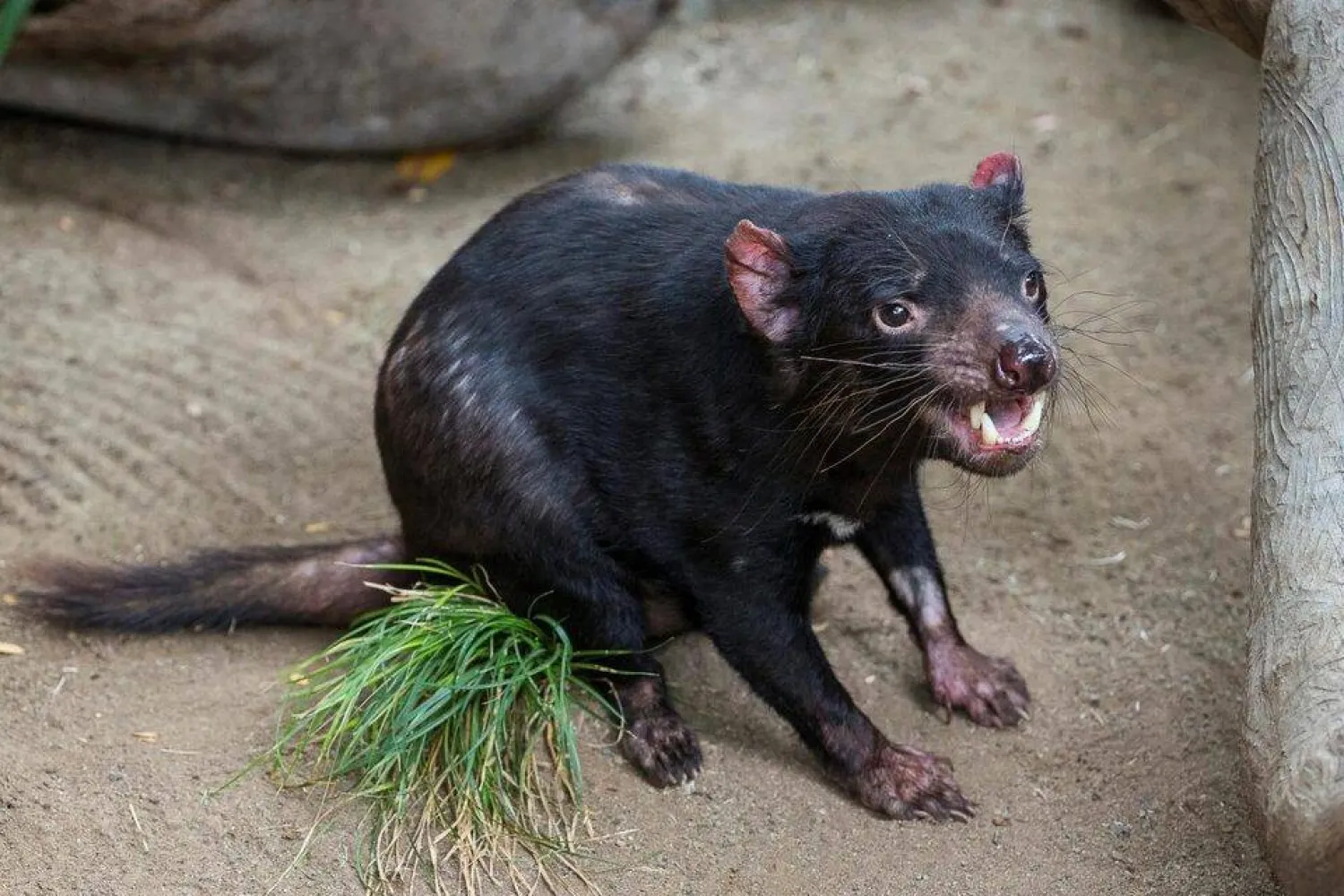
'Unstable' Tasmanian Devil Found after 15 Days on the Run

A Tasmanian devil named Nick is seen at the Conrad Prebys Australian Outback at the San Diego Zoo in San Diego, California May 31, 2016. Courtesy Ken Bohn/San Diego Zoo/Handout via Reuters
TT

'Unstable' Tasmanian Devil Found after 15 Days on the Run

A Tasmanian devil named Nick is seen at the Conrad Prebys Australian Outback at the San Diego Zoo in San Diego, California May 31, 2016. Courtesy Ken Bohn/San Diego Zoo/Handout via Reuters

A Tasmanian devil named Mary has been found in an "unstable condition" more than two weeks after escaping her enclosure, an Australian wildlife park said Wednesday.

Searchers tracked down the carnivorous marsupial the previous night in the bush, less than two kilometers (1.2 miles) from her home in the Paradise Country park on Queensland's Gold Coast.

"Upon finding her, Mary was in an unstable condition, and the team assessed and determined she required veterinary care and rushed her to a specialist veterinary hospital where they were able to stabilize her condition," AFP quoted the park as saying in a statement.

The two-year-old furry critter, described by keepers as extremely shy, was being kept in the hospital for diagnostic testing, it said.

A dozen wildlife experts backed by a sniffer dog and a thermal-imaging drone had searched for the Tasmanian devil after her widely publicized break-out on June 2, partly captured in CCTV images.

The wildlife park said it believed Mary made an "abnormally large leap" to embark on her 15-day adventure.

Tasmanian devils -- agile, mostly nocturnal animals that can roam for 16 kilometers (10 miles) in a single night -- have been extinct on the Australian mainland for more than 3,000 years.

They can live up to six years in the wild, with males weighing as much as 14 kilograms (30 pounds) and standing 30 centimeters (12 inches) tall at the shoulder, according to Tasmania's environment department.

Though widespread on the island state of Tasmania, they are listed as endangered and face a significant threat from a transmissible cancer known as Devil Facial Tumor Disease.


Volunteers Rescue Climber Stranded on Small Ledge in California’s Sierra Nevada

This photo released by the Mono County Search and Rescue shows volunteers conducting an operation to rescue a man stranded on a ledge in the Sierra Nevada, Calif., on Aug. 22, 2026. (Mono County Sheriff Search and Rescue via AP)
TT

Volunteers Rescue Climber Stranded on Small Ledge in California’s Sierra Nevada

This photo released by the Mono County Search and Rescue shows volunteers conducting an operation to rescue a man stranded on a ledge in the Sierra Nevada, Calif., on Aug. 22, 2026. (Mono County Sheriff Search and Rescue via AP)

Volunteers carried out a more than 15-hour operation to rescue a man who got off route in the Sierra Nevada and was stranded on a small ledge, the Mono County Sheriff Search and Rescue Team said.

A four-person team carried out the rescue last weekend near Mammoth Lakes, California, in a precarious gully. The challenge came in having no time to spare with thousands of feet of vertical exposure below, said team spokesperson Mitchell Quiring.

The stranded climber had only one foot fully on the 6-inch (15-centimeter) ledge and was shaking out his legs and switching them to avoid tiring, said Quiring, who was part of the rescue team.

“Any fall would almost certainly be fatal,” the team wrote on its Facebook page.

Quiring said he credits the climber, Rob Martin, with having the strength and will to live.

“He was not going to give up. He was going to push until there was a solution,” Quiring said. “It’s what we train for, so there’s a lot of trust in leaning back on that.”

The volunteer group has long trained to carry out technical rescues. The rescuers are among those dispatched the Mono County Sheriff's Office in the Sierra Nevada, about 200 miles (322 kilometers) east of San Francisco.


Vietnamese Coffee Farmers Ride China’s Durian Wave

This photograph taken on August 15, 2026 shows Ngo Thi Minh Trinh inspecting durians at a farm in Ea Knuec commune, Vietnam's Dak Lak province. (AFP)
TT

Vietnamese Coffee Farmers Ride China’s Durian Wave

This photograph taken on August 15, 2026 shows Ngo Thi Minh Trinh inspecting durians at a farm in Ea Knuec commune, Vietnam's Dak Lak province. (AFP)

Vietnam's Central Highlands produces around one sixth of the world's coffee, but farmers are switching their traditional crop for durian to cash in on surging Chinese demand for the pungent "king of fruits".

"You can live okay with coffee, but it's durian that makes you rich," said Pham Xuan Lan, as he showed AFP journalists around his farm.

Blessed with a tropical climate and rich basalt soil, the lush Central Highlands produces vast quantities of robusta beans, and Vietnam trails only Brazil in coffee output.

But the area dedicated to durian has soared more than fivefold to 200,000 hectares (494,000 acres) nationwide over the past decade, according to the agriculture ministry.

Vietnam only officially entered the Chinese durian market after a 2022 trade protocol but last year became the country's biggest supplier by volume, ending Thailand's near two-decade dominance.

Lan was an early adopter, diversifying his crop two decades ago and now boasting 400 durian trees in Ea Knuec commune, part of Dak Lak province.

They produce 60 tons of the sweet yet smelly fruit, which is driven in frozen containers thousands of kilometers north into China.

The 56-year-old expects to make $76,000 this year -- against $10,000 had he stayed with just coffee.

"With durian, I bought a car, houses for my children and built a villa for my family," he said, his affluence evident around him.

Other local farmers have followed suit, focusing on the premium Ri6, Musang King and Dona varieties.

During the August-October harvest, Dak Lak's roads are packed with trucks loaded with the spiky fruit, and at a durian festival this month, 525 vehicles formed what the Guinness World Records declared the largest ever parade of fruit-carrying vehicles.

- Billions of views -

The boom is driven by demand from China, fueled by a combination of expanding supply and growing popularity on social media, particularly among young people.

On Douyin, China's equivalent of TikTok, videos of users cracking open fruit with their bare hands have been watched billions of times.

"This tastes really sweet. It's almost like it's been coated in sugar," said Douyin influencer Liulianzi in a clip liked more than 17,000 times.

Once a luxury food, increased competition between Thailand and Vietnam and improved transport links have helped cut prices and make the fruit more affordable.

At a durian tasting event in Beijing last month, Ada Song told AFP that she had spent almost 1,000 yuan ($150) on the fruit in recent weeks.

"I have tried nearly 20 different varieties," Song said.

Durian "tastes just as sweet as cake, without the greasiness and heaviness".

China imported almost $7.5 billion worth of fresh durian last year, a near 12-fold rise from 2015.

Now Beijing is seeking to boost its homegrown produce, with more than 3,000 hectares of plantations on the southern island province of Hainan, which has a similar climate to northern Vietnam.

But "our Hainan durians will always be just a supplement to Southeast Asian durians", acknowledged Feng Xuejie, a durian expert at the Hainan Academy of Agricultural Sciences.

"It's not even a competition."

- Improving quality -

Vietnam's durian exports are expected to reach $4 billion this year, up from $180 million in 2021 -- 90 percent of them going to its northern neighbor.

But in the Central Highlands there are concerns about the reliance on China, as well as the risks of oversupply as more farmers join the rush.

Many anxiously eyed a recent price crash in Malaysia, blamed on an unusually bumper harvest.

Many farmers there have also switched to durian, focusing on premium varieties and fresh fruit, although the country has only a small slice of the Chinese market.

Vietnam's government warned in early August of the "risks of oversupply and loss of quality control as the planted area is increasing rapidly".

Farmers warn durian is not a one-way bet, requiring a strict mix of humidity, water and fertilizers.

Lan likened growing it to "raising a child -- I can give you all the tricks but I cannot guarantee you similar success".

He still grows coffee as his land is leased from a coffee company, allowing him to hedge his bets.

For some, the durian dream has already turned sour.

Hung, a farmer who gave only one name, switched entirely from coffee to durian five years ago, but switched back two years ago, admitting it was too hard to produce the quality required.

"I could not do it. I failed," the 42-year-old said. "So I would never go back to durian again."



Kinshasa Urban Train Back on Track after Years to Beat Gridlock

Kinshasa's urban train is back in service after nearly 15 years. AFP
TT

Kinshasa Urban Train Back on Track after Years to Beat Gridlock

Kinshasa's urban train is back in service after nearly 15 years. AFP

At dawn, dozens of passengers crowded along dusty tracks to board the only urban rail link serving downtown Kinshasa, the Democratic Republic of Congo's congested capital.

Recently brought back into service after nearly 15 years out of operation, the sky-blue train sporting the national colors makes the daily round trip between the outskirts of the airport and the center of the megacity of nearly 17 million inhabitants, said AFP.

At Masina station, a suburb about 10 kilometers (six miles) from the city center, people have to elbow their way through to find a spot in the packed carriages.

Those who miss their stop -- which last barely a few moments -- have to jump on while the train is moving.

The basic one-way ticket costs 2,000 Congolese francs (around $0.87), rising to 4,000 francs in second class and 5,000 in first class.

Carriages are packed to bursting and the heat inside quickly becomes stifling due to a lack of air conditioning.

Those lucky enough to have a seat can see the busy avenues and vast shantytowns that have sprung up along the tracks in recent years as they go by.

Others end up missing the legendary yellow minibuses that clog the city streets.

"We're paying the same price, but here there's nowhere to sit," grumbled Clovis Musa, who lives in Masina and works at the central market, standing in a second-class carriage filled with noise and chatter.

Nevertheless, the Kinshasa rail service offers an escape for residents of outlying neighborhoods who are otherwise forced to spend several hours a day in monster traffic jams.

"I haven't taken a car in four years; I do all my trips back and forth by motorbike," Britey Mafuka, a trader who spends around $380 a month on transport, said.

"I was starting to look for a house near the city, but when they brought the train back, I dropped the whole idea," he added.

- Quick but 'expensive' -

Mass transit systems are considered vital for the future of African megacities, which are seeing rapid population growth and often chaotic urbanization.

Kinshasa, Lagos in Nigeria and Tanzania's Dar es Salaam are projected to be the most populous cities in the world by 2100.

Nigeria's biggest city inaugurated a long-awaited urban train in 2023.

The Senegalese capital, Dakar, did the same in 2021, and three years later, established a bus network on dedicated lanes to alleviate the congestion in the city center.

But in Kinshasa, which sits on the banks of the mighty Congo River, such infrastructure has remained at the planning stage.

The railway network, built in the aftermath of independence from Belgium in 1960, was gradually abandoned by the National Transport Office (ONATRA) due to a lack of funds to maintain the tracks.

President Felix Tshisekedi officially restarted the Kinshasa urban train service after nearly 15 years at the end of June.

Its resurrection is part of the MetroKin project, a 300-kilometer rail network supported by Africa Finance Corporation, a pan-African organization that helps fund and develop infrastructure, the president's office said.

The revamped city link means it takes around an hour and 15 minutes to travel into the city center from the area around the airport.

By road "it's practically impossible", Chadrack Walele, the line manager, said.

Between 4,000 and 5,000 passengers are transported per train, he said.

"If these passengers were now to go by road it would cost us an enormous amount of time and cause traffic jams," he said.

The train currently does one daily round trip but that will soon rise to two, he added.

On arrival at Kinshasa's central train station, thousands of passengers poured out onto the tracks -- with mixed opinions.

"We're glad they restarted the train because it's the fastest way to travel," Gabriel Mfutila said.

But "we are poor, we are trying to survive -- how are we going to feed our children and pay for transportation that's so expensive?" he said, on the platform before disappearing into the city's crowds.