

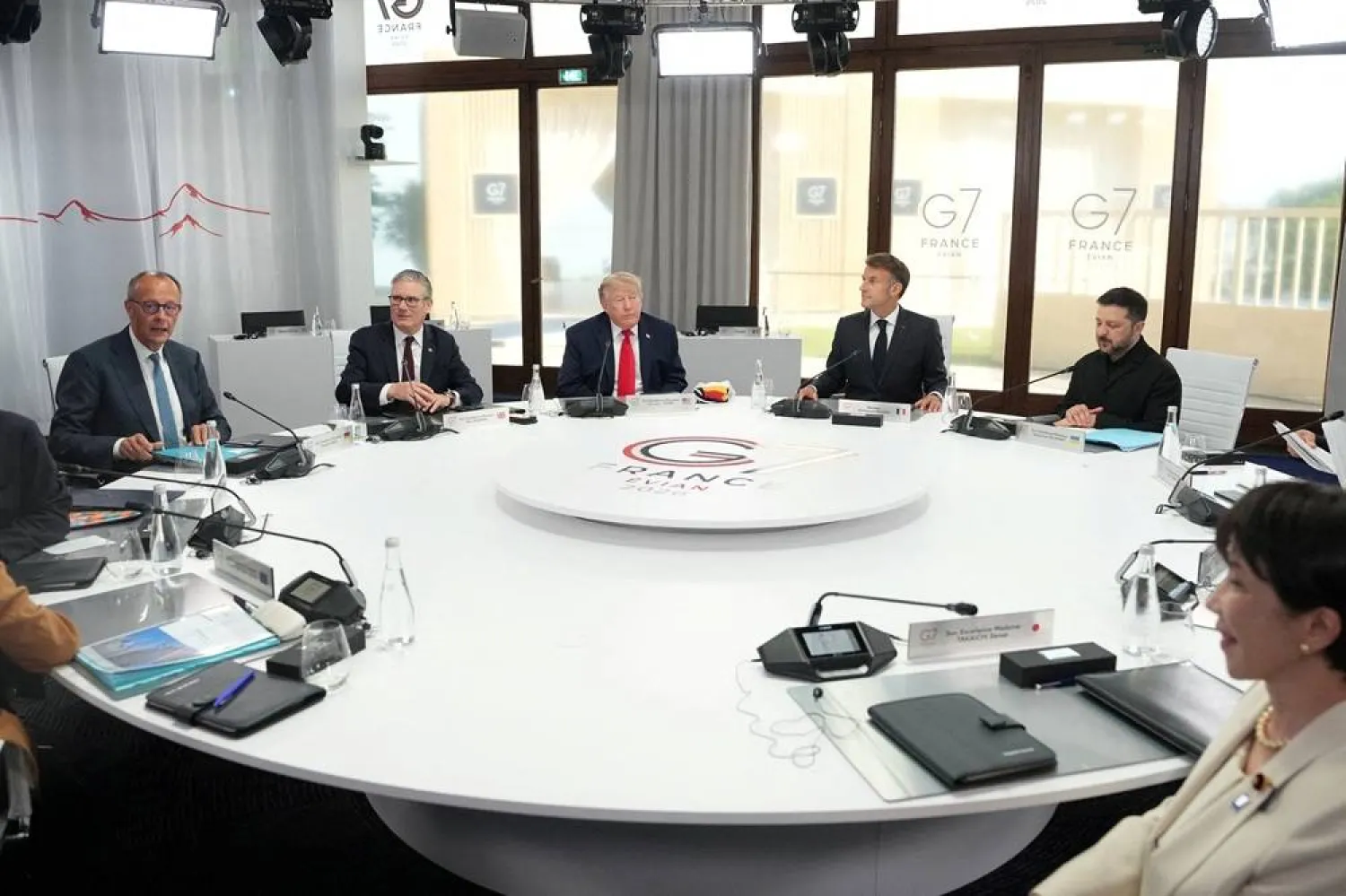

G7 Leaders Welcome Trump ‘Change’ on Ukraine

German Chancellor Friedrich Merz, British Prime Minister Keir Starmer, US President Donald Trump, French President Emmanuel Macron, Ukrainian President Volodymyr Zelenskyy and Japan’s Prime Minister Sanae Takaichi during a working session at the G7 summit in Evian-les-Bains, France, June 16, 2026. (Reuters)
TT

G7 Leaders Welcome Trump ‘Change’ on Ukraine

German Chancellor Friedrich Merz, British Prime Minister Keir Starmer, US President Donald Trump, French President Emmanuel Macron, Ukrainian President Volodymyr Zelenskyy and Japan’s Prime Minister Sanae Takaichi during a working session at the G7 summit in Evian-les-Bains, France, June 16, 2026. (Reuters)

G7 leaders on Wednesday hailed a newly-found unity on increasing pressure on Russia to end its war against Ukraine, sensing a shift by President Donald Trump to take a tougher line against Moscow.

The three-day meeting of the leaders of Britain, Canada, France, Germany, Italy, Japan and the United States has focused intensely on Trump's deal to end the war with Iran and efforts to pressure Russia into brokering peace with Ukraine through ramped up sanctions.

In contrast to last year's G7, when Trump walked out early, the leaders agreed on a final statement involving key geopolitical issues including Ukraine and Russia.

"It was tough work but worth it," said German Chancellor Friedrich Merz, describing the statement as a "success".

As well as increasing supplies of air defense equipment to Ukraine more than four years into the war launched by Russia, the leaders agreed to "increase the pressure on the Russian war economy" by strengthening sanctions, including on Moscow's fossil fuel revenues, the statement said.

President Emmanuel Macron hailed a "very deep change in the US approach" towards Ukraine, saying Trump had understood that Russian President Vladimir Putin was not interested in peace.

"President Trump, like all of us, simply acknowledged that there was no serious willingness on Russia's part today to discuss peace."

Canadian Prime Minister Mark Carney said he had noted a US "change in tone with respect to Ukraine".

Throughout the summit, which was attended by Ukrainian President Volodymyr Zelensky, Trump took a harder line against Moscow, saying Russia had to seek a deal and showing impatience over the casualty toll on both sides.

G7 leaders also agreed to grant licenses for Ukraine-based companies to produce long-range missiles and air defense systems, a diplomatic source said.

- 'Smack in head' -

At a lunch on Wednesday the digital sphere took center stage, with some European G7 members pushing for more security to protect minors in a fast-changing world, moves that have irked the United States.

Sam Altman, head of artificial intelligence giant OpenAI, Anthropic chief Dario Amodei, the founder of Google's AI lab DeepMind Demis Hassabis, and Arthur Mensch of their European rival Mistral AI were all attending.

G7 leaders called on tech firms "to develop and apply technology and systems that ensure safe, secure and age-appropriate experiences," according to a joint statement.

Macron called for "better regulation" of artificial intelligence, warning of the risk of "non-cooperation between democracies."

Trump has been the center of attention throughout his stay at the summit in the lakeside resort of Evian.

French officials were thrilled that the mercurial US president has stayed for the entire event and signed on to the G7 communique.

In an unusual gesture, Macron invited Trump to dinner at the Palace of Versailles outside Paris after the summit winds down on Wednesday afternoon.

Trump said Tuesday that he had accepted Macron's offer because Louis XIV's former palace was "not gold leaf" but the "real deal".

Macron, under pressure to show he is not fawning over Trump, has already said the evening at Versailles will not be a "gala" dinner.

Yet it promises to be a relatively regal affair with dozens of guests set to attend the dinner inside the palace -- preceded by a concert and followed by a fireworks display -- before Trump flies back to the United States.

Trump emphasized that the Iran agreement was only a memorandum of understanding and said he was ready to resume military action if Tehran did not abide by its obligations.

"If they don't behave, we'll go right back to dropping bombs right smack in the middle of their head," he said.

While Macron was formally chairing the summit, the US president made clear who he believed was in charge as he arrived for the third and final day.

"I'm the boss," Trump said before taking his seat.


Iranian Messages Seek to Defuse Iraq Dispute Over Armed Factions

Iraqi Prime Minister Ali al-Zaidi attends a Coordination Framework meeting in Baghdad. (INA)
TT

Iranian Messages Seek to Defuse Iraq Dispute Over Armed Factions

Iraqi Prime Minister Ali al-Zaidi attends a Coordination Framework meeting in Baghdad. (INA)

Iran has urged leaders of Iraq’s Coordination Framework to contain a dispute over armed factions’ weapons and avoid a confrontation with groups that may refuse to disarm after a Sept. 30 deadline set by Baghdad.

Iraq’s judiciary, meanwhile, said it would take action against anyone carrying weapons after the deadline.

Local reports cited informed sources as saying Tehran had called for negotiations with the factions rather than confrontation. The proposed talks would cover which weapons could be surrendered, how they would be handed over, and what the factions might receive in return.

Committees could also be formed to manage the process and prevent a direct confrontation with the government or the United States.

The move comes as Prime Minister Ali al-Zaidi’s government pushes ahead with a plan to place all weapons under state control.

Baghdad has tied the end of September to the conclusion of the US-led international coalition’s military mission against ISIS and the start of a new phase in bilateral security relations.

National Security Adviser Qassem al-Araji said this week that the coalition’s mission would end on Sept. 30. Dialogue with the factions over restricting weapons could begin afterward, he said, in an apparent effort to ease tensions over the deadline.

An informed source said a senior Iranian official briefly attended a recent Coordination Framework meeting and delivered messages on how to handle the coming political and security developments.

The messages also addressed the communication channel between the Framework and Tehran.

The reports identified the official as Mohsen Qomi, a representative of Iran’s supreme leader. Qomi attended part of the meeting in Baghdad during a visit that the source said was also intended to formally introduce his role to the Iraqi government and political and religious leaders.

The source said Qomi left shortly afterward and did not take part in all the discussions.

Qomi also met Coordination Framework leaders in Baghdad, including Iraqi Islamic Supreme Council President Humam Hamoudi and al-Zaidi.

The meeting, held at Hamoudi’s office, covered issues of mutual interest, according to the Iraqi News Agency.

The reports said Qomi told Framework leaders that Hamoudi had been designated as a channel of communication between Iran and Iraq. The move would organize political contacts with Tehran as pressure mounts on Iran-aligned armed factions.

The reports attributed the delay in Qomi’s visit to security conditions in Iran. His arrival coincided with growing debate in Iraq over the future of armed groups after the coalition’s mission ends.

Ghalib al-Daami, a professor of media studies at Mustansiriyah University, said the Coordination Framework forces understood the risks of confronting the United States over the weapons issue.

But they also did not want disarmament to be carried out quickly or fully if that would strengthen the government and the prime minister, he said.

Daami said Shi’ite forces could seek a formula that partly meets US demands without handing the government a major political victory. In his view, those forces generally prefer to keep the prime minister’s success within limits they can control.

Washington says ending the coalition’s military mission does not mean abandoning its security relationship with Baghdad. Instead, the relationship will shift to a bilateral defense partnership.

The United States and Iraq agreed in 2024 on a timetable to end the coalition’s military mission in Iraq by September.

The deadline has brought growing pressure on Iran-backed armed groups to surrender their weapons or fully integrate into state institutions.

Iraqi officials say some factions are resisting the move, making the issue one of the most sensitive tests facing al-Zaidi’s government as the coalition mission draws to a close.

International coalition withdrawal

In the Kurdistan Region, German forces serving with the international coalition ended their military and advisory duties this week, another step in the coalition’s gradual withdrawal.

An official ceremony was held on Tuesday at Camp Stephan at Erbil International Airport.

Officials from the Kurdistan Regional Government and the Peshmerga Ministry attended, along with representatives of the German Defense Ministry.

The Peshmerga Ministry said the German advisers and trainers had completed their mission after years of working with Peshmerga forces in the fight against ISIS.

Kurdistan Region President Nechirvan Barzani told a member of the German parliament that the region valued Germany’s support during the war against terrorism.

He highlighted the assistance Germany provided while Peshmerga forces were fighting and the region was receiving large numbers of displaced people.

The German withdrawal comes as US troops and the remaining coalition forces finalize plans to leave Iraq.

The United States and Iraq agreed in 2024 to end the coalition’s military mission and move to a bilateral security partnership. Cooperation against ISIS will continue under the new arrangements.

Separately, Iraqi Supreme Judicial Council President Faeq Zidan met with Joshua Harris, chargé d’affaires at the US Embassy in Baghdad, on Wednesday.

They discussed judicial measures against individuals and groups carrying weapons in violation of the Constitution and the law.

The meeting signaled a growing focus on the judiciary’s role as the end of the coalition’s military mission approaches.

The Supreme Judicial Council said the talks covered measures the judiciary would take after the mission ends on Sept. 30. They also discussed how to enforce the rule of law equally.

The meeting followed Zidan’s visit to Iran, where he met several senior officials.

They included Judiciary Chief Gholam-Hossein Mohseni-Eje’i, President Masoud Pezeshkian, Parliament Speaker Mohammad Bagher Ghalibaf and Supreme National Security Council Secretary-General Mohsen Rezaei, according to statements from Iraq’s judiciary.

After meeting Zidan in Tehran, Rezaei said the countries of the region would determine their own future and that the US would have no place there.

He said Iran wanted “an independent and strong Iraq.”

Rezaei also called for resolving the status of groups opposed to Iran that are based along the two countries’ border, a reference to Iranian Kurdish parties in Iraq’s Kurdistan Region.


Trump Believes Iran’s Supreme Leader Is Still Alive

Iranians shop at a bazaar in northern Tehran, Iran, 25 August 2026. (EPA)
TT

Trump Believes Iran’s Supreme Leader Is Still Alive

Iranians shop at a bazaar in northern Tehran, Iran, 25 August 2026. (EPA)

US President Donald Trump on Wednesday said he believes Iran's supreme leader, who has not been seen in public since taking over after his father's killing in February, remains alive. 

"I don't think he's dead. He was very seriously wounded. The left side of his body, the arm, the leg, the whole thing. He was very seriously wounded. But I don't think he's dead," Trump said in an interview with conservative radio host Glenn Beck. 

Officially, Mojtaba Khamenei continues to lead his country under US and Israeli attack. However, his public absence and the rise to power of veteran Revolutionary Guards figures has fueled speculation that he is either dead or not fully in command. 

His father was killed in bombing at the start of the US-Israeli assault. 

Trump -- who has already declared victory over Iran on multiple occasions but remains unable to force the opening of the Hormuz sea route or force Iran to surrender its nuclear materials -- said again that military and economic pressure was working. 

"Those things are going toward a very big victory," he said. "We're going to have a big victory here very soon." 

Trump also insisted that the Strait of Hormuz, where Iran's military has disrupted and to a large extent blocked shipping, is in fact fully open. 

"You could really say, you know, because the Strait is open. We take a lot of ships through the Strait now. We're taking them in. The mines are gone," he said. 

"We cannot let Iran have a nuclear weapon. That's what it's all about. That's 99.9 percent. We cannot let them because they are crazy and they will use it," he said, before adding that he had already "stopped it twice." 


CIA Director Was on ‘Semi-Routine’ Mission in Moscow, Says Trump

Central Intelligence Agency (CIA) Director John Ratcliffe attends a US House Intelligence Committee hearing on worldwide threats, on Capitol Hill in Washington, DC, US, March 19, 2026. (Reuters)
TT

CIA Director Was on ‘Semi-Routine’ Mission in Moscow, Says Trump

Central Intelligence Agency (CIA) Director John Ratcliffe attends a US House Intelligence Committee hearing on worldwide threats, on Capitol Hill in Washington, DC, US, March 19, 2026. (Reuters)

US President Donald Trump said Wednesday that CIA Director John Ratcliffe's visit to Moscow was "semi-routine," while implying that the intelligence chief was in the Russian capital to discuss the Ukraine war.

"He's there, very sort of semi-routine. I hate to disappoint people. We would like to see the war with Ukraine end," Trump said in an interview with conservative radio host Glenn Beck.

Ratcliffe is one of the highest-ranking US officials to visit Russia since its war with Ukraine started in 2022.

His Tuesday visit came amid an escalation in Moscow's offensive in Ukraine, with attacks this summer increasing the civilian death toll, while US-brokered peace talks have stalled.

The Kremlin said Wednesday that Ratcliffe had "contacts" with Russia's special services on his visit to Moscow but did not meet President Vladimir Putin.

Kremlin spokesman Dmitry Peskov said Putin was briefed on the talks but refused to say whether the Ukraine war was raised.

"Contacts through the intelligence services are a positive development in and of themselves. It is too early to say how this will affect the process of resolving the crisis in our relations," Peskov said.

The last time a CIA director visited Moscow was in November 2021 -- when William Burns warned Russia against sending troops into Ukraine. Weeks later, the Kremlin launched its attack that turned into Europe's worst conflict since World War II.

The CIA has also been involved in prisoner swap deals with Russia, including a major exchange in mid-2024.

The war in Ukraine has killed hundreds of thousands and the Kremlin has refused to ease its maximalist demands of seizing the rest of eastern Ukraine and keeping Crimea.

Trump dismissed suggestions that Ratcliffe was discussing other issues such as Russia testing the resolve of NATO or the US campaign to ramp up economic pressure on Iran.

"He is not in there for any of the things that you said, now something may come out, you know, out of it," Trump told Glenn Beck.

"We're working very hard to get that war ended, and frankly, they both want to see it ended at this point," the US president said.
