


Saudi Arabia Urges Rebuilding Trust before Any Economic Cooperation with Iran

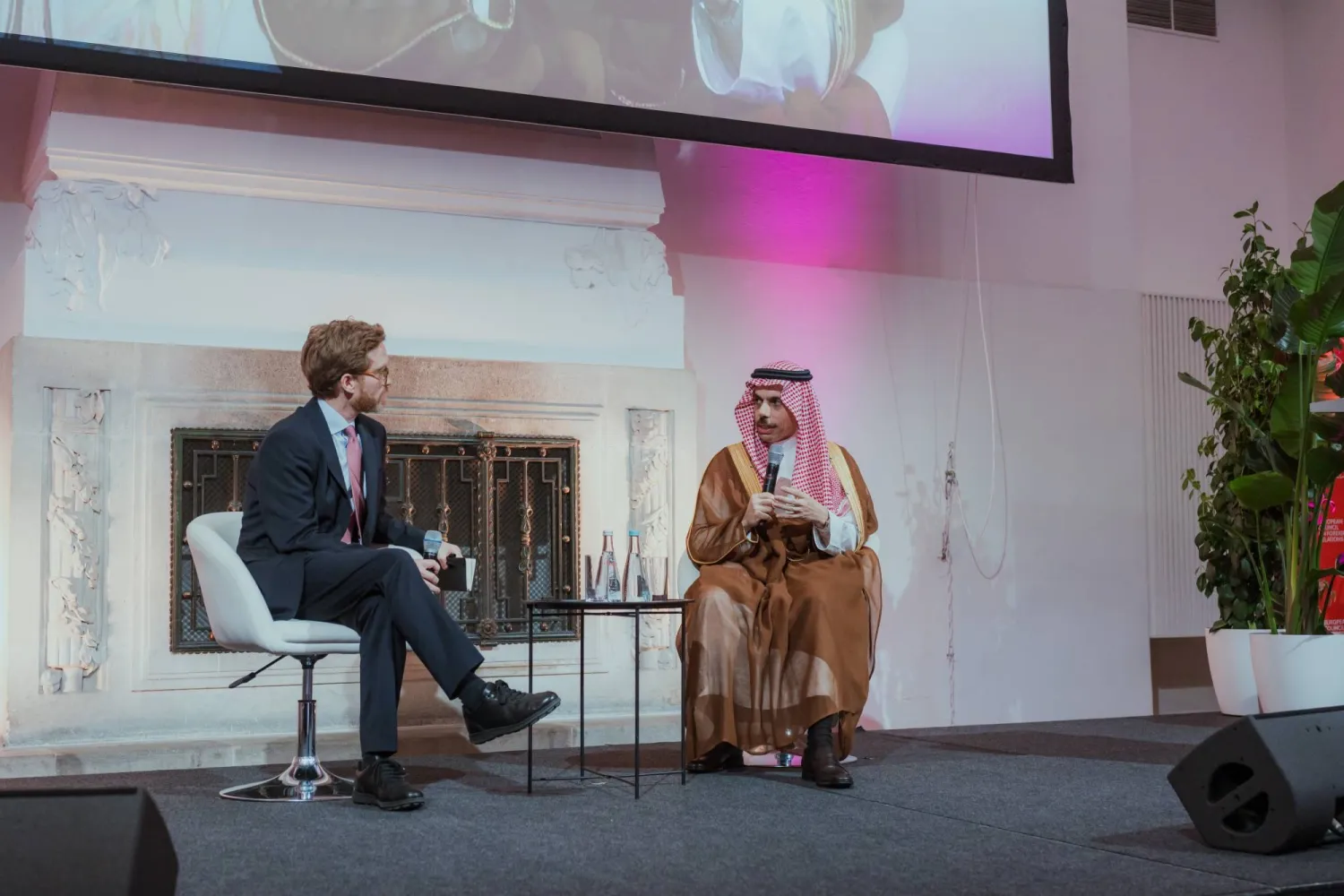
Saudi Foreign Minister Prince Faisal bin Farhan spoke on Wednesday as a keynote guest at a European Council on Foreign Relations panel in Vienna
TT

Saudi Arabia Urges Rebuilding Trust before Any Economic Cooperation with Iran

Saudi Foreign Minister Prince Faisal bin Farhan spoke on Wednesday as a keynote guest at a European Council on Foreign Relations panel in Vienna

Saudi Arabia said trust must be rebuilt with Iran before any discussion of economic cooperation or mutual investment can begin.

The Saudi position came in response to media reports that a memorandum of understanding between the United States and Iran, signed on Wednesday by US President Donald Trump and Iranian President Masoud Pezeshkian, includes a provision for companies from the region, other countries and US partners to take part in a fund supporting Iran’s reconstruction after a final agreement is reached.

Saudi Foreign Minister Prince Faisal bin Farhan, speaking on Wednesday as a keynote guest at a European Council on Foreign Relations panel in Vienna, said he had no information about the alleged fund to rebuild Iran.

But he said the latest conflict had seen Iran attack Saudi Arabia and all Gulf states, creating a major breach of trust.

The minister said this had happened while relations with Iran were being rebuilt under the “Beijing agreement,” a process that had gained real momentum to the point that the two sides were exploring potential areas for economic cooperation and the like on the sidelines.

Dialogue to rebuild trust

“That trust has regressed,” Prince Faisal said.

“We will have to hold a dialogue on how to rebuild that trust and rebuild the relationship before any concept of economic cooperation, mutual investment, or anything of that sort can be rationally addressed,” he added.

He said Saudi Arabia’s development priority now remains focused on the domestic front.

On the nuclear file, Prince Faisal said one lesson from the previous nuclear agreement, which also completely ignored the regional context, was that any deal that fails to address regional concerns risks becoming less secure.

Without tackling the issues that matter to the region, he said, a nuclear agreement could become a source of dispute and risk as much as a solution to the nuclear issue.

Support for diplomacy

Despite ambiguity over some provisions, Riyadh supported the Pakistani and Qatari efforts that led to the memorandum of understanding.

Prince Faisal said Saudi Arabia remains committed to diplomacy, which is why it backed the diplomatic efforts that helped produce the memorandum.

That commitment, he said, is also why Riyadh is “very actively engaged” in supporting the success of the upcoming negotiations, and why it will work with regional partners to launch a regional dialogue on rebuilding trust after the conflict.

He said such talks should focus on how to overcome the crisis of trust, look toward a better future and ensure that potential flashpoints are handled through diplomacy rather than confrontation.

But he said that diplomacy cannot be effective without strong deterrence and high resilience to address potential threats and challenges.

The Saudi Foreign Minister said Riyadh would pursue a dual-track approach, including building its defense capabilities to confront threats and strengthening its logistical and economic resilience.

‘Trust first, then cooperation’

Researchers say Riyadh’s approach toward Iran reflects both hedging and flexibility.

Political researcher Ahmed Alibrahim said Prince Faisal’s remarks on Wednesday set the stage for a new phase in dealing with Iran, based on the principle of “trust first, then cooperation.”

He said Riyadh does not reject economic openness or support for regional stability, but believes that any sustainable path requires addressing the fallout from the previous phase and establishing concrete guarantees to prevent threats from recurring.

That is especially important, he said, given the previous experience of the “Beijing agreement.”

Alibrahim told Asharq Al-Awsat that Saudi support for diplomacy does not conflict with its insistence on strengthening its defense capabilities and protecting its national interests.

Recent political contacts show Saudi Arabia was a key player in supporting the Pakistan-sponsored negotiations and the accompanying Qatari efforts.

Those contacts included 11 phone consultations between the two countries’ leaders and foreign ministers in the past month alone.

The latest was Monday’s visit to Riyadh by Qatari Minister of State at the Foreign Ministry Mohammed al-Khulaifi, who met Saudi Deputy Foreign Minister Waleed al-Khuraiji.

Dr. Khaled al-Habbas told Asharq Al-Awsat that Riyadh had used its active diplomacy to support a political solution and back mediation efforts led by Pakistan with Qatari support, leading to the announced peace agreement.

He said that role was reflected in praise for Saudi Arabia’s support for de-escalation and settlement efforts.

Saudi Arabia welcomed the agreement reached between the United States and Iran to end military operations and begin 60 days of detailed negotiations aimed at a permanent agreement.

It stressed the importance of restoring security and freedom of navigation in the Strait of Hormuz, calling it essential to regional stability and the smooth flow of global trade and energy.

Riyadh said it hoped the talks would lead to a lasting peace that strengthens security in the region and the world, through understandings that account for the security interests of regional states and uphold respect for state sovereignty and non-interference in internal affairs.

Saudi Foreign Minister Prince Faisal bin Farhan also received a phone call from his Iranian counterpart on Monday, hours after the agreement was announced.

During the call, Prince Faisal affirmed the Kingdom’s welcome of the US-Iran agreement to end military operations and begin detailed negotiations toward a permanent deal.

He expressed Riyadh’s hope that the agreement would help strengthen security and stability and achieve peace in the region and the world.

Habbas said the Gulf approach to the war, led by Saudi Arabia, was marked by wisdom.

He said the Kingdom avoided becoming a party to the war while seeking from the start to prevent it, contain its effects and support a political settlement that serves regional security and stability.

He said Riyadh was likely to continue its efforts in the next phase to prevent a return to confrontation, consolidate peace and stability, and ensure maritime security in the region.


Nine Riyadh-Paris Visits Chart Path from Coordination to Strategic Partnership

Mohammed bin Salman and Macron during the French president’s visit to Riyadh in December 2024 (AP) 
TT

Nine Riyadh-Paris Visits Chart Path from Coordination to Strategic Partnership

Mohammed bin Salman and Macron during the French president’s visit to Riyadh in December 2024 (AP) 

Saudi Crown Prince and Prime Minister Mohammed bin Salman’s current state visit to France marks the ninth official visit exchanged between the Saudi and French leaders since 2015, according to an Asharq Al-Awsat review of official sources.

The crown prince has traveled to France six times on official visits since 2015, including the current trip, while French President Emmanuel Macron has made three official visits to Saudi Arabia since taking office in 2017.

2015: First Visit

Mohammed bin Salman made his first official trip to France in June 2015, meeting then-President François Hollande at the Élysée Palace.

He also led the Saudi delegation at the inaugural meeting of the Saudi-French Permanent Coordinating Committee. The trip saw the signing of 10 agreements worth a total of $12 billion.

2016: Vision 2030 Joins the Agenda

Mohammed bin Salman returned to Paris in June 2016, meeting Hollande and other senior French officials.

Talks centered on developing bilateral ties and cooperation under Saudi Vision 2030, unveiled by the Kingdom two months earlier, as well as developments in the Middle East and efforts to bolster regional security and stability.

The trip broadened economic cooperation, placing Saudi Arabia’s transformation and diversification plans at the heart of discussions alongside political and defense coordination.

Several agreements and memorandums of understanding were signed, while the third Saudi-French Business Opportunities Forum brought together companies and business leaders to explore investment opportunities.

2017: Macron Makes First Saudi Trip

Macron traveled to Saudi Arabia on Nov. 9, 2017, months after taking office.

He met Mohammed bin Salman in Riyadh for talks on regional stability, counterterrorism and peace efforts, according to the French presidency.

The French leader also condemned a Houthi ballistic missile attack targeting Riyadh and voiced his country’s solidarity with the Kingdom.

2018: Three Days in France, AlUla Agreement

In April 2018, Mohammed bin Salman traveled to France for the first time since becoming crown prince and for the third time since 2015.

During the three-day trip, he held wide-ranging discussions with Macron covering political, economic, defense and cultural ties, as well as regional issues.

The two countries signed an intergovernmental agreement on cooperation to develop AlUla, while Saudi and French companies concluded 19 agreements worth more than $18 billion.

2021: Macron in Jeddah

Macron returned to Saudi Arabia in December 2021 for talks with Mohammed bin Salman in Jeddah.

Discussions focused on regional security and stability and ways to expand the bilateral partnership under Vision 2030, alongside Lebanon, Yemen, Iran and counterterrorism.

Riyadh and Paris also sought to broaden economic and investment cooperation, particularly in new technologies, future industries, renewable energy, culture and tourism.

2022: Energy and Global Crises

Mohammed bin Salman traveled to France again in July 2022, meeting Macron at the Élysée Palace as the Russia-Ukraine war weighed on global energy markets and food security.

Their discussions covered diversifying energy supplies to Europe and mitigating the impact of the food crisis, as well as developments in Lebanon and Yemen and Iran’s nuclear program.

Riyadh and Paris agreed to deepen cooperation in defense, energy, digital transformation, transport, sustainable cities and culture. France also renewed its support for Riyadh’s bid to host Expo 2030.

2023: A Broader Partnership

Mohammed bin Salman’s fifth official trip to France came in the summer of 2023, when he held bilateral and expanded talks with Macron at the Élysée Palace.

The leaders discussed bilateral ties and regional and international developments.

The crown prince also headed the Saudi delegation to the Summit for a New Global Financing Pact and attended an official reception promoting Riyadh’s Expo 2030 bid.

The trip reflected the widening scope of Saudi-French ties, extending beyond politics and defense to climate action, the global economy, investment and culture.

2024: Strategic Partnership

Macron traveled to Saudi Arabia for a third time from Dec. 2 to 4, 2024, on a state visit encompassing Riyadh and AlUla.

The trip saw the establishment of a strategic partnership between the two countries and the signing of a memorandum of understanding to create the Saudi-French Strategic Partnership Council, an umbrella framework for cooperation in politics, defense, the economy, culture, energy and technology.

Macron also attended an investment forum bringing together more than 200 Saudi and French companies and took part in the One Water Summit in Riyadh before traveling to AlUla in northern Saudi Arabia.

2026: Ninth Visit

Mohammed bin Salman’s current state visit to France is his sixth official trip to the country since 2015 and brings the total number of official visits exchanged between the two countries’ leaders to nine.

Macron has traveled to Saudi Arabia three times since becoming president in 2017.


GCC, India Discuss Ministerial Meeting Set to be Held Next Month

Secretary-General of the Gulf Cooperation Council (GCC) Jasem Albudaiwi
TT

GCC, India Discuss Ministerial Meeting Set to be Held Next Month

Secretary-General of the Gulf Cooperation Council (GCC) Jasem Albudaiwi

Secretary-General of the Gulf Cooperation Council (GCC) Jasem Albudaiwi met in Riyadh on Sunday with Indian Ambassador to Saudi Arabia Shri Vipul.

During the meeting, the two sides reviewed a number of topics of common interest, most notably relations between the GCC and India, and ways to develop and enhance them in a manner that serves common interests.

They also discussed the latest developments regarding the launch of negotiations on the Free Trade Agreement (FTA) between the GCC and India, signed in February 2026, in addition to preparations for the GCC-India ministerial meeting scheduled to be held next September.

The two officials also exchanged views on the latest developments in the region and the world, affirming the importance of continuing coordination and consultation on issues of common interest.


GCC Secretary-General Holds Separate Meetings with South Korean, Georgian Ambassadors

Gulf Cooperation Council (GCC) Secretary-General Jasem Albudaiwi
TT

GCC Secretary-General Holds Separate Meetings with South Korean, Georgian Ambassadors

Gulf Cooperation Council (GCC) Secretary-General Jasem Albudaiwi

Secretary-General of the Gulf Cooperation Council (GCC) Jasem Albudaiwi met in Riyadh on Sunday with South Korean Ambassador to Saudi Arabia Kang Shin-chul.

During the meeting, the two sides discussed several topics of common interest, most notably GCC-Korean ties and the latest developments on the signing of the Free Trade Agreement (FTA) between the GCC and South Korea, SPA reported.

They also exchanged views on developments in the region, and international and regional efforts aimed at enhancing security and stability.

Albudaiwi also met with Ambassador of Georgia to the Kingdom Nikoloz Revazishvili.

During the meeting, the two sides discussed a number of topics related to strengthening relations between the GCC and Georgia, as well as ways to develop them in a manner that serves common interests, including the latest developments regarding the Joint Action Plan for 2022–2026.

They also discussed the latest developments in the region and the world and exchanged views on a number of issues of common interest.
