


US-Iran Peace Talks in Geneva Called Off, Clouding Prospects for Lasting Truce

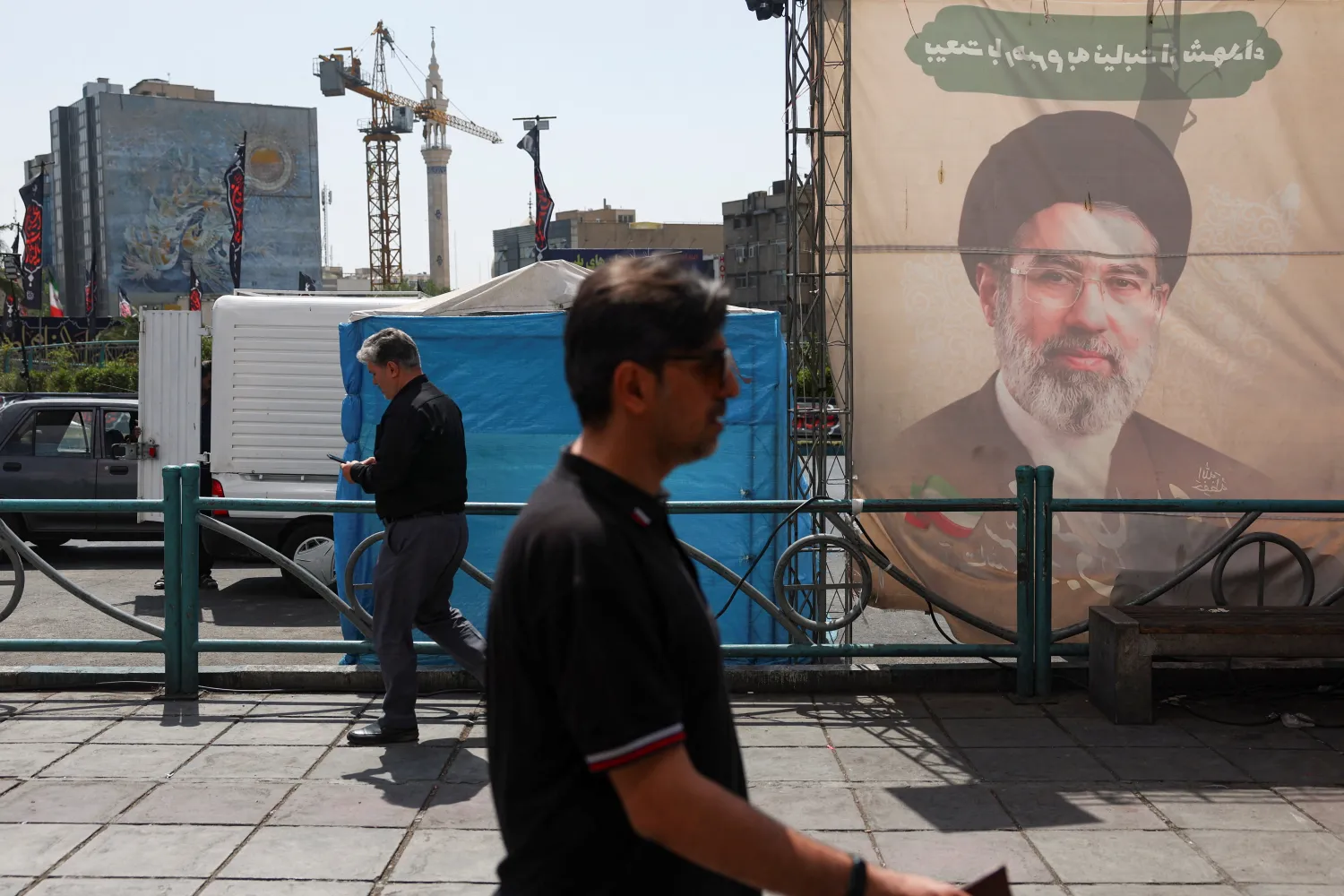
People walk past a banner with a picture of Iran's Supreme Leader, Mojtaba Khamenei, in Tehran, Iran, June 17, 2026. Majid Asgaripour/WANA (West Asia News Agency) via REUTERS
TT

US-Iran Peace Talks in Geneva Called Off, Clouding Prospects for Lasting Truce

People walk past a banner with a picture of Iran's Supreme Leader, Mojtaba Khamenei, in Tehran, Iran, June 17, 2026. Majid Asgaripour/WANA (West Asia News Agency) via REUTERS

Switzerland said US talks with Iranian negotiators on a pact to end the Middle East conflict would not take place on Friday, as Vice President JD Vance dropped plans to travel to Geneva, adding to uncertainty whether a lasting truce can be found. 

"The logistics of these negotiations have never been simple or predictable," the White House spokesperson said in a statement on Thursday night. Vance and the US delegation had been ready to depart as soon as plans were finalized. 

The talks, set for the mountaintop resort of Burgenstock, would not take place, Switzerland's foreign ministry confirmed, but gave no details, Reuters reported. 

There was no immediate response from Iran, which had earlier said it was ready to begin technical talks after Wednesday's 14-point accord extended a tenuous ceasefire by at least 60 days. 

Iran's negotiators first needed to see signs of the US implementing the interim deal, and there was no confirmation its delegation would travel to Geneva, the semi-official Tasnim news agency said before Vance's Thursday announcement. 

US officials had also said they would hold a formal signing ceremony for the US-Iran agreement in Switzerland, but Iran's foreign ministry had cast doubt on the plan, calling it unnecessary after both countries' presidents signed the pact. 

The war, ‌which began on ‌February 28 with US and Israel air attacks on Iran, has killed at least 7,000 people, sent energy prices ‌soaring ⁠and shaken global ⁠markets. 

ISRAEL CONTINUES FIGHT 

Israel, left out of the peace talks, has distanced itself from the US-Iran accord and kept up fighting against the Iranian-allied Hezbollah militant group in Lebanon, also raising questions about whether the agreement would hold. 

In Washington, some of US President Donald Trump's Republican allies in Congress questioned whether he had conceded too much in order to end the conflict, unpopular with most Americans in the run-up to mid-term elections in November. 

Trump had sworn to end the war only with Iran's "UNCONDITIONAL SURRENDER." 

But the memorandum signed with Iran instead provides relief from economic sanctions, unfreezes assets worth tens of billions of dollars and immediate US waivers for its exports of oil. 

Iran's Supreme Leader Mojtaba Khamenei said Trump had signed the deal "out of desperation" and signaled that approaching talks over Iran's nuclear program, among Trump's stated reasons ⁠for starting the war, would not be easy. 

"If the American side wants to be too demanding, we ‌will not accept it," he said in a message. 

The deal gives negotiators 60 days to agree ‌on the status of Iran's nuclear program, unless an extension is agreed, and set up a $300 billion reconstruction fund for Iran and other financial incentives. 

Vance said Washington would also ‌seek to limit Iran's long-range missiles. 

The growing cost of the war also drew the spotlight, as the US defense department told lawmakers it needed $80 ‌billion to cover the costs and some unrelated bills, the Wall Street Journal said. 

When the US and Israel launched the war nearly four months ago, Trump said he aimed to destroy Iran's nuclear capabilities to ensure it could never develop such weapons. 

He also sought to end Tehran's ability to strike its neighbors, prevent it from backing allied anti-Israel militants in the region and make it possible for Iranians to topple their theocratic government. 

None of those objectives had been met when Trump signed the agreement, in which Iran restated ‌its decades-long assertion not get or develop nuclear weapons, a position doubted by a succession of US presidents. 

It also agreed to the onsite "down blending" of its highly enriched uranium stockpile and inspections by the International Atomic ⁠Energy Agency as a Non-Proliferation Treaty ⁠member, rejecting Trump's wish to remove the material from the country. 

US officials say the negotiations could still yield a strong agreement on Iran's nuclear program, aiming to better one dating from 2015 between Iran, the US and other countries that Trump tore up in his first term. 

But critics say Iran is in a stronger position now, having withstood a superpower attack, demonstrated its control of the Strait of Hormuz and gained valuable waivers to financial sanctions. 

Iran has said it will still exert control over Hormuz in partnership with Oman, its neighbor across the critical waterway, and intends to charge ships service fees that did not exist before the war, although not during the 60-day talks. 

Oil prices dipped on Friday as prospects brightened for more supply after tankers began moving through the reopening Strait, which had carried nearly a fifth of global crude oil and liquefied natural gas supplies before the war. 

In Lebanon, where more than a million people have been displaced by the fighting, fresh Israeli strikes on Friday killed at least 15, the state news agency NNA said, in attacks Israel said were directed at Hezbollah targets. 

That raised doubt about how far Trump will go to force his wartime ally to halt an offensive he has now pledged to end. 

The deal calls for "permanent termination" of the war in Lebanon, but Israel has said it has no intention of withdrawing, instead depicting an expanded occupation zone in a new map. 

Trump has become openly critical of Israel's operations in Lebanon, opening one of the biggest rifts between the two countries in decades. 


Cuba Adopts Historic Package of Free-market Reforms

A vintage car passes by images of late Cuban President Fidel Castro, Cuba's former President Raul Castro and Cuba's President Miguel Diaz-Canel displayed on a billboard in Havana, Cuba, May 15, 2026. REUTERS/Norlys Perez
TT

Cuba Adopts Historic Package of Free-market Reforms

A vintage car passes by images of late Cuban President Fidel Castro, Cuba's former President Raul Castro and Cuba's President Miguel Diaz-Canel displayed on a billboard in Havana, Cuba, May 15, 2026. REUTERS/Norlys Perez

Cuban lawmakers Thursday adopted nearly 200 historic free-market reforms aimed at rescuing the communist island from a severe crisis aggravated by a US oil blockade.

In a landmark speech to the National Assembly, Prime Minister Manuel Marrero unveiled 176 measures aimed at rolling back the state's role in the economy and attracting investment in everything from banking to tourism and agriculture.

Under the reforms, foreign investors are no longer required to form joint ventures with the state, large private enterprises will be authorized and both Cuban and foreign investors will be allowed to acquire stakes in state companies.

These and other huge changes come as the United States exerts relentless pressure on the island, with President Donald Trump musing openly about taking over the Caribbean nation just 90 miles (145 km) from Florida.

Daniel Torralbas, a London-based Cuban economist, described the reforms as "the most profound" since the 1959 revolution led by Fidel Castro.

- 'Socialism or death!' -

They were adopted in a unanimous show of hands by lawmakers at a session which ended with President Miguel Diaz-Canel intoning Castro's famous revolutionary slogan: "Socialism or death!"

Marrero did not give a time-frame for implementing the reforms but Diaz-Canel had on Wednesday argued the need for "urgent changes" to stave off economic collapse.

The oil blockade imposed by Trump in January after his ouster of Cuba ally Nicolas Maduro in Venezuela has brought the island's economy to the brink of collapse, forcing the Communist Party into concessions it previously considered heretical.

While Havana's custom has always been to blame its woes on a more-than-six-decade US trade embargo and more recently the oil blockade, Diaz-Canel admitted to the existence of "obstacles that don't come from outside, nor the blockade."

In usually frank language, he called out "slowness, bureaucracy and norms that impede those who want to produce" as well as "decisions that we have put off."

"Their backs are up against the wall as never before," Michael Bustamante, Cuban studies chair at the University of Miami, told AFP.

"They're in the uncomfortable position of making changes to their economic model, seemingly because of the pressure that's being exerted on them by the United States."

A defiant Diaz-Canel insisted that the government was "not doing this because of pressure from the Yankees," but to "preserve" socialism.

- Collapsing revolution -

Just a single oil tanker -- from Russia -- has docked in Cuba since the beginning of the year.

Power cuts sometimes lasting over 30 hours have become the norm, and food, fuel, drinking water and medicine are in short supply.

The United Nations High Commissioner for Human Rights, Volker Turk, has warned that "children are dying" in Cuba because of a shortage of medical supplies and medication.

Victor Hierrezuelo, a 63-year-old bank worker, told AFP on Thursday that, absent reforms, "the revolution will collapse!"

It is unclear, however, whether the changes will satisfy Trump, who is pushing for a change in Cuba's leaders as well as its economic model.

Asked Thursday if Cuba was now in Trump's sights after he signed a deal to end the Iran war, Vice President JD Vance said Washington wanted Cubans to be "happy and successful."

"We're actually talking to the Cuban government right now about how they could change their ways to change that," he added.

Many disillusioned locals, weary after weeks of power cuts, which causes food to rot in 40C heat, shrugged off the reforms as too little, too late.

But the country's burgeoning small business sector welcomed the changes.

They "offer hope," said Mario Gonzales, the 32-year-old manager of a restaurant in Havana's historic old town, who is hoping for a tourism revival.


UN Reports Record Violations of Children in Conflict, with Government Forces the Main Perpetrators

United Nations Secretary-General Antonio Guterres speaks during a press conference in the Petion-Ville commune of Port-au-Prince, Haiti, on June 16, 2026. (Photo by Clarens SIFFROY / AFP)
TT

UN Reports Record Violations of Children in Conflict, with Government Forces the Main Perpetrators

United Nations Secretary-General Antonio Guterres speaks during a press conference in the Petion-Ville commune of Port-au-Prince, Haiti, on June 16, 2026. (Photo by Clarens SIFFROY / AFP)

Nearly 25,000 children caught in conflict were victims of a record number of violations last year, including killings, rape and recruitment to fight, and for the first time, government forces — not armed groups — were the main perpetrators, a new United Nations report says.

Secretary-General Antonio Guterres’ annual report, released this week, has a blacklist of violators against children: government forces from eight nations and 67 armed groups from 16 countries and territories.

The number of violations — which also include abductions, attacks on schools and hospitals, and denial of humanitarian access to help them — rose for a fourth straight year to 38,558, according to the report that is based on verified UN data. It said 24,174 children, a third of them girls, were affected, with several thousand subjected to multiple violations.

“The scale and persistence of these violations demand more than acknowledgment — they demand resolve,” the UN special representative for children in armed conflict, Vanessa Frazier, said in an analysis of the report.

She urged the 193 UN member nations to confront the findings and “recognize that protecting children is not an aspiration but an obligation, and that the decisions taken today will shape the futures they may or may not live to claim.”

For the first time since the UN authorized monitoring of abuses against children in conflict 30 years ago, the report said that “government forces were responsible for a majority of grave violations.”

Topping the 2025 list are the Israeli military and its security forces, with 12,445 violations. That is followed by Congo, with 4,114 violations, and Myanmar, Somalia and armed groups in Nigeria, all with over 2,000 violations. Government forces from Sudan, South Sudan, Syria and Russia's armed forces in Ukraine are also on the blacklist.

The blacklist also includes Hamas and Palestinian Islamic Jihad, which carried out the Oct. 7, 2023, surprise attacks in southern Israel that killed some 1,200 people, mostly civilians, and sparked the war in Gaza. The UN says Israeli settlers were responsible for 326 grave violations last year, and Guterres warned that if these attacks continue, the settlers could be put on the blacklist.

The report says government forces were “the main perpetrators” of 6,266 killings of children — a 34% increase from last year — as well as 7,958 injuries.

The UN said it verified the killing of 2,668 Palestinian children by Israeli forces in Gaza and 55 Palestinian kids in the West Bank and east Jerusalem. The UN received reports of the killing of an additional 4,588 children in Gaza and injuries to 346 Israeli children that it is in the process of verifying, the report said.

Guterres said he was “appalled by the magnitude of grave violations against children” in Palestinian territories and Israel, “gravely alarmed by the staggering increase in grave violations” perpetrated by Israeli forces, and “deeply alarmed at the staggering rise in attacks carried out by Israeli settlers” affecting children with no accountability.

The UN chief urged Israel to develop and sign a plan with the United Nations to end the killing and maiming of children and attacks on schools and hospitals with time-bound commitments.

Israel's UN Ambassador Danny Danon accused Guterres of blurring “the fundamental distinction between a democratic state fighting for its survival and murderous terrorist organizations” like Hamas and Islamic Jihad rather than standing with the victims of the Oct. 7, 2023, attacks. He said this will be Guterres' legacy — “one of the greatest moral failures in the history of the United Nations.”

Frazier, the special representative for children in conflict, told reporters Thursday that there are a number of reasons government forces were responsible for more violations this year. That includes “the impunity that we are seeing towards international law” and changes in warfare from battlefields to densely populated places using new weapons like drones and explosives that cover a wide area, she said.

“Children were impacted while escaping fighting, seeking food, water or medical care, and navigating areas heavily contaminated by explosive remnants of war, often contributing to life-long disabilities,” she said in the analysis of the report.

The UN said it verified the recruitment and use of 6,607 children in conflict, with the highest numbers in Congo, Nigeria, Haiti, Somalia and Colombia. It said 5,129 youngsters were abducted, mainly in Nigeria, Congo, Somalia, Myanmar and Mozambique.

And it reported 1,783 child victims of rape and sexual violence, with the highest number in Congo, Nigeria, Somalia, Sudan and Haiti.


Police Charge 3rd Suspect in Melbourne Synagogue Arson Allegedly Directed by Iran

People gather outside the Adass Israel Synagogue, Dec. 9, 2024, after a firebombing in Melbourne, Australia. (Con Chronis/AAP Image via AP)
TT

Police Charge 3rd Suspect in Melbourne Synagogue Arson Allegedly Directed by Iran

People gather outside the Adass Israel Synagogue, Dec. 9, 2024, after a firebombing in Melbourne, Australia. (Con Chronis/AAP Image via AP)

Police charged a third suspect on Friday with an arson attack on a Melbourne synagogue that was allegedly directed by Iran.

The 20-year-old man was one of three masked offenders who broke into the Adass Israel Synagogue, doused the interior with flammable liquid then set it alight in the early hours of Dec. 6, 2024, a police statement alleged.

The fire caused extensive damage to the synagogue and a worshipper sustained minor injuries.

The Victorian Joint Counter Terrorism Team, which brings together federal and state police with a spy agency, charged the man, who has not been named, with offenses including arson.

He was charged in a Melbourne jail where he was already being held in custody on unrelated offenses. According to The Associated Press, police declined to elaborate on those offenses.

His co-accused Giovanni Laulu, 21, was arrested in July last year and another suspect, Younes Ali Younes, 20, was arrested a month later.

Prime Minister Anthony Albanese last year accused Iran’s Revolutionary Guard of directing the synagogue fire and an arson attack two months earlier at a Sydney kosher eatery, Lewis’ Continental Kitchen.

Mike Burgess, director-general of the Australian Security Intelligence Organization, the nation’s main domestic spy agency, said the Revolutionary Guard used a “complex web of proxies to hide its involvement” in both antisemitic attacks.

Iran’s ambassador to Australia and another three Iranian diplomats were expelled. Tehran has denied Australia’s allegations.

Australian Federal Police Assistant Commissioner Peter Crozier told reporters on Friday that investigators were working with international partners in the continuing investigation.

Police were also investigating whether the three alleged arsonists knew who ordered the attack.

“They may not actually be aware of the people who are directing or the principals of these investigations. That remains a key line of inquiry for us,” Crozier said.

Victoria Police Acting Assistant Commissioner Paul O’Halloran said police had informed the local Jewish community of the third arrest before the news was made public.

“Our heart goes out to them. Again, this brings back this terrible incident,” O’Halloran said.

“People deserve the right to feel safe and be safe in their community and particularly at their place of worship. Today's charges are a strong testament to this,” he added.

The latest suspect will make his first court appearance on the new charges next week.

The Australian government has established a public inquiry to investigate a rise in antisemitism across the country, including the killing of 15 people when two gunmen opened fire on a Sydney Hanukkah celebration in December.
