


Hamas Pushes to Elect Leader to Demonstrate Unity, Heed ‘External Advice’

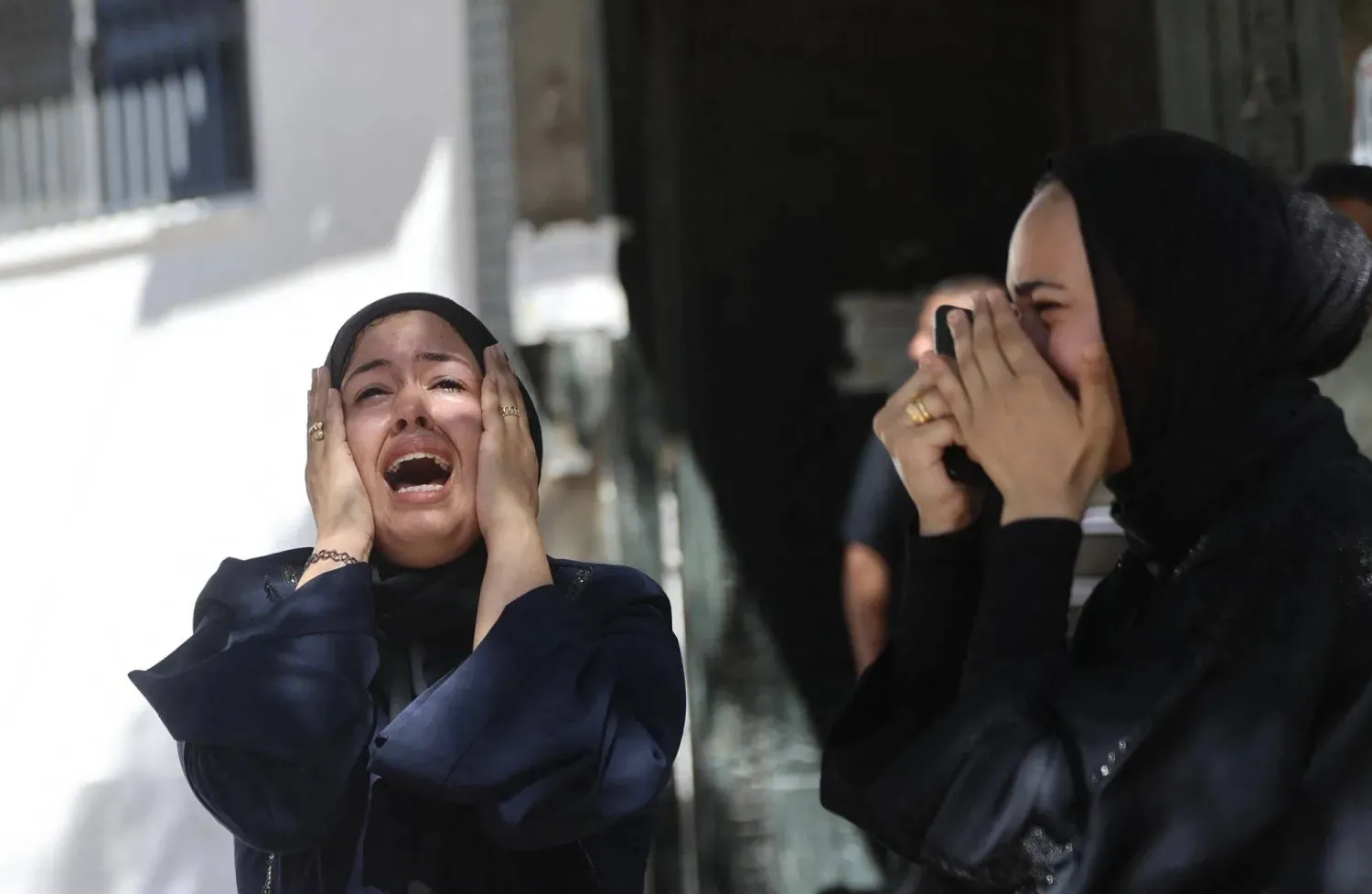
Palestinian women mourn during the funeral of a man killed in an Israeli strike in Gaza City on Thursday. (AFP)
TT

Hamas Pushes to Elect Leader to Demonstrate Unity, Heed ‘External Advice’

Palestinian women mourn during the funeral of a man killed in an Israeli strike in Gaza City on Thursday. (AFP)

Hamas is pressing ahead with efforts to elect a new political bureau chief despite ongoing Gaza ceasefire negotiations and continued Israeli military operations, a move that officials say is intended to project internal unity and respond to recommendations from outside parties close to the movement.

The push comes after a first round of voting in May failed to produce a winner between the two leading contenders: Khalil al-Hayya, a member of Hamas’s leadership council, and Khaled Meshaal, the veteran leader of the movement’s overseas branch.

Sources within Hamas said the accelerated election process is driven by several factors, including a desire to project internal consensus and recommendations from outside parties close to the movement.

Under Hamas regulations, the new leader would initially serve a short term lasting until early next year, with the possibility of an extension until broader internal elections are completed.

A senior Hamas official based outside the Palestinian territories said electing a political bureau chief is necessary to ensure stability within the movement. He noted that the leadership council had originally been expected to continue managing Hamas’s affairs until the next internal elections, but several developments prompted a decision to fast-track the selection of a new leader.

Among those factors, the official said, is the need to make both internal and external decisions while demonstrating unity to observers, supporters and Hamas’ broader constituency. “There is a need to show that capable leaders are in place to guide the movement through this critical period,” he said.

The official added that several outside actors with close ties to Hamas have encouraged the movement to appoint a clearly identifiable leader, arguing that such a step is politically important. He declined to identify those parties.

For roughly the past year and a half, Hamas has been run by a leadership council headed by Mohammed Darwish, chairman of the movement’s Shura Council. The body includes leaders representing Gaza, the West Bank and Hamas’s overseas branches, as well as the movement’s secretary-general.

Another source said Darwish himself pushed for the election process to resume in order to fill the leadership vacancy. While he has effectively represented the movement through the leadership council, he is expected to return to his previous role as head of the Shura Council once a new chief is chosen.

The source noted that a combination of personal considerations and organizational concerns, both internal and external, contributed to Darwish’s support for holding the election.

Asked whether Darwish may be seeking to avoid responsibility for major decisions expected in the coming months — particularly as ceasefire negotiations enter a sensitive phase involving the future of Hamas’s weapons — the source rejected the notion.

“Such decisions are not made by one person, even if that person is the head of the political bureau,” the source underlined. “All major decisions are reached through consensus within the political bureau and the movement’s executive bodies.”

While emphasizing that responsibility for consequential decisions is collective, the source acknowledged that the movement’s leader still plays an important role during pivotal moments.

Military Wing Backed Vote

Three Hamas sources in Gaza said the push to elect a political bureau chief was strongly supported by both the movement’s Gaza leadership and its military wing, the Izz al-Din al-Qassam Brigades, even before the killings of senior commanders Izz al-Din al-Haddad and Mohammed Awda.

One source said al-Haddad believed Hamas needed a clearly defined leader under current circumstances and that other Qassam commanders shared that view. He also participated in the most recent round of voting.

The assassination campaign targeting Hamas and Qassam leaders in Gaza temporarily interrupted the election process. According to one source, the vote was postponed to allow the military wing to reorganize its leadership structure and ensure that both military and political leaders in Gaza could participate securely.

The sources said electing an overall movement leader would also give Hamas’ three regional branches — Gaza, the West Bank and the external leadership — greater flexibility in managing their own affairs. The winner of the race, either al-Hayya or Meshaal, would vacate his current regional leadership post, creating an opportunity for a new figure to assume responsibility for either Gaza or Hamas’ overseas organization.



Arab Parliament President Stresses Houthi Attacks on Saudi Arabia Pose Direct Threat to Regional Security

Arab Parliament President Stresses Houthi Attacks on Saudi Arabia Pose Direct Threat to Regional Security
TT

Arab Parliament President Stresses Houthi Attacks on Saudi Arabia Pose Direct Threat to Regional Security

Arab Parliament President Stresses Houthi Attacks on Saudi Arabia Pose Direct Threat to Regional Security

President of the Arab Parliament Mohammed bin Ahmed Al-Yamahi stressed that repeated terrorist attacks by the Houthi militia against Saudi Arabia and its civilian and oil facilities pose a direct threat to regional security.

During his speech at the 153rd Assembly of the Inter-Parliamentary Union in Arusha, United Republic of Tanzania, Al-Yamahi addressed Iranian attacks that targeted several Arab countries and threatened civilians, infrastructure, and vital facilities, SPA reported.

He also discussed regional escalation and related threats to the security of Arab countries. He called on the international community to move beyond condemnation and take measures to protect states and their sovereignty and compel the parties to respect international law.


Sudan’s Burhan Rules Out Talks with RSF or ‘Any Other Party’

Wreckage of a drone allegedly used in an attack on Damazin (activists’ Facebook pages). 
TT

Sudan’s Burhan Rules Out Talks with RSF or ‘Any Other Party’

Wreckage of a drone allegedly used in an attack on Damazin (activists’ Facebook pages). 

Sudan’s army chief Abdel Fattah al-Burhan has reiterated his refusal to negotiate with the paramilitary Rapid Support Forces (RSF) or “any other party,” vowing to continue military operations despite renewed US efforts to secure a political settlement.

His remarks came after Massad Boulos, US President Donald Trump’s senior adviser for Arab and African affairs, announced that he had met Burhan in Egypt earlier this week.

Meanwhile, a drone attack on Damazin, the capital of Blue Nile state, killed four women and wounded dozens of civilians, according to a Sudanese human rights group.

Addressing residents of Amri locality in Northern state on Tuesday, Burhan declared: “There will be no negotiations with the rebels or with any other party,” without specifying whom else he meant.

“We are a state of institutions. Decisions on negotiations, peace and war are therefore made by the Security and Defense Council,” he added, according to a statement from the Sovereignty Council’s media office.

Burhan, who heads the Sovereignty Council and commands the armed forces, reaffirmed his determination to continue what he described as efforts to defeat and eliminate the rebellion.

He also praised Amri residents for supporting the army and the Popular Resistance, reiterating the military’s commitment to what it calls the “Battle of Dignity.”

Deadly drone attack

Hours after Burhan’s remarks, Emergency Lawyers, a volunteer human rights organization, reported that drones belonging to the RSF had struck civilian sites in Damazin early Wednesday.

The strikes hit homes and a mosque, killing four women in the Al-Hijra neighborhood and wounding dozens of civilians, the group alleged.

Its statement provided no further details about the wounded or how it had established responsibility for the attack.

Emergency Lawyers warned against continued attacks on civilian sites, stressing that deliberately targeting them constitutes a serious violation of international humanitarian law.

The organization demanded an end to the attacks and accountability for those responsible, urging all parties to the conflict to respect civilian protections and avoid endangering lives.

Neither the army nor the RSF issued a comment, although platforms aligned with the paramilitary group reported that the drones had targeted the homes of the finance and information ministers.

In a separate statement, Damazin Technical College condemned a two-drone attack on its campus, reporting damage to classrooms, administrative offices, laboratories, and other infrastructure.

Diplomatic efforts

Burhan’s rejection of negotiations came less than a day after Boulos announced that he had attended a lunch hosted by Egyptian President Abdel Fattah al-Sisi in New Alamein, on the sidelines of an African Union coordination meeting, where he met the Sudanese leader.

In a post on X on Monday, Boulos reaffirmed Washington’s commitment to working with regional and international partners toward a political settlement that would help end Sudan’s war and alleviate the country’s humanitarian suffering.

He emphasized US support for Sudan’s unity, sovereignty and territorial integrity.

According to Boulos, the diplomatic efforts aim to restore security and stability, begin reconstruction and development, and facilitate a transition to a civilian-led government through an inclusive national dialogue owned and led by the Sudanese people.

In a television interview last September, Boulos maintained that Washington engaged with both sides in Sudan’s conflict without formally recognizing either.

He also stressed that his meetings with Burhan did not constitute recognition of the Sudanese government.

However, in his latest X post, Boulos referred to Burhan by his official title, “Chairman of Sudan’s Transitional Sovereignty Council,” wording that some interpreted as tacit recognition.

Boulos has argued that maintaining contact with both warring parties is essential to reaching a peaceful settlement and facilitating humanitarian aid deliveries.

His remarks followed a Sept. 22 statement by US State Department spokesperson Tommy Pigott, who declared that neither the Sudanese army nor the RSF and their leaders represented a legitimate constitutional government of Sudan.

Pigott also affirmed Washington’s readiness to work with partners committed to peace.

The diplomatic exchanges coincided with Washington’s refusal to grant Burhan a visa to attend the United Nations General Assembly meetings in New York.

Reuters reported at the time, citing a Sudanese diplomatic source and a Western analyst, that Burhan’s participation had been made conditional on his acceptance of a 90-day truce proposed by Boulos. The US State Department declined to comment.


Iraq Warns of ISIS Resurgence after Attacks North of Baghdad

A member of the Iraqi security forces in Baghdad (AFP)
TT

Iraq Warns of ISIS Resurgence after Attacks North of Baghdad

A member of the Iraqi security forces in Baghdad (AFP)

Iraqi officials warned Wednesday of an ISIS resurgence after a series of attacks on security forces in rural areas north of Baghdad left several personnel dead or wounded, prompting authorities to impose a nighttime curfew in parts of Kirkuk province.

Security sources said the second battalion of the Popular Mobilization Forces’ 61st Brigade came under armed attack late Tuesday in the village of Al-Barghaliya–Al-Dandish in Hawija district, southwest of Kirkuk.

A sniper disabled a thermal imaging camera at a military position, triggering search operations in the village and surrounding areas to track down the attackers.

The assault came a day after an attack on the Federal Police’s Ninth Brigade in the same village killed one person and wounded four others. Several thermal imaging cameras were also destroyed, according to a security source.

The Federal Police Command identified the slain officer as Bakr Majid Mohammed, who was killed while confronting ISIS militants attempting to storm his guard post in Al-Barghaliya in Hawija district.

The position falls within the operational area of the third battalion of the Ninth Brigade, Federal Police Third Division.

Nighttime curfew

In response to the attacks, Federal Police authorities imposed a curfew across Hawija and its villages from 6 p.m. to 6 a.m.

The restrictions prohibit movement during those hours, with tighter controls on motorcycles, cars and cargo motorcycles. The latter may operate only in essential cases with official authorization.

Residents were urged to comply with the measures and cooperate with security forces, while authorities warned that violations could result in legal action.

Security was also tightened around farms and villages near Federal Police positions, with restrictions on the movement of farmers whose land lies close to security deployments.

Ahmed Ramzi Koprulu, chairman of the Kirkuk Provincial Council’s Security and Defense Committee, said that the Hawija attack underscored the continuing threat posed by ISIS sleeper cells.

He called for stronger intelligence gathering and intensified security operations to prevent further attacks.

Speaking to Shafaq News, Koprulu stressed the need to prevent militants from regrouping or exploiting remote areas to target security forces and civilians. He also urged closer coordination and intelligence-sharing among security agencies.

On Monday, ISIS claimed responsibility for an attack southwest of Kirkuk city that killed an Iraqi police officer and wounded others.

It was the group’s first attack on Iraqi security forces since US troops completed their withdrawal from Iraq on Sept. 30, bringing their military mission in the country to an end.

On the day of the withdrawal, Iraqi Prime Minister Ali al-Zaidi called for heightened vigilance, constant readiness and closer coordination among security forces.

He also asked security agencies to update their operational plans, procedures and databases and make greater use of modern technology to maintain stability nationwide.

How serious is the threat?

Despite the recent violence, security experts played down ISIS’s ability to regain control of territory.

Security analyst Sarmad al-Bayati told Asharq Al-Awsat that the group, or what remains of it, could still threaten military units in some areas because it possesses weapons and explosive belts.

However, he argued that it no longer poses a threat to Iraq’s overall national security.

Bayati described the Hawija incidents as limited attacks by sleeper cells, suggesting they could nevertheless be used for political purposes amid the debate over the US withdrawal and efforts to disarm armed factions.

Security expert Mukhlid Hazem also dismissed the prospect of ISIS staging a resurgence on the scale of its 2014 offensive.

He said the group’s capabilities were now largely confined to deploying small armed units in scattered areas, while Iraqi security forces worked to contain them through preemptive operations.

“The organization’s attacks coinciding with the US withdrawal are merely an attempt to demonstrate that it still exists,” Hazem told Asharq Al-Awsat.

He added that ISIS was no longer capable of carrying out attacks in city centers, even where it retained local support networks.

Still, he urged caution over the possibility of larger militant groups attempting to mobilize.

Political science professor Abbas Abboud pointed to significant improvements in Iraq’s intelligence capabilities compared with previous years, arguing that these advances reduced the likelihood of ISIS expanding its operations.

He cautioned, however, that threats could also emerge from other terrorist groups enlisted by various parties to advance specific objectives.