


Stocks Rally Falters, Oil Rises as US-Iran Talks Postponed

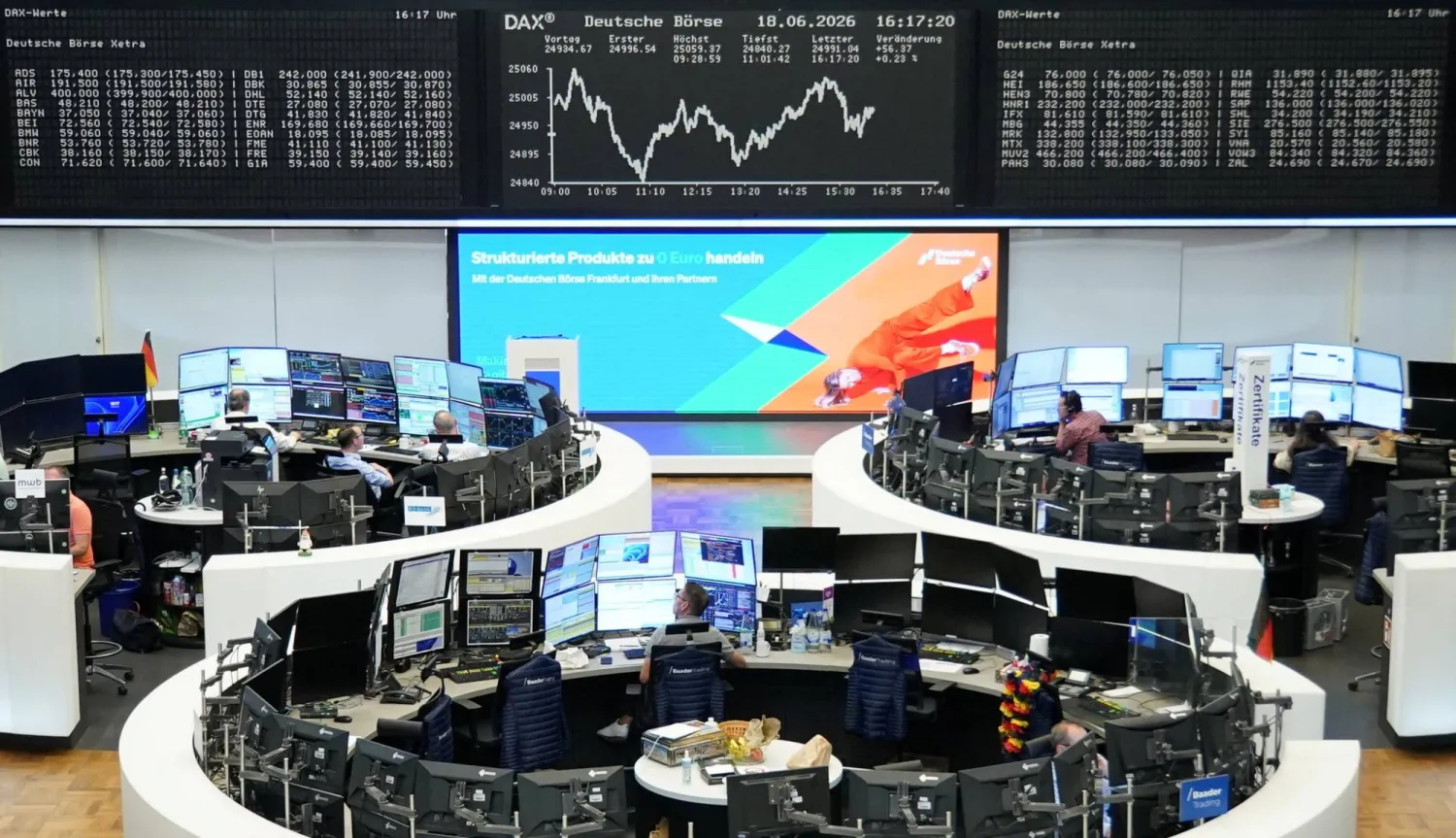
The German share price index DAX graph is pictured at the stock exchange in Frankfurt, Germany, June 18, 2026.  REUTERS/staff
The German share price index DAX graph is pictured at the stock exchange in Frankfurt, Germany, June 18, 2026. REUTERS/staff
TT

Stocks Rally Falters, Oil Rises as US-Iran Talks Postponed

The German share price index DAX graph is pictured at the stock exchange in Frankfurt, Germany, June 18, 2026.  REUTERS/staff
The German share price index DAX graph is pictured at the stock exchange in Frankfurt, Germany, June 18, 2026. REUTERS/staff

Stock markets were mixed on Friday and oil prices rose after Switzerland said planned talks following up on the US-Iran agreement had been postponed, dealing a blow to the week-long rally.

Equities have been on a tear since the two announced last weekend that they would end their three-month conflict and reopen the Strait of Hormuz, fueling global relief as economies have been hit by energy shortages and surging inflation.

The agreement has been signed separately by US President Donald Trump and his Iranian counterpart Masoud Pezeshkian, and approved by Iran's supreme leader.

That was meant to signal the beginning of 60 days of talks on wider issues, including Tehran's nuclear program.

But Swiss officials said they would not start on Friday as expected, hours after US Vice President JD Vance's departure for the country was cancelled, with a spokesperson saying the "logistics of these negotiations have never been simple or predictable".

The deal was also meant to halt the fighting in Lebanon, but Israel's military announced new strikes against Hezbollah targets in the nation's south. Lebanon has been a major sticking point in reaching a US-Iran deal.

"The planned talks between the US, Iran, Qatar and Pakistan have been postponed," the Swiss foreign ministry said in a message to AFP.

"Switzerland remains ready to facilitate these talks. The relevant preparatory work at Burgenstock is continuing," it said, without providing a new date for the talks.

Iran's Tasnim news agency had said "nothing has been confirmed" about the Tehran delegation's trip to Switzerland.

The news sparked a reverse in several equity markets that had been heading for a positive end, with profit-taking adding to the selling.

Seoul, which has hit multiple records this week and topped 9,000 points for the first time on Thursday, ended in the red after a strong start to the day led by tech firms.

There were also losses in Tokyo, Singapore, Sydney, Mumbai, Bangkok and Jakarta but Tokyo, Wellington and Manila edged up.

London dipped at the open but Paris and Frankfurt rose.

Oil prices, which have tanked around 10 percent this week, climbed with West Texas Intermediate up around 1.8 percent.

"With the deal signed, that geopolitical cloud is lifting, but markets have learned more than once that a resolution can unravel quickly," Josh Gilbert, at eToro, said.

"The hard work starts now, and investors will likely be cautious until we've got an air-tight deal and traffic genuinely flowing in full through the strait again."

American forces lifted on Thursday their naval blockade of Iranian ports that had prevented ships from sailing to or from the Iranian republic, the US military said, noting that its warships "will remain in the general area".

Activity was still muted in the Strait of Hormuz, the strategic bottleneck for energy shipments that Iran blockaded during the conflict.

Observers have pointed out that while the waterway -- through which about a fifth of crude passes -- has reopened, it could take some time before supplies are back up to pre-war levels.

The US-Iran agreement had allowed investors to look past Tuesday's Federal Reserve meeting, which ended with officials indicating they could hike interest rates before the end of the year owing to elevated inflation caused by the war.

Still, Forex.com's Fawad Razaqzada said traders would turn their focus back to the economic outlook.

"What is almost certain to happen now is that markets will become increasingly data-dependent once again. For now, equity bulls maintain some control," he wrote in a commentary.

"However, with valuations still elevated and a lack of obvious near-term catalysts, the prospect of profit-taking or a modest correction has become more plausible following the Fed's hawkish pivot."

The yen strengthened but remained above 161 per dollar -- and near its weakest level since 1986 -- after this week's jump fueled by Fed rate hike expectations.

The yen's gains were also helped by comments from Japan's Finance Minister Satsuki Katayama, who warned of "bold action against excessive speculative moves in the foreign-exchange market".

The government spent around 11.7 trillion yen ($72 billion) last month propping up the currency by intervening in financial markets.

The currency was still in trouble despite the Bank of Japan's decision to hike interest rates on Tuesday to their highest since 1995.



SABIC, Rongsheng Petrochemical Sign PDA for Potential Strategic Investment in Advanced Materials Project in China

The SABIC headquarters in Al-Jubail (SABIC website)
TT

SABIC, Rongsheng Petrochemical Sign PDA for Potential Strategic Investment in Advanced Materials Project in China

The SABIC headquarters in Al-Jubail (SABIC website)

The Saudi Basic Industries Corporation (SABIC) signed on Thursday a Project Development Agreement (PDA) with Rongsheng Petrochemical Co. Ltd. and its wholly owned subsidiary Rongsheng New Materials (Zhoushan) Co. Ltd. to jointly advance the development of the Jintang New Materials Project in Zhoushan, China.

“Under the PDA, SABIC and Rongsheng Petrochemical are evaluating a potential equity investment by SABIC up to 50% of Rongsheng New Materials, positioning the project as a strategic collaboration between two leading global petrochemical companies,” the Saudi company said in a statement said.

The agreement also establishes a framework for project development activities towards a potential final investment decision (FID), the statement added.

SABIC CEO and Executive Board Member Dr. Faisal M. Alfaqeer said that the partnership with Rongsheng Petrochemical reflects SABIC’s vision for global footprint expansion.

“SABIC continues to prioritize innovation, portfolio advancement and sustainable value creation, strengthening its ability to serve customers worldwide,” he added.

CEO of Rongsheng Petrochemical and Executive Director of the Board Mr. Xiang Jiongjiong said: “The collaboration represents a landmark partnership and a model of win-win cooperation between Rongsheng Petrochemical and SABIC.”

He described the partnership as “a flagship outcome of two industry leaders complementing their strengths and robust capabilities to jointly research, develop and operate in advanced chemical materials.”

He said the alliance “also serves as a critical stabilizing anchor for the chemical sector, enabling us to deliver more valuable and comprehensive product solutions to our customers.”

The Jintang New Materials Project is designed to enhance production capabilities for advanced chemical materials and support growing demand from key downstream industries in China and Asia.

The project is expected to leverage world-class technologies, integrated manufacturing capabilities and operational excellence to strengthen competitiveness, foster innovation and create long-term value for all stakeholders.


Saudi Ports Authority Signs Seven Agreements Worth Over $266 Million to Develop Logistics Centers

A container terminal at one of Saudi Arabia's ports. (SPA)
TT

Saudi Ports Authority Signs Seven Agreements Worth Over $266 Million to Develop Logistics Centers

A container terminal at one of Saudi Arabia's ports. (SPA)

The Saudi Ports Authority (Mawani) has signed seven agreements to establish logistics centers in Jeddah, western Saudi Arabia, with a total value exceeding SAR 1 billion ($266 million).

The signing ceremony was attended by Minister of Transport and Logistic Services Saleh Al-Jasser and Mawani President Suliman Al-Mazroua.

Al-Mazroua said the new agreements provide for the development of logistics centers under concession terms of up to 25 years, supporting efforts to position Jeddah as a global logistics hub. He noted that two agreements were signed with international companies, while five were awarded to Saudi firms with global ambitions. Valued at more than SAR 1 billion, the projects are also expected to create additional jobs.

He said that in February, at the onset of the Strait of Hormuz crisis, the Minister issued urgent directives to prepare the Kingdom's western coast to receive supply chains serving Saudi Arabia and the Gulf region. As a result, all entities involved in the logistics ecosystem worked toward that objective.

Al-Mazroua said Mawani focused on several key areas. The first was strengthening maritime connectivity by increasing shipping services to compensate for the shortfall affecting the Kingdom's eastern region.

During the crisis, more than 27 additional shipping services were introduced on the western coast, increasing capacity by more than 200,000 TEUs (twenty-foot equivalent units) per month to offset the shortfall.

He added that the second area focused on preparing ports to handle higher volumes by streamlining procedures with the Saudi Customs Authority and terminal operators, while expanding equipment capacity. Investments in these measures exceeded SAR 640 million over a three-month period.


Oil Eases as Traders Weigh US-Iran Conflict Risks

A horse grazes near an oil drilling rig in Kazakhstan (Reuters)
TT

Oil Eases as Traders Weigh US-Iran Conflict Risks

A horse grazes near an oil drilling rig in Kazakhstan (Reuters)

Oil prices eased on Thursday as traders weighed escalating tensions between the United States and Iran and the risks to oil supplies moving through the Strait of Hormuz.

Brent crude futures were down 27 cents, or 0.32%, to $84.68 a barrel at 1011 GMT, while US West Texas Intermediate futures were down 11 cents, or 0.14%, to $79.49 a barrel. Both contracts remain close to one-month highs.

"The market is still reacting with a surprising degree of calmness," said Ole Hvalbye, market analyst at SEB Research, Reuters reported.

"It seems reasonable that prices could continue to climb towards $90-$95 and maybe even touch the $100 mark again and that is because the Strait of Hormuz is repeatedly being disrupted, creating uncertainty over oil flows from the Gulf."

The US struck Iran's coastal defences and missile sites on Wednesday after reimposing a naval blockade of its ports, while Tehran threatened to shut off more regional energy exports, saying it was engaged in an "existential war" with America.

The escalation comes after a fragile truce reached in June collapsed, reviving fears of a return to full-scale conflict and disrupting energy flows through the Strait of Hormuz, which handled about a fifth of daily global oil and LNG trade before the war began.

Fewer vessels passed through the strait on Wednesday, the first day after the US reimposed its naval blockade on Iran. Seven crossed on Wednesday, down from 13 the previous day.

"Markets could remain cautious as they assess immediate supply risks. So far, despite heightened military tensions, oil tankers continue to sail through the Strait of Hormuz, although in more limited numbers," said Wael Makarem, financial markets strategist lead at Exness.

Iran said on Thursday the strait was an inviolable "red line", warning that if US President Donald Trump carried out his threat to attack Iran's infrastructure, it would strike all infrastructure across the Gulf region.

Analysts say Iran has signalled it may use its Houthi allies in Yemen to shut the Bab el-Mandeb gateway to the Red Sea, opening a new front against Washington and putting a second of the world's most vital energy arteries at risk.

Oxford Economics said the likeliest scenario was that low, fluctuating levels of traffic through the strait spark intermittent oil price rallies that keep average prices above $80 per barrel for several quarters.

Elsewhere, Ukraine's Security Service said on Thursday that together with Ukraine's navy it has struck two Russian "shadow fleet" tankers with naval drones in the Black Sea.