

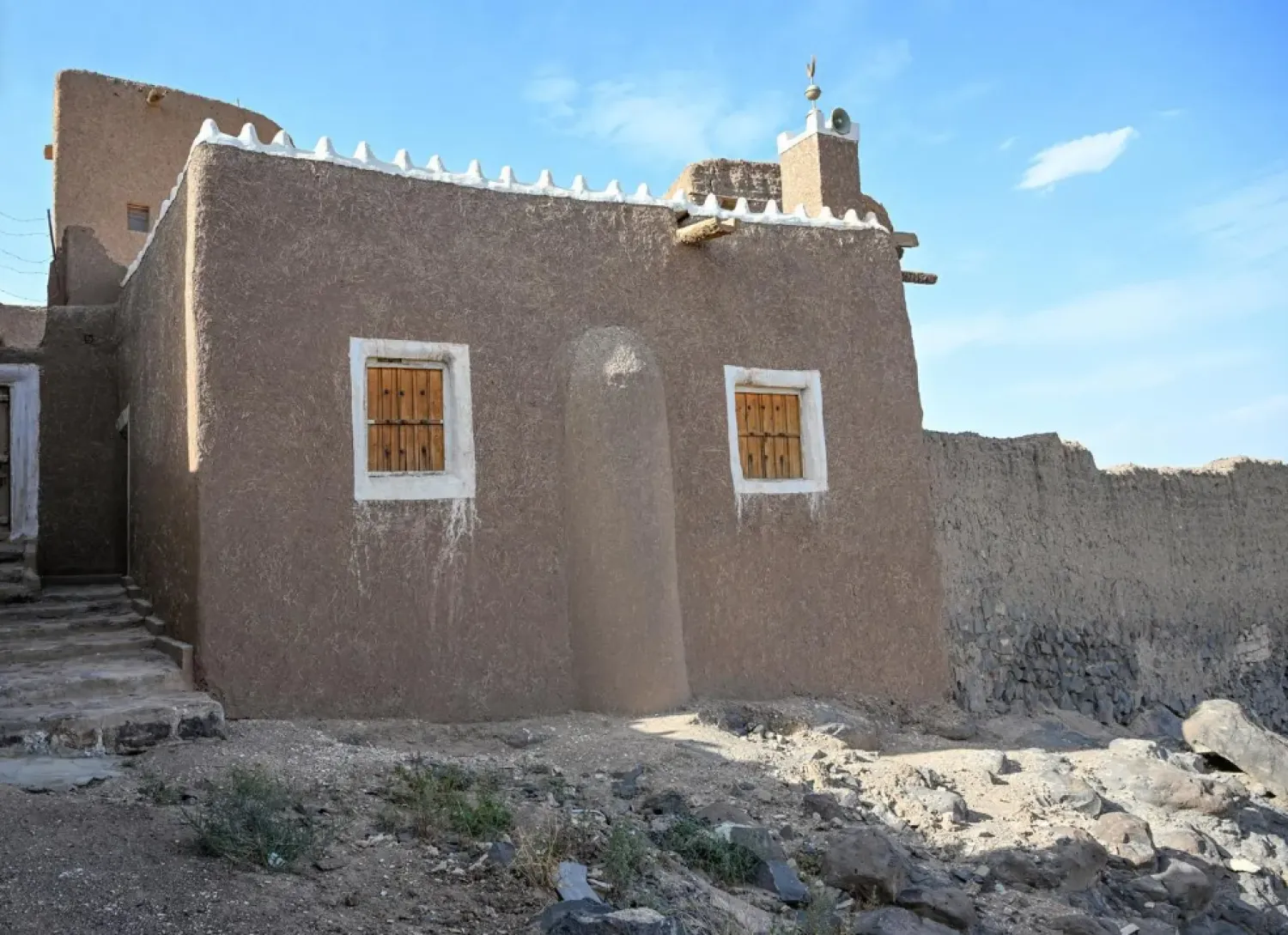

Why is Fadak Known as the 'City of Walls and Fortresses'?

Located 250 kilometers southwest of Hail, this historic village boasts a legacy as rich as its soil - SPA
TT

Why is Fadak Known as the 'City of Walls and Fortresses'?

Located 250 kilometers southwest of Hail, this historic village boasts a legacy as rich as its soil - SPA

Encircled by a massive, seven-kilometer wall of rugged black lava stone, the ancient village of Fadak, known today as Al-Hait, earned its title as the "City of Walls and Fortresses." Guarded by north and south gates, the village is flanked by ancient castles and robust fortifications that still dominate the landscape, SPA reported.

Located 250 kilometers southwest of Hail, this historic village boasts a legacy as rich as its soil. While known in antiquity as Fadak, its modern name, "Hait Al-Nakhl" (The Palm Wall), captures its lush topography—defined by sprawling palm groves, fertile land, and abundant water.

According to the Encyclopedia of the Kingdom of Saudi Arabia, published by the King Abdulaziz Public Library, Al-Hait is one of the oldest urban centers in Hail Region.

According to SPA, the name Fadak echoes through antiquity, recorded among the cities conquered by Babylonian King Nabonidus in the sixth century BC, and frequently cited in classical chronicles and early geographical dictionaries.

Bridging the pre-Islamic and Islamic eras, the site remains an archaeological treasure. From early rock inscriptions and crumbling fortresses to ancient stone wells and traditional farms, these enduring artifacts stand as a living testament to Fadak’s rich cultural heritage and continuous human settlement.



Dragon Boat Festival Links Modern China to Traditions More Than 2,000 Years Old

Competitors take part in the Aberdeen Dragon Boat Race to celebrate the Dragon Boat Festival in Hong Kong, Friday, June 19, 2026. (AP Photo/Chan Long Hei)
TT

Dragon Boat Festival Links Modern China to Traditions More Than 2,000 Years Old

Competitors take part in the Aberdeen Dragon Boat Race to celebrate the Dragon Boat Festival in Hong Kong, Friday, June 19, 2026. (AP Photo/Chan Long Hei)

The Dragon Boat Festival was celebrated Friday across mainland China, Hong Kong and Taiwan with colorful boat races, lion dances and other festivities.

The more than 2,000-year-old holiday is best known for its sporting events, but its origins are rooted in Chinese history and ancient beliefs about health, protection and harmony with nature.

“The Dragon Boat Festival is probably the richest and most diverse of all traditional Chinese festivals,” said Tsinghua University’s history professor Liu Xiaofeng. “Across different regions, people developed a wide variety of traditions based on ideas connected to the summer solstice and the balance of yin and yang.”

The festival is widely associated with the ancient poet Qu Yuan, who according to legend drowned himself more than 2,000 years ago. The tradition of dragon boat races was born from the story that people raced out in boats to search for the poet and threw rice into the river so fish would not eat his body.

A three-day race in Beijing features men’s, women’s and mixed dragon boat races over distances of 100, 200 and 500 meters. Teams from Beijing, Tianjin, Hebei, Shanxi and Guangdong will compete throughout the holiday weekend.

Guided by the thunderous beat of their drummers, crews pulled their paddles through the water in unison, each boat surging toward the finish line as spectators cheered them on.

Others watched the races at home as they enjoyed a traditional sticky rice treat known as “zongzi” with their families.

Beijing’s 2026 celebrations will continue through June 21 at the capital’s Grand Canal.

“The competition helped strengthen our team spirit,” said Li Maoshan, a participant in Friday’s races. “It also gave us an opportunity to demonstrate the spirit of perseverance and hard work.”

Participants in Hong Kong’s dragon boat races on Friday wore costumes including a cartoon version of Chinese Taoist deity Ne Zha.


French Curator Unearths Rare Mozart Manuscript

This photograph taken on June 15, 2026, shows an original fragment of Wolfgang Amadeus Mozart's music handwritten notebook at Richelieu Library (Bibliotheque Nationale de France-National Library of France-BnF) in Paris. (Photo by Kenzo TRIBOUILLARD / AFP)
TT

French Curator Unearths Rare Mozart Manuscript

This photograph taken on June 15, 2026, shows an original fragment of Wolfgang Amadeus Mozart's music handwritten notebook at Richelieu Library (Bibliotheque Nationale de France-National Library of France-BnF) in Paris. (Photo by Kenzo TRIBOUILLARD / AFP)

Musicians this weekend will for the first time publicly interpret music for flute and harp that Wolfgang Amadeus Mozart wrote as a 22-year-old while teaching an aristocratic French student.

The unprecedented concert on Sunday at France's National Library (BnF) comes after what it has called a "major discovery.”

Francois-Pierre Goy, a curator in the library's music department, stumbled across the treasure as he examined a pile of anonymous manuscripts he wanted to get through before retirement.

"I never imagined what I was about to find," he told AFP.

The 44-page notebook includes a dozen daily exercises the Austrian prodigy gave Marie-Louise-Philippine de Bonnieres de Guines from May to July 1778, as well as seven pieces for flute and harp, he said.

She was an excellent harpist and the daughter of the Duke of Guines, himself a renowned flutist.

"It just so happened that I had been looking at some of Mozart's teaching material a few weeks earlier," Goy said.

Soon he noticed similarities -- including "the treble clefs that are quite rounded and tilted slightly forward,” and the bass clefs drawn in the opposite direction from how they usually are in France, he added.

"Could it be him?" Goy said he thought to himself.

Comparisons with Mozart's other handwritten works, the French paper used, and stamps on the notebook identical to those on a French copy of Mozart's "Concerto for Flute and Harp" that the Duke of Guines had commissioned all seemed to indicate he was right.

Armin Brinzing, director of the Austria-based Mozarteum Foundation, authenticated the document in April.

The manuscript "is part of two bundles of music that were confiscated from the home of the Duke of Guines in 1794" during the French Revolution, and eventually ended up at the BnF, according to the library.

Mozart died in 1791 aged 35.

Discoveries like this "for such a famous composer are almost unheard of,” said Mathias Auclair, director of the BnF's music department.

Several Mozart compositions have been rediscovered in recent years.

In one case, in 2012, someone found a Mozart piano piece composed when he was 11 in an Austrian attic.

For harpists and flautists, who have "very little repertoire" available to them, the discovery at the BnF is a wonderful surprise, he said.

BnF president Gilles Pecout said the new music sheets shed light on Mozart as a young teacher and documented his last stay in Paris in 1778 -- on which there is scant information.


Archaeology Team Unearths 'Prototype' of World-famous Stonehenge Monument Just a Few Miles Away

This photo provided by Wessex Archaeology shows archaeologist Phil Harding standing at Stonehenge in May 2026, near Salisbury, England. (Wessex Archaeology via AP)
TT

Archaeology Team Unearths 'Prototype' of World-famous Stonehenge Monument Just a Few Miles Away

This photo provided by Wessex Archaeology shows archaeologist Phil Harding standing at Stonehenge in May 2026, near Salisbury, England. (Wessex Archaeology via AP)

Archaeologists revealed Thursday that they have discovered a structure near the prehistoric stone circle of Stonehenge in southern England that may have served as a “prototype” for the 5,000-year-old Neolithic monument.

A team from the British firm Wessex Archaeology said the structure would have consisted of two wooden poles 120 meters (394 feet) apart and aligned to point directly at the rising sun during the summer solstice and the setting sun at the winter solstice.

Researchers said the discovery predated Stonehenge by around 500 years, The Associated Press reported.

The team was led by archaeologist Phil Harding, who is well known in the UK through his many years of excavations for Channel 4 TV series “Time Team.”

Harding, 76, said the site, which also turned up a treasure trove of finds including pottery, animal bones and a rare disc-shaped knife, was likely to have been a focus for major religious gatherings.

“Opportunities like this probably only come once in a career, in a lifetime,” Harding said. “I’m probably towards the end of my career now, but thank God I’m still in archaeology long enough to be part of this discovery, because it’s certainly the highlight of my career.”

The findings were released ahead of the summer solstice, which falls this year on Sunday, when thousands head to Stonehenge each year to celebrate the longest day of the year in the Northern Hemisphere.

Stonehenge is a symbol of British culture and history and remains one of the country’s biggest tourist draws. The World Heritage Site was built on the flat lands of Salisbury Plain in stages starting 5,000 years ago, with the unique stone circle erected in the late Neolithic period about 2,500 B.C.

The site’s meaning has been the subject of vigorous debate. The most generally accepted interpretation is that it was a temple aligned with movements of the sun — lining up perfectly with the summer and winter solstices.

Researchers who found the structure near Stonehenge carried out the dig at Bulford, 5 kilometers (3.1 miles) from the main stone circle, as part of archaeological work to support the British defense ministry's program to accommodate troops who have been withdrawn in recent years from Germany, where the army had a big footprint for decades. The area around Stonehenge is one of the largest military training grounds and in the UK and Bulford is home to a barracks.

The original excavation took place between 2015 and 2017, with the findings requiring many years of analyses and tests.

English Heritage said other theories about Stonehenge include that it was a coronation place for Danish kings, a druid temple, a cult center for healing, or an astronomical computer for predicting eclipses and solar events.

Whatever the explanation, thousands of people, many dressed as druids and pagans, will gather at the site on Sunday to see the sun rise.

“What few will realize is that 5,000 years ago on a nearby hillside overlooking modern day Bulford, people were doing the exact same thing — revering and celebrating the sunrise on Midsummer’s Day,” said Harding.
