


Sudan’s El-Obeid Under Drone Pressure, Fears El Fasher Fate

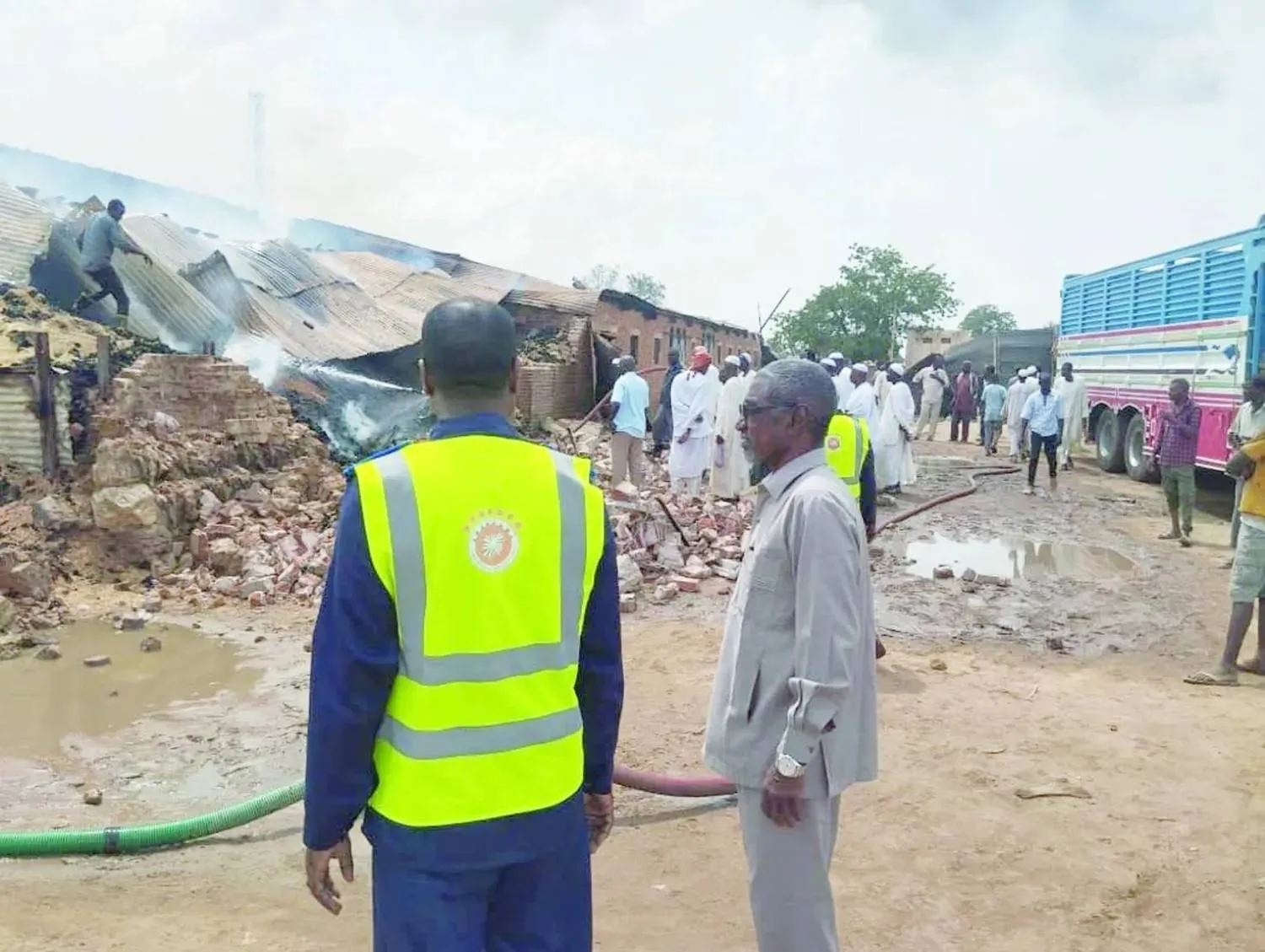
Damage caused by Rapid Support Forces drones in Sudan’s el-Obeid, North Kordofan state. (Photo circulated on social media)
TT

Sudan’s El-Obeid Under Drone Pressure, Fears El Fasher Fate

Damage caused by Rapid Support Forces drones in Sudan’s el-Obeid, North Kordofan state. (Photo circulated on social media)

Only hours after the United Nations and several Western countries urged the Rapid Support Forces to halt its assault on el-Obeid, the capital of North Kordofan state, it was plunged into darkness.

A drone strike hit the city’s main power station, marking the latest in a wave of attacks that have battered el-Obeid for days.

Local sources said a strategic drone belonging to the RSF struck the electricity substation late on Thursday, cutting power across the city. By Friday morning, strikes had resumed on other sites inside al-Obeid.

For residents of the city, known in Sudan as the “Bride of the Sands,” the blackout was not an isolated blow. It was another episode in a weeks-long buildup of pressure. In recent days, heavy drone attacks have killed more than 40 civilians and wounded dozens, according to local sources.

The strikes have also hit fuel stations, supply trucks and civilian and military sites, spreading fear through the city.

Local witnesses said drones still fly regularly over el-Obeid, turning anticipation into part of daily life.

Residents said they now track the movement and sound of drones more closely than they follow the news on television or smartphones.

Some have cut back their movements or stayed indoors, fearing sudden attacks after repeated strikes on civilian and service facilities in recent days.

Fears of an El Fasher scenario

Those fears have deepened because of what happened in El Fasher, the capital of North Darfur state, which fell to the RSF last year after months of siege and military attrition.

Since then, El Fasher has become the reference point in every discussion about the fate of el-Obeid, especially as attacks intensify and pressure on the city grows.

El-Obeid lies about 411 km from Khartoum and forms the main link between Darfur and central Sudan. It is also home to the headquarters of the 5th Infantry Division, known as the Haggana, a name derived from the use of camels in military operations.

The division is one of the Sudanese army’s most important units.

But el-Obeid’s importance is not only military. It is also economic, political and logistical. The city lies near the center of Sudan, at the meeting point of Darfur, Kordofan and the country’s central regions. For decades, that position has made it a major hub for trade, transport and the movement of goods.

El-Obeid is connected to roads, railway lines and vital supply routes linking western Sudan to the east, making it an important center for trade, supplies and transport.

It is also a major administrative and political center in Kordofan, with a historical symbolism that has made it one of the most influential cities in western Sudan.

That importance helps explain why el-Obeid has become a key target in the battles between the army and the RSF. For the army, the city is a major base for current or future military operations in Kordofan and Darfur. It is also the most important line of defense for central Sudan.

‘El-Obeid will not fall’

Former Sudanese army chief of staff General Hashem Abdel Muttalib told Asharq Al-Awsat that the RSF is using its attacks to disrupt the army and prevent it from advancing towards Darfur. But he ruled out the possibility that drones could achieve that goal.

“El-Obeid will not fall,” he said.

The army goes further in dismissing any direct threat to the city. Colonel al-Basha Hakim, commander of the armored corps in the 5th Infantry Division, the Haggana, told Asharq Al-Awsat that the Rapid Support Forces are far from the outskirts of al-Obeid and that talk of a siege is only a rumor.

He said military plans are moving as intended and that the attacking forces have suffered heavy losses. He added that the army, joint forces and supporting forces are working in full coordination, and that residents will soon hear “good news.”

But the reassurances have not erased the fears. Military expert Saleh Abdullah told Asharq Al-Awsat that what is happening in el-Obeid resembles tactics used by the RSF in El Fasher: sustained pressure, attrition, weakening services and opening routes for those who want to leave the city.

The targeting of infrastructure has sharpened those concerns. Fuel stations have repeatedly come under attack, and fuel trucks on roads leading to the city have also been hit. The result has been a severe transport crisis in recent days, directly affecting residents’ movement and public services.

Residents said fuel has become part of the battle around el-Obeid. Repeated attacks on supplies have disrupted transport and pushed up the cost of moving around the city.

Still, the picture inside al-Obeid is not entirely bleak. Journalist Zuhair Hashem, who lives in the city, told Asharq Al-Awsat that life continues normally in most neighborhoods.

He said the recent transport crisis was linked mainly to the targeting of five fuel stations in one day, which knocked some of them out of service, rather than to a wider collapse of services or daily life.

Political analyst Osman Mirghani told Asharq Al-Awsat that el-Obeid’s military position makes capturing it harder than many assume.

He said the presence of the 5th Infantry Division, with its equipment and forces, gives the city a strong defensive capacity. He ruled out its fall, or even the approach of such a threat, for now.

According to Mirghani, the Rapid Support Forces understand el-Obeid’s importance as the army’s strongest defensive line west of Omdurman. That is why, he said, they are using drones to put psychological pressure on residents and push some of them to flee, rather than trying at this stage to settle the battle militarily.

Even so, concern is no longer confined to the city. The latest developments have prompted the United Nations and several Western countries to warn against military escalation around el-Obeid and call for an end to the attack, in a sign of growing fears that the humanitarian situation could deteriorate if operations continue at the current pace.

Between the army’s reassurances, international warnings and the fears of residents living under the sound of drones and disrupted services, el-Obeid has become one of Sudan’s most sensitive cities at this stage of the war.

If El Fasher has become the example everyone invokes when speaking of siege and collapse, the question now confronting the “Bride of the Sands” is whether it can avoid the same fate, or whether the war is gradually pushing it towards that scenario, even if the tools and circumstances differ.




Iraq’s ‘Oil Network’ Arrests Reach Another Official

Iraqi security personnel patrol a street in Baghdad on June 28. (AFP)
TT

Iraq’s ‘Oil Network’ Arrests Reach Another Official

Iraqi security personnel patrol a street in Baghdad on June 28. (AFP)

An Iraqi security force on Thursday arrested Hussein Talib, director general of the state-run Oil Products Distribution Company, on suspicion of involvement in corruption cases, hours before he was scheduled to take the constitutional oath as a replacement member of parliament, a security source said.

Talib’s detention came as investigations into corruption linked to the oil sector widened. The Central Anti-Corruption Criminal Court announced Thursday that an additional 14 billion Iraqi dinars, or about $10.7 million, had been seized in the case of detained Oil Ministry Undersecretary Adnan al-Jumaili.

Talib, who heads the Oil Ministry-affiliated company, had been named to replace lawmaker Ammar Mousa as a Baghdad representative for the National State Forces Alliance. His arrest prevented him from taking the oath, the source said.

The National Wisdom Movement, led by Ammar al-Hakim and of which Talib is a member, said it supported measures taken by the government, judiciary and Integrity Commission to combat corruption.

Movement spokesman Hossam al-Hassani said it backed legal action aimed at protecting public funds, adding that an official’s compliance with investigative procedures demonstrated respect for constitutional and legal institutions.

He stressed that “the accused is innocent until proven guilty by a final court ruling,” adding that any legal responsibility, if established, was personal and should not extend to any political, social or institutional entity. He urged against prejudging or politically exploiting the case.

Iraqi security forces last week arrested politicians, lawmakers and senior government officials named in al-Jumaili’s confessions. Security and legal sources described the arrests as the beginning of a broader anti-corruption campaign ordered by Prime Minister Ali al-Zaidi.

Al-Zaidi, who took office in May, has pledged to root out corruption, one of Iraq’s most persistent challenges despite repeated accountability promises by successive governments.

An investigating judge said continued inquiries into the waste of public funds in projects led authorities to discover money hidden in a stormwater drainage pit. Investigations were continuing to identify all members of the network.

Parliament also voted Thursday to dismiss National Investment Commission Chairman Haider Makkiya and refer the relevant files to the Integrity Commission after he failed to attend a questioning session.

Al-Zaidi said his government would fight corruption “without exceptions or red lines,” pursue those involved and recover stolen funds.

Local media also reported that Foreign Minister Fuad Hussein discussed in Kuwait efforts to freeze and recover money allegedly deposited in Kuwaiti banks by corruption suspects, as well as cooperation to identify shell companies and return assets to Iraq.


Syrian Authorities Say Captured ISIS-linked Cell Behind Blasts

Syrian security personnel inspect a burned vehicle near the Four Seasons Hotel after two explosions rocked the area earlier in Damascus, Syria, Tuesday, July 7, 2026. (AP Photo/Omar Albam)
TT

Syrian Authorities Say Captured ISIS-linked Cell Behind Blasts

Syrian security personnel inspect a burned vehicle near the Four Seasons Hotel after two explosions rocked the area earlier in Damascus, Syria, Tuesday, July 7, 2026. (AP Photo/Omar Albam)

Syrian officials said late Thursday the country had captured an ISIS-linked cell responsible for two bomb blasts during French President Emmanuel Macron's visit to Damascus earlier this week.

In a joint press conference with his Syrian counterpart, Macron said we must "not let ourselves be destabilized" by such attacks, and the two leaders vowed to boost ties with new ambassadors to be installed in each country.

Syria's Interior Minister Anas Khattab said that "the cell responsible for the terrorist bombings that targeted Damascus two days ago is now in our custody".

"Once the investigations are completed, we will reveal to the public the identities of the cell's members, their roles, and all of their affiliations and connections," he wrote on X.

Ahmad Dalati, head of interior security for the Damascus region, said on Syrian state television that preliminary investigations indicated "the cell was affiliated with the ISIS group".

The interior ministry said in a statement that the cell had been captured following a series of raids "carried out at the same time against the suspects' different locations across Damascus and its countryside".

The statement said the raids occurred in four neighborhoods.

Two blasts hit central Damascus on Tuesday, killing one person and wounding dozens during the French president's first visit to Syria.

The explosives had been planted near the Four Seasons Hotel, where Macron had spent the night, with Syria's interior ministry saying one was placed in a garbage container and the other in a vehicle near the hotel in the heart of the capital.


Hamas Shifts Its Center of Gravity to Türkiye, Seeks Rapprochement with Syria

Turkish Foreign Minister Hakan Fidan meets a Hamas delegation led by Khalil al-Hayya in Istanbul. (Hamas)
TT

Hamas Shifts Its Center of Gravity to Türkiye, Seeks Rapprochement with Syria

Turkish Foreign Minister Hakan Fidan meets a Hamas delegation led by Khalil al-Hayya in Istanbul. (Hamas)

Hamas has shifted much of its organizational center of gravity toward Türkiye in recent months, according to meetings, activities and public positions by the group, after years in which it kept its operations there at a distance and reduced its presence.

The shift has coincided with statements of condemnation and solidarity after bombings in Syria, whose new government Hamas is seeking to approach.

The clearest sign of Hamas’s growing reliance on Ankara came in May, when the group chose Türkiye as the venue for internal elections to select the head of its political bureau. The vote ended without a decisive result.

Three Hamas sources abroad told Asharq Al-Awsat that the group had recently resumed holding its meetings in Türkiye, after using the Qatari capital Doha in recent years for meetings and internal elections.

In recent years, Turkish security agencies have announced the dismantling of “espionage networks working for Israel’s Mossad”. Turkish media reports, citing investigations, said some of the networks’ activities involved tracking Hamas members and activity in Türkiye, along with other missions.

Israel had repeatedly demanded that Türkiye deport senior Hamas figures, including prisoners freed in a 2011 exchange deal for Israeli soldier Gilad Shalit.

The most prominent among them was Saleh al-Arouri, deputy head of Hamas’s political bureau, who was in Türkiye from 2011 to 2015. He moved almost permanently to Beirut’s southern suburbs in 2017 and remained there until Israel assassinated him in January 2024.

The three sources said in separate accounts that the recent election for head of the political bureau, which ended without a decision, was held in Istanbul with leaders from the political bureau and the Shura Council present. They said the process would also resume there soon if the voting inside the Palestinian territories is completed after its recent renewal.

A dispute with Qatar?

The sources said the vast majority of Hamas leaders have recently been based in Türkiye and have stayed there for extended periods, including leaders whose families live in Qatar.

They said all meetings now being held, whether on ceasefire discussions, internal affairs or other files, are taking place in Türkiye.

Israel targeted a meeting of Hamas leaders in Doha last September. Hamas said its senior officials survived, but five of its members were killed, along with a member of Qatar’s security forces.

Asked by Asharq Al-Awsat whether the transfer of most meetings to Türkiye reflected security concerns or a dispute with Qatar, one senior source said: “This does not amount to a dispute with Qatar; rather, it came to ease the burden on Qatar in the face of US pressure, driven by Israel, demanding the expulsion of the movement’s leaders.”

A second source said: “The Hamas leadership still maintains a solid and strong relationship with Qatari officials, who continue to welcome the movement’s leadership.”

The third source said Türkiye was now a safer destination after the Israeli attack on Hamas leaders in Doha. “Israel, at least, cannot attack targets in Türkiye from the air, although it can carry out assassinations by other means. But its options are also limited,” the source said.

The source said the security situation in Qatar, amid continuing tension and strikes between Iran and the United States, could create a gap that Israel might exploit to carry out its plan to assassinate the group’s leaders, “as it did last time.”

Although Israel pledged to US President Donald Trump’s administration not to repeat the attack, the source said, “it cannot be trusted and may do it again.”

Moves toward Syria

The activity in Türkiye has notably coincided with two Hamas statements issued about a week apart, condemning two bombings in Damascus. The first took place near the Palace of Justice, while the second coincided with French President Emmanuel Macron’s visit to Syria.

Syria and Türkiye have had strong ties since the overthrow of ousted President Bashar al-Assad. Hamas’s condemnations came as Islamic Jihad, which is closely linked to Iran, remained silent.

In its statement condemning the first blast, Hamas said that “targeting innocent civilians and terrorizing peaceful people is a crime condemned by all standards, and serves only projects of chaos and the destabilization of security and stability.”

It offered condolences to “the families of the victims, and to the Syrian Arab Republic, its leadership, government and people.”

Hamas also declared its “full solidarity with sisterly Syria in confronting this crime” and said it was confident in “the ability of Syria, its leadership and people, to overcome this ordeal and preserve its security and stability.”

The second statement used almost the same language. Hamas said that “targeting Syria’s security and stability represents a blatant assault that serves suspicious agendas aimed at undermining the region’s security and stirring chaos in it.”

The senior Hamas source said “openness to the new Syrian government, or to other Arab, Islamic and international countries, is natural, since the movement is a national liberation movement seeking normal relations with everyone based on mutual respect, in line with the interests of each party, and in a way that guarantees everyone’s safety and non-interference in the affairs of others.”

Asked whether any further step was expected in the rapprochement, the source said: “So far, there is no plan for any official visit by a delegation from the movement, but such an option appears likely after the internal situation of the new government improves and it rearranges its domestic and foreign priorities.”

According to a source from one of the Palestinian factions that had been active in Syria before suspending its activities there, Hamas has what he described as “good relations with the Syrian government”.

The source said Hamas had mediated in cases involving Palestinians from several factions who were detained over their previous activities before being released and moving to other countries. Others, he said, were forced to leave voluntarily for several countries.

The Hamas sources declined to confirm or deny the information.