


US and Iran Set for New Talks after Delay over Lebanon Conflict and Deadly Strikes

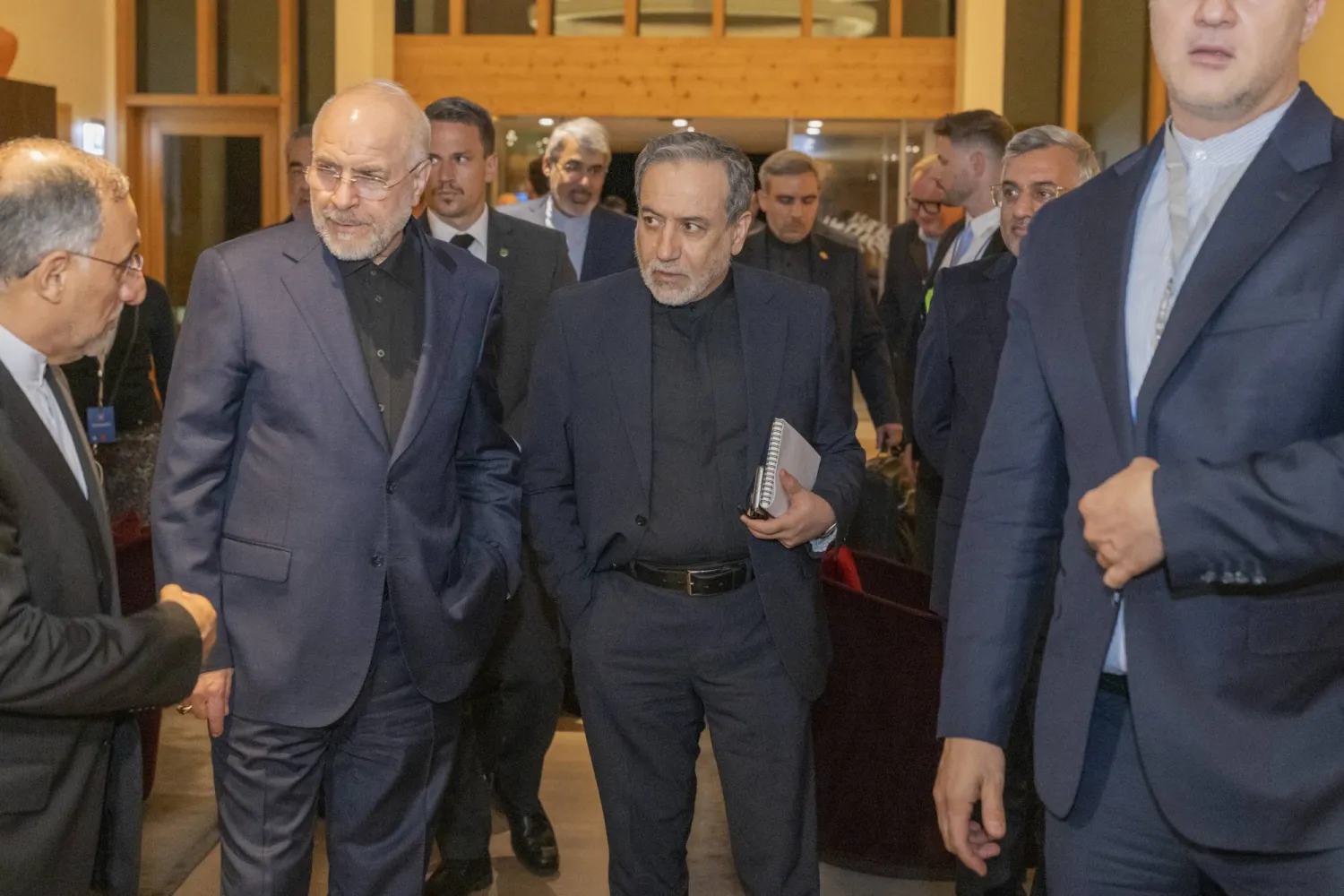
Iran's Speaker of the Iranian Parliament, Mohammed Bagher Ghalibaf (L), and the Minister of Foreign Affairs of Iran, Seyyed Abbas Araghchi (C), attend a meeting at the Bürgenstock resort in Obbürgen, near Lucerne, Switzerland, Sunday, 21 June 2026.  EPA/URS FLUEELER
Iran's Speaker of the Iranian Parliament, Mohammed Bagher Ghalibaf (L), and the Minister of Foreign Affairs of Iran, Seyyed Abbas Araghchi (C), attend a meeting at the Bürgenstock resort in Obbürgen, near Lucerne, Switzerland, Sunday, 21 June 2026. EPA/URS FLUEELER
TT

US and Iran Set for New Talks after Delay over Lebanon Conflict and Deadly Strikes

Iran's Speaker of the Iranian Parliament, Mohammed Bagher Ghalibaf (L), and the Minister of Foreign Affairs of Iran, Seyyed Abbas Araghchi (C), attend a meeting at the Bürgenstock resort in Obbürgen, near Lucerne, Switzerland, Sunday, 21 June 2026.  EPA/URS FLUEELER
Iran's Speaker of the Iranian Parliament, Mohammed Bagher Ghalibaf (L), and the Minister of Foreign Affairs of Iran, Seyyed Abbas Araghchi (C), attend a meeting at the Bürgenstock resort in Obbürgen, near Lucerne, Switzerland, Sunday, 21 June 2026. EPA/URS FLUEELER

A new round of negotiations over the Middle East war was set to kick off Sunday, with Iranian negotiators arriving in the Swiss host city hours ahead of US Vice President JD Vance, even as Tehran said it was closing the Strait of Hormuz again over Israeli attacks in Lebanon.

Before boarding his flight to Europe, Vance told reporters he hoped to "make progress on the nuclear issue, make progress on the Lebanon ceasefire issue. Those are the two big things that I think we're going to be focused on".

Follow-up talks had been planned in Switzerland on Friday but were postponed at the last minute after Israel launched deadly strikes in Lebanon following the deaths of four of its soldiers in combat.

Washington announced a renewed ceasefire there later Friday -- a condition of its preliminary agreement with Iran -- but Israeli troops clashed again with Hezbollah fighters on Saturday, with each side accusing the other of breaking the truce.

Citing a US "breach of contract" and "the Zionist regime's continuous and relentless violation of the ceasefire in southern Lebanon", Iran's central military command said "the Strait of Hormuz will be closed to vessel traffic".

Hormuz, a key conduit for oil and gas shipments, was blockaded by Iran for much of the war, sending shockwaves through global energy markets, said AFP.

Tehran had agreed to reopen it under the preliminary accord signed by US President Donald Trump and his Iranian counterpart Masoud Pezeshkian, and shipping traffic had begun to recover.

US Central Command said after Iran's announcement that safe passage through the international waterway had "remained intact" and that US forces were "present and vigilant".

Trump later warned that Washington could impose its own tolls on Hormuz if negotiators failed to complete the deal.

There would be no tolls "unless they are imposed by and for the United States of America", Trump wrote on Truth Social.

- Switzerland push -

An Iranian delegation arrived in Switzerland late Saturday, state media and the Swiss foreign ministry said.

Iran's official broadcaster said it included parliamentary speaker Mohammad Bagher Ghalibaf and Foreign Minister Abbas Araghchi.

Foreign ministry spokesman Esmaeil Baqaei said the delegation would "demand implementation of the other party's commitments" under the deal.

"Otherwise, the entire understanding will be in trouble," he said, according to official news agency IRNA.

Vance left Washington on an afternoon flight to join the talks, saying he could only stay "a day or two".

US negotiators Jared Kushner and Steve Witkoff were already there handling "some of the technical elements" and had reported that "things are going well", Vance said in an interview with Fox News earlier Saturday.

Pakistan, which has been helping to mediate, said Sunday that Prime Minister Shehbaz Sharif and army chief Asim Munir had left for Switzerland to take part in high-level talks involving US and Iranian representatives and other mediators from Qatar.

The talks are meant to open a two-month negotiation period on issues left unresolved by the initial accord, notably Iran's nuclear program.

- Lebanon truce frays -

Israel and Hezbollah continued trading accusations Saturday as fighting persisted in southern Lebanon.

The Israeli military said one soldier was killed in combat, the fifth such fatality since the US-Iran deal was reached.

An Israeli army official later said the military had received orders from the country's political leadership to cease fire, adding that troops were "not conducting proactive strikes" but operating defensively inside a security zone.

Earlier, an Israeli military official said fresh attacks were under way after Hezbollah "launched more than 50 projectiles at Israeli forces in southern Lebanon" overnight.

Hezbollah accused Israel of carrying out "under the cover of the ceasefire... an infiltration attempt towards the Ali Taher hills", a strategic feature overlooking Nabatieh, and said its fighters had responded "with appropriate weapons".

Lebanese state media reported Israeli air raids on around 20 locations, with authorities counting more than 30 dead. The overall death toll from the fighting in Lebanon had surpassed 4,000, the health ministry said.

Hezbollah lawmaker Hassan Fadlallah said his group retained "the full right to confront this enemy when it attacks us".

Israel's US ambassador Yechiel Leiter maintained it was Hezbollah that broke the truce, saying Israel was "defending itself against terrorist attacks".

But Hezbollah said Israel bore "full responsibility".

Fadi Zayat, who fled the southern Lebanon town of Tayr Debba, told AFP that "fear dominates" the south.

"We returned to the village a few days ago, but our bags are ready to flee again," the 53-year-old said.

Hezbollah pulled Lebanon into the wider Middle East conflict in early March when it fired rockets at Israel in retaliation for the killing of Iran's supreme leader in US-Israeli strikes.

A previous ceasefire meant to take effect in Lebanon in April was never honored, with each side justifying its attacks by citing alleged violations by the other.



2 Ships Ablaze in Romanian Black Sea Waters, 7 Sailors Missing

A screengrab from an aerial footage shows San Marino-flagged tanker ship that caught fire in Romanian territorial waters, released October 15, 2026. Romanian Interior Ministry/Handout via REUTERS
TT

2 Ships Ablaze in Romanian Black Sea Waters, 7 Sailors Missing

A screengrab from an aerial footage shows San Marino-flagged tanker ship that caught fire in Romanian territorial waters, released October 15, 2026. Romanian Interior Ministry/Handout via REUTERS

Rescuers were searching for seven missing crew on Thursday from one of two chemical tankers that caught fire overnight inside Romanian territorial waters in the Black Sea, after Russian drones strayed into Romanian airspace, Romanian officials said.

Romanian officials stopped short of explicitly linking the fires onboard the ships to the Russian drones. But the incidents follow drone strikes on at least five other cargo ships near the coasts of Romania and neighboring fellow NATO member Bulgaria over the past 10 days.

At least 23 sailors were lost from those strikes, which unlike the latest incidents took place ⁠just outside NATO's territorial ⁠waters.

The two ships hit overnight were both anchored in the Black Sea near the mouth of the canal leading into the Danube River, a major shipping route used by Ukraine as Russia has attacked Ukraine's own Black Sea ports.

Romania's naval authority said it received an emergency alert from the San Marino-flagged tanker. Seven of its 12 crew were missing and 5 were rescued, Reuters reported.

The interior ministry said it had sent two Black Hawk helicopters to the ⁠search and rescue mission, as well as two ships with medical staff on board.

"At the moment, the rescue cannot be done safely because of very big waves," it said in a statement.

Late on Wednesday, a Comoros-flagged chemical and oil tanker also caught fire. Romanian authorities initially said it was not clear whether it had been attacked. All its crew were safe.

Romania shares a 614-km (381-mile) border with Ukraine, much of it along the Danube. It has reported repeated breaches of its airspace by Russian drones over the past four years.

Both vessels caught fire near the mouth of the Danube River's Sulina Canal leading to the Black Sea, where ships often anchor waiting to pass because of ⁠delays from weather and ⁠congestion.

Increasing attacks on Black Sea shipping connected with the Russia-Ukraine war in recent months have threatened to cause a global food crisis, as both countries are major exporters of grain, as is Romania.

"We're looking at the Black Sea as a global food artery," Romanian Foreign Minister Oana Toiu told a security conference in Warsaw earlier this week.

"It is currently, unfortunately, the deadliest sea when it comes to the number of casualties of sailors in the last months. That means we need to increase our investments in deterrence, defense."

Bulgarian Prime Minister Rumen Radev said EU leaders would discuss on Thursday a proposed moratorium on attacks on civilian ships in the Black Sea.

Russia has been bombing Ukraine's Black Sea ports, forcing Kyiv to rely increasingly on Danube River ports and shipping routes close to the coasts of Bulgaria and Romania. For its part, Ukraine has targeted Russian ships near the mouth of the Don River in the Azov Sea.


Moscow Arrests Swede for 'Illegally' Crossing into Russia and Planning Attacks

People walk near the Kremlin, in Moscow, Russia, 25 September 2026. EPA/MAXIM SHIPENKOV
TT

Moscow Arrests Swede for 'Illegally' Crossing into Russia and Planning Attacks

People walk near the Kremlin, in Moscow, Russia, 25 September 2026. EPA/MAXIM SHIPENKOV

Russia's security services arrested a Swedish man they said fought for Ukraine for "illegally" crossing into Russia and allegedly planning attacks on military infrastructure, Russian media reported Thursday.
Russia's FSB security service, quoted by state news agencies, said an unnamed Swede was arrested in the northwestern Pskov region near the Lithuanian border, adding that "under the pretext of joining the Russian armed forces, he travelled to Russia to carry out acts of sabotage and terrorism on military facilities".


Washington Divided Over Renewed Strikes on Iran

US Secretary of War and CENTCOM commanders favor resuming the war against Iran, according to Axios. (CENTCOM)
TT

Washington Divided Over Renewed Strikes on Iran

US Secretary of War and CENTCOM commanders favor resuming the war against Iran, according to Axios. (CENTCOM)

Divisions have emerged within the Trump administration over whether to resume major military operations against Iran, with Defense Secretary Pete Hegseth and US Central Command (CENTCOM) leadership favoring fresh strikes while most presidential advisers advocate continued economic pressure, Axios reported.

The disagreement comes after President Donald Trump and Israeli Prime Minister Benjamin Netanyahu discussed a possible joint operation against Iranian military and nuclear facilities last week, according to US and Israeli officials and another informed source.

On Wednesday, Netanyahu warned that Iran’s proxies were seeking to launch missiles and carry out attacks.

Speaking to Israeli Army Radio, he said he opposed a preemptive strike on Tehran ahead of the elections, arguing that the timing was inappropriate. He nevertheless vowed to eliminate Hamas and Hezbollah and bring down Iran within two years.

Military Option Remains Open

The discussions suggest military escalation remains possible despite Trump’s insistence that he will not attack Iran before the US midterm elections, scheduled a week after Israel’s October 27 vote.

A US official said Netanyahu appeared eager to resume hostilities, but Trump had offered no firm commitment.

“Go ahead and prepare,” Trump reportedly told Netanyahu, a remark the official said could signal imminent action, a later operation or no attack at all.

A White House official denied that the leaders had discussed resuming the war, reiterating Trump’s position on the midterms.

Netanyahu’s office confirmed regular contacts with Washington but declined to discuss their substance.

According to the sources, Trump initially appeared inclined toward renewed strikes before becoming more hesitant.

Hegseth and CENTCOM leaders remain the strongest advocates of military action, while most advisers argue that sanctions and other economic measures are increasingly effective.

The debate pits military action aimed at disrupting Iran’s capabilities against sustained pressure intended to extract concessions without another round of fighting.

US and Israeli forces remain on alert, although preparations do not indicate that a final decision has been made.

Nuclear Concerns

Israel says intelligence indicates Iran is rebuilding parts of its nuclear program, concerns Netanyahu raised with Trump.

Israeli officials are particularly worried that Tehran could use the Pickaxe Mountain facility for uranium enrichment.

Senior Trump administration officials met for hours at Camp David on October 2 to discuss possible renewed strikes, including operations against Iranian military installations.

Whether the intelligence concerns will prompt military action or strengthen Washington’s negotiating position remains unclear.

The electoral calendar further complicates the calculations. A renewed offensive could provoke hundreds of Iranian ballistic missile launches toward Israel, potentially widening the conflict and disrupting its elections.

Diplomacy Continues

Meanwhile, Qatari mediators are awaiting Tehran’s response to Washington’s latest counterproposal to end the war, which demands nuclear concessions.

A US official said negotiations had not collapsed but were making little progress.

The official said Tehran had expected Trump to retreat under wartime pressure and with the midterms approaching, but the president had demonstrated that those calculations were mistaken.

On Tuesday, Trump again called Iran a “failed state” and said Washington would make a decision concerning Tehran “very soon.”