
Two Suspects in Custody After Shooting at High School in Philippines Kills 3

Philippines National Flag is pictured as the rainbow displays over it a day before the annual procession to celebrate Black Nazarene feast day at Quirino Grandstand in Manila, Philippines, January 8, 2020. (Reuters)
TT

Two Suspects in Custody After Shooting at High School in Philippines Kills 3

Philippines National Flag is pictured as the rainbow displays over it a day before the annual procession to celebrate Black Nazarene feast day at Quirino Grandstand in Manila, Philippines, January 8, 2020. (Reuters)

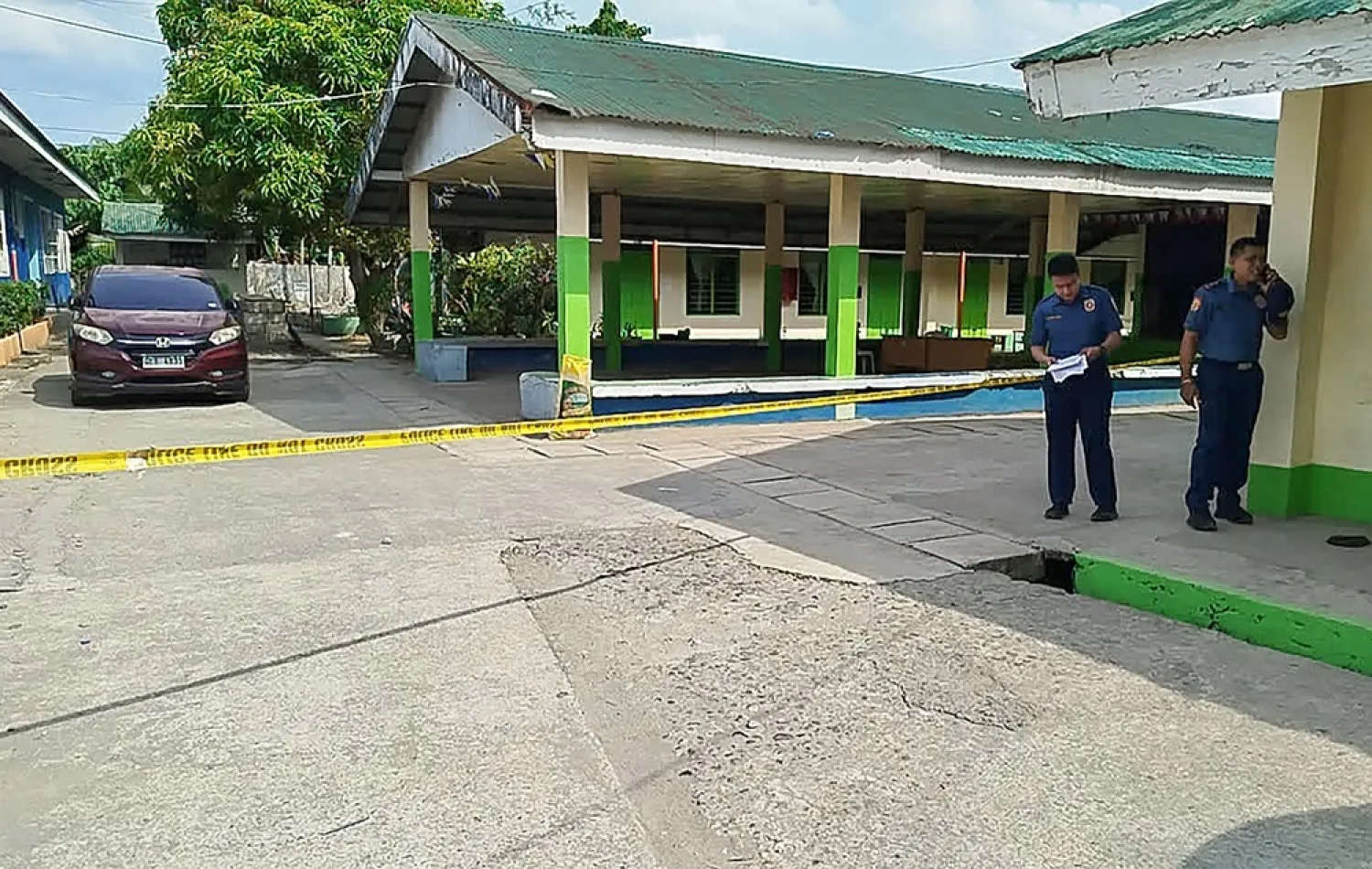
Two young students opened fire in a high school in the central Philippines on Monday, killing three fellow students and wounding another seven, police said. 

The suspects, aged 14 and 15, were armed with one pistol each. They were arrested. The suspects and the victims were students of the San Jose National High School in Tacloban city, where the mid-morning shooting happened, regional police chief Brig. Gen. Jason Capoy said. 

An investigation was underway to determine the cause of the shooting in the government-run school, which has more than 1,500 students. Capoy said that the suspects, who were close friends, said in initial questioning that they were bullied in school. He did not elaborate. 

They have no criminal records and it's not immediately clear where they got the pistols used in the attack. They managed to bring the guns into the campus because there was only one guard on duty at multiple entrances and exits, Capoy said. 

“The suspects barged into two rooms because after the shooting in the first, the children scampered and the suspects apparently ran after some victims into another room,” Capoy told reporters. 

Most of the dead and wounded were female students, he said. 

One of the suspects was arrested in the school after the attack, but the second fled and hid in a house nearby. He was found by police who were alerted by residents, police said. 

President Ferdinand Marcos Jr. ordered a thorough investigation of the shooting and asked law enforcers to boost security in all schools, workplaces and public areas, Communications Undersecretary Claire Castro said. 

“The president was saddened by this incident. Anybody, especially the parents of the victims, will feel sad and terrified,” Castro said. 

The national police have urged the public to remain calm and cooperate with authorities by providing any information that may aid the ongoing investigation. 

Crimes involving the use of firearms are prevalent in the Philippines, partly due to the proliferation of unlicensed firearms, but school shootings are relatively rare. 


Moscow Shoots Down Nearly 60 Drones; Russian Attacks Kill Five in Ukraine

Thick plumes of smoke with flames rise from an oil refinery following a Ukrainian drone attack in the course of Russia-Ukraine conflict, in Moscow, Russia, June 18, 2026, in this picture obtained from social media. (Social media/via Reuters)
TT

Moscow Shoots Down Nearly 60 Drones; Russian Attacks Kill Five in Ukraine

Thick plumes of smoke with flames rise from an oil refinery following a Ukrainian drone attack in the course of Russia-Ukraine conflict, in Moscow, Russia, June 18, 2026, in this picture obtained from social media. (Social media/via Reuters)

Moscow shot down dozens of drones in the early hours of Monday and briefly suspended flights at airports, authorities in the Russian capital said, just days after Ukraine hit the city's oil refinery again.

Ukrainian authorities said Russian drones had hit civilian merchant vessels, killing an Egyptian crew member, while drone attacks elsewhere killed at least five people, including three members of the same family in Ukraine's northern Sumy region.

Nearly 60 drones headed for Moscow were downed, Mayor ‌Sergei Sobyanin said on ‌Telegram.

He said emergency services had been dispatched to the areas where ‌drones ⁠were downed but ⁠gave no further information.

The airports of Sheremetyevo, Domodedovo and Vnukovo, as well as Zhukovskiy near the Russian capital, had suspended flights, though they were later resumed, the aviation watchdog said separately. In total, Russian defense systems downed 301 drones overnight, local newswires said, citing the defense ministry. That tally included Russian-occupied areas of Ukraine.

The latest attacks come after drones again hit Moscow's sole oil refinery last week, in one of the biggest air attacks on the city since Russia's full-scale invasion of Ukraine in 2022.

The drone attack early ⁠on Monday in Ukraine's Sumy region killed a 13-year-old boy, his 36-year-old ‌father and 73-year-old grandmother, while the boy's mother and two ‌siblings were injured, regional prosecutors said.

In the southeastern Ukrainian city of Zaporizhzhia, a woman was killed and three other ‌people injured after a drone attack, Ivan Fedorov, the local governor, said on Telegram on ‌Monday.

Russia also hit the southern Odesa region with an Iskander ballistic missile on Sunday evening, killing one and injuring three people, regional governor Oleh Kiper said on Telegram.

Vehicles and fuel storage tanks caught fire after the strike hit an agricultural facility, he said.

Elsewhere, the city of Sevastopol in Russia-annexed Crimea cancelled all open-air public events ‌on Monday and will keep street lights switched off, its governor Mikhail Razvozhayev said, as he called on people to curb electricity usage.

Crimea, ⁠a popular tourist destination ⁠for Russians, has suspended fuel sales to the public and businesses, with supplies restricted to government agencies responsible for essential services and security, as Ukraine's drone attacks on its supply routes and energy facilities elsewhere led to a fuel crisis.

THREE VESSELS UNDER RUSSIAN DRONE ATTACK

Russian drones hit a Turkish dry cargo vessel, the Victress, which was sailing under the Panamanian flag, Ukraine's navy said.

Deputy Prime Minister Oleksiy Kuleba said a 58-year-old Egyptian cook was killed and eight other crew members, including Turkish and Indian nationals, had to evacuate on a lifeboat.

The vessel sustained significant damage, Kuleba said on Telegram.

The operator of the Victress, Türkiye’s Rana Denizcilik according to LSEG data, could not immediately be reached for comment.

Kuleba said vessels operating under the flags of Palau and Belize also came under attack overnight, but nobody was hurt and the vessels resumed their journey.

Russia has repeatedly targeted Ukraine's maritime export routes, striking vessels and ports vital to foreign trade and the wartime economy.


China Sanctions 10 US Defense, Rare Earth Firms Over Pentagon Blacklist

Lockheed Martin showcases advanced capabilities at World Defense Show in Riyadh. (Asharq Al-Awsat) 
TT

China Sanctions 10 US Defense, Rare Earth Firms Over Pentagon Blacklist

Lockheed Martin showcases advanced capabilities at World Defense Show in Riyadh. (Asharq Al-Awsat) 

China imposed export controls on 10 US companies involved in defense and rare earths mining in response to Washington's blacklist of Chinese firms, Beijing said on Monday.

Also, exporters are prohibited from providing dual-use items to the listed entities, China's commerce ministry said, adding that “any relevant export activities currently underway must cease immediately.”

The move comes a month after US President Donald Trump visited Beijing, seeking to stabilize fraught relations during talks with Chinese counterpart Xi Jinping.

Although the countries agreed to work towards reducing tariffs, ties have since been tested as both sides stunt the other in tech and defense.

Washington released a new blacklist this month of 80 companies and their subsidiaries it said were aiding the Chinese military.

China's new export controls come “in response to the US government's egregious act of adding to its so-called 'Chinese military enterprise list,’” the commerce ministry said in a statement, adding the move was also to “safeguard national security.”

The 10 entities include Aveox, which holds aerospace defense contracts with the US military, and Oshkosh Defense, which produces military vehicle fleets.

It also lists US rare earths producers MP Materials and USA Rare Earth.

China's finance ministry simultaneously announced a ban on agencies involved in public procurement from buying products made by 46 US firms, including Lockheed Martin, Raytheon and Boeing's defense division.

Companies with US investments operating in China are excluded, according to a statement from the finance ministry, which said measures would take effect from Monday.

The list of companies and their subsidiaries that Washington blacklisted this month include Chinese e-commerce giant Alibaba, internet search provider Baidu, and automakers BYD and NIO.


US-Iran Negotiations End, Technical Talks Will Continue after Trump Shakes Talks with Threats

US Vice President JD Vance (L), Pakistan's Prime Minister Shehbaz Sharif and Qatar's Prime Minister Sheikh Mohammed bin Abdulrahman bin Jassim al-Thani attend a quadrilateral meeting between the United States, Iran, Pakistan and Qatar at the Burgenstock luxury hotel complex overlooking Lake Lucerne, Switzerland, on June 21, 2026, as part of high-level talks aimed at advancing a deal to end the Middle East conflict.  (Photo by Nathan Howard / POOL / AFP)
US Vice President JD Vance (L), Pakistan's Prime Minister Shehbaz Sharif and Qatar's Prime Minister Sheikh Mohammed bin Abdulrahman bin Jassim al-Thani attend a quadrilateral meeting between the United States, Iran, Pakistan and Qatar at the Burgenstock luxury hotel complex overlooking Lake Lucerne, Switzerland, on June 21, 2026, as part of high-level talks aimed at advancing a deal to end the Middle East conflict. (Photo by Nathan Howard / POOL / AFP)
TT

US-Iran Negotiations End, Technical Talks Will Continue after Trump Shakes Talks with Threats

US Vice President JD Vance (L), Pakistan's Prime Minister Shehbaz Sharif and Qatar's Prime Minister Sheikh Mohammed bin Abdulrahman bin Jassim al-Thani attend a quadrilateral meeting between the United States, Iran, Pakistan and Qatar at the Burgenstock luxury hotel complex overlooking Lake Lucerne, Switzerland, on June 21, 2026, as part of high-level talks aimed at advancing a deal to end the Middle East conflict.  (Photo by Nathan Howard / POOL / AFP)
US Vice President JD Vance (L), Pakistan's Prime Minister Shehbaz Sharif and Qatar's Prime Minister Sheikh Mohammed bin Abdulrahman bin Jassim al-Thani attend a quadrilateral meeting between the United States, Iran, Pakistan and Qatar at the Burgenstock luxury hotel complex overlooking Lake Lucerne, Switzerland, on June 21, 2026, as part of high-level talks aimed at advancing a deal to end the Middle East conflict. (Photo by Nathan Howard / POOL / AFP)

High-level negotiations in Switzerland seeking a permanent end to the Iran war concluded early Monday, with lower-level talks planned for the rest of the week as Iran and the United States agreed to create a “de-confliction cell” to address the fighting in Lebanon.

A statement from mediators Pakistan and Qatar said the cell would include the Lebanese government and would “ensure the adherence of the termination of military operations in Lebanon." But it remains unclear whether that will be enough to stop fighting between the Iranian-backed militia Hezbollah and Israel, which occupies Lebanon and insists it must maintain a free hand to attack militants who are launching attacks into northern Israel.

The US offered no immediate comment, while Iran praised the meditators' work, The Associated Press said.

The talks marked the start of a 60-day diplomatic process that seeks to reach a permanent deal to end the Iran war. But the fighting in Lebanon remains one of the key sticking points.

Meanwhile, Iran insisted it had again shut the Strait of Hormuz over the weekend, the narrow mouth of the Arabian Gulf crucial to energy shipments, while the US said traffic continued.

Tense start to talks

The negotiations had a tense start Sunday in Switzerland, when Tehran took offense at US President Donald Trump's threat to attack and his warning that Iran's president should watch what he says.

“Iran must immediately stop their highly paid PROXIES in Lebanon from causing trouble,” Trump said on social media. “If they don’t, we’ll hit Iran very hard again, just like we did last week, only harder!!!”

The comments from afar — on social media and to news outlets — complicated efforts by Vice President JD Vance and mediators Pakistan and Qatar to keep Iran engaged in discussions.

“They would do better to be careful about their statements," Iran's lead negotiator, Mohammad Bagher Qalibaf, said on X after Trump's comments. "Our armed forces are prepared to respond to them in a different manner. They may keep talking, it is we who act.”

But later, Iranian Foreign Minister Abbas Araghchi wrote on X that “tireless Pakistani and Qatari mediation has delivered major progress to end Lebanon War.” He said the first “real test” of negotiations would be whether the deconfliction cell succeeded in halting the fighting in Lebanon.

Vance and US negotiators including Steve Witkoff and Jared Kushner, Trump’s son-in-law, met with Qalibaf and Araghchi for what Iranian state media said was about 80 minutes. One released photo showed Vance on a laptop, working with Qatar's prime minister and Kushner over his shoulder, a coffee machine visible in the background.

Pakistan and Qatar after the meeting said lower-level technical talks would continue in Switzerland for the rest of the week. Such talks aim at producing the breakthroughs needed for high-level officials to return and sign agreements.

A senior US diplomat engaged in the talks, speaking on condition of anonymity to describe private discussions, said the talks Sunday included clarifying what Iran meant by recent statements about the Strait of Hormuz. Negotiators also discussed “mechanisms” to ensure the strait remains open and that a ceasefire in southern Lebanon is enforced, along with “robust” discussions on the nuclear issue.

Iran first wants to focus on Israeli strikes in Lebanon Negotiators are in a 60-day sprint to reach an agreement on the technical details that hold massive implications for the world economy and global security.

“The question before us now is how much more can we accomplish together? Can we turn over a new leaf?” Vance said as the talks began, and asked whether they could “change relations in the Middle East permanently.”

The Iranian delegation did not take part in speaking to assembled Western journalists ahead of the talks.

The US wants Iran locked into negotiations over its nuclear program amid concerns it may be used for military purposes, which Iran denies. Vance also wants Tehran to commit to keeping open the Strait of Hormuz, which Iran on Saturday claimed to close. The US has disputed that, saying shipping traffic continued Sunday.

A renewed ceasefire in Lebanon, brokered on Saturday, appeared to be holding, and Israel's military said it would lift movement restrictions for residents near the border with Lebanon on Monday morning — another sign of calm.

But neither Israel nor Hezbollah is a signatory to the US-Iran deal, and Israeli Prime Minister Benjamin Netanyahu has vowed to keep his forces in southern Lebanon until any threat to Israel is eliminated. Hezbollah has refused to halt attacks unless Israel commits to withdrawing.

Sharp words are exchanged over Iran's nuclear program The agreement signed by Trump and Iranian President Masoud Pezeshkian immediately allows Tehran to sell its oil freely and paves the way for Iran to tap into billions of dollars in assets that are currently frozen. A member of Iran's negotiating team told state television that draft wording was reached about “temporary sanctions waivers for oil and petroleum derivatives."

The agreement also calls for Iran to dilute its stockpile of highly enriched uranium, believed to be buried under nuclear sites that were targeted in US strikes a year ago.

Pezeshkian, however, declared Sunday that "we will never back down from the right to enrich uranium, and the other side is also forced to accept it,” according to Iran’s state media.

Trump, in a telephone interview with Fox News, later warned that the Iranian president should watch what he says and threatened to take over Iran, in comments relayed by a Fox correspondent.

Iran had cautiously approached the talks given its previous experience with US negotiations on the nuclear issue, which twice in the past year were interrupted by military strikes.

The deal has stirred controversy

Trump and Vance have come under searing criticism from parts of their own party for the deal, with Republican hard-liners unfavorably likening it to the nuclear agreement signed by the Obama administration that Trump and Republicans have insisted did nothing to terminate Iran’s nuclear program.

The new agreement says commercial vessels can pass through the Strait of Hormuz for 60 days without charge, but does not preclude future fees imposed by Iran. Trump made his own threat Saturday to levy US tolls if there is no deal with Iran in 60 days, insisting that the money would be for “services rendered as the Guardian Angel to the countries of the Middle East.”

The Trump administration has been working to reassure global markets that the war has been merely a blip on oil prices, as Americans complain about high gasoline prices ahead of peak summer travel. After the deal was announced, oil futures dropped almost 8%.