


Lebanon's Berri to Asharq Al-Awsat: We Are in Constant Contact with Aoun, Salam Despite Difference in Ideas

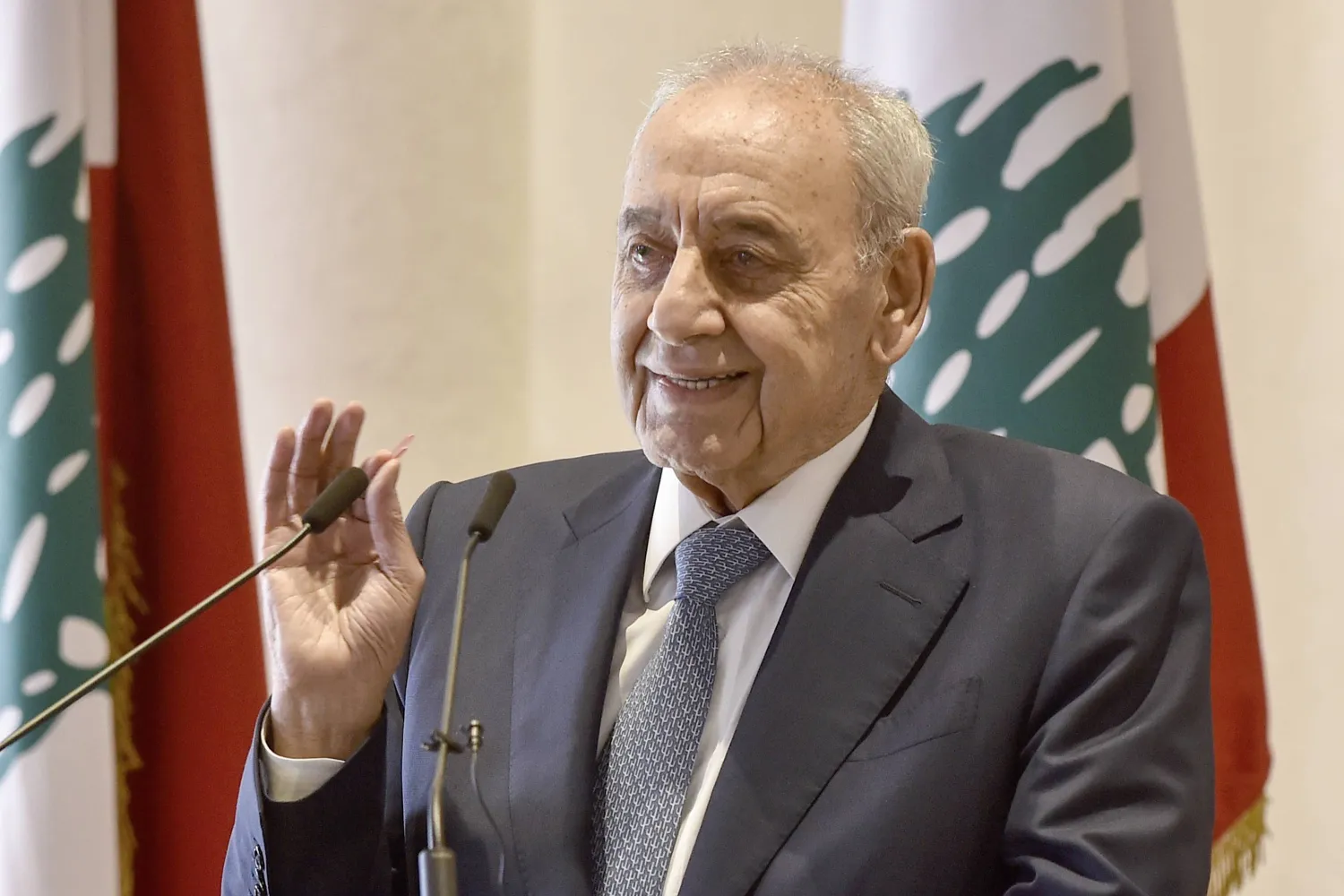
01 October 2020, Lebanon, Beirut: Speaker of the Lebanese parliament Nabih Berri speaks during a press conference in Beirut. (Lebanese Parliament/dpa)
TT

Lebanon's Berri to Asharq Al-Awsat: We Are in Constant Contact with Aoun, Salam Despite Difference in Ideas

01 October 2020, Lebanon, Beirut: Speaker of the Lebanese parliament Nabih Berri speaks during a press conference in Beirut. (Lebanese Parliament/dpa)

Lebanese parliament Speaker Nabih Berri stressed on Sunday that he was in “constant” contact with President Joseph Aoun and Prime Minister Nawaf Salam “despite differences in ideas.”

In remarks to Asharq Al-Awsat, he said: “I don't think we have a problem as long as we are united in demanding that Israel first withdraw from the South and then that the army be deployed there and that the people are allowed to return to their homes.”

The demands also include the release of detainees held by Israel and coming up with a plan, with Arab and international backing, to rebuild what Israel destroyed during the war, he added.

Berri made his remarks on the eve of the launch of the fifth round of US-sponsored Lebanese-Israeli military and political negotiations.

The speaker expressed his “satisfaction” with the efforts that have led to a ceasefire in the fighting between Israel and Hezbollah. Berri is a close ally to the Iran-backed group.

He hoped the ceasefire will last, saying that that hinges on Israel respecting it, which will in turn lead Hezbollah to respect it as well “because it is unjust to negotiate under fire.”

Berri revealed that Israel had requested the ceasefire through the “mechanism” committee that is responsible for overseeing the implementation of the 2024 truce between Israel and Hezbollah.

He noted that Israel came under American pressure to agree to a ceasefire following “two bloody days in the South that claimed dozens of civilian lives.”

He stressed that Hezbollah is “committed to the ceasefire,” accusing Israel of violating it.

“We hope that the ceasefire, with US pressure, will stand. We welcome any effort to pressure Israel to cease its hostile war against Lebanon,” he continued.

Moreover, the speaker expressed his rejection of “pilot zones” in the South, saying that reaching an agreement over their geographic borders could take years.

Israel and Lebanon agreed to move quickly towards establishing “pilot zones” in which the Lebanese Armed Forces would exercise exclusive control “to the exclusion of all non-state actors”.

Berri said that Lebanon “has not interest in wasting time that would allow Israel to continue its hostile activities. The solution lies in adopting a timetable for its withdrawal from the entire South in exchange for the deployment of the Lebanese army.”

“This remains the shortest path towards the South’s liberation from occupation instead of remaining bogged down by talks over the ‘pilot zones’,” he added.



Israel Army Prepares West Bank Troop Reinforcements ahead of Jewish Holidays

TOPSHOT - Two girls walk past the rubble of collapsed buildings in Khan Yunis in the southern Gaza Strip on August 25, 2026. (Photo by Bashar Taleb / AFP)
TT

Israel Army Prepares West Bank Troop Reinforcements ahead of Jewish Holidays

TOPSHOT - Two girls walk past the rubble of collapsed buildings in Khan Yunis in the southern Gaza Strip on August 25, 2026. (Photo by Bashar Taleb / AFP)

Israel's military chief on Thursday said he had ordered preparations for reinforcing troops in the occupied West Bank ahead of Jewish high holidays and as violence surges in the territory.

"Given the tensions in Judea and Samaria and the upcoming holiday period, I am ordering the elevation of readiness of an additional division headquarters in order to reinforce the forces in the area," Lieutenant General Eyal Zamir was quoted as saying in a military statement, using the Biblical term for the West Bank.

"In addition, preparations must be made for the immediate deployment of units and battalions to reinforce the area," he added.

The Israeli army “across all of its arrays, will maintain full, multi-front readiness throughout the holiday period -- there will be no reduction in operational forces."

The Jewish high holiday season begins in mid-September with Rosh Hashana, the Jewish new year.

Israel has since 1967 occupied the West Bank, where more than 500,000 Israelis live in settlements that are illegal under international law. The territory is home to about three million Palestinians.

Israeli settler violence against Palestinians has increased dramatically since the October 7, 2023 attack on Israel by Hamas from the Gaza Strip.

Speaking generally, Zamir said "many challenges are ahead of us".

"We are advancing operational procedures across all fronts, from Iran to Lebanon to Gaza, and remain on high alert in accordance with the sensitive multi-front situation," he said.


Death Journey from Kordofan Ends in Hunger in Omdurman

A displaced woman from Dalanj braids her grandmother's hair at a displacement registration center in El Obeid, North Kordofan State, Sudan, January 15, 2026. REUTERS/El Tayeb Siddig
TT

Death Journey from Kordofan Ends in Hunger in Omdurman

A displaced woman from Dalanj braids her grandmother's hair at a displacement registration center in El Obeid, North Kordofan State, Sudan, January 15, 2026. REUTERS/El Tayeb Siddig

A long journey marked by fear, hunger and thirst has been undertaken by large numbers of Sudanese families fleeing cities and towns in North Kordofan state, where fighting has flared again, for Omdurman, the second-largest city in the capital Khartoum.

Families that have lost children, relatives, and perhaps all their possessions have been forced to leave their homes and take difficult routes through mountains and valleys. Some have travelled on foot, while others have relied on animal-drawn carts or trucks. Others have become stranded before reaching safety.

Reports by local and international aid organizations said hundreds of families — with some estimates putting the number at more than 3,000 — have been displaced in recent weeks following a resurgence of military operations in parts of North Kordofan, amid what the reports described as “dire humanitarian conditions”.

After weeks of hardship, the families reached the far western outskirts of Omdurman “hungry and exhausted,” carrying what remained of their belongings and memories of the homes they had left behind.

Others had lost family members along the arduous journey. But reaching Omdurman did not end their ordeal. Displaced families face shortages of food and drinking water and a lack of humanitarian assistance, while cases of diarrhea, fever and infections are spreading among children, turning their escape from the war into an open-ended ordeal with no clear end in sight.

The Arduous Journey

The Sudanese Armed Forces and allied forces are seeking to expand their control in North Kordofan and secure the area around the state capital, El Obeid, while large numbers of the Rapid Support Forces are positioned west and south of the city.

Halima Dhow al-Bait said she fled with her family of nine from the Al-Jamama area of Sodari locality in North Kordofan after they were forced to leave their home at gunpoint.

Her journey took several days aboard cargo trucks and was arduous and exhausting, while some residents and neighbors became stranded in the mountains and among the trees.

“We arrived in Omdurman in a state of extreme exhaustion,” the Sudanese woman told Asharq Al-Awsat. “During the first few days, we received some food supplies, including oil, sugar and flour, but those supplies later stopped.”

Another displaced woman said: “During the journey, three of my children fell ill because of hunger, thirst and the hardships of the road.”

“We left our homes, our property and everything we owned. We left with nothing but the clothes we were wearing,” she said. “Our situation is now extremely difficult, and we are receiving no humanitarian assistance.”

“We saw death with our own eyes”

Sudan’s humanitarian crisis has deepened as a result of the war between the Sudanese army and the Rapid Support Forces, which has continued since April 2023, killing hundreds of thousands of people and displacing about 13 million others as refugees and internally displaced people, according to UN estimates.

Sayedah Khamis, a displaced woman from the town of Al-Jamama, recounted the details of her arduous journey.

“Our journey took about 13 days. At times we travelled on foot, and at others in donkey-drawn carts,” she said.

“We left because of the deteriorating security situation, violations and the looting of civilians’ property,” she added.

The displaced woman described the hardship of the journey and the harsh conditions her family endured throughout those days.

A New Reality

Renewed fighting in Sudan’s Kordofan region has displaced hundreds of families to El Obeid, Khartoum, Kosti and Omdurman. The crisis has also displaced about 200,000 people in North Darfur and a similar number in Blue Nile state.

Mohamed Ali, who was also displaced from Abu Hadid, said armed conflict forced his family to leave the area. They traveled for about two weeks through mountains and valleys, using different forms of transport and sometimes sleeping outdoors in harsh conditions amid insects and disease.

He said they lost several family members along the way and now urgently need food and clean drinking water, particularly as flies have contributed to illnesses among children.

Although the families’ displacement journey to Omdurman may have ended, their hardship continues. They have lost homes, property and relatives, and now face a daily struggle for food, water and healthcare. Their hope of returning home remains on hold until the violence ends, turning their escape from war into an ongoing fight for survival.


Official Leading Trump's Gaza Ceasefire Effort Criticizes Israel for Its Attacks

Peace Council High Representative Nikolay Mladenov (Reuters)
TT

Official Leading Trump's Gaza Ceasefire Effort Criticizes Israel for Its Attacks

Peace Council High Representative Nikolay Mladenov (Reuters)

The official in charge of President Donald Trump's ceasefire plan for Gaza criticized Israel on Wednesday for its attacks on the war-battered Palestinian territory and warned that the alternative to the US proposal is the next war, The Associated Press said.

Nikolay Mladenov, the Board of Peace high representative, insisted to the UN Security Council that Trump's 20-point plan has not stalled and “has moved from the negotiating table to the engineering table.”

The group Hamas has agreed to the proposal’s key provision to disarm and turn Gaza over to civilian rule, he said. But Israel’s ongoing strikes since last October’s ceasefire are still killing Palestinians — though much fewer — and Gazans can’t feel that the conflict is ending, he said.

“After three years of war and 20 years of military operations, I ask, will another strike on a munitions depot stop Hamas from rearming or tightening its grip on Gaza?" Mladenov said. “It will not. It only delays the demilitarization that would happen” and obstructs the transfer to a civilian government.

A recent US deal with Hamas to disarm was seen as a potential breakthrough to end the war, which was sparked by the militant group’s deadly Oct. 7, 2023, attacks in southern Israel. But Israeli Prime Minister Benjamin Netanyahu said his forces won’t withdraw from their current lines in Gaza until Hamas has handed over all its weapons.

Mladenov said that at a meeting he took part in last week with Netanyahu and Jared Kushner, Trump’s son-in-law and adviser, “we went through his government’s concerns one by one and narrowed the areas that still require technical work.”

Israel’s deputy UN ambassador, Noa Furman, reiterated to the Security Council his country’s commitment to Trump’s plan, but stressed that it can’t succeed while Hamas remains armed. He said Israel is working closely with the US to achieve Hamas’ disarmament.

The US ambassador to the UN, Mike Waltz, said concerns about Trump's plan are being addressed and Hamas' disarmament will be judged on its actions.

Mladenov warned of the distance between the roadmap and what’s happening on the ground, and said if war resumes, there won’t be a roadmap to return to or anything left on the ground to rebuild.

“That would not be a setback,” he said. “it would be a point of no return for everyone.”

Mladenov stressed the need for political will to overcome the differences and said there is a choice to be made: “A Gaza disarmed, rebuilt and reconnected to the world. Or a Gaza rearmed, divided and in rubble, with a radicalized generation raised inside it and the next war already on the horizon."

As for the Palestinians, Mladenov said, the Trump plan includes a “credible pathway to a political horizon" and a two-state solution to the decades-old conflict. Netanyahu vehemently opposes a Palestinian state.