


Milan Designers Go Lighter in Silhouette, if Not Materials, for Next Summer

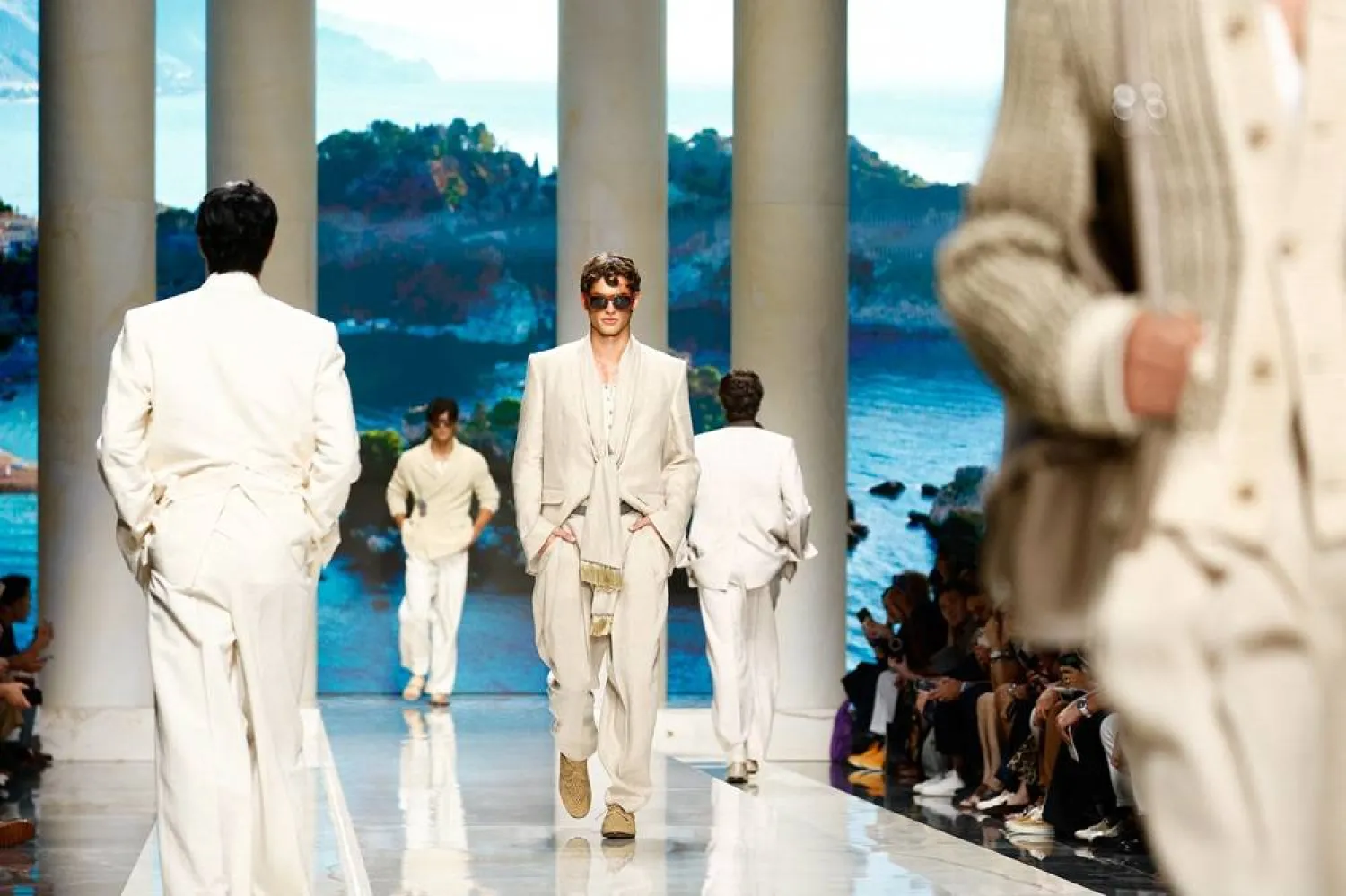
Models present Dolce & Gabbana Spring/Summer 2027 men's collection at Milan Fashion Week, in Milan, Italy June 20, 2026. (Reuters)
TT

Milan Designers Go Lighter in Silhouette, if Not Materials, for Next Summer

Models present Dolce & Gabbana Spring/Summer 2027 men's collection at Milan Fashion Week, in Milan, Italy June 20, 2026. (Reuters)

In complicated, heavy times, Milan designers went lighter — if not in materials, then in silhouette.

Amid economic uncertainty, geopolitical tensions and a sweltering Milan Fashion Week, designers largely stripped things back for next summer, embracing clean lines and pared-down looks. Prada led the way, with co-creative directors Miuccia Prada and Raf Simons arguing for simplicity and familiar clothes reimagined through proportion and fabrication.

That didn’t mean dressing for the heat was straightforward. Milan’s runways were filled with leather and knits for the next summer season, suggesting that fashion’s elite may need generous air-conditioning, mountain escapes or higher latitudes to wear some of the looks.

Key trends from Milan Fashion Week menswear Spring-Summer 2027 collections that closed on Monday include the embrace of luxury materials, sartorial ventilation and lighter tailoring, while a few defiantly chose bling over restraint.

Perhaps the biggest surprise of the season was the persistence of leather.

Prada’s leather combinations were inspired by the universality of jeans, featuring slim five-pocket pants matched with cropped flat-pocketed jackets that functioned as shirts. Other designers used woven and perforated techniques to make leather more breathable, even as temperatures climbed.

In Milan, luxury and practicality were often in tension.

After years of oversized silhouettes, menswear is once again embracing the body.

Designers broadly agreed that a well-dressed man still wears a suit. The challenge was how to survive the heat. The response was ventilation, with dress shirts left unbuttoned. Some were rendered transparent. Or they were simply done away with.

Long trousers remained dominant, but there was a shift toward closer-to-the-body dressing. Dolce & Gabbana pushed the idea furthest with microshorts that showcased muscular legs, while some brands exposed torsos.

Tailoring remained central to Milan collections, but in lighter, more relaxed forms.

Designers softened construction, opened necklines and experimented with fabrics and construction that allowed more airflow. The result was tailoring designed for rising temperatures without abandoning formality.

US designer Thom Browne, now under Zegna ownership, returned to Milan for the first time since 2008 with layered suiting that drew heavily on summer-friendly seersucker and pleated skirts for men, long a brand hallmark.

The message from Milan was clear: the suit isn’t going anywhere, but it is adapting.

Of course, restraint is not for everyone. While much of Milan embraced restraint, some designers doubled down on decoration.

Philipp Plein presented a crystal-encrusted denim ensemble that takes days of handwork to complete. Dolce & Gabbana also leaned into embellishment, including beaded accents that recalled coral.

If Prada’s vision was reduction, these designers unapologetically offered maximalism and glamour.

A lighter Milan calendar created opportunities for emerging designers to gain attention alongside the industry’s biggest names.

Martin Quad made his Milan debut with unusual tailoring tricks that got him noticed in his native Copenhagen, while Domenico Orefice embraced leather and richly woven textiles for his co-ed collection.

Japanese designer Shinya Kozuka's Shinyakozuka label made its Milan debut with one of the most poetic and summery collections of the season, epitomized by a bare-chested model in a billowing sheer coat in teal worn baggy white trousers.

UK Retailer Debenhams Announces Return of McDonald as New Chair

FILE PHOTO: Debenhams logo is seen on smartphone in front of a displayed Boohoo logo in this illustration taken January 25, 2021. REUTERS/Dado Ruvic/Illustration/File Photo
TT

UK Retailer Debenhams Announces Return of McDonald as New Chair

FILE PHOTO: Debenhams logo is seen on smartphone in front of a displayed Boohoo logo in this illustration taken January 25, 2021. REUTERS/Dado Ruvic/Illustration/File Photo

British fashion retailer Debenhams said on Friday Iain McDonald has returned to its board as chair, replacing Tim Morris, as the company looks to focus on rebuilding its equity value after completing the initial stage of its turnaround.

Here are some details:

McDonald stepped down in February after Debenhams launched an equity raise, in which McDonald and his fund Belerion Capital invested about $5 million, making him ⁠the ninth largest ⁠investor in the group, per LSEG data.

McDonald, who had served as a non-executive director since June 2017, stepped down to facilitate his fund's participation in the funding earlier this year.

McDonald ⁠is currently chair and investor at London-listed cosmetics group Revolution Beauty, whose shares have soared over 60% so far this year.

Debenhams, formerly known as Boohoo, has seen its shares rise 8.6% so far this year.

Debenhams on Thursday reported a 13.9% rise in first-half adjusted core profit, driven by a return to growth at ⁠major brands ⁠including PrettyLittleThing, boohoo and Karen Millen.

Morris is stepping down with immediate effect after serving as chair for nearly two years and oversaw the group's new strategy, which was led by CEO Dan Finley.

As part of Friday's changes, Debenhams also appointed Michael Stewart and Stephen Rothwell as independent non-executive directors, bringing expertise in capital markets, investment management, technology and AI-enabled consumer platforms.


Next Nudges Up Profit Guidance but Sees UK Headwinds

Shoppers walk past a NEXT retail store in London, Britain, January 2, 2025. REUTERS/Hollie Adams/File Photo
TT

Next Nudges Up Profit Guidance but Sees UK Headwinds

Shoppers walk past a NEXT retail store in London, Britain, January 2, 2025. REUTERS/Hollie Adams/File Photo

British clothing retailer Next edged up its annual forecast on Thursday, as it reported a 10.5% profit rise for its first half, but expects sales growth to slow in its second half and warned of headwinds in its core UK market.

The group, which trades from more than 800 stores in the UK and Ireland, including Reiss, Joules and FatFace outlets, and has an online ⁠operation serving the ⁠UK and overseas markets, said full price sales were 7.7% higher in the six months to August 1, helped by a hot summer in Britain.

But it said full price sales growth would slow to 5.8% in its second half, and moderated its second half sales growth expectations for the UK to 2.0% from 2.8%, flagging concerns in its ⁠home market which accounts for about three quarters of sales.

"Our primary concerns are rising inflation, higher mortgage interest costs and a weak employment market. These worries will only be compounded if they are accompanied by tax increases," it said in reference to new finance minister John Healey's first budget on October 28.

"It seems likely that it (the government) will have to increase taxes in order to fund its expenditure,” Reuters quoted it as saying.

British households will see their energy bills rise in October, inflation ticked up on Wednesday, and, last week, Next rival John Lewis highlighted a tough UK ⁠trading environment, saying ⁠consumers were holding back on bigger ticket items.

Rival Primark said trading in continental Europe remained challenging, though Zara owner Inditex reported a strong start to autumn trading.

Next made a profit before tax of £569 million ($762 million) in its first half. It said its international business had made an encouraging start to the season, and raised its second half sales growth guidance to 20.5%.

The retailer, whose shares have increased by a quarter over the last year, raised its profit before tax guidance for its year to January 2027 by £12 million ($16 million) to £1.255 billion, reflecting the small upgrade in sales expectations and some additional cost savings, mainly in warehousing. It made £1.158 billion in 2025/26.


Ukrainian Fashion Designer Debuts Art between Air Raids

An empty street near the Ukrainian Foreign Ministry in Kyiv. (Asharq Al-Awsat)
TT

Ukrainian Fashion Designer Debuts Art between Air Raids

An empty street near the Ukrainian Foreign Ministry in Kyiv. (Asharq Al-Awsat)

In Kyiv's largest art museum, Arina Petrova and her father Serhii busily applied the final touches to their mannequins, anxious that a Russian drone attack could delay her long-awaited debut.

The fashion-designing duo from Ukraine's "Bob Basset" art house were about to present Petrova's first ever collection -- an array of punk leather animal costumes.

But with Russian jet-powered drones now crashing into Ukraine's capital on a daily basis, triggering air alerts that paralyze life in the city, the pair had more pressing concerns.

"If it's in the shelter, fine -- we'll do it in the shelter," Petrova told AFP, adding she was prepared to bring all the models and their cellist down to the basement to showcase their work.

Petrova and her 50-year-old father run their punk fashion studio out of Kharkiv, a heavily attacked city close to the Russian border.

Having arrived to the capital by minibus, their designs in hand, the pair wanted to show through their art that Kharkiv was still very much alive.

Petrova was concerned that a drone could cut things short.

"We want to have time to say what we want to say," the 28-year-old said with a sigh.

If halted, they would continue underground -- even if they had to use the flashlights on their cellphones to light up the show, she said.

As Petrova adjusted the lace on a corset, an alarm started blaring: Russian jet-powered drones were approaching the capital.

Security guards evacuated the audience.

Outside, a woman in a red dress posed for a photographer. There was a heavy explosion, she flinched, and without hesitation, resumed her pose with a smile.

In the distance, a plume of black smoke rose among the buildings.

- 'Become a little more ferocious' -

While other designs on display at Kyiv Fashion Week were full of color, Bob Basset's collection was monochrome.

In front of large black drapes, the designers adjusted a black leather breastplate adorned with a feather-like design, to be paired with a black horse mask.

For her first collection, entitled "Mutabor" ("I shall transform," in Latin), Petrova based her designs on creatures her father had imagined -- dark, feathered animals with claws.

"I feel like during war, everyone has to become a little more ferocious... grow fangs," the designer told AFP.

"You acquire something from the animal that makes you stronger."

Before Russia invaded in February 2022, Bob Basset had built a reputation designing leather masks, some of them worn by metal bands Korn and Slipknot.

But as Russian troops approached the outskirts of Kharkiv in 2022, the group closed their workshop and the family moved west.

Far from his hometown, Serhii sank into depression.

Leaving his wife and children safe in Europe, he returned to Kharkiv, under bombardment.

"I'm afraid," he said. "But I'm even more afraid of not being able to do anything tomorrow."

Their collection at Kyiv Fashion Week is their first in 11 years.

- Fashion amid the bombs -

Wearing a mask himself to hide a squint, Serhii has made face coverings the focus of his work -- a way to reinvent his identity.

He began creating masks for free for wounded soldiers who wanted to hide their scars.

His daughter joined him, and despite the sleepless nights, the workshop in Kharkiv came back to life.

"If I hadn't come back, this collection would never have existed," she said.

With just a few minutes to go before the show, Petrova appeared agitated.

In Kharkiv, anxiety kept her awake at night, as Russia bombed warehouses and logistics centers, complicating their work.

"If something hits the studio, everything we've worked on for a year will be gone," she said.

"Every day, there's this feeling that we have very little time. Something could happen, and you'll never be able to finish."

During a brief moment of respite from incoming strikes, a cellist played for a few moments.

Then, silently, the models made their way through the crowd, their faces masked, amid the flashes of cell phones.

The performance ended in a mix of applause and air raid sirens.

A woman approached Serhii to congratulate him, wearing a dress made from pieces of drones.

In the courtyard, Petrova smiled, despite the explosions from air defenses in the sky overhead.

She's used to it. In Kharkiv, "only those who are capable of creating under these conditions remain," she said.