


Mexico, Italy and Others See up to Two More Months of Heat Stress Than in the 1970s, Study Says

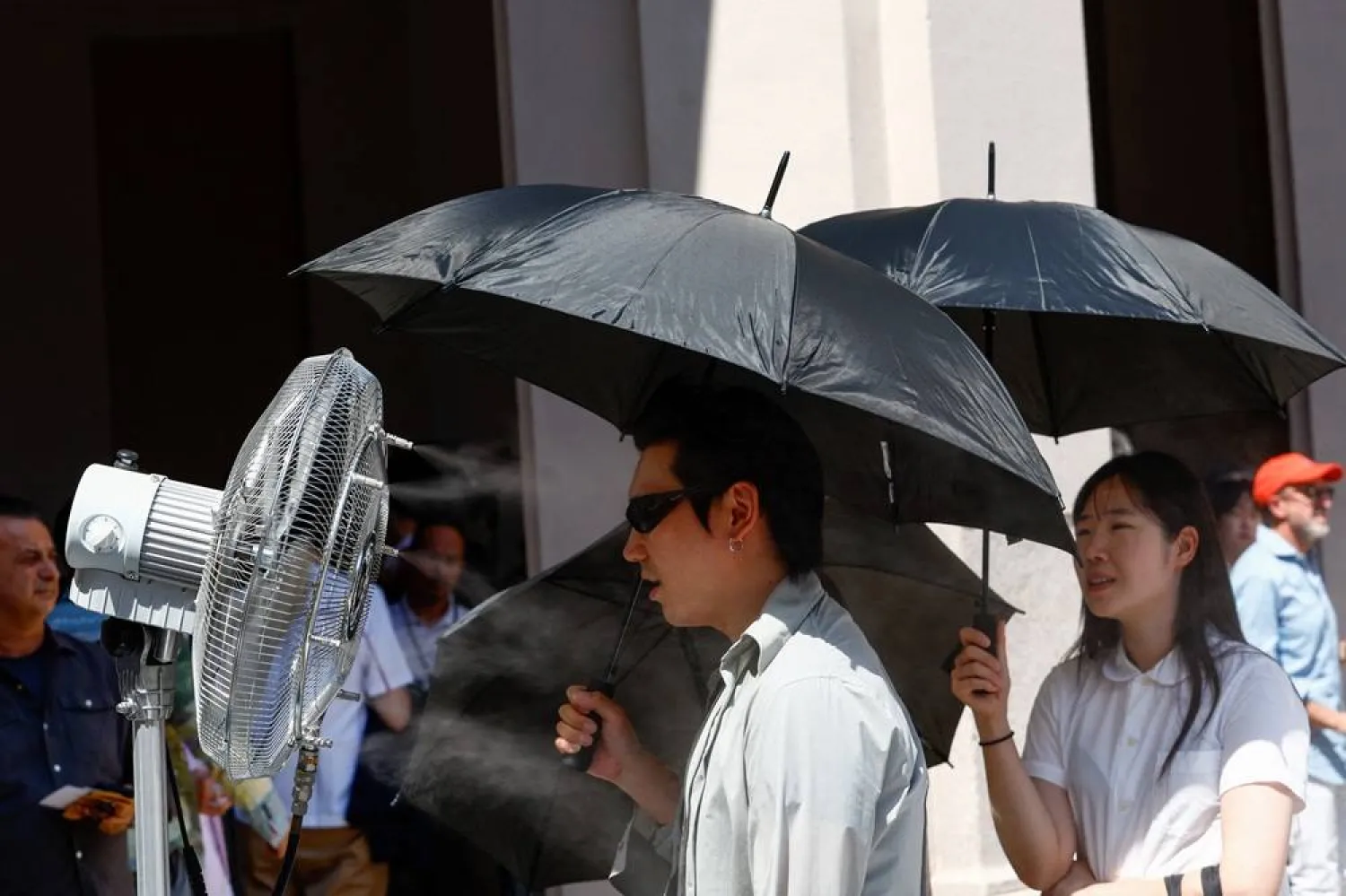
 A man stands in front of a cooler spraying water ahead of Thom Browne’s Spring/Summer 2027 men’s collection show as part of Milan Fashion Week, in Milan, Italy, June 22, 2026. (Reuters)
A man stands in front of a cooler spraying water ahead of Thom Browne’s Spring/Summer 2027 men’s collection show as part of Milan Fashion Week, in Milan, Italy, June 22, 2026. (Reuters)
TT

Mexico, Italy and Others See up to Two More Months of Heat Stress Than in the 1970s, Study Says

 A man stands in front of a cooler spraying water ahead of Thom Browne’s Spring/Summer 2027 men’s collection show as part of Milan Fashion Week, in Milan, Italy, June 22, 2026. (Reuters)
A man stands in front of a cooler spraying water ahead of Thom Browne’s Spring/Summer 2027 men’s collection show as part of Milan Fashion Week, in Milan, Italy, June 22, 2026. (Reuters)

Mexico, Kenya, Italy and other nations around the world are experiencing one to two more months of heat stress than they were several decades ago, new research published Monday says, and some areas even more so. Regions previously untouched by heat stress are now feeling it, too.

Extreme feels-like temperatures, heat stress days and tropical nights have all become dramatically more frequent, long and severe over the past six decades as the planet's warming intensifies — a result of the burning of fossil fuels coal, oil and gas — according to a new study published in the journal Nature Climate Change on Monday.

The researchers went beyond just temperature, which is frequently studied, and used feels-like temperatures, to understand more of the impact on people. They assessed heat stress on individual humans, influenced by temperature, humidity, wind speed and more. They used what’s called the Universal Thermal Climate Index to analyze those factors and model the human body’s response to the environment.

The combination of heat and humidity can be dangerous for humans, because humidity impacts how sweat evaporates, and that's a cooling mechanism. Heat waves that are humid can be more fatal than dry heat waves as humans don't cool down as easily.

Heat stress is worsening in already-warm regions, and beyond

Past studies have looked at the extent to which human-driven climate change has sent temperatures soaring, especially in recent years. One study says people globally suffered an average of 41 extra days of dangerous heat in 2024. Some research says that the world is on track to add nearly two months of superhot days each year by the end of the century.

Here, researchers looked at heat stress at three levels: strong (index temperatures of greater than or equal to 32 degrees Celsius, or 89.6 degrees Fahrenheit); very strong (index temperatures of greater than or equal to 38 degrees Celsius, or 100.4 degrees Fahrenheit); and extreme (index temperatures of greater than or equal to 46 degrees Celsius, or 114.8 degrees Fahrenheit).

Places that might see around 50 more days per year of at least strong heat stress compared with the 1970s include parts of Southern Africa, such as in Namibia and Angola; Eastern Africa, including parts of Tanzania, Kenya and Uganda; and parts of Mexico and Central America.

In Southern Spain, Italy, Greece and Türkiye, some areas will see up to 40 additional days with strong heat stress compared with the 1970s. Much of Southern Europe is seeing almost a full month of additional strong heat stress days from decades ago.

In the US, much of the country sees 15 or more days of at least strong heat stress, and southern parts, including Texas and Florida, are seeing close to 25 or more days with very strong heat stress.

Those heat stress seasons are also lasting longer.

The study’s lead author Rebecca Emerton, also a senior scientist at the European Centre for Medium-Range Weather Forecasts in the United Kingdom, said it was striking “to see heat stress not only intensifying in those places that we already consider as being hot or used to experiencing heat waves ... but also to see this, we call it, expanding footprint of heat stress expanding into regions where it’s historically been rare or non-existent.”

According to the study, the feels-like temperatures on the ten warmest nights of each year have also increased faster — 0.32 degrees Celsius (0.58 degrees Fahrenheit) per decade — than the ten warmest days, 0.27 degrees Celsius (0.49 degrees Fahrenheit) per decade.

For tropical nights, the researchers considered minimum temperature of 20 degrees Celsius (68 degrees Fahrenheit). This means people might not be recovering properly from daytime heat in the overnight hours.

And now, one billion more people face at least one day of extreme heat stress each year than they did in the 1970s.

The future impact depends on action

The world has known that adding heat-trapping gases to the atmosphere by burning fossil fuels and cutting down forests will warm the globe, said Jennifer Francis, a climate scientist at the Woodwell Climate Research Center on Cape Cod, who was not involved in the research.

“This study adds stark details about increasing dangers to billions of humans,” Francis said. “This analysis shows not only is temperature rising, but so is humidity, which makes high temperatures more deadly because our body’s air conditioning system — sweating — struggles to keep up.”

Emerton says the work highlights the urgent need to mitigate future warming and ensure adaptation strategies, heat health action plans, early warning systems and climate risk assessments are in place.



First Confirmed Black-winged Kite Nesting Documented in Saudi Arabia’s King Abdulaziz Reserve

The Black-winged Kite is a bird of prey associated with open habitats that provide suitable nesting trees and reliable food sources. (SPA)
TT

First Confirmed Black-winged Kite Nesting Documented in Saudi Arabia’s King Abdulaziz Reserve

The Black-winged Kite is a bird of prey associated with open habitats that provide suitable nesting trees and reliable food sources. (SPA)

The King Abdulaziz Royal Reserve Development Authority announced the documentation of the first confirmed nesting record of Elanus caeruleus, commonly known as the Black-winged Kite, within the boundaries of the King Abdulaziz Royal Reserve, reported the Saudi Press Agency on Monday.

Providing new scientific evidence of the reserve's suitability as a natural habitat that supports wildlife settlement, breeding, and biodiversity conservation, the achievement aligns with the strategic objectives of the royal reserves and the Saudi Green Initiative in support of Saudi Vision 2030.

The nesting activity was recorded between January 20 and May 26, 2025, based on field surveys conducted in several natural meadows characterized by dense Sidr tree growth.

Adult and juvenile birds of the species were observed throughout the season, before researchers discovered an active nest on May 14, 2025, atop a Sidr tree approximately 2.9 meters high. The nest contained three eggs, providing direct evidence of local breeding within the reserve.

The Black-winged Kite is a bird of prey associated with open habitats that provide suitable nesting trees and reliable food sources.

Its documentation within the reserve reflects the authority’s efforts to protect and manage natural habitats and provide safe environments capable of supporting raptor populations, particularly in areas undergoing ecological recovery and improvements in vegetation cover.

The nesting activity was recorded between January 20 and May 26, 2025, based on field surveys conducted in several natural meadows characterized by dense Sidr tree growth. (SPA)

The authority also holds scientific records confirming the expansion of the species’ breeding range within Saudi Arabia through a combination of field observations in the reserve and national records published in a global biodiversity database.

These findings indicate a seasonal pattern of occurrence that supports the hypothesis of local breeding synchronized with seasonal movements and dispersal across several regions of the Kingdom.

The findings were published in a peer-reviewed study in the international journal Zoology and Ecology. The study was conducted by a joint research team comprising researchers from the King Abdulaziz Royal Reserve Development Authority and King Saud University as part of efforts to promote scientific research and document biodiversity within the reserve in accordance with internationally recognized scientific standards.

The authority underlined the importance of continuing environmental monitoring and surveillance programs in the reserve, identifying new nesting sites and incorporating them into conservation programs. These efforts contribute to protecting natural habitats, supporting wildlife, and advancing scientific knowledge of biodiversity in Saudi Arabia.


Interstellar Comet Likely Far Older Than Solar System, Say Astronomers

This handout photograph released by NASA on June 22, 2026, shows a view taken by Hubble of the interstellar comet 3I/ATLAS on July 21, 2025, when the comet was 277 million miles from Earth. "AFP photo / NASA / ESA / David Jewitt (UCLA)"
TT

Interstellar Comet Likely Far Older Than Solar System, Say Astronomers

This handout photograph released by NASA on June 22, 2026, shows a view taken by Hubble of the interstellar comet 3I/ATLAS on July 21, 2025, when the comet was 277 million miles from Earth. "AFP photo / NASA / ESA / David Jewitt (UCLA)"

An interstellar comet that blazed past the Sun last year could be nearly three times older than our Solar System and is unlike anything ever before seen in our cosmic backyard, astronomers said Monday.

The comet 3I/ATLAS is just the third visitor from beyond our Solar System that humanity has ever observed, its unusual brightness offering scientists an unprecedented opportunity to study something that came from elsewhere in the galaxy.

After being spotted in July last year, the space rock prompted excitement online, with one prominent Harvard researcher speculating it could be an alien spacecraft -- a theory that NASA shot down.

Now, observations by the world's most powerful telescopes are revealing more about the unique comet.

According to a new study published in the journal Nature, 3I/ATLAS could be up to 12 million years old. Our Solar System is believed to have formed around 4.5 billion years ago.

Lead study author Martin Cordiner of NASA's Goddard Space Flight Center told AFP that "maybe it's the oldest object to have been observed in our Solar System".

However, there could be "edge-case scenarios" that offer other explanations for the comet's unusual chemical composition, he added.

The new research is based on the comet's ratio of chemical elements called isotopes detected by the James Webb space telescope and the ALMA observatory in Chile.

These measurements "reveal an elemental composition unlike any Solar System body", the study said.

- Relic from 'cosmic noon'? -

Compared to comets in our Solar System, 3I/ATLAS has 10 times more deuterium, a type of hydrogen commonly seen in heavy water, according to the study.

"That high abundance of heavy water can only really happen, according to our understanding of astrochemistry, in a very cold environment," Cordiner explained.

This means the comet is also likely among the coldest objects ever seen in our Solar System, the isotopic evidence suggesting it formed in an environment that was minus 243 degrees Celsius.

Exactly where this comet came from within the Milky Way remains a mystery.

But these interstellar objects are thought to form in a similar way to the comets in our Solar System -- being flung out during the violent formation of a new planet.

Untethered to any star, 3I/ATLAS likely spent billions of years on "vast unimaginable trajectories around our galaxy," Cordiner said.

The scientists also detected a strange lack of chemical enrichment on the comet, which suggests it formed relatively close to stars being born.

It could even be a "relic" from an era called "cosmic noon" when many stars were forming around 10 billion years ago, Cordiner said.

The previous interstellar objects -- 1I/'Oumuamua, which was spotted in 2017, followed by 2I/Borisov in 2019 -- were not bright enough to gather isotopic evidence.

Harvard professor Avi Loeb, who had previously sparked controversy by suggesting 'Oumuamua could be an alien spacecraft, made similar suggestions about 3I/ATLAS.

However, NASA has dismissed this possibility. The Search for Extraterrestrial Intelligence Institute (SETI) said last month it had found "no evidence of extraterrestrial technology" on the comet.

- 'Just the beginning' -

Several astronomers who have studied 3I/ATLAS, but were not involved in the new research, hailed the "unprecedented" results.

"Until these measurements we could only really dream about" getting this kind of information for an interstellar object, Darryl Seligman of Michigan State University told AFP.

He cautioned that the comet's age remained uncertain, adding it was "a safe bet that it's older than anything that formed in the Solar System".

Astronomer Peter Veres, who was involved in identifying the comet at the International Astronomical Union's Minor Planet Center, called the research "exciting".

"The comet is now leaving the Solar System and will never return, so future observations will become increasingly difficult," he told AFP.

However, astronomers expect to spot many more interstellar objects in the coming years, particularly via the new Vera C. Rubin Observatory in Chile.

"This is just the beginning of an exciting new field, we've got a lot more to learn about these things -- and what they can tell us about our galaxy," Cordiner concluded.


Gaza's Surfers Seek Solace in the Sea

Surfers still ride the waves off Gaza City, despite the devastation wreaked on the Palestinian territory during the recent conflict. Omar AL-QATTAA / AFP
TT

Gaza's Surfers Seek Solace in the Sea

Surfers still ride the waves off Gaza City, despite the devastation wreaked on the Palestinian territory during the recent conflict. Omar AL-QATTAA / AFP

Carrying their boards past tents and bombed-out buildings, a group of Gazan surfers headed for the sea, seeking solace in the waves despite the risk of Israeli attacks.

On the beach in Gaza City, the trio laid out their boards on the sand while they warmed up their limbs and readied their gear.

A few children splashed in the shallows as the surfers paddled out to sea, fighting the crashing waves.

"This sport is indescribable. When you catch a wave, ride it, glide along it, that feeling can't be put into words," said 23-year-old Tahseen Abu Assi, who learned how to surf from his father.

"I used to see him practicing it at the beach with his father, and I watched and learned from them," he told AFP.

"We learned little by little, and even with the war, the shelling, and the destruction, we're still continuing with this sport, because it lets us breathe and makes us feel safe."

A ceasefire between Israel and the Palestinian movement Hamas came into effect in Gaza in October after two years of devastating war.

But the tiny coastal territory remains gripped by bloodshed, with each side accusing the other of near-daily violations.

Even out at sea, the violence persists.

In mid-May, Nasser Hospital in Khan Yunis reported receiving two fishermen who had been injured by Israeli naval gunfire near the beach in the southern Gaza Strip.

A few days later, a Gazan security source reported that three fishermen were wounded by Israeli fire near the coast off Gaza City.

"The situation is still unstable," Abu Assi explained.

"At any moment, shells or explosives could land near you."

- Candle wax -

Out at sea, the surfers glide effortlessly across the crests of waves, momentarily free from the hardships of daily life in Gaza.

But the severe shortages caused by the war and ongoing Israeli import restrictions have posed obstacles for the sport.

"One of the biggest challenges and difficulties we face as surfers in the Gaza Strip is the lack of tools and equipment specific to this sport," Abdel Rahim Al-Ustadh, 19, told AFP.

"Surf wax, which we put on the boards, is not available at all in Gaza, so we resort to candle wax so we can keep this sport going," he added.

Ustadh said preserving old equipment was also essential, clutching a battered red and blue surfboard that was nearly two decades old.

"As surfers, we treat these boards like great treasures to us, because losing any board or having it confiscated threatens our ability to continue in this sport," he said.

The war in Gaza flattened swathes of the territory, displaced most of the population at least once, and left hundreds of thousands of people living in tents and temporary shelters.

Khalil Abu Jiyab, 18, said that before the war there had been a team of 17 surfers in Gaza.

Now, he said, there were just the three of them, pointing to shortages and a lack of boards.

"I've been surfing for 13 years now, and my hopes have almost been shattered," Abu Jiyab told AFP, but said he still dreamed of one day being able to surf in competitions outside the Gaza Strip.

"There's nothing in Gaza you can really look forward to except the sea," he added.

"The only outlet in Gaza is the sea; without it, life would have vanished long ago."