


Interstellar Comet Likely Far Older Than Solar System, Say Astronomers

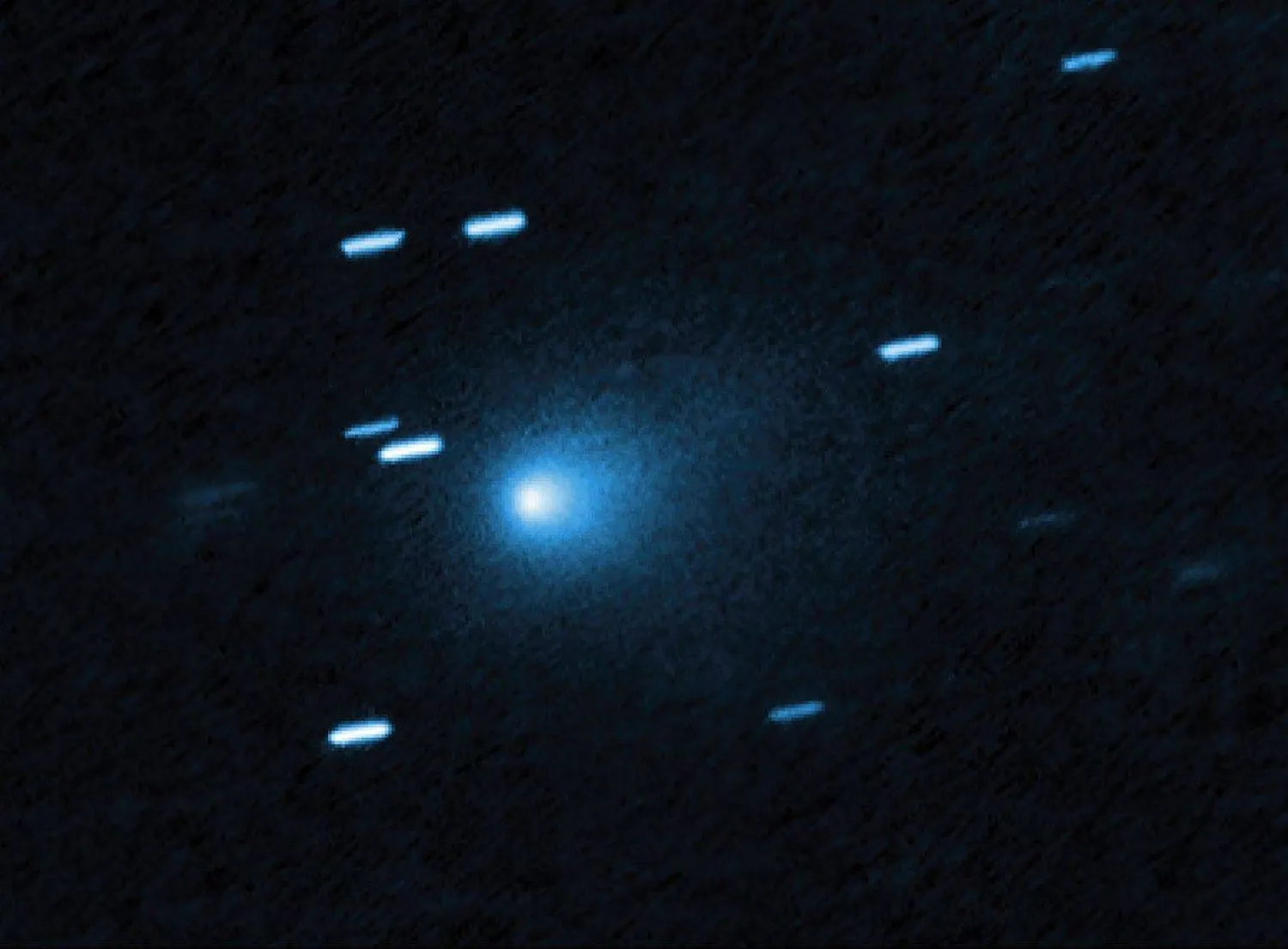
This handout photograph released by NASA on June 22, 2026, shows a view taken by Hubble of the interstellar comet 3I/ATLAS on July 21, 2025, when the comet was 277 million miles from Earth. "AFP photo / NASA / ESA / David Jewitt (UCLA)"
TT

Interstellar Comet Likely Far Older Than Solar System, Say Astronomers

This handout photograph released by NASA on June 22, 2026, shows a view taken by Hubble of the interstellar comet 3I/ATLAS on July 21, 2025, when the comet was 277 million miles from Earth. "AFP photo / NASA / ESA / David Jewitt (UCLA)"

An interstellar comet that blazed past the Sun last year could be nearly three times older than our Solar System and is unlike anything ever before seen in our cosmic backyard, astronomers said Monday.

The comet 3I/ATLAS is just the third visitor from beyond our Solar System that humanity has ever observed, its unusual brightness offering scientists an unprecedented opportunity to study something that came from elsewhere in the galaxy.

After being spotted in July last year, the space rock prompted excitement online, with one prominent Harvard researcher speculating it could be an alien spacecraft -- a theory that NASA shot down.

Now, observations by the world's most powerful telescopes are revealing more about the unique comet.

According to a new study published in the journal Nature, 3I/ATLAS could be up to 12 million years old. Our Solar System is believed to have formed around 4.5 billion years ago.

Lead study author Martin Cordiner of NASA's Goddard Space Flight Center told AFP that "maybe it's the oldest object to have been observed in our Solar System".

However, there could be "edge-case scenarios" that offer other explanations for the comet's unusual chemical composition, he added.

The new research is based on the comet's ratio of chemical elements called isotopes detected by the James Webb space telescope and the ALMA observatory in Chile.

These measurements "reveal an elemental composition unlike any Solar System body", the study said.

- Relic from 'cosmic noon'? -

Compared to comets in our Solar System, 3I/ATLAS has 10 times more deuterium, a type of hydrogen commonly seen in heavy water, according to the study.

"That high abundance of heavy water can only really happen, according to our understanding of astrochemistry, in a very cold environment," Cordiner explained.

This means the comet is also likely among the coldest objects ever seen in our Solar System, the isotopic evidence suggesting it formed in an environment that was minus 243 degrees Celsius.

Exactly where this comet came from within the Milky Way remains a mystery.

But these interstellar objects are thought to form in a similar way to the comets in our Solar System -- being flung out during the violent formation of a new planet.

Untethered to any star, 3I/ATLAS likely spent billions of years on "vast unimaginable trajectories around our galaxy," Cordiner said.

The scientists also detected a strange lack of chemical enrichment on the comet, which suggests it formed relatively close to stars being born.

It could even be a "relic" from an era called "cosmic noon" when many stars were forming around 10 billion years ago, Cordiner said.

The previous interstellar objects -- 1I/'Oumuamua, which was spotted in 2017, followed by 2I/Borisov in 2019 -- were not bright enough to gather isotopic evidence.

Harvard professor Avi Loeb, who had previously sparked controversy by suggesting 'Oumuamua could be an alien spacecraft, made similar suggestions about 3I/ATLAS.

However, NASA has dismissed this possibility. The Search for Extraterrestrial Intelligence Institute (SETI) said last month it had found "no evidence of extraterrestrial technology" on the comet.

- 'Just the beginning' -

Several astronomers who have studied 3I/ATLAS, but were not involved in the new research, hailed the "unprecedented" results.

"Until these measurements we could only really dream about" getting this kind of information for an interstellar object, Darryl Seligman of Michigan State University told AFP.

He cautioned that the comet's age remained uncertain, adding it was "a safe bet that it's older than anything that formed in the Solar System".

Astronomer Peter Veres, who was involved in identifying the comet at the International Astronomical Union's Minor Planet Center, called the research "exciting".

"The comet is now leaving the Solar System and will never return, so future observations will become increasingly difficult," he told AFP.

However, astronomers expect to spot many more interstellar objects in the coming years, particularly via the new Vera C. Rubin Observatory in Chile.

"This is just the beginning of an exciting new field, we've got a lot more to learn about these things -- and what they can tell us about our galaxy," Cordiner concluded.



82-year-old Dies after Beach Fight in Greece over Sun Lounger

Tourists from a nearby hotel watch military helicopters fly overhead during Medusa 15, a joint military exercise led by Greece and Egypt, at Maleme on the Greek island of Crete, Friday, Sept. 18, 2026. (AP Photo/Thanassis Stavrakis)
TT

82-year-old Dies after Beach Fight in Greece over Sun Lounger

Tourists from a nearby hotel watch military helicopters fly overhead during Medusa 15, a joint military exercise led by Greece and Egypt, at Maleme on the Greek island of Crete, Friday, Sept. 18, 2026. (AP Photo/Thanassis Stavrakis)

An 82-year-old man died Sunday after he got into a fight over a sun lounger on a beach in Greece near Athens, local media reported.

The octogenarian had a dispute with a 76-year-old man and a 21-year-old woman over the sun lounger, with the argument degenerating into a scuffle between the two men, according to police, the ANA news agency and ERT state television channel reported.

The 82-year-old, badly hurt, was transported to hospital from the Vouliagmeni beach resort area where the argument broke out. He was later declared dead at the hospital, AFP said.

Both the 76-year-old man and the 21-year-old woman were arrested, ANA said, with police investigating what happened.


10 Lions Die in Suspected Poisoning at Tanzania Wildlife Reserve

Lions are seen in their counpound at the Artis Amsterdam Royal Zoo in Amsterdam, Netherlands in this handout photo released to media on January 28, 2021. Artis Amsterdam Royal Zoo/Handout via REUTERS
TT

10 Lions Die in Suspected Poisoning at Tanzania Wildlife Reserve

Lions are seen in their counpound at the Artis Amsterdam Royal Zoo in Amsterdam, Netherlands in this handout photo released to media on January 28, 2021. Artis Amsterdam Royal Zoo/Handout via REUTERS

Ten lions were found dead in Tanzania's Ngorongoro wildlife reserve this week and preliminary findings suggest they may have been poisoned, the area's management authority said.

The deaths raise concerns over the conservation of lions in one of Africa's most renowned wildlife ecosystems. Poisoning has been a recurring threat to large ⁠carnivores across parts ⁠of East Africa, often linked to conflicts between predators and livestock owners.

The lions were discovered on September 18 in the Ndutu area of Endulen Ward in Arusha ⁠region, Reuters quoted the Ngorongoro Conservation Area Authority as saying in a statement released late on Saturday.

"Preliminary findings suggest the animals may have died after ingesting poison," the authority said, adding that it had launched an investigation to determine the cause and identify those responsible.

The Ngorongoro Conservation Area, a UNESCO ⁠World ⁠Heritage Site in northern Tanzania, is one of the country's leading tourism attractions. It is home to a wide range of wildlife, including lions, elephants, buffaloes and endangered black rhinos.

Last month, police arrested four suspects in an investigation into the deaths of 18 elephants across the border in Kenya.


Diana's Brother Compares Media Treatment of Harry, Meghan to Late Princess' Ordeal

FILED - 13 February 2018, United Kingdom, Edinburgh: FILE PHOTO - Prince Harry and Meghan, Duke and Duchess of Sussex, attend a reception for young people at Holyroodhouse Palace in Edinburgh. Photo: Andrew Milligan/PA Wire/dpa
TT

Diana's Brother Compares Media Treatment of Harry, Meghan to Late Princess' Ordeal

FILED - 13 February 2018, United Kingdom, Edinburgh: FILE PHOTO - Prince Harry and Meghan, Duke and Duchess of Sussex, attend a reception for young people at Holyroodhouse Palace in Edinburgh. Photo: Andrew Milligan/PA Wire/dpa

The media's treatment of Prince Harry and his wife Meghan is on a par with that faced by his mother Diana, the late princess' brother said in an interview published on Sunday, warning that lessons needed to be learned from that period.

Diana died aged 36 in a 1997 Paris car crash as photographers pursued her on motorbikes, sparking an outpouring of grief and a reckoning over whether the media bore some responsibility for her death after splashing details of her life across front pages for years.

"If you look at an article in a tabloid about Diana or the couple that you were ⁠mentioning, Harry and ⁠Meghan, you know, they can be really, really unpleasant," Diana's brother, Earl Charles Spencer, told the BBC.

"And I think it would be really beholden on people to learn from Diana's example.

"I'm not here to speak for Harry and Meghan, but for anyone who's being destroyed in this way daily, it must be such ⁠a cancerous influence in their life,” Reuters quoted him as saying.

Harry, Diana's youngest son, and Meghan, cited the impact of what they called a toxic media on their lives before they quit royal duties and moved to the United States in 2020.

They also sued much of the British tabloid press - with varying degrees of success - before they moved back to Britain in August.

Spencer has made headlines around the world in the last week after his book, "Swan Song: Diana, My Sister", was serialized in the Daily Mail, accusing her former husband, the now ⁠King Charles, of ⁠sounding "giddily elated" in the hours after her death.

The palace hit back by saying the king "is mindful that the pain of fraternal grief can cloud reason, affect judgment and color memory in ways others do not recognize, even many years after such a loss".

The publication of the book and the return of Harry and Meghan to Britain are another challenge for the king, who is still undergoing treatment for cancer.

Diana's family accused the royals of showing a lack of support or care towards the late princess before her death, a charge that was repeated by Harry, who is now largely estranged from the rest of the royal family.