


Archaeologists Find Huge Viking Textile Production Site in Denmark

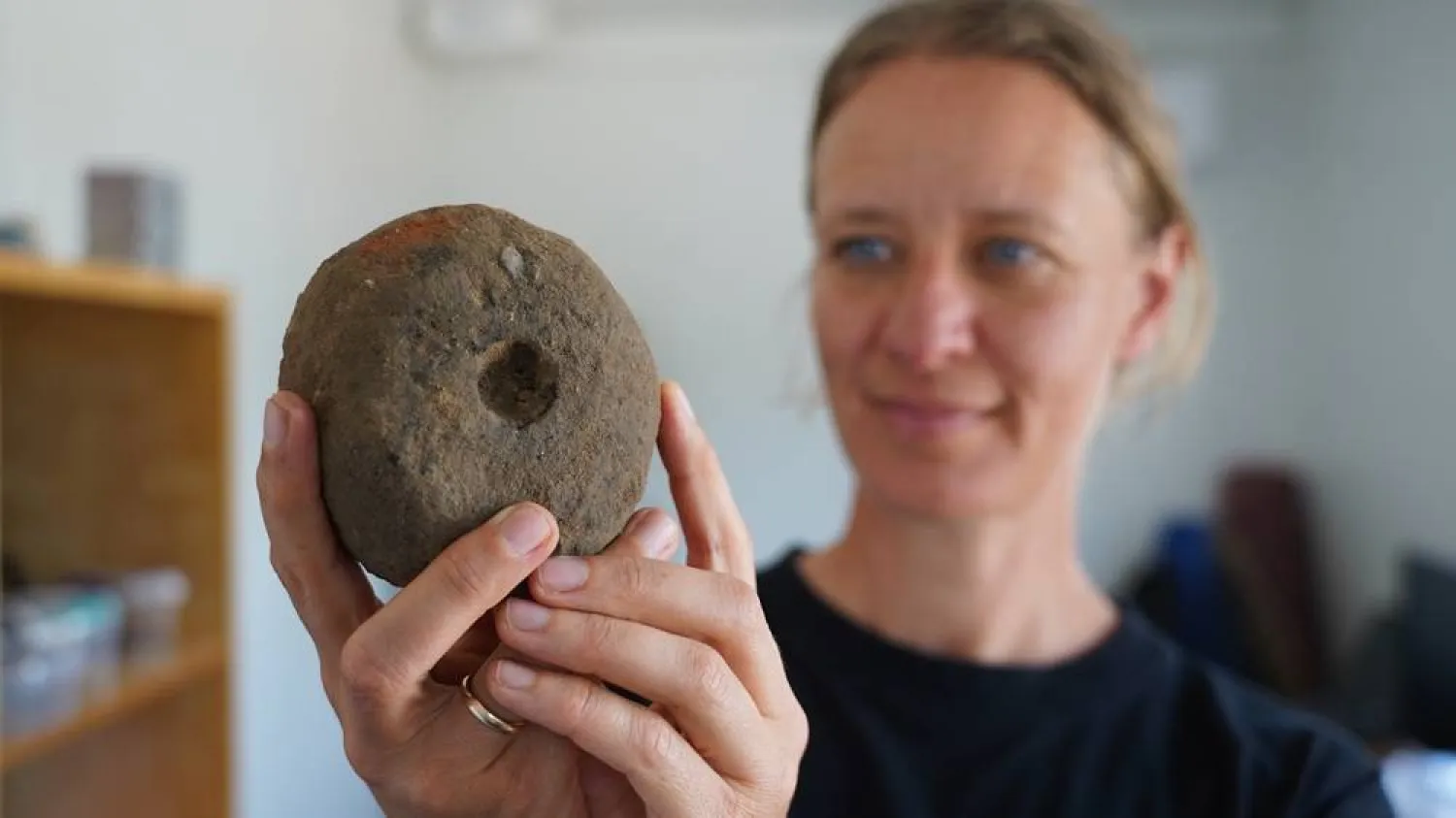
 Moesgaard Museum archaeologist Liv Stidsing Reher-Langberg holds a Viking Age weight loom unearthed in Aarhus, Denmark, on June 22, 2026. (AP)
Moesgaard Museum archaeologist Liv Stidsing Reher-Langberg holds a Viking Age weight loom unearthed in Aarhus, Denmark, on June 22, 2026. (AP)
TT

Archaeologists Find Huge Viking Textile Production Site in Denmark

 Moesgaard Museum archaeologist Liv Stidsing Reher-Langberg holds a Viking Age weight loom unearthed in Aarhus, Denmark, on June 22, 2026. (AP)
Moesgaard Museum archaeologist Liv Stidsing Reher-Langberg holds a Viking Age weight loom unearthed in Aarhus, Denmark, on June 22, 2026. (AP)

Archaeologists have discovered a huge Viking Age textile production site in Denmark that dates back more than 1,000 years and underlines the sophistication of Viking society.

Experts from the Moesgaard Museum said this week that the sprawling 100,000-square-meter (more than 1 million-square-foot) site features an area for processing flax as well as more than 80 pit houses — semi-submerged huts that were used as workshops and dwellings in Viking times.

It's located in Søften, 10 kilometers (6 miles) north of Denmark’s second-largest city, Aarhus, on the Jutland peninsula. The site dates back to the late Iron Age and early Viking Age, sometime between A.D. 600 and 950.

Archaeologist Liv Stidsing Reher-Langberg, who led the 10-month dig, said that “we have a clear focus on textile production, which makes this settlement different from other kinds of settlements of this period.”

“We have spindle whorls, we have weight looms; that tells us about what has been going on in the pit houses,” said Reher-Langberg, adding that archaeologists had also discovered silver coins, glass beads and pottery.

Experts found separate areas for production and crafts, plus a single residential home, which suggests work was overseen by a powerful individual with control over resources and production.

Reher-Langberg said that, over the last three decades, people with metal detectors had unearthed several silver coins in the area. A trial excavation 1½ years ago, before the start of construction work on a new road and industrial area, then piqued archaeologists’ interest.

“We could see in the trenches that it just keeps on going, with these houses and pit houses and textile production features,” Reher-Langberg said.

Moesgaard Museum historian Kasper Andersen said that the discovery at Søften is “another piece in the puzzle” to understanding the local economic, cultural and political structure at the time.

During the Viking era, Aarhus — then known as Aros — functioned as a center for royalty and international trade. And last year, archaeologists discovered another Viking site in Lisbjerg, just 4 kilometers (2½ miles) away, that was likely home to members of the nobility.

Goods and resources were likely brought from the countryside and settlements like Søften, before entering an extensive international trade network, Andersen said.

“When you have a production site of this scale, it cannot be only because of the local area. It needs to be understood as part of a greater network, a much bigger international perspective,” Andersen said.

Reher-Langberg hopes future carbon dating and pollen analysis might answer some lingering questions, for instance about what kind of textile production went on at the site.

During the Viking Age, considered to run from A.D. 793 to 1066, Norsemen known as Vikings undertook large-scale raids, colonization, conquest and trade throughout Europe, even reaching North America.

Andersen said that the discovery at Søften shows that Vikings were “not just simple, uncivilized, barbaric hordes, rambling about Europe.”

“To have a place like Søften, you need a very well-organized society with a production line, and you also need a market to have the production,” he said. “The textiles from Søften go into a market that’s much bigger than just the local area.”



Misk Art Institute to Launch Creative Forum 2026 in September

This year's forum will explore the human imprint in contemporary cultural practices and the relationship between people and creativity as patterns of cultural and creative production and reception continue to change - SPA
TT

Misk Art Institute to Launch Creative Forum 2026 in September

This year's forum will explore the human imprint in contemporary cultural practices and the relationship between people and creativity as patterns of cultural and creative production and reception continue to change - SPA

Misk Art Institute, a subsidiary of Mohammed bin Salman Foundation (Misk), announced the launch of the Creative Forum 2026, to be held on September 3 and 4 at the King Abdullah Petroleum Studies and Research Center (KAPSARC) in Riyadh.

Over two days, the forum will bring together more than 48 cultural experts, curators, academics, artists, and policymakers from around the world across 16 specialized panel discussions, eight artistic and cultural mentorship sessions covering various topics, and six sessions of the "Coffee with a Cultural Expert" program to examine the rapid transformations taking place in cultural practices amid technological developments, SPA reported.

This year's forum will explore the human imprint in contemporary cultural practices and the relationship between people and creativity as patterns of cultural and creative production and reception continue to change.

It will also examine aspects of storytelling and identity, creative collaboration networks, and the impact of digital transformation and artificial intelligence on today's cultural landscape.

The forum reflects Misk Art Institute's commitment to fostering cultural dialogue at both the regional and international levels and creating spaces for discussion on issues shaping the future of the cultural sector.

It also underscores the importance of preserving the human dimension of creative practice and promoting the exchange of expertise and knowledge, contributing to a thriving creative ecosystem and reinforcing Saudi Arabia's position as a leading regional and international destination for cultural and artistic dialogue.

Since its launch in 2020, the Creative Forum has hosted more than 280 speakers from over 20 countries, attracted more than 14,000 participants, and generated more than three million digital impressions worldwide, reflecting its established position as one of the region's leading cultural events.


Palestinian Artist Sliman Mansour Dies at 79

Painter and sculptor Sliman Mansour and his landmark 1973 painting, "Camel of Hardships". (Sliman Mansour on Instagram)
TT

Palestinian Artist Sliman Mansour Dies at 79

Painter and sculptor Sliman Mansour and his landmark 1973 painting, "Camel of Hardships". (Sliman Mansour on Instagram)

Painter and sculptor Sliman Mansour, one of the most prominent names in Palestinian art, has died at the age of 79, his family announced.

Mansour, whose vivid artwork depicted both Palestinian traditions and his people's struggles under Israeli occupation, died on Monday at his home in east Jerusalem, his family said.

"The final chapter has been written. With hearts gripped by sorrow beyond description, we announce that our dear father has left this world," the family said in a statement.

"For the world, he leaves behind a life filled with beauty and memories, and a legacy that will continue through everyone whose lives he touched. As for us, we have lost a father who was the source of our love, our strength and our refuge."

Mansour was born in Birzeit, north of Ramallah, in 1947 and studied art and design in Jerusalem, graduating in 1970.

The Palestinian Culture Ministry mourned Mansour, calling him "one of the most important pillars of contemporary Palestinian visual art, whose career over decades formed part of the Palestinian visual and national memory".

The ministry hailed his landmark 1973 painting, "Camel of Hardships", depicting an elderly Palestinian porter carrying the city of Jerusalem on his back, as "an artistic and national icon", adding that his work served "as witness to Palestinian history and guardian of identity".

Mansour was the recipient of numerous awards, among them the UNESCO-Sharjah Prize for Arab Culture in 2019.


Saudi Arabia Establishes Cultural Center in Paris

Saudi Arabia Establishes Cultural Center in Paris
TT

Saudi Arabia Establishes Cultural Center in Paris

Saudi Arabia Establishes Cultural Center in Paris

The Saudi Ministry of Culture announced on Monday the establishment of a Saudi cultural center in Paris on the sidelines of the visit of Prince Mohammed bin Salman bin Abdulaziz Al Saud, Crown Prince and Prime Minister, to France.

The center will serve as a platform for promoting Saudi culture and highlighting its historical depth and creative diversity through high-quality cultural programs and initiatives involving French practitioners, institutions and the public.

It will support the international presence of Saudi cultural practitioners, strengthen communication between intellectuals and creative professionals in the two countries, and build strategic partnerships between Saudi and French cultural institutions, facilitating the exchange of expertise and implementation of joint cultural initiatives.

The establishment of the center reflects the continued development of Saudi-French relations and underscores the Kingdom's commitment to strengthening its international cultural presence and presenting an authentic cultural image that introduces the world to its rich heritage and contemporary creative output.