


US Congress Passes Symbolic Iran War Rebuke to Trump

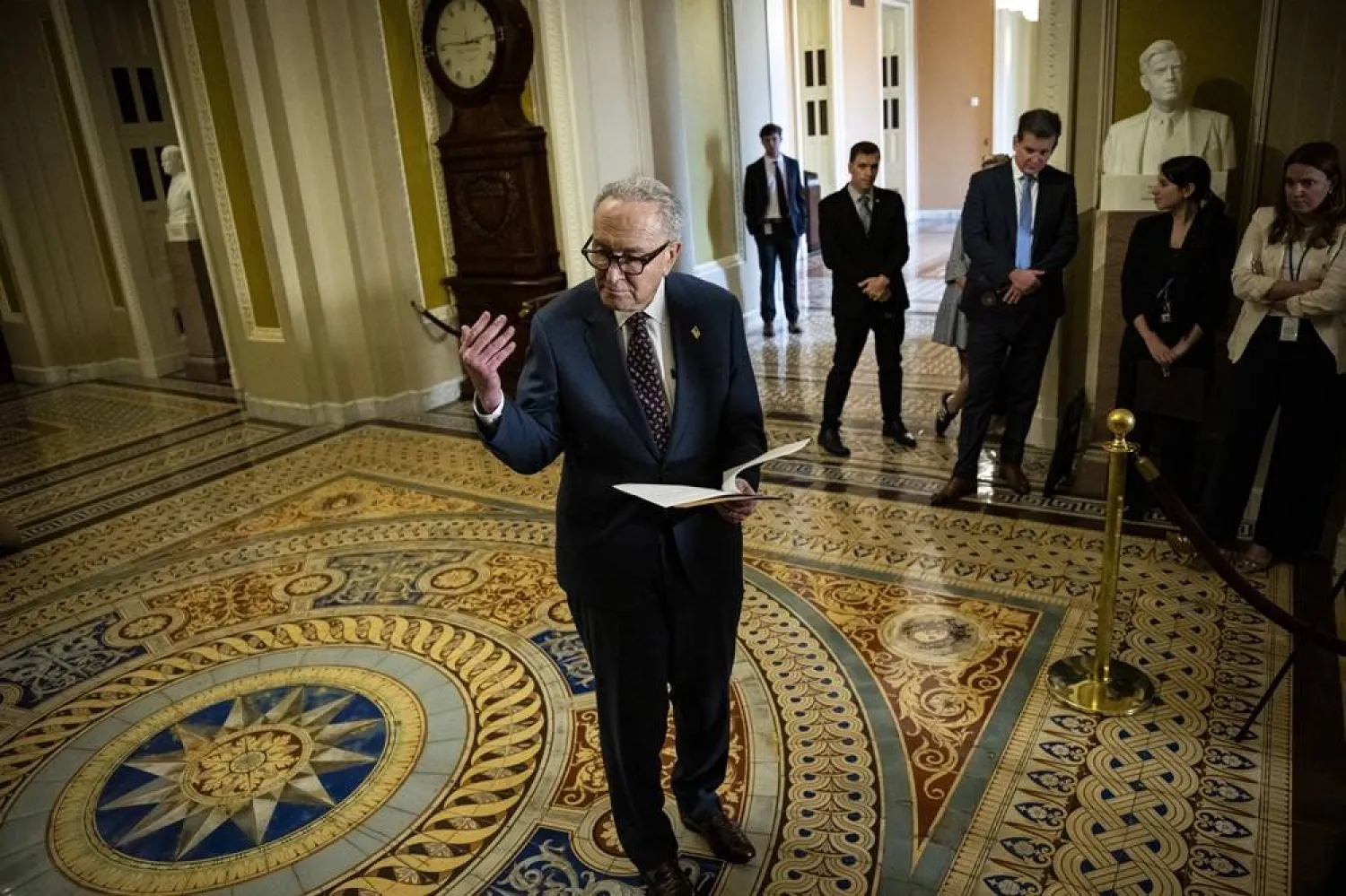
US Senator Chuck Schumer, the Senate Minority Leader, speaks during the weekly Senate Democrat Leadership press conference after luncheons, at the US Capitol, in Washington, DC, US, 23 June 2026. (EPA)
TT

US Congress Passes Symbolic Iran War Rebuke to Trump

US Senator Chuck Schumer, the Senate Minority Leader, speaks during the weekly Senate Democrat Leadership press conference after luncheons, at the US Capitol, in Washington, DC, US, 23 June 2026. (EPA)

The US Senate passed a largely symbolic resolution Tuesday calling for an end to President Donald Trump's war with Iran, delivering a fresh rebuke to the White House as it tries to negotiate a lasting settlement with Tehran.

The House-passed measure, adopted by the Senate in a 50-48 vote, directs Trump to remove US forces from hostilities with Iran unless Congress explicitly authorizes military action.

Because the measure is a "concurrent resolution," it does not go to Trump's desk for signature and carries disputed legal force.

But its passage still puts both chambers of Congress on record against a conflict that began with US and Israeli strikes on Iran in late February, rattled global energy markets and opened a broader regional war involving Lebanon and Gulf states.

During Trump's first term, Congress passed War Powers bills in 2019 and 2020 against military action in Yemen and Iran, respectively, but both were vetoed by Trump and the Senate failed override them.

Trump slammed the vote later Tuesday on his Truth Social platform, calling it "poorly timed and meaningless."

"These Senators have just made my job more difficult, but I will get it done, one way or the other, because I always get it done!" Trump said.

The vote came as the Trump administration pursued a 60-day diplomatic push to turn a preliminary memorandum of understanding with Iran into a final agreement covering Tehran's nuclear program, sanctions relief and the Strait of Hormuz.

Senate Democratic leader Chuck Schumer forced the vote to put Republicans on record after several Trump allies voiced alarm over both the war and the president's deal to end it.

"Republicans can complain about Trump's war, his secrecy, and his disastrous deal with Iran all they want behind closed doors, but the only way to ensure this war ends once and for all is for Republicans to act," Schumer said in a floor speech ahead of the vote.

The resolution earlier cleared the Republican-controlled House after four Republicans joined every Democrat in backing it, a rare break with Trump on matters of war and national security.

Democrats say Trump violated the Constitution by launching military operations against Iran without congressional approval.

- 'Dangerous prospect' -

Under the 1973 War Powers Act, presidents must obtain authorization from Congress within 60 days of introducing US forces into hostilities, though administrations of both parties have often contested how the law applies.

The White House has argued that resolutions seeking to curb Trump's powers to wage war in Iran are unconstitutional and says the conflict had already ended under an April ceasefire ordered by Trump.

It has also warned that restricting the president's authority could weaken Washington's leverage as negotiators seek to lock in a final deal with Iran.

Speaker Mike Johnson, a Trump ally, said before the House vote that limiting the commander-in-chief during negotiations was a "very dangerous prospect."

But Democrats and some Republicans say the fighting continued well beyond the legal deadline and that Trump has repeatedly threatened renewed strikes.

The vote also reflects growing unease in Congress over the cost of the war, which disrupted trade routes, drove up energy prices and placed new strain on US voters already worried about inflation ahead of November's midterm elections.

The administration's diplomacy with Tehran has moved quickly since Trump and Iranian President Masoud Pezeshkian signed the preliminary agreement, which was meant to halt the wider regional conflict and reopen the Strait of Hormuz.

But major disputes remain.

Iran said Tuesday that the UN nuclear watchdog would not be allowed to inspect nuclear sites bombed by the United States and Israel last year, rejecting Vice President JD Vance's claim that Tehran had agreed to allow inspectors back in.

Trump later insisted on social media that Iran had accepted "the highest level" of nuclear inspections.

Meanwhile, Tehran's top negotiator Mohammad Bagher Ghalibaf said the Strait of Hormuz would "never return" to the days of free passage before the war, despite new communication lines aimed at keeping the vital shipping route open.


Four Missing as Torrential Rain Pounds Southern Taiwan

Taiwanese soldiers offer prayers in heavy rain next to the tombstones of fallen soldiers during a ceremony marking the 68th anniversary of the August 23rd artillery battle between Taiwan and China, in Kinmen, Taiwan, 23 August 2026. (EPA)
TT

Four Missing as Torrential Rain Pounds Southern Taiwan

Taiwanese soldiers offer prayers in heavy rain next to the tombstones of fallen soldiers during a ceremony marking the 68th anniversary of the August 23rd artillery battle between Taiwan and China, in Kinmen, Taiwan, 23 August 2026. (EPA)

Four people are missing after torrential rain lashed southern and eastern Taiwan on Monday, closing offices and schools, with authorities bracing for a typhoon to hit the island later in the week.

A low-pressure system has hovered over southern Taiwan for the past few days, bringing heavy rain and causing flooding.

The local governments of the two cities of Kaohsiung and Tainan, home to ‌more than ‌four million people, ordered offices and ‌schools ⁠closed, as did ⁠the counties of Pingtung and Chiayi and the mountainous eastern counties of Taitung and Hualien.

The Kaohsiung government said it expected cumulative rainfall over the five-day period of the low-pressure system to exceed 1.3 meters (4.3 feet), nearly half what the city typically ⁠expects in an entire year.

Taiwan's fire ‌department said four people ‌were missing in the floodwaters - three in Hualien and ‌one in Tainan.

TSMC, the world's largest contract ‌chipmaker, said in a statement it had completed routine heavy rain preparation procedures at all its Taiwan factories, which were operating normally.

TSMC has factories in both Tainan and ‌Kaohsiung and is building new facilities in Chiayi country.

Taiwan Railway said there would ⁠be disruptions ⁠on the main east coastline and trains to and from Kaohsiung and Taitung with express services cancelled and local trains dependent on weather conditions.

"If you've got nothing on, for goodness sake don't go out," Taitung county chief April Yao wrote on her Facebook page.

Taiwan's Central Weather Administration said separately that Typhoon Saudel, currently heading towards Japan's southern Okinawa region, is expected to pass by the northern part of Taiwan early on Friday before reaching the eastern coast of China.


Türkiye Takes First Steps to Integrate PKK Members

A law passed by the Turkish parliament on August 10 allows for the conditional return of PKK members after their weapons have been verified. (AFP)
TT

Türkiye Takes First Steps to Integrate PKK Members

A law passed by the Turkish parliament on August 10 allows for the conditional return of PKK members after their weapons have been verified. (AFP)

Türkiye has begun implementing a law aimed at advancing the peace process based on the dissolution and disarmament of the Kurdistan Workers’ Party (PKK), which the government calls the “Terror-Free Türkiye” process.

The 12-article Law on Strengthening National Solidarity and Social Integration, known as the process’s “framework law,” was passed by parliament on August 10 and approved by President Recep Tayyip Erdogan eight days later.

Implementation begins Monday with the inaugural meeting of the Monitoring, Coordination and Implementation Council, chaired by Vice President Cevdet Yilmaz.

The council includes the justice, defense, interior and foreign ministers, as well as the intelligence chief and the secretaries-general of the presidency and National Security Council. It is tasked with verifying and endorsing the full dissolution and disarmament of the PKK.

Once the council issues a report confirming that process, the National Security Council will formally declare the end of the group’s existence, triggering a six-month process to reintegrate eligible members into Turkish society.

The one-time law will apply to PKK members in northern Iraq’s Qandil Mountains, Iran, Syria and Europe, as well as people prosecuted or wanted on charges of PKK membership and similar offenses.

Initial estimates put the number potentially covered at around 10,000, in addition to roughly 4,000 people held in Turkish prisons. Some 230 senior PKK leaders are excluded and are expected to reside in a safe area in Iraq’s Sulaymaniyah province.

Yilmaz said the council’s first meeting would discuss its working mechanisms and rules, as well as subcommittees to be formed according to the needs of the disarmament and dissolution process.

The council may request the creation of subcommittees to follow up on specific tasks. Parliament will also form a monitoring committee chaired by Speaker Numan Kurtulmus and comprising lawmakers from parties represented in parliament, except the nationalist IYI Party, which opposes the process and rejects any dialogue with imprisoned PKK leader Abdullah Ocalan.

Ocalan’s role

Pervin Buldan, deputy speaker of parliament and a lawmaker from the pro-Kurdish Peoples’ Equality and Democracy Party (DEM Party), said a subcommittee called the “Disarmament and Politicization Committee” would also be established.

Buldan, a member of the Imrali delegation involved in talks between Ocalan and the state, said Ocalan would sit on the committee, which would organize the disarmament process and political integration.

The Turkish government has neither confirmed nor denied plans for such a committee.

Nationalist Movement Party (MHP) leader Devlet Bahceli, whose party is the main ally of Erdogan’s ruling Justice and Development Party (AK Party) in the People’s Alliance, had called in May for an office or committee dealing with politicization, with Ocalan given the role of “peace and politicization coordinator.”

Bahceli has also repeatedly called for Ocalan to be granted the “right to hope,” which could open the possibility of release under a legal principle recognized by the European Court of Human Rights for prisoners who have served 25 years of an aggravated life sentence. Ocalan has spent 27 years in prison on Imrali Island in western Türkiye.

Buldan said the Imrali delegation also raised the need for a women’s committee during its August 13 meeting with Erdogan and in talks with other government officials.

A new Kurdish movement

Buldan described the law as fundamental but said Ocalan regarded it as merely a framework for addressing the Kurdish issue and intended to discuss how it could be developed in subsequent stages.

She quoted Ocalan as saying during his latest meeting with the Imrali delegation on August 1 that he had made considerable efforts to reach the current stage and is seeking to move from armed struggle to political struggle.

According to Buldan, Ocalan has discussed a new party to replace the DEM Party, changes to its charter, program and members, and a broader Kurdish movement. She said those issues would be discussed at a DEM Party congress in September.

How will the weapons be handled?

The pro-government Yeni Safak newspaper reported that a registration and monitoring system would be established to prevent surrendered PKK weapons from being transferred elsewhere or falling into the hands of other terrorist organizations.

Citing unidentified sources, it said weapons and ammunition would be handed to the Turkish Defense Ministry under intelligence supervision. A detailed inventory would be compiled and compared with intelligence reports to determine whether any arms or ammunition were missing.

After technical inspection, surrendered weapons would be divided into three categories.

Unused weapons and ammunition, including conventional arms compatible with NATO standards and technologically advanced drones, could be added to the Turkish military’s arsenal after the necessary inspections.

Weapons incompatible with Turkish military systems, but usable by other countries, could be sold, with proceeds going to the state treasury or exchanged for usable weapons.

Equipment unsuitable for military use, but valuable as raw material, would be melted down and recycled for projects run by Türkiye’s environment, industry and agriculture ministries.


IRGC Says it Prepared Scenarios to Avoid US Sanctions

The Iranian Revolutionary Guard Corps (IRGC) spokesman, Hossein Mohebi (center), speaks at a press conference in Kharg, west Tehran (IRNA)
TT

IRGC Says it Prepared Scenarios to Avoid US Sanctions

The Iranian Revolutionary Guard Corps (IRGC) spokesman, Hossein Mohebi (center), speaks at a press conference in Kharg, west Tehran (IRNA)

Tehran has prepared economic scenarios, including expanding trade networks with regional allies to bypass tightening US sanctions, Hossein Mohebi, the Iranian Revolutionary Guard Corps (IRGC) spokesman said on Sunday, adding that the results of the new measures would become evident in the near future.

His comments came shortly before US Secretary of the Treasury Scott Bessent announced imposing new sanctions on Iran at dawn Monday, described as “the toughest in history.”

Speaking at a press conference on Sunday, Mohebi said: “We have scenarios to counter the adverse effects of the enemy’s war and can easily establish economic relations with countries.”

Cited by Tasnim, the IRGC spokesman said Iran is maintaining economic interactions “right under America’s nose” and bypassing US pressure, and that the results would become evident in the near future.

Mohebi, however, offered no specifics regarding nations, firms, or financial conduits used to bypass US restrictions, asserting only that Iran maintains broad alternative economic plans.

Last week, US President Donald Trump threatened “tremendous economic consequences” on any nation that does business with Iran, without offering details.

Mohebi said the economic warfare is nothing new, noting that the US has imposed sanctions on Iran’s economic sectors for 47 years.

The current US campaign, he added, is primarily aimed at shaping public perceptions and creating the belief that Washington is prevailing.

He described Trump’s announcement of a new economic campaign against Iran as an “implicit admission” that Washington had failed militarily.

Mohebi attributed a large part of his press conference to the nature of the ongoing war, saying the US-Iran war is multifaceted and not limited to military operations, but includes the economic and media sectors.

Touching on previous military confrontations with the US, Mohebi said that before the last war, Iranian forces had targeted “between 30 and 40 US warships” inside the Arabian Gulf.

He did not provide details of the names of the ships, the timing of the attacks or the extent of the damage. There is no independent evidence to prove his statements are correct.

The IRGC spokesperson said the US has no warships left in the Arabian Gulf, affirming a major retreat of American forces following the recent regional clashes. “US troops are now deployed 400 kilometers away from the Gulf waters,” he noted.

Addressing Washington, Mohebi said: “You mobilized all your military capabilities to close the Strait of Hormuz, but you couldn't.”

He warned that if Iran faces another threat, it could target energy pipelines, power plants and internet-connected systems.

Mohebi’s comments came as the Strait of Hormuz remains a focal point of the US-Iran conflict following the collapse of a sixty-day ceasefire negotiated in mid-June 2026.
