


Iraqi Judiciary Applies ‘Terrorism Provisions’ to Drones

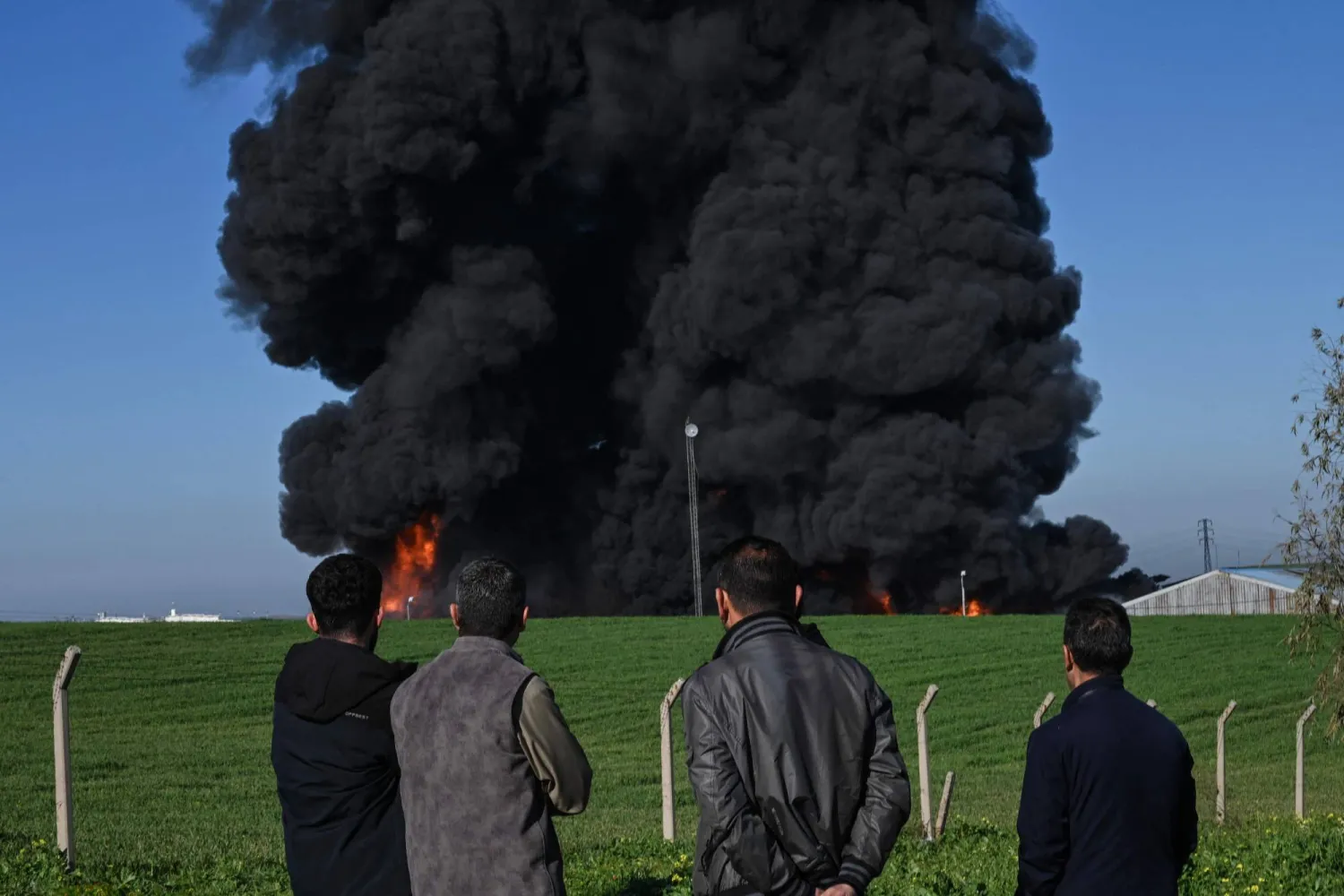
People watch as smoke billows from an oil warehouse in the Kani Qirzhala area on the outskirts of Erbil, the capital of Iraq's autonomous Kurdistan region, following a suspected drone strike, on April 1, 2026. (Photo by AFP)
TT

Iraqi Judiciary Applies ‘Terrorism Provisions’ to Drones

People watch as smoke billows from an oil warehouse in the Kani Qirzhala area on the outskirts of Erbil, the capital of Iraq's autonomous Kurdistan region, following a suspected drone strike, on April 1, 2026. (Photo by AFP)

Iraq’s Supreme Judicial Council has instructed the country’s courts to apply the provisions of the Anti-Terrorism Law to anyone who manufactures, uses, or possesses drones for unlawful purposes, while a security official said the directive is aimed specifically at curbing the activities of armed factions.

In a brief statement on Wednesday, the Council said it had directed the competent courts to enforce Anti-Terrorism Law No. 13 of 2005 against “anyone who manufactures, uses, or possesses drones employed for purposes contrary to the law.”

The law is Iraq’s principal legal framework for prosecuting terrorist crimes that threaten national unity and public safety, carrying penalties of up to the death sentence for perpetrators, instigators, planners, and financiers.

The directive comes amid months of government efforts to bring all weapons under state control and dismantle armed groups operating outside official security institutions.

An Interior Ministry security official told Asharq Al-Awsat that the judicial directive is “exclusively linked to armed factions” and is intended to increase pressure on them. He said the measure places drone-related offenses under terrorism statutes even though Iraqi law permits the use of officially licensed drones, indicating that it is directed at attacks carried out - or potentially to be carried out - by armed factions.

Speaking on condition of anonymity, the official described drones as one of Iraq’s most serious security challenges because they are easy to transport and operate, while the country lacks effective counter-drone capabilities, a weakness exposed during recent attacks.

Since the outbreak of the US-Israeli war against Iran on February 28, armed factions have carried out hundreds of attacks, many involving drones, against civilian and military targets.

Kurdish sources say cities in the Kurdistan Region alone have come under more than 800 attacks by Iran-aligned factions, ostensibly because of the presence of US forces and Iranian Kurdish opposition groups.

The factions have also launched dozens of drone attacks against vital assets in several Gulf states and Jordan, prompting those countries to issue a joint statement on March 25 condemning the attacks and urging Baghdad to take immediate action to halt operations by Iran-backed armed groups.

Iraq has long permitted drones for civilian, commercial, and official security purposes, provided operators obtain prior approval from the Iraqi Civil Aviation Authority and the relevant security agencies.

In early February, the authority introduced new regulations governing licensing, operating requirements, legal obligations, and approved uses, including media production, filmmaking, advertising, tourism, protection of oil and energy pipelines and public utilities, agriculture, environmental monitoring, border security, and official Interior Ministry thermal-drone operations against smugglers.

Drone manufacturing is also “common in Iraq,” according to Ahmed al-Janabi, a software and telecommunications engineer, though primarily for civilian and service-related uses. He said drone components are widely available on Iraqi markets and enter the country through multiple routes, including smuggling networks from Iran via Sulaymaniyah.

Specialized import offices also supply drones, often disguising component shipments. While authorities routinely confiscate unauthorized drones and impose relatively light prison sentences on violators, al-Janabi said the key change is that such offenses are now prosecuted under the Anti-Terrorism Law.



Sudan’s Currency Tumbles to New Low as War Hammers Economy

People stand at a market in Omdurman, Sudan, September, 19, 2026. (Reuters)
TT

Sudan’s Currency Tumbles to New Low as War Hammers Economy

People stand at a market in Omdurman, Sudan, September, 19, 2026. (Reuters)

Sudan's currency ‌hit a new low of 10,000 Sudanese pounds to the dollar on Wednesday in parallel market trading, continuing a dramatic fall over recent months as wartime conditions take their toll on the economy.

The rapid 60% depreciation has heaped hardship on Sudanese still trying to regain their footing after devastating conflict and ‌forced displacement caused ‌by the war between ‌Sudanese ⁠armed forces and the ⁠paramilitary Rapid Support Forces, putting basic food items out of reach.

Sudan's official exchange rate remains stuck at 4,200 SDG to the dollar, a rate last seen on the parallel market ⁠in army-controlled areas in May.

A large ‌portion of ‌that fall has happened over the past month, ‌as the pound fell from a ‌previous low of 8,000, depreciating 20%. Prior to the start of the war in April 2023, the rate was about 600 ‌pounds to the dollar.

Currency traders cited import demands as a ⁠chief ⁠factor as the government increased the tightly controlled customs dollar, used to calculate duties, to more than 5,600 this week.

As the war continues Sudan has decreased production of key dollar earners while its chief export, gold, has increasingly been smuggled abroad. Meanwhile, the army-controlled government has said the war and reconstruction efforts require dollar-draining imports.


France Says to Hold Conference for Lebanese Forces after Israeli Elections

French President Emmanuel Macron gestures as he speaks to members of the media on the day of the 9th Annual One Planet Sovereign Wealth Funds (OPSWF) Summit, in Lusail, Qatar, 21 October 2026.  EPA/BENOIT TESSIER
French President Emmanuel Macron gestures as he speaks to members of the media on the day of the 9th Annual One Planet Sovereign Wealth Funds (OPSWF) Summit, in Lusail, Qatar, 21 October 2026. EPA/BENOIT TESSIER
TT

France Says to Hold Conference for Lebanese Forces after Israeli Elections

French President Emmanuel Macron gestures as he speaks to members of the media on the day of the 9th Annual One Planet Sovereign Wealth Funds (OPSWF) Summit, in Lusail, Qatar, 21 October 2026.  EPA/BENOIT TESSIER
French President Emmanuel Macron gestures as he speaks to members of the media on the day of the 9th Annual One Planet Sovereign Wealth Funds (OPSWF) Summit, in Lusail, Qatar, 21 October 2026. EPA/BENOIT TESSIER

French President Emmanuel Macron said on Wednesday that this country will organise a conference to support the Lebanese armed forces after the Israeli elections this month, as truce talks between the two sides stall.

"We will also coordinate to carry out this work of support for the Lebanese armed forces and a conference will be set up in the coming weeks by France... I think it is useless to do it before the Israeli elections, but we will organise such a conference because it is unavoidable," he told reporters in Qatar.

Israel goes to the polls on October 27.

Lebanese authorities last year committed to disarming Hezbollah after months of cross-border hostilities culminated in a 2024 war between the group and Israel.

But Hezbollah drew Lebanon into the Middle East war this year by attacking Israel, which responded with heavy strikes and a ground invasion.

In June, Lebanese and Israeli authorities signed a framework agreement which involves the disarmament of Hezbollah, a gradual Israeli withdrawal from territories it occupies, and the deployment of the Lebanese army to the area.

Hezbollah has rejected surrendering its weapons and the direct negotiations with Israel.


Syria: Israeli Forces Shell Quneitra Countryside

An Israeli military vehicle is seen near the border between the Israeli-occupied Golan Heights and Syria, May 4, 2025. REUTERS/Shir Torem/File Photo
TT

Syria: Israeli Forces Shell Quneitra Countryside

An Israeli military vehicle is seen near the border between the Israeli-occupied Golan Heights and Syria, May 4, 2025. REUTERS/Shir Torem/File Photo

Israeli forces fired several artillery shells on Wednesday at the area around eastern Tell al-Ahmar in the southern Quneitra countryside in southern Syria.

The Syrian Arab News Agency (SANA) said that “occupation forces fired two projectiles that landed on agricultural land around eastern Tell al-Ahmar, causing no injuries".

Israel continues to violate the 1974 Disengagement Agreement through repeated incursions into southern Syria, raids on and arrests of civilians, land bulldozing and shelling, among other attacks, the agency said.

Syria has repeatedly called for Israeli forces to withdraw from its territory, stressing that all measures taken by Israel are null and void and have no legal effect under international law. Damascus has also urged the international community to fulfil its responsibilities and compel Israel to withdraw fully from southern Syria.