
Greece Launches Fire-hunting Satellites as Part of Europe's Strategic Push into Space

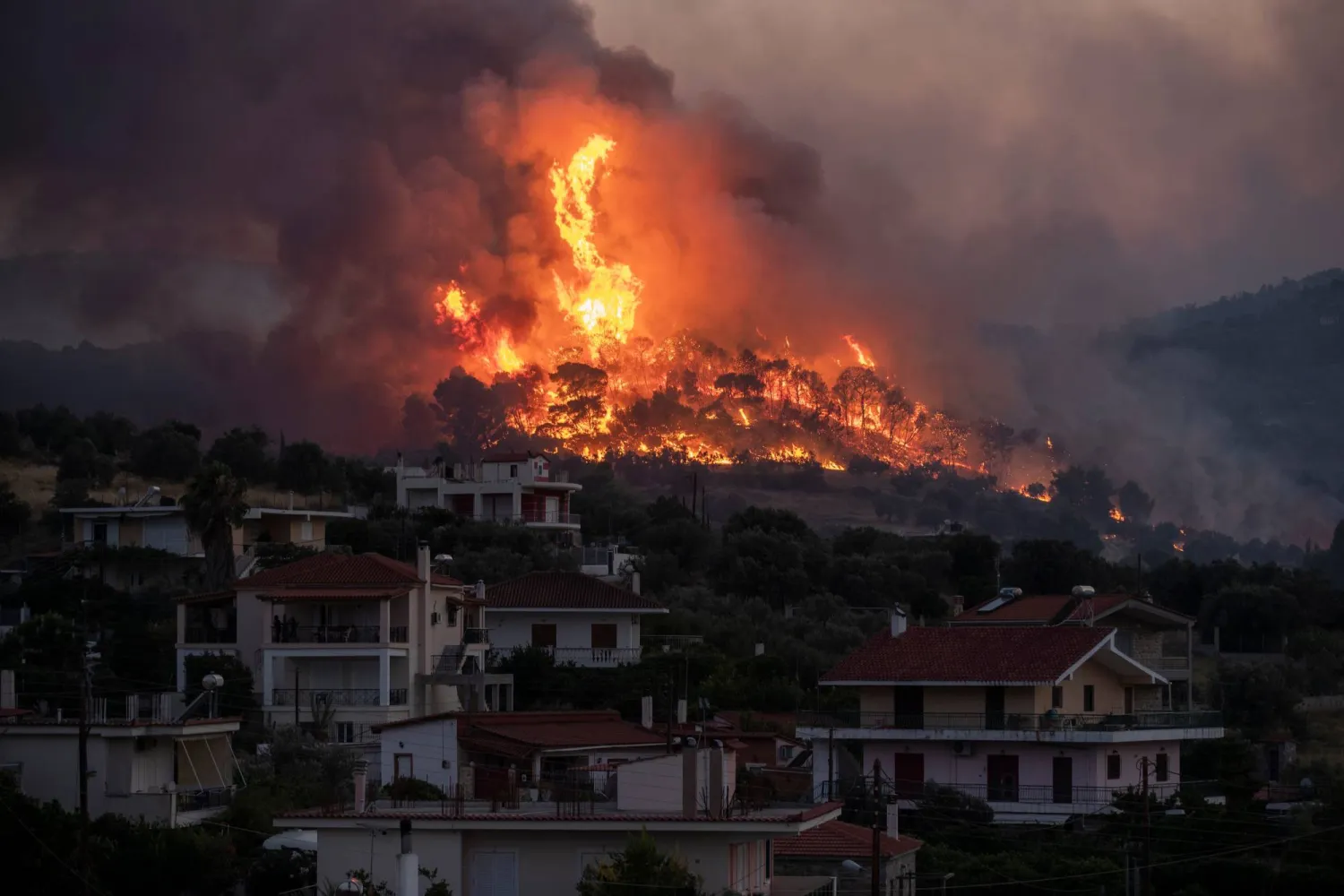
FILE - Fire burns near the village of Galataki as authorities evacuate the place near Corinth, Greece, July 22, 2020.(AP Photo/Petros Giannakouris, File)
TT

Greece Launches Fire-hunting Satellites as Part of Europe's Strategic Push into Space

FILE - Fire burns near the village of Galataki as authorities evacuate the place near Corinth, Greece, July 22, 2020.(AP Photo/Petros Giannakouris, File)

In the searing Mediterranean summer, wildfires turn dangerous in minutes.

Greece has learned that at a terrible cost. In 2018, a blaze east of Athens moved with ferocious speed, killing more than 100 people. Five years later, a massive fire tore through a remote nature reserve; it was the largest wildfire ever recorded in the European Union.

Greece is looking to the heavens for help, with a dedicated satellite constellation that monitors for fires. It's a model for the continent as Europe races toward broader independence in space technology.

Four satellites, each smaller than a piece of carry-on luggage, were launched into low orbit in May. That made Greece the first nation in the world to integrate a dedicated satellite array into its national firefighting system.

Built by German company OroraTech, the satellites carry thermal sensors designed to flag new blazes as small as four meters (13 feet) wide, beating traditional satellites that can only spot fires the size of a cruise ship.

Satellites help manage multiple wildfires As Europe struggles with its latest blistering heatwave, the high temperatures foreshadow the wildfire season. Fires pose a unique challenge in Greece with its tinder-dry mountainous mainland and over 100 inhabited islands.

If a fire ignites, AI-processed satellite data is sent as an alert to commanders with the location, size and intensity already calculated. If multiple fires are burning at once, real-time data is crucial to determining response.

“For example, if you have 10 fires all over Greece and the fire radiative power is lower in some cases, you will not give priority to those ignitions; you will give priority to other ones,” Fire Service Col. Zisoula Ntasiou, vice president of the International Association of Fire and Rescue Services, told The Associated Press in an interview.

Thermal sensors also pick up solar panels, hot factory roofs and sunbaked rock faces, but AI models are built to filter out those false alarms before alerts reach emergency services, according to officials involved in the program.

Hotter summers require better AI models Greece recorded its hottest summer on record in 2024 and its third-hottest last year.

“The global temperature is going up. That causes fires to change in intensity and ferocity,” Ioannis Lantouris, head of OroraTech’s Greek operations, told the AP. “Our models have to change and adjust to that. They have to be faster. They have to be more precise.”

Lantouris spoke in his office in Athens, while engineers worked on fire behavior models. Near their desks, they keep a life-sized replica of the satellite.

Thermal satellites add a layer of detection to drones and ground sensors, and Greece has expanded both since the 2018 disaster forced an overhaul of wildfire response. The constellation helps fill coverage gaps from international satellites, spot fires in remote terrain and build more detailed models of fire behavior.

Multiple countries use thermal satellites but Greece is the first to fully integrate them into its firefighting system. The satellites themselves mark an early stage of a broader Europe-backed effort.

Greece is building a wider observation network with three European companies, combining thermal satellites, radar satellites capable of seeing through clouds and smoke, and optical satellites that capture highly detailed imagery of the ground.

That network carries a total price tag of 200 million euros ($227 million) and is funded by the EU. Falling costs for launch and manufacturing have made the expansion possible. Additional satellite deployments are planned by the end of the year.

Future ideas include border surveillance Planners in Athens and across Europe already envision applying the same kind of network far beyond fire detection. Future systems will support border surveillance, crop management, disaster response and heat-wave planning.

One priority is identifying urban “heat islands,” allowing authorities to target cooling centers and emergency services more effectively.

The ambitions follow a strategic shift to seek greater technological independence. Rattled by Russia’s war in Ukraine and strained trans-Atlantic ties, European governments are reducing dependence on foreign technology.

Space infrastructure has become a pillar of that effort.

Greece’s satellite network is part of a European push linking launch vehicles, navigation systems, Earth observation networks and secure communications into a more sovereign technological ecosystem.

The goal, officials say, is to move beyond satellite imagery as a passive tool and develop near-real-time decision systems that help governments manage crises as they happen.

The blazing Greek summer will offer an initial test.


Analysis: At Least 150 Mn People in Europe Forecast to Face Temperatures Above 35C Friday

Youths cool down in the waters of the Canal Saint-Martin as France experiences a heatwave, in Paris on June 25, 2026. (Photo by Ludovic MARIN / AFP)
TT

Analysis: At Least 150 Mn People in Europe Forecast to Face Temperatures Above 35C Friday

Youths cool down in the waters of the Canal Saint-Martin as France experiences a heatwave, in Paris on June 25, 2026. (Photo by Ludovic MARIN / AFP)

At least 150 million people in Europe are expected to experience temperatures above 35C on Friday, according to an AFP analysis.

Germany is now expected to bear the brunt of the heatwave, with some 82 million people forecast to experience temperatures above 30C on Friday, including 52 million facing temperatures exceeding 35C.

Some 420 million people across Europe (excluding Türkiye) -- around 70 percent of the population -- will swelter in temperatures of more than 30C, according to the analysis.

Pedestrians cool off at “The area with Ljubljana’s own weather” in Preseren Square in Ljubljana on June 24, 2026. (Photo by Jure MAKOVEC / AFP)

Britain, France, Spain and Switzerland have all broken temperature records during the heatwave, with the high temperatures now expected to affect large parts of Hungary, Belgium and Luxembourg, among others.

The analysis is based on forecasts from the German Meteorological Service and 2025 population projections from the Joint Research Center and is in line with figures from Austrian NGO Klimadashboard.


Australia Pledges Tougher Enforcement of Social Media Ban for Teens

FILE - Three boys use their phones while sitting outside a school in Sydney, Monday, Dec. 8, 2025. (AP Photo/Rick Rycroft, File)
TT

Australia Pledges Tougher Enforcement of Social Media Ban for Teens

FILE - Three boys use their phones while sitting outside a school in Sydney, Monday, Dec. 8, 2025. (AP Photo/Rick Rycroft, File)

Australia's prime minister vowed on Friday to bullet-proof laws supporting a social media ban for under-16s as the government prepares legal action against platforms amid a steady stream of evidence that the ban has had little impact on teen use.

The country's groundbreaking six-month-old experiment is being closely watched by many nations seeking to emulate it due to concerns about the impact of social media on youth mental and physical health. Britain this month said it planned restrictions that go further as gaming and live-streaming platforms will also be affected.

The Australian government plans to stress-test the law which bans platforms like Meta's Instagram and Google's YouTube from giving under-16s accounts.

Numerous studies have shown age-assurance mechanisms, such as taking a selfie, that have been put in place by tech companies are easily circumvented by children and that in many cases, ⁠the children have ⁠never been asked to prove their age.

"What we want to do is to make sure that the laws are as strong as possible and that they will withstand any legal challenges which are made," Prime Minister Anthony Albanese told the Australian Broadcasting Corp, according to Reuters.

One focus would be making sure that the eSafety commissioner, the country's internet regulator, was sufficiently empowered to do the job, he said.

He did not give further details about what steps the government would take and the regulator declined to comment.

The eSafety commissioner and Australia's Communications Minister Anika Wells have said they are ⁠preparing legal action against five of the biggest platforms, which face a fine of up to A$49.5 million ($34 million) if they are found to have systemically failed to uphold the ban.

Message board website Reddit is separately challenging the ban in Australia's highest court, seeking to overturn it on free speech grounds. The government has said it will defend the lawsuit. Reddit was not immediately available for comment on Friday.

When Australia's ban went live last December, there were early reports that platforms had shut down millions of accounts, but parents have said and studies have shown that teen social media use is little changed.

A paper published in the British Medical Journal this week said 85% of Australians aged 12 to 15 were still using social media three months after the ban took effect, according to a study of 408 adolescents.

Two-thirds of underage ⁠users stayed online by ⁠self-declaring an age over 16 or posting a selfie that the platform accepted as over 16, the paper said.

That broadly matched data shared by Australia's eSafety Commissioner in March which showed one-third of Australians under 16 were still on social media.

Experts on youth social media use say that a teething period in which platforms, parents and teenagers adjusted to the new rules was always to be expected.

Parents are now much more willing to police their kids' social media use, said Susan Sawyer, a professor of adolescent health at the University of Melbourne and an advisor to the eSafety commissioner. She is also co-author of a paper this month which found high social media use was linked to adverse mental health outcomes, especially in young teens.

"We do have evidence that those social norms are starting to change about what is the right age to get a phone," added Sawyer.

"As a pediatrician who is doing research in this space, I've got my antennae up. The conversations that people are having with me now are the sorts of conversations that no one was having with me six months ago," she said.


Humans and Great Apes Share Similar Giggles

A Lowland gorilla plays during an environmental enrichment activity, predicting the outcome of the Spain vs. Uruguay FIFA World Cup football match, with Uruguay winning, at the Guadalajara Zoo in Guadalajara, Jalisco, Mexico, on June 5, 2026. (Photo by ULISES RUIZ / AFP)
TT

Humans and Great Apes Share Similar Giggles

A Lowland gorilla plays during an environmental enrichment activity, predicting the outcome of the Spain vs. Uruguay FIFA World Cup football match, with Uruguay winning, at the Guadalajara Zoo in Guadalajara, Jalisco, Mexico, on June 5, 2026. (Photo by ULISES RUIZ / AFP)

Humans and great apes have been giggling in similar ways since branching off the evolutionary tree, a new study suggests.

How do we know this? Researchers tickled 13 captive apes — including gorillas, orangutans, chimpanzees and bonobos — and recorded the results. The new research reexamined those decades-old recordings and compared them with the newly captured giggles of four young children while they were being tickled and playing at home.

It turns out that the chuckles of humans and great apes follow similar rhythms, with regular timing between their laughs, a uniting thread that likely reflects their ties to a common ancestor, The Associated Press quoted researchers as saying.

“In a way, we are very similar to other great apes because we’ve been laughing in a similar way for 15 million years,” said study author Chiara De Gregorio, a primatologist at the University of Warwick in England.

Laughter communicates a playful, happy feeling without using words. Many animals can laugh too, but the giggles don’t follow human patterns as closely. When researchers tickle rats, for example, they respond with ultrasonic squeaks.

Scientists trying to uncover how laughter evolved have picked apart animals’ facial expressions, but less work has been done on how laughs sound. And compared with apes, human laughter has become faster and more complex. For one, our laughs sound different based on context — from a polite chuckle among colleagues to a full-bodied guffaw with close friends.

“We are like the masters of laughter, I would say,” said De Gregorio, whose findings were published Thursday in the journal Communications Biology.

These giggles evolved to best suit animals’ different social lives, said Brittany Florkiewicz, who studies animal communication at Lyon College and had no role in the new research. She said the study’s findings make sense, and point to a need for more investigation.

Florkiewicz said she’d like to hear comparable recordings of other animals with playful facial expressions, like dogs, horses and cats. That could tell us more about how laughter evolved, so we can “understand what makes us uniquely human, but also what is similar between humans and other animals.”

Studying the origins of laughter may seem corny, but it's one aspect of human communication that can help us understand others — including how we learned to speak.

Because sounds don't fossilize, scientists are using the evidence we do have to trace things back, one chuckle at a time.