

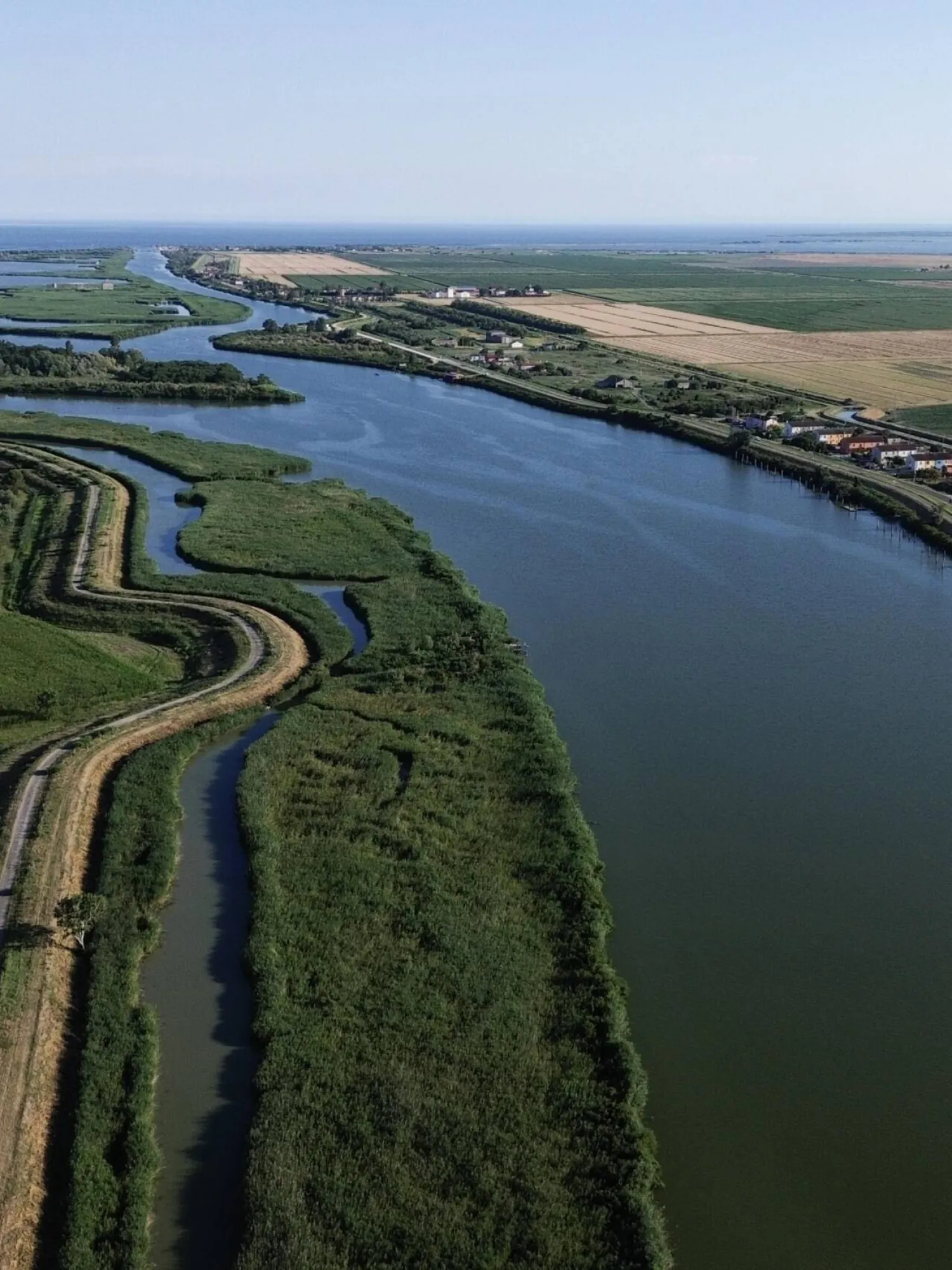

Farmers Fear Drought as Italy's Longest River Runs Dry

The Po River has never fallen this low so early in the year. Stefano RELLANDINI / AFP
TT

Farmers Fear Drought as Italy's Longest River Runs Dry

The Po River has never fallen this low so early in the year. Stefano RELLANDINI / AFP

Seawater is seeping into Italy's longest river as the waterway starts to run dry in the heatwave, hitting a farming heartland that produces the milk for Parmesan cheese.

The Po River has never fallen this low so early in the year, raising fears of a devastating drought in July in this corner of northern Italy, AFP said.

On the bank of one of its branches, farmer Federica Vidali looked anxiously at her sunflower field. The first bloom of the season has appeared, but part of the field is already dry and starting to crack.

One of the two canals that irrigate it has been shut because the seawater would enter and damage the crops.

"We're left with the water that others are willing to leave us. But we're not second-division farmers!" Vidali told AFP.

The Po River's flow has collapsed in a matter of days, dropping below 300 cubic meters per second, compared with an average of around 1,500 in June, according to Aipo, the interregional river agency.

"It has never dropped so fast, so early," said Stefano Calderoni of the Italian irrigation association (Anbi).

Sandbanks are multiplying, depths fall to barely one meter in places, and the river's few remaining fishermen swelter in the heat.

"Before, we used to pass on the left; now the passage is to the right of the sandbank, and it's very, very narrow," said Daniela Cuoghi, a surveyor for Aipo.

The many Alpine lakes that feed the Po Valley, Italy's agro-industrial heartland, are still about 60 percent full. But farmers are drawing heavily from the waterways to irrigate fields parched by the heat.

It rained this winter, but the mountain snow that used to replenish the lake has already melted due to climate change.

"We're not in a drought situation yet, but at this rate, there's less than three weeks of water left in reserve," said Damiano Di Simine, an expert with environmental group Legambiente.

Drought last struck the Po Valley in 2022 -- but only at the end of July.

- 'Really big problems' -

Further downstream, at the river's mouth, the situation is already serious: seawater has pushed about 20 kilometers upstream.

Saltwater is beginning to contaminate farmland reclaimed over the past five centuries from the delta marshes.

Barriers have been placed in the river to stop seawater, but they only work if river's flow is strong enough.

"We'd need almost double the current flow for them to work," said Rodolfo Laurenti, the engineer in charge of irrigation in the delta.

Laurenti called for cooperation and solidarity between regions to manage water in the event of a crisis.

Farmers are also considering new dams or water retention basins, but "we're afraid that all these structures will still never be enough," Laurenti said.

A few kilometers closer to the sea, clam fishermen are also struggling with soaring June temperatures. The heat has warmed the lagoons, boosting the growth of algae that cover the shellfish.

They must also clear algae from the nets protecting clams from invasive blue crabs, which arrived from North America in recent years.

"On top of all the problems we already have, we now have this crazy, long, and unexpected heat," said Paolo Mancin, head of the local fishermen's cooperative, standing with in water at 31C.

"Macroalgae are forming, there's a high mortality rate among clams... If it were something that lasted a week, we could get through it.

"But this prolonged heat is now causing really big problems."


Saudi Arabia Emphasizes Collective Action to Enhance Global Water Security at UN Session

Participants reviewed national strategies for resilience, sustainable funding mechanisms, and scalable cross-border partnerships - SPA
TT

Saudi Arabia Emphasizes Collective Action to Enhance Global Water Security at UN Session

Participants reviewed national strategies for resilience, sustainable funding mechanisms, and scalable cross-border partnerships - SPA

The Kingdom of Saudi Arabia emphasized the need for collective international action to advance global water security and translate multilateral commitments into tangible results that support public health, food security, economic development, and climate resilience.

The position was delivered during a high-level ministerial session titled "United for Water: A Call for Collective Action," co-chaired by Saudi Arabia and Senegal in collaboration with the Global Water Organization on the sidelines of the 81st Session of the UN General Assembly in New York. The gathering convened ministers, senior officials, multilateral development banks, and United Nations agencies alongside water sector leaders, SPA reported.

Head of the Founding Team of the Global Water Organization Dr. Fahd Balghunaim stated that the session addressed growing pressures on water resources, focusing on aligning funding with priority needs, scaling high-impact innovations, improving data access, and strengthening institutional implementation capacity.

Participants reviewed national strategies for resilience, sustainable funding mechanisms, and scalable cross-border partnerships, underscoring the Global Water Organization's role as an institutional platform connecting governments with essential financing, technical expertise, and operational coordination.


Bacteria Suspected in Deaths of Hundreds of Baby Whales off Argentina

Scientists suspect a bacterial infection to be behind the mystery deaths of hundreds of southern right whale calves washed up on beaches in Argentina's Patagonia region. MAXI JONAS / AFP
TT

Bacteria Suspected in Deaths of Hundreds of Baby Whales off Argentina

Scientists suspect a bacterial infection to be behind the mystery deaths of hundreds of southern right whale calves washed up on beaches in Argentina's Patagonia region. MAXI JONAS / AFP

A bacterial infection is suspected of killing hundreds of baby whales in the southern Argentine region of Patagonia, a marine mammal expert told AFP on Thursday.

This week again, dozens of dead southern right whale calves washed up on beaches in southern Chubut province, continuing a disturbing trend that began in June.

"The death rate (among young whales) is quite high this season in particular," Mariano Coscarella, a researcher at the Marine Mammals Laboratory of the national research council Conicet, confirmed to AFP.

Coscarella, who is based in Puerto Madryn, a major whale-watching destination on the Atlantic coast, said veterinarians suspected an outbreak of erysipelas, a serious disease caused by bacteria commonly found on the mammals' skin.

"It seems to be a natural cause however we cannot completely rule out the influence of human activity," he said.

The Chubut provincial government said Wednesday it was working closely with the scientific community to solve the mystery of the dying whales.

It said that preliminary research suggested it was caused by a "common marine bacteria."

Puerto Madryn and the nearby Valdes Peninsula are a major breeding ground for southern right whales, which grow up to 17 meters (55 feet) in length and weigh on average 40 tons, roughly the equivalent of four elephants.

A record 2,110 whales were counted in the area in 2025, including 800 young.

This year, authorities have counted 1,375 specimens, including nearly 400 calves, Coscarella said.

He added that the recent deaths "do not constitute a medium-term danger" for the area's whale population given the average life span of the southern right whale, which local authorities put at 60 years.


Cash for Nature Protection: Hotelier's Offer to Principe Islanders

Locals on the island of Principe are paid a financial dividend to preserve its natural beauty. Daniel BELOUMOU OLOMO / AFP
TT

Cash for Nature Protection: Hotelier's Offer to Principe Islanders

Locals on the island of Principe are paid a financial dividend to preserve its natural beauty. Daniel BELOUMOU OLOMO / AFP

On the paradise island of Principe, a lush jungle haven in the turquoise waters of the Gulf of Guinea, a South African multimillionaire is offering locals a financial dividend to preserve the natural beauty on which his luxury tourism business depends.
The initiative is the brainchild of tech entrepreneur Mark Shuttleworth, who for over a decade has been promoting a model of exclusive ecotourism aimed at an ultra-wealthy foreign clientele.
The dividend scheme, which Shuttleworth's charitable organization pays out individually to locals, aims to encourage them to preserve their natural environment -- a mountainous volcanic island, bordered by pristine beaches and whose tropical forest is home to a wealth of endemic species, AFP said.
In return for agreeing in writing not to engage in environmentally damaging activities like sand extraction or unregulated logging, adults can receive up to 6,250 dobras ($290) per quarter -- the equivalent of around $3.20 a day.
It represents a bonus in a tiny country where 45 percent of the population lives on less than $3.60 a day, according to the latest World Bank data from 2017.
But some critics say the initiative is a missed opportunity to work with the government to address the island's economic and social needs.
"I've just received the first quarterly payment. At 900 dobras it's definitely not a salary but it'll help," grinned 23-year-old technician Ermelindo Mendes, talking to AFP from his village of Monte Alegre in the lush hills.
The whole of Principe, part of the archipelago of Sao Tome and Principe, is an internationally recognized UNESCO biosphere reserve.
Staying in one of Shuttleworth's four hotels on the archipelago can cost up to $1,700 a night.
The hotelier promises his guests -- most of whom are European -- a luxury experience discovering a "hidden west African paradise".
- Nature's guardians -
His business model depends on preserving Principe's pristine natural environment.
So in February, to enlist the support of the island's 10,000 inhabitants, Shuttleworth began offering them a small nature dividend via his charitable organization, the Faya Foundation.
The locals are "nature's principal guardians. We need them on our side", said Vik Michau, a sociologist with the Foundation.
None have yet earned the maximum dividend of $290 per quarter.
"Data monitoring shows the natural environment isn't in an optimal state yet," Michau said.
To earn more, locals need to reforest the island and make what she described as "better choices regarding the natural environment".
Every year, 15,000 tourists visit the 140-square-kilometer (54-square-mile) island.
Many book the luxury package offered by Shuttleworth's HBD (Here Be Dragons) group.
"Most visitors are looking for nature, tranquility and peace -- everything the region has to offer," said Wander Dias de Sousa Pires, the head of the Principe tourist board.
- 'We see the suffering' -
But for the inhabitants of one of the world's poorest countries, the picture-postcard scenery masks a precarious daily struggle, beset by logistical difficulties and affected by distant geopolitical events over which they have no control.
"People who come here look at the scenery and say to themselves: 'This is paradise.' But those who live here see the suffering," said Conceicao Moreno, a 46-year-old member of parliament.
"We face utterly degrading social and economic conditions. The cost of living is very high, we have no access to quality healthcare or education and the roads and most of the infrastructure are in a state of disrepair," he said.
Moreno declined to take part in the dividend program, wary of the "relationship of domination" the grant might entail and unconvinced of its benefits to the recipients.
"The amounts paid out are too insignificant to have any impact on a family's survival," he said.
"They should have partnered with the government to offer social progress and infrastructure that would guarantee the island's development".
Michau said this view was to misunderstand the purpose of the foundation's "pioneering experiment".
The dividend is "not a salary" and charitable work cannot take the place of the state, she said.
"We are a private organization, not the government. We have drawn a very clear line between what falls within the government's remit, what we do here and where we can help."
