


Germany Hit by Record Temperatures as Heatwave Moves East

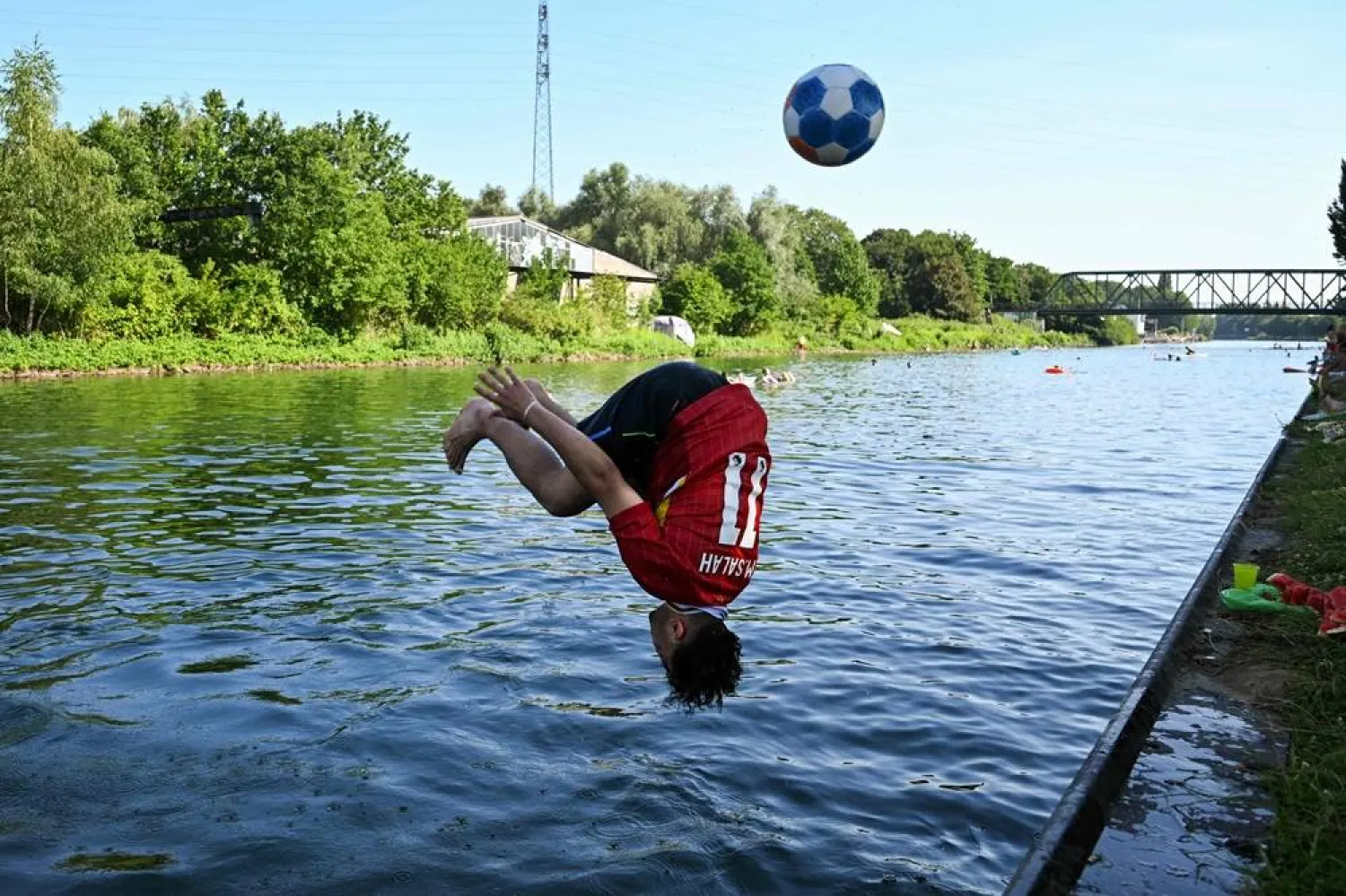
A boy jumps into the Dortmund-Ems Canal in Dortmund, western Germany on June 26, 2026 during a heatwave in Europe. (AFP)
TT

Germany Hit by Record Temperatures as Heatwave Moves East

A boy jumps into the Dortmund-Ems Canal in Dortmund, western Germany on June 26, 2026 during a heatwave in Europe. (AFP)

Germans braced for sweltering conditions on Saturday as a heatwave linked to dozens of deaths in Western Europe was expected to move east after temperatures broke records above 40 degrees Celsius (104 degrees Fahrenheit).

Britain, France, Switzerland and Germany have all experienced record heat in June, and the weather system could test more records as it rolls across Germany towards Poland.

On Friday, a new German record of 41.3 C was reached near the city of Saarbruecken close to the French border, a spokesperson for Germany's National Meteorological Service said, noting ‌the reading was ‌still preliminary.

In France, dozens of people both young and ‌old have ⁠died during the heatwave. ⁠Temperatures above 40 C have disrupted rail travel and power generation, suspended schools and postponed outdoor events.

"The heatwave is going to peak at the weekend, well over 40 degrees in some parts of Germany," said Karsten Brandt, a meteorologist at weather forecasting site Donnerwetter.de.

The Ironman European Championship long-distance triathlon taking place on Sunday in Frankfurt shortened the cycling and running courses due to the heat, organizers said.

Struggling with the prospect of damage to ⁠infrastructure like buckling roads and swelling train tracks, some major public service ‌providers have sought to reduce traffic.

FREE CANCELLATIONS TO ‌REDUCE RAIL TRAVEL

German national rail operator Deutsche Bahn has given customers the option of cancelling ‌long-distance travel bookings into early next week without charge due to the heatwave.

The company ‌said its infrastructure is under particular strain because of sun exposure and additional risk to signals, tracks and overhead wires stemming from thunderstorms and wildfires.

Parts of Germany, mainly in the southwest, have already experienced a much hotter June than usual.

The most extreme heat is forecast to begin fading at ‌the weekend, with heavy thunderstorms expected on Sunday.

Across Europe, cultural landmarks have had to close, farming has suffered, and some hospitals have ⁠struggled to cope.

The ⁠heatwave has pushed temperatures up to 18 C above their seasonal average, according to the Reuters Climate Monitor, and is being driven by a phenomenon known as an Omega block.

This weather pattern traps a bulging ball of hot air over regions for extended periods, with cooler air on its fringes.

Demand for electric fans has shot up, and Asian air conditioning makers have reported a European sales boom.

Most of the housing stock in Northern Europe is not built to temper heat but rather to keep it in.

The present heatwave will begin shifting by the end of the month, hitting Central Europe and the Balkans, the World Meteorological Organization said.

Scientists said the heatwave would have been virtually impossible without man-made climate change, which has made this week's night-time temperatures 100 times more likely than they would have been even two decades ago.



Farmers Fear Drought as Italy's Longest River Runs Dry

The Po River has never fallen this low so early in the year. Stefano RELLANDINI / AFP
TT

Farmers Fear Drought as Italy's Longest River Runs Dry

The Po River has never fallen this low so early in the year. Stefano RELLANDINI / AFP

Seawater is seeping into Italy's longest river as the waterway starts to run dry in the heatwave, hitting a farming heartland that produces the milk for Parmesan cheese.

The Po River has never fallen this low so early in the year, raising fears of a devastating drought in July in this corner of northern Italy, AFP said.

On the bank of one of its branches, farmer Federica Vidali looked anxiously at her sunflower field. The first bloom of the season has appeared, but part of the field is already dry and starting to crack.

One of the two canals that irrigate it has been shut because the seawater would enter and damage the crops.

"We're left with the water that others are willing to leave us. But we're not second-division farmers!" Vidali told AFP.

The Po River's flow has collapsed in a matter of days, dropping below 300 cubic meters per second, compared with an average of around 1,500 in June, according to Aipo, the interregional river agency.

"It has never dropped so fast, so early," said Stefano Calderoni of the Italian irrigation association (Anbi).

Sandbanks are multiplying, depths fall to barely one meter in places, and the river's few remaining fishermen swelter in the heat.

"Before, we used to pass on the left; now the passage is to the right of the sandbank, and it's very, very narrow," said Daniela Cuoghi, a surveyor for Aipo.

The many Alpine lakes that feed the Po Valley, Italy's agro-industrial heartland, are still about 60 percent full. But farmers are drawing heavily from the waterways to irrigate fields parched by the heat.

It rained this winter, but the mountain snow that used to replenish the lake has already melted due to climate change.

"We're not in a drought situation yet, but at this rate, there's less than three weeks of water left in reserve," said Damiano Di Simine, an expert with environmental group Legambiente.

Drought last struck the Po Valley in 2022 -- but only at the end of July.

- 'Really big problems' -

Further downstream, at the river's mouth, the situation is already serious: seawater has pushed about 20 kilometers upstream.

Saltwater is beginning to contaminate farmland reclaimed over the past five centuries from the delta marshes.

Barriers have been placed in the river to stop seawater, but they only work if river's flow is strong enough.

"We'd need almost double the current flow for them to work," said Rodolfo Laurenti, the engineer in charge of irrigation in the delta.

Laurenti called for cooperation and solidarity between regions to manage water in the event of a crisis.

Farmers are also considering new dams or water retention basins, but "we're afraid that all these structures will still never be enough," Laurenti said.

A few kilometers closer to the sea, clam fishermen are also struggling with soaring June temperatures. The heat has warmed the lagoons, boosting the growth of algae that cover the shellfish.

They must also clear algae from the nets protecting clams from invasive blue crabs, which arrived from North America in recent years.

"On top of all the problems we already have, we now have this crazy, long, and unexpected heat," said Paolo Mancin, head of the local fishermen's cooperative, standing with in water at 31C.

"Macroalgae are forming, there's a high mortality rate among clams... If it were something that lasted a week, we could get through it.

"But this prolonged heat is now causing really big problems."


Heavy Rain Pounds Western Japan as 2 Tropical Storms Approach

 People clean mud and debris from a flooded area after heavy rain brought by Tropical Storm Mekkhala in Hsinchu, Taiwan, June 26, 2026. (Reuters)
People clean mud and debris from a flooded area after heavy rain brought by Tropical Storm Mekkhala in Hsinchu, Taiwan, June 26, 2026. (Reuters)
TT

Heavy Rain Pounds Western Japan as 2 Tropical Storms Approach

 People clean mud and debris from a flooded area after heavy rain brought by Tropical Storm Mekkhala in Hsinchu, Taiwan, June 26, 2026. (Reuters)
People clean mud and debris from a flooded area after heavy rain brought by Tropical Storm Mekkhala in Hsinchu, Taiwan, June 26, 2026. (Reuters)

Heavy downpours triggered flooding in parts of western Japan on Friday as two approaching tropical storms added to a seasonal rain front already stuck above the country.

Storm Mekkhala was off the western coast of Japan's southern remote island of Amami as of late afternoon Friday as it headed northeast, the Japan Meteorological Agency said.

Another storm, Higos, was traveling nearby and the two storms are expected to reach the Tokyo region Saturday while dumping heavy rain, the JMA said.

Earlier Friday, a man was injured as he fell into a waterway in Nara, according to Japan's NHK public television.

Television footage from Kyoto showed the Kamo River swollen with muddy water. A flooding alert was issued in parts of Kyoto, Osaka and other areas in western Japan.

The Fire and Disaster Management Agency said more than 30 homes were flooded in Nara and Hiroshima on Friday. Heavy rain also disrupted some train operations and flights in the area.


Swiss Glaciers Facing Drastic Loss from Heatwave

Switzerland's glaciers are taking a hammering from the European heatwave. Fabrice COFFRINI / AFP/File
TT

Swiss Glaciers Facing Drastic Loss from Heatwave

Switzerland's glaciers are taking a hammering from the European heatwave. Fabrice COFFRINI / AFP/File

Swiss glaciers are set to lose an enormous amount of ice due to the heatwave battering Europe, the head of Glacier Monitoring in Switzerland (GLAMOS) told AFP.

The snow and ice accumulated last winter by Switzerland's glaciers is expected to have all melted away by Monday, marking the alarming second-earliest arrival on record of the tipping point known as glacier loss day.

All further melting between now and October will see the size of glaciers in the Swiss Alps shrink.

In data going back to 2000, the only time that the tipping point arrived even earlier was in 2022, when it came on June 26.

The grim scenario is driven by the current heatwave, as well as the one in May -- both coming on the back of another winter with poor snowfall.

"We're just seeing enormous ablation, ice melt rates and snow melt rates all over the Alps," GLAMOS network chief Matthias Huss told AFP on Friday, as multiple Swiss weather stations registered new all-time records.

"We are three months too early compared to a healthy state."

This century, the tipping point, on average, has been reached in mid-August -- itself already bad news for the nation's glaciers, which are shrinking at a staggering rate.

- Glaciers in 'very bad state' -

Much of the water that flows into the Rhine and the Rhone, two of Europe's major rivers, comes from the Alpine glaciers.

Huss said he had just returned from the Rhone Glacier, and in the 10 days since his previous visit, "there was one meter of ice melted in the vertical direction -- one meter of melting within just the last 10 days".

"It's very impressive to see, and this is just the effect of the heatwave."

But, said Huss, "one heatwave alone is not a big problem for glaciers".

"The problem is rather that we have very high temperatures that last for a very long time.

"The more days that are added that are very high temperatures, not even mattering whether it's 35C or 40C, this is just very bad for the glaciers."

Huss said the "very bad state of the glaciers at the moment" was down to a "combination of bad circumstances", including less snowfall, and the arrival of dust from the Sahara Desert in March.

He said 2026 was "surprisingly similar" to 2022, which for glaciers was "by far the most extreme year ever recorded in the Alps, with melt rates shattering everything we had seen before".

- Melting away -

He said this year had seen 25 percent less snow replenishing the surface of the glaciers compared to the 2010-2020 figures.

Meanwhile May was warm, causing the snowpack to disappear earlier.

Once the reflective white snow coverage from winter is gone from the top of the glacier, the darker, more absorbent grey surface of the bare ice is exposed.

This absorbs radiation more quickly, meaning extreme melting produces an accelerating feedback effect, worsening the situation even further.

While the full scale of this year's damage will be measured in September, "it is clear already now that we will have very strong ice loss also this year".

Glaciers in the Swiss Alps began to retreat about 170 years ago.

The retreat was initially modest but in recent decades, melting has accelerated significantly as the climate warms.

The volume of Swiss glaciers shrank by 38 percent between 2000 and 2024.

Huss said Switzerland had already lost 1,200 glaciers in the past 50 years, and there now only 1,300 left.

"Those lost were small glaciers, but they were still relevant in peripheral regions of the Alps," the glaciologist said.

"If warming continues as it did over the last decades, by 2100 we will only be left with some little remnants of ice."