


Netanyahu Says Israel to Remain in South Lebanon Until Hezbollah Disarms

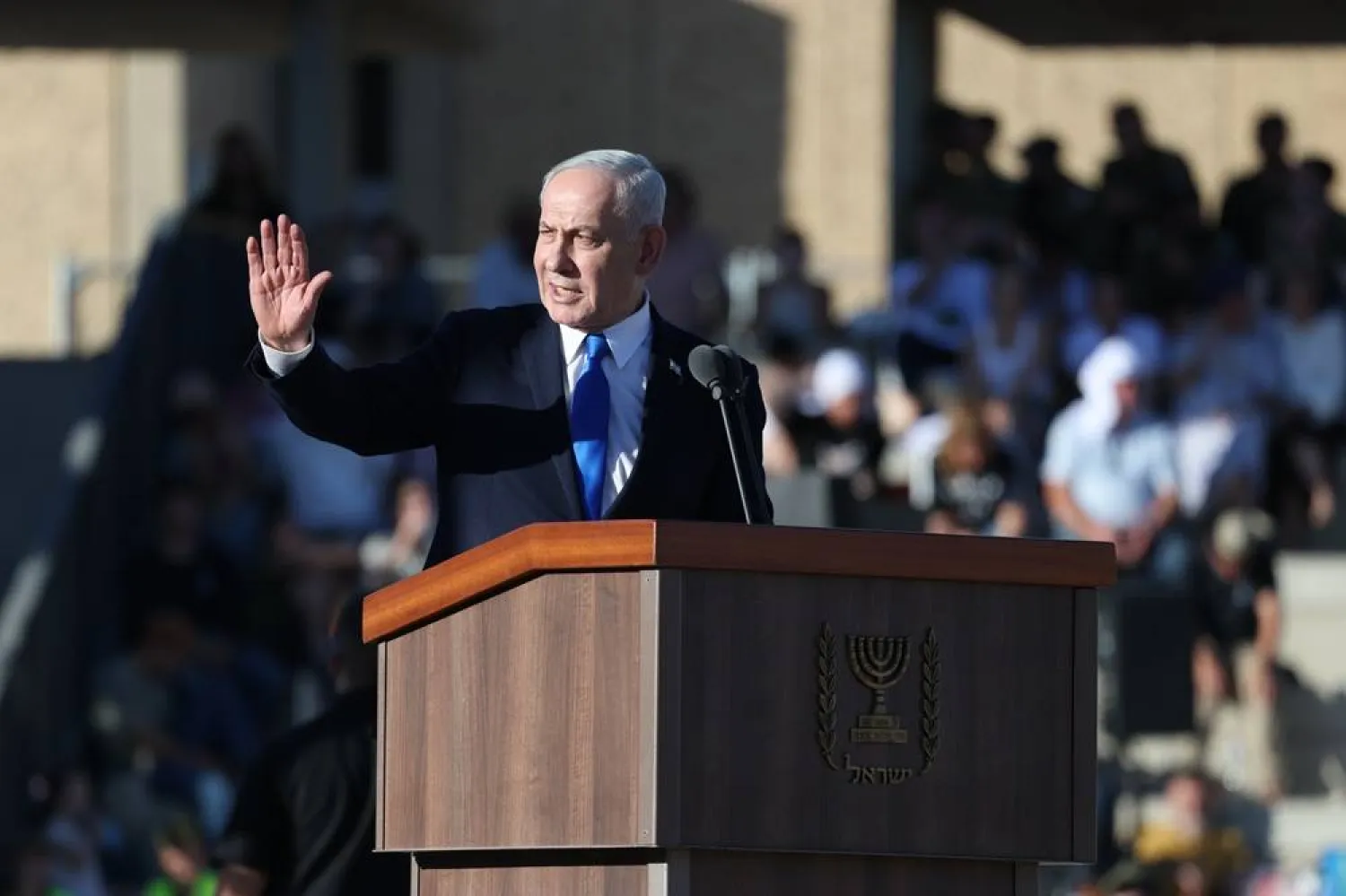
Israeli Prime Minister Benjamin Netanyahu speaks during the graduation ceremony of the Israel Defense Forces officers' course at a military base near Mitzpe Ramon, southern Israel, 25 June 2026. (EPA)
TT

Netanyahu Says Israel to Remain in South Lebanon Until Hezbollah Disarms

Israeli Prime Minister Benjamin Netanyahu speaks during the graduation ceremony of the Israel Defense Forces officers' course at a military base near Mitzpe Ramon, southern Israel, 25 June 2026. (EPA)

Israeli Prime Minister Benjamin Netanyahu said on Friday that Israel would remain in south Lebanon until Hezbollah disarms, shortly after the announcement in Washington of a framework agreement with the United States and Lebanon.

"The most important thing is, first of all, that Israel remains in the security zone in southern Lebanon. This is a major achievement, and we will maintain it as long as Hezbollah has not disarmed," Netanyahu said in a pre-recorded video shared with Israeli media shortly after the trilateral framework agreement was announced.

The agreement is the result of five rounds of talks in Washington aimed at ending decades of hostilities and weeks of fighting between Israel and Hezbollah in southern Lebanon.

The agreement "begins to put in place a framework for lasting peace and security," US Secretary of State Marco Rubio said at the signing ceremony.

In his video statement, Netanyahu added that Israel's military would also allow the Lebanese army to take control of territory in two areas.

"We are implementing two pilot areas, both at the army's recommendation. One is entirely outside the security zone and south of the Litani River, while the other is north of the Litani," a river in south Lebanon.

Netanyahu added that Lebanese civilians displaced from the so-called "security zone" that Israeli forces established in south Lebanon won't be allowed to return home.

"We are maintaining the original security zone at all times, outside the range of anti-tank fire. We are not allowing Hezbollah to enter it, nor are we allowing the civilian population to enter," Netanyahu said.

Hezbollah drew Lebanon into the broader Middle East war on March 2 with rocket fire at Israel intended to avenge the killing of Iran's supreme leader Ali Khamenei in US-Israeli strikes.

Israel then launched devastating air strikes and an invasion that Lebanon says have killed more than 4,200 people.

Under US pressure, Lebanese officials began direct talks with Israel in April in Washington, and a truce was announced on April 17 that ultimately failed to stop the fighting.

A new ceasefire was declared this month, with Tehran insisting that its deal with Washington to end the broader conflict launched by the United States and Israel in late February must include Lebanon.



Regional Turmoil Fuels Growing Defense Cooperation Between Egypt, Türkiye

An Egyptian-Turkish joint air exercise hosted at Egyptian air bases this month (Egyptian military spokesman) 
TT

Regional Turmoil Fuels Growing Defense Cooperation Between Egypt, Türkiye

An Egyptian-Turkish joint air exercise hosted at Egyptian air bases this month (Egyptian military spokesman) 

Egypt and Türkiye have stepped up military cooperation in recent months through a series of joint exercises, the launch of a high-level military dialogue in Cairo, and the signing of a “framework military agreement” four months ago, against the backdrop of escalating regional tensions.

Türkiye’s Ministry of National Defense announced Thursday that the Turkish, Egyptian and Azerbaijani air forces are conducting their first trilateral air exercise in Turkish airspace. The announcement came days after the conclusion of a separate Egyptian-Turkish air drill. The Turkish Armed Forces also said that Chief of the General Staff Gen. Selcuk Bayraktaroglu held talks with Egyptian officials in Cairo on Thursday.

Military officers and analysts told Asharq Al-Awsat that the expanding defense partnership is primarily intended as a deterrent amid regional instability. They said it is part of the broader Egyptian-Turkish rapprochement and reflects growing coordination on key regional issues.

Relations between Cairo and Ankara have steadily improved after years of estrangement. The two countries reinforced ties by establishing a Strategic Cooperation Council, which held its second meeting in Cairo in February during President Recep Tayyip Erdogan’s visit to Egypt. The meeting produced several cooperation agreements, including a framework military accord.

Alongside closer political coordination, defense ties have expanded through a series of joint exercises. According to Türkiye’s Defense Ministry, the trilateral drill will run through July 3 and is designed to enhance operational capabilities while testing new technical and tactical procedures for air operations.

The exercise follows a bilateral Egyptian-Turkish air drill held at Egyptian air bases from June 11 to 21, involving multirole fighter aircraft of various types.

Military cooperation has also expanded beyond air operations. Egypt and Türkiye conducted the Sea of Friendship naval exercise in the Mediterranean in September 2025, while Turkish and Egyptian special forces held joint training in Ankara from April 21 to 29, 2025.


Maj. Gen. Nasr Salem, former head of the Egyptian Armed Forces Reconnaissance Department, and advisor at the Nasser Military Academy for Postgraduate Studies, said joint exercises serve several strategic objectives, including exchanging expertise and enhancing combat readiness.

Salem told Asharq Al-Awsat that the intensified Egyptian-Turkish drills also send a deterrent message in light of regional turmoil by demonstrating the capabilities and preparedness of both militaries to confront threats to their national security and strategic interests. “The principle of military deterrence,” he stated, “is that if you want to prevent war, you must prepare for it.”

In parallel with the exercises, Egypt and Türkiye held a high-level military dialogue attended by Egyptian Armed Forces Chief of Staff Lt. Gen. Ahmed Fathi Khalifa, Bayraktaroglu, and senior military officials from both countries, Türkiye’s Defense Ministry said.

Political analyst Taha Oghlu, who specializes in Turkish affairs and international relations, described Egyptian-Turkish ties as undergoing “an unprecedented rapprochement.” He said cooperation now extends beyond diplomacy to encompass deepening military and defense ties, reflected in joint exercises and the launch of the military dialogue.

Speaking to Asharq Al-Awsat, Oghlu said the defense partnership is driven by shared interests and growing coordination on Libya, Syria, Gaza, and the Iran war. He added that instability across the Middle East — particularly the war in Gaza and the crisis in southern Lebanon — has accelerated the rapprochement.

The two countries have also intensified diplomatic contacts. Most recently, Turkish Foreign Minister Hakan Fidan visited Cairo last week for talks with his Egyptian counterpart Badr Abdelatty on bilateral ties. He also joined a meeting of the regional quartet comprising the foreign ministers of Egypt, Türkiye, Saudi Arabia, and Pakistan to discuss regional developments.

Oghlu said Azerbaijan’s participation in the latest exercise sends a clear signal that Egyptian-Turkish defense cooperation is acquiring broader strategic and geographic dimensions that extend beyond the Eastern Mediterranean and could help reshape the region’s security outlook.


Lebanon President Says Israel Deal First Step to Restoring Sovereignty

 Israeli and Lebanese flags hang in a memorial site on the border with Lebanon in northern Israel, Saturday, June 27, 2026 after Israel and Lebanon sign a framework agreement, described as a first step toward peace following months of conflict between Israel and the Lebanese group Hezbollah. (AP)
Israeli and Lebanese flags hang in a memorial site on the border with Lebanon in northern Israel, Saturday, June 27, 2026 after Israel and Lebanon sign a framework agreement, described as a first step toward peace following months of conflict between Israel and the Lebanese group Hezbollah. (AP)
TT

Lebanon President Says Israel Deal First Step to Restoring Sovereignty

 Israeli and Lebanese flags hang in a memorial site on the border with Lebanon in northern Israel, Saturday, June 27, 2026 after Israel and Lebanon sign a framework agreement, described as a first step toward peace following months of conflict between Israel and the Lebanese group Hezbollah. (AP)
Israeli and Lebanese flags hang in a memorial site on the border with Lebanon in northern Israel, Saturday, June 27, 2026 after Israel and Lebanon sign a framework agreement, described as a first step toward peace following months of conflict between Israel and the Lebanese group Hezbollah. (AP)

Lebanese President Joseph Aoun said a deal signed with Israel on Friday was a first step towards fully restoring his country's sovereignty after the latest war between Israel and the Iran-backed Hezbollah.

"The framework agreement signed today is a first step" that will enable Lebanese "to return to their fully liberated lands, and to their certainly rebuilt homes... under the sovereignty of the Lebanese state that has no partner in its sovereignty over its land and people," Aoun said according to a statement released by his office.

"We swear to continue to work until this is fully achieved. There will be no more occupation, prisoners, subordination or tutelage," he added.

Lebanese Prime Minister Nawaf Salam said the agreement "aims to achieve Israel's withdrawal from all Lebanese territory, restore state sovereignty over it" and see the return of displaced Lebanese.

"I look forward to the blessed moment when Israel begins to withdraw -- so that our dear people can return to their homes with safety and dignity -- and to the launch" of reconstruction efforts, Salam added, according to a statement.

Israel and Lebanon signed a framework agreement in Washington on Friday following several days of talks to secure an end to fighting between Israel and Iran-backed Hezbollah, though both sides framed the deal as an initial step.

"Today we've taken the first step in what will be a difficult journey, without a doubt, but an important and an essential and a necessary one," US Secretary of State Marco Rubio said before the agreement was inked.

Rubio added that the agreement ‌establishes ⁠a clear process ⁠to restore Lebanon's sovereignty, disarm Hezbollah and dismantle ⁠its infrastructure.

Hezbollah supporters block the old airport road in the southern suburbs of Beirut, with burning tires to protest against the trilateral agreement that was signed between the US, Israel and Lebanon on June 27, 2026. (AFP)

In a later statement he said that the US would facilitate the implementation of the deal through a trilateral "Military Coordination ‌Group for Lebanon" ‌and that Washington would commit significant resources, including an immediate $100 million in humanitarian assistance in coordination with ‌the ⁠UN.

Rubio added that ⁠the US reaffirmed its intent to improve the capabilities of the Lebanese Armed Forces "to more effectively establish sovereignty throughout Lebanese territory" with more than $30 million in funds under existing US authorities and appropriations.

Hezbollah warning

Hezbollah lawmaker Hassan Fadlallah warned that Lebanese officials who signed the agreement with Israel could not enforce the deal without sparking a civil war.

Lebanese "authorities will be unable to impose the implementation of the agreement signed in Washington unless they go, with American support, to civil war," said Fadlallah, whose party has long rejected the direct Israel-Lebanon talks.

He added that "what happened in Washington is an attempt to disrupt the Islamabad path, and without the resistance (Hezbollah) nothing will pass," referring to the initial agreement between the US and Iran on halting the Middle East war, which includes Lebanon.

After the announcement of the agreement, Hezbollah supporters took to the streets of Beirut late Friday in protest.

The state-run National News Agency (NNA) reported that "Hezbollah supporters rode motorbikes through the streets of Beirut" including central areas and along a road leading to the airport "in protest at the framework agreement announced between Lebanon and Israel".

Footage circulating on local outlets and social media showed hundreds of Hezbollah supporters on motorbikes and mopeds roaming Beirut's southern suburbs, the group's stronghold, before they headed to the heart of the capital.


Rubio: Lebanon-Israel Agreement Paves Way for Lasting Peace

US Secretary of State Marco Rubio, top center, speaks at the start of a signing of a framework agreement, described as a first step toward peace following months of conflict between Israel and the Lebanese group Hezbollah, at the State Department, Friday, June 26, 2026, in Washington. (AP)
TT

Rubio: Lebanon-Israel Agreement Paves Way for Lasting Peace

US Secretary of State Marco Rubio, top center, speaks at the start of a signing of a framework agreement, described as a first step toward peace following months of conflict between Israel and the Lebanese group Hezbollah, at the State Department, Friday, June 26, 2026, in Washington. (AP)

US Secretary of State Marco Rubio said the signing of the US-mediated framework agreement between Lebanon and Israel “begins to put in place a framework for lasting peace and security,” which is what “these two nations deserve”.

“The people of Lebanon have suffered tremendously now for decades as a result of outside interference in their affairs, of countries trying to use the country as a launchpad for attacks, and this is not what the people of Lebanon want and that’s not what they deserve,” he added following the signing of the agreement in Washington.

“What they deserve to have is what they once had, and of which there is recent history of, and that is a prosperous and peaceful country, a diverse country where people of different backgrounds are able to live and coexist side by side and, in many ways, was the envy of the region and of the world,” he stressed.

“It will take a lot of work and some time to get back to that point, but we believe today is the first step in that journey. And the first step is sometimes the hardest step, but it’s the one we’re taking together today,” he remarked.

Lebanon, Israel and the United States on Friday signed a trilateral framework agreement aimed at paving the way for a peace deal between the two long-time Middle East adversaries.

The agreement -- which includes a pilot effort in which Lebanese soldiers take control of two areas occupied by Israel, as well as a process aimed at disarming Hezbollah -- is the result of five rounds of talks in the US capital.

Rubio said the people of Israel, particularly those in the north, “have been targeted repeatedly by terrorist attacks launched from the territory of Lebanon, but not by the Lebanese people, not by the Lebanese Government, but by an outside actor who has sought to use that territory to target innocent civilians who have been unable to live in these places for a long time.”

“There is a lot of work ahead. We don’t in any way underestimate the difficulty of the task ahead. But we understand the importance of it, how vital it is, and we are honored to have played a part in bringing this together,” he went on to say.

“Hopefully we’ll make real and tangible progress so that the people of both of these countries can be hopeful about their future – a future of peace, a future of prosperity, a future of mutual coexistence in a way that’s beneficial to the men and women and children, including those not yet born, who deserve what all people deserve, and that is the right to live in their country without fear of harm, without fear of war, without fear of conflict,” Rubio said.

Hezbollah drew Lebanon into the broader Middle East war on March 2 with rocket fire aimed at Israel to avenge the killing of Iran's supreme leader Ali Khamenei in US-Israeli strikes.

Israel responded with heavy airstrikes and a ground invasion, and its troops continue to occupy swaths of southern Lebanon, where they have been carrying out extensive demolition of homes and other buildings.

The conflict has displaced more than one million Lebanese and left more than 4,200 dead, according to Lebanese authorities.